
Why Your Body Gets Puffy [What Lymph Has to Do With It]
You spend real money on your face. Then you grab the cheapest sunscreen at the drugstore for everything from the neck down. I’ve done it too.
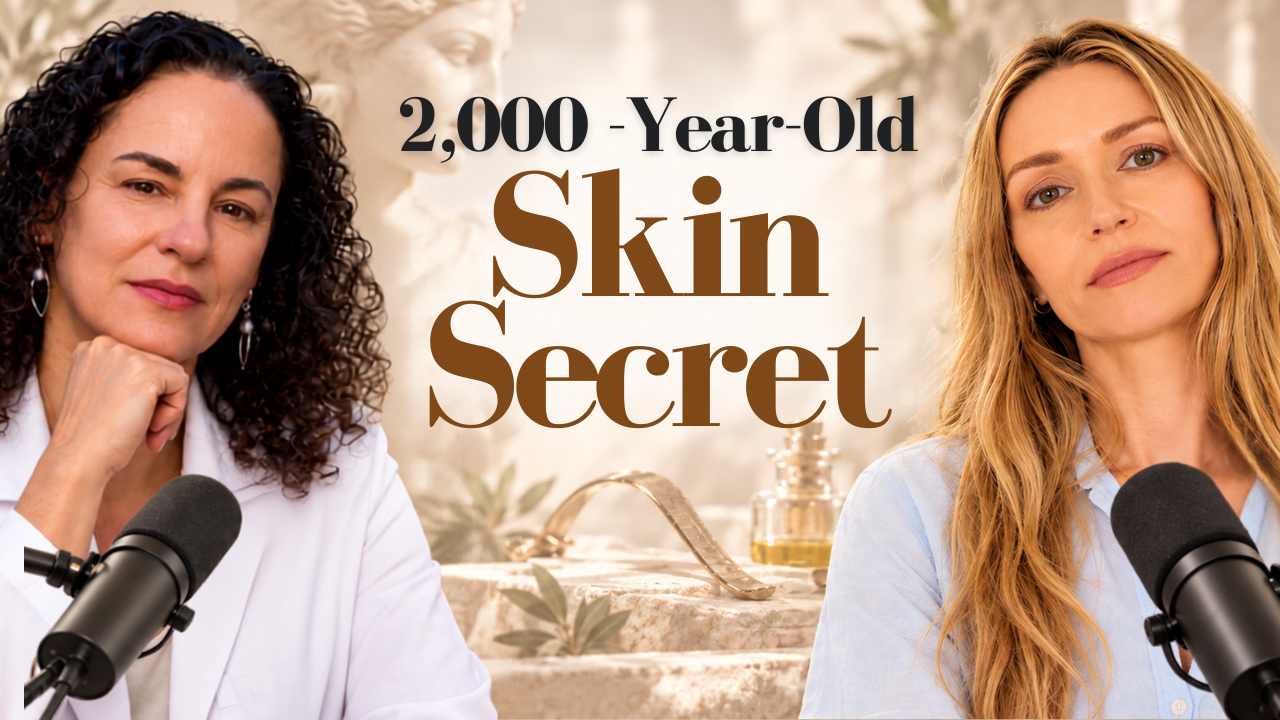
My guest on this episode of Med Spa Confidential is Shannon Davenport, founder and CEO of Esker Beauty. She spent 12 years as a trend forecaster before building a body care line around rituals from ancient Greece and Rome.
Our talk made me look hard at something I see every day in my practice. A high-end facial often includes 15 minutes of lymphatic drainage on the neck. The rest of your body puffs up too, and it gets worse with age.
So why does almost nobody treat it?
Your Body’s Slow Drain
“Lymph only flows in one direction. So if you want a massage, you’ve gotta flow basically towards your heart.” — Dr. Kate Dee, Med Spa Confidential
Your heart pumps your blood. Lymph doesn’t get a pump. It’s the extra fluid around your cells, and it moves back toward your heart through its own set of ducts. Muscles squeeze it along. If you sit at a computer all day, it pools.
As we get older, those ducts widen and don’t spring back. That’s the heavy feeling in your legs by evening. It’s part of the bags under your eyes, too.
For providers offering lymphatic work, explain the direction to your clients. Set honest expectations. People trust you more when you teach them what’s happening under the skin.
In the episode, Shannon shares a toothpaste trick for moving fluid past each node.
Not Everyone Swells the Same
“Everyone carries lymph in different places.” — Shannon Davenport, Med Spa Confidential
Shannon holds hers in her legs and none in her stomach. Other people carry it in the face, the neck, or the upper arms. A cookie-cutter routine will miss the spots that matter most for you.
The fix starts with your own hands. Her lymphatic specialist friend says to touch these areas like you’re checking whether a peach is ripe. Gentle. You’re not working a knot out of a muscle. And by the way, putting your legs up on the wall costs nothing.
We walk through the six spots to touch, and I give you the medical name for each one.
Exfoliate Without the Damage
“You really don’t want to have a wet plastic loofah just sitting and hanging in your shower.” — Shannon Davenport, Med Spa Confidential
Your outer layer of skin keeps allergens and germs out. Scrub too hard and you break that barrier. Remember the face brushes everyone owned a few years back?
Lots of people never cleaned them, so they spread bacteria around. A loofah that never dries does the same thing.
Safer options include glycolic or salicylic acid body washes. Shannon’s Body Plane is based on the strigil, an ancient bathing tool. Its edge is blunt, about like a metal credit card. I’ve used it for a few days now. My skin tingled for a good 10 minutes after, and my serum felt softer going on.
The Sunscreen Step Most Skip
“Tint does block visible light, and visible light actually contributes a lot to aging.” — Dr. Kate Dee, Med Spa Confidential
I’m 58 and I don’t wear makeup, but I wear tinted mineral sunscreen every single day, even in gray Seattle winters. My view? Mineral options with zinc or titanium are the better pick. A study found that chemical sunscreens get absorbed into your bloodstream. There’s no data showing harm, but we don’t know for sure that it’s harmless either.
Put body oil on damp skin first, then sunscreen. Tint does rub off on white shirts and bike helmet pads, so I skip it on my body. Honestly, the best sunscreen is the one you’ll actually wear.
Stay to the end for a sunscreen ingredient Europe has used for decades. The FDA just approved it here.
Before Your Next Appointment
Body care can help you feel less swollen and more comfortable in your own skin. Listen to the full episode of Med Spa Confidential to hear the six-point routine and the new sunscreen ingredient worth watching for.
Listen to This Episode
Full Episode Transcript
Read the Transcript
[00:00:00] Dr. Kate Dee: If you book a high-end facial, you'll often get 15 minutes of lymphatic drainage massage in your neck.
[00:00:05] The thing is, the rest of your body gets the same puffiness, and it gets worse with age. So why does almost nobody treat that? I'm Dr. Kate Dee, founder and medical director of Glow Medispa, and this is Med Spa Confidential, where we expose the risks, the red flags, and the outright illegal practices happening inside med spas right now because you deserve to know before you book.
[00:00:28] My guest today is Shannon [00:00:30] Davenport. She's founder and CEO of Esker Beauty, and she spent 12 years as a trend forecaster and then built a body care line around rituals that go back thousands of years. You'll find out what lymph has to do with the bags under your eyes. You'll learn the one rule about massage direction that most people never think about.
[00:00:51] And you'll find out some people hold lymph in their legs and others in their stomach or face. Finally, you'll see why a tinted sunscreen guards [00:01:00] against more than just UV. Stay until the end, and I'll tell you about Bemotrizinol. Europe has used it for decades, and the FDA just approved it here, and it's the first of its kind in over 20 years. Shannon's been leading the conversation around caring for the skin on the rest of our bodies, with thoughtful ingredient-focused products and really a lot about daily ritual.
[00:01:20] So Shannon, thanks so much for being on the podcast today. Really appreciate it
[00:01:26] Shannon Davenport: Thank you so much for having me. I'm excited
[00:01:28] Dr. Kate Dee: Yeah. So I don't [00:01:30] actually have a lot of people from the industry on the podcast 'cause, mostly people are, you know, just trying to sell stuff. But I really think that this is such an important topic. People spend a lot of money, like, taking care of their facial skin and kind of, you know, use the cheapest sunblock at Walgreens to, to deal with their body.
[00:01:55] And so, I was really kind of intrigued, especially by, [00:02:00] your body plane that you have, which I have been using the last few days, and it's really, really cool. So, but let's start with the basics. Like, what are the basics of body skincare and, like, what... Why should we be doing... Why should we be upping our game in that direction?
[00:02:15] Shannon Davenport: Yes, absolutely. And I guess I should start by just saying I don't consider myself as someone in the industry, even though I know that I am 'cause I'm a brand founder, but I truly approach this just like my customers [00:02:30] do, like with the same, you know, level of curiosity and I learn alongside them. And, I did work in the beauty industry, but what led me to this was really, like, my personal quest.
[00:02:45] Okay. Body Plein. My career started out in trends. I was a trend forecaster for 12 years. That was what I wanted to do. That was my dream job, and I'm dating myself because I read about it in a book. And I was [00:03:00] like, "I'm gonna move to New York and do that," and I did. And, through like a lot of weird twists of fate and ended up, you know, having this really interesting career where I worked with a lot of, beauty brands, food and beverage brands, fashion is where I actually started my career. And, I found myself like really curious about the way that the industry was going 'cause I was thinking about it all the time at work. But personally, as a human, [00:03:30] I am very drawn to nature and calmness, and I like to read about the way people have used plants throughout centuries and, how they've bathed and how they've, you know, like the role that cleanliness has played in their lives.
[00:03:49] I think the category is just really interesting, and I kind of have become like a scholar of it. And just like any good trend forecaster is also like a bit of a historian. [00:04:00] It's all part of the same lens. Every trend forecaster knows, every designer knows, like sometimes you go back and look in the archives.
[00:04:08] And so for me, the archives was ancient Greece. Ancient Greece and Rome. And, I think we all have heard about the ancient baths, and as a kid I remember like learning about like the plumbing and stuff, and I was like, "I don't care about how they built these aqueducts." But when I got older and I started learning about this [00:04:30] after I started my brand, I was like, "Whoa, these guys are like using this wild tool." And people who study art history will know that, there's, you know, it's very ever present in art from that time. Lots of statues and, and art made with people holding what was called a strigil.
[00:04:52] I have this body brand, and we have body oils, and we have these other products, but I think it was this [00:05:00] strigil that my husband and I reinvented into this different shape of product, which we called the Body Plane, and we have a design patent pending on. I think this was really like what helped us stand out because we had something that was really different
[00:05:16] Dr. Kate Dee: I think it's really, it feels amazing. It does exfoliate, but in kind of a gentle way. And it also kind of massages. It really, makes your skin feel really tingly, and it [00:05:30] increases blood flow to your skin.
[00:05:32] And I could imagine that it would increase the absorption of topicals you might put on. And it's funny because I know a lot of people don't spend a ton on their body skin, and I really traditionally haven't as much either, to be honest. Like obviously I care a lot about what I put on my face.
[00:05:50] But, I do get all these samples as part of vetting certain skincare products for face, and we don't bring [00:06:00] on a lot of new SKUs in my practice. Like we have kinda the basics. But, people are always trying to get us to try things. So, so what I end up doing with them is, is using it on my body and deciding if I wanna try it on my face.
[00:06:13] And, I find that the Body Plane just feels amazing, but also if I put the serum on afterwards, everything's that much softer. So I think it's kind of cool. So, but what are people [00:06:30] accomplishing with the Body Plane?
[00:06:32] Shannon Davenport: Yeah. So it's so interesting. Traditionally, I guess thousands of years ago, they did actually have soap, but they didn't use soap on their bodies. People have not used like lathering soap on their bodies for very long. That's like a relatively new thing.
[00:06:49] So, in those times they would, you know, they would bathe obviously in water all the time, and so, you know, how clean you are coming in and out of the water mattered, and that was one of the reasons that [00:07:00] you carried your strigil around.
[00:07:01] So they would actually use olive oil on their skin,
[00:07:04] and they would, use an exfoliant. They would use mud or, or like sand in there. And so that was the way that they were cleansing. So they were oil cleansing, right? Essentially.
[00:07:17] Dr. Kate Dee: Mm-hmm
[00:07:18] Shannon Davenport: A body tool, if we're gonna put it in like a beauty
[00:07:21] terminology. And, you know, with a scrub mixed in. So, it really is just, you know... I think [00:07:30] it's not that different. Once you just think about all the ways that you exfoliate your face, and then you just think it's really the same type of skin down here. And so, you know, a dermaplane facial, right? Where you're... And it's removing hair because it's a razor. This is not a razor, but it's blunt enough to remove that dead skin cell, those dead skin cells. I say it's like the edge of a credit card, kind of like the edge of a metal credit card. And so, and people say [00:08:00] that sometimes, like when we get hate online, they're like, "I'm just gonna use a credit card." I'm like, "You can do
[00:08:06] that. That's absolutely fine. I have no problem with that. Don't worry about it." Anyway, you know, I think, it's, it's mechanical exfoliation. It's just like how we exfoliate our feet at the spa, where when we have our, you know, when we soften the skin, the skin wants to float off.
[00:08:25] All you have to do is really just manually remove it.
[00:08:28] And so you're using that [00:08:30] oil to manually remove that skin. But the beauty of it, I think, as an exfoliation method, is that it doesn't... You're not scrubbing and you're not like
[00:08:40] rubbing and tearing. It's just lifting off, you know?
[00:08:45] Dr. Kate Dee: So for anyone who doesn't know what we're talking about here, it's important not to disrupt your barrier, right? So the...
[00:08:53] This, your epidermis has those cells that protects inside your body. It protects allergens from getting in, it [00:09:00] protects other things. So, and so you wanna use exfoliation that does not disrupt the barrier, but still takes off those surface dead cells.
[00:09:08] So options are, an alpha or beta hydroxy acid, which we recommend all the time, you know, a glycolic acid scrub or a salicylic acid scrub, especially for the body, or you know, a mechanical exfoliation that does not screw up the barrier. Because if you go back a few years when everyone was using those Clarisonic [00:09:30] brushes and stuff, I don't know that that's so popular anymore.
[00:09:33] But those were pretty notorious for disrupting your barrier and also because no one ever cleaned those brushes. They tended to just spread the bacteria around on your skin, so not great for your skin, especially if you're acne prone. So this is a great tool for exfoliation for your body.
[00:09:52] Shannon Davenport: And to your point, Kate, about bacteria, that is one thing that I feel like you [00:10:00] would know, and many people don't think about in their own homes, but you really don't want to have a wet plastic loofah just sitting and hanging in your shower. Like, that's not ideal. That is not the most hygienic way to exfoliate, especially because
[00:10:19] you are talking about what can happen when you exfoliate, which is that your moisture barrier can be damaged. So I still see a lot of these, those little plastic [00:10:30] poofs in people's bathrooms, and I'm like, "Eh." One, you're
[00:10:33] scrubbing yourself with plastic. That's part of it. And then, you know, that's... And then it's never drying. The bacteria is never drying out, you know?
[00:10:41] Dr. Kate Dee: It absolutely needs to dry, otherwise the bacteria won't die, for sure.
[00:10:45] Shannon Davenport: Yeah, yeah.
[00:10:46] But most people don't realize that if you don't put it in the sun, it might
[00:10:52] never dry
[00:10:53] Dr. Kate Dee: isn't drying out, yeah. Yeah, for sure. So is there a method... So I mean, I think you should probably, [00:11:00] okay, let's ask about lymphatic drainage, because one of the things that's unique on your website are these lymphatic drainage dots that you put on. And so I think, so you'll have to tell me what's in those dots, and why that's effective.
[00:11:17] But then also part of putting those dots on are to show you where the major lymph nodes are, so you're doing lymphatic drainage towards the [00:11:30] nodes, so for people who don't really understand what the lymph system is, 'cause I think this is not, I don't think most people really understand it.
[00:11:37] So like in your body, you have your heart and it pumps the blood around, and there's arteries and veins, and that's where the blood goes. But there's a whole separate circulatory system for lymph, and lymph is all the extra kind of water and stuff in the water of your body, so, you know, electrolytes and other things, that's floating in and around your [00:12:00] cells.
[00:12:00] And so your lymph gets collected into these lymph ducts and slowly filters into, back into your heart. And lymph's gotta flow, and lymph can get stuck. And along that highway, let's just say those lymph ducts are a highway, the lymph nodes are kind of like a truck stop along the highway. And lymph only flows in one direction.
[00:12:22] So if you want a massage, you've gotta flow, like, basically towards your heart. You want a massage towards your [00:12:30] heart. So this is my like, you know, I don't know, weird, geeky look at what those lymph dots are, but basically it's, like, where you wanna massage your lymph towards.
[00:12:40] Shannon Davenport: This is a really good explanation. You can probably explain it medically better than I can, but I'm learning so much, like, around the lymphatic system because, again, I think I told you, in the beginning, like, I like to approach the brand with curiosity.
[00:12:59] [00:13:00] I'm a trends person, and so that doesn't mean that I necessarily wanna chase trends. It just means that I'm curious.
[00:13:05] So I realized at a certain point, and I would like definitely die on this hill, that I think, you know, I thought that certain types of body care or certain ingredients like topically would just be enough to really change my skin. And
[00:13:22] I don't think that that is really something that I stand behind anymore. I think that [00:13:30] you can really see results on your skin with topical body products plus tools that are stimulating your lymph. And that just goes back to the thing of essentially like it really is skin deep. So, you know, topical products are literally skin deep.
[00:13:46] So what is below skin? It's your lymphatic system. And so, you know, the puffiness, and I think we are used to thinking about this like in terms of inflammation. Like people talk about how like, "Oh, it's all [00:14:00] coming from inflammation." It's sort of the same thing with when we look at our bodies and we think about, you know, does my skin look glowing or healthy?
[00:14:10] It's a lot of times it's the underlying lymph that's stuck, that's creating that dullness, that's not giving you the ability to have that circulation that you were talking about earlier.
[00:14:21] Dr. Kate Dee: I mean, it has to do with a lot, like stasis, you know, meaning if you're sitting at a computer all day long, [00:14:30] your lymph is not moving. So the lymph generally needs muscles contracting around it to make it flow. So either you're, you know, you're up and you're active, and anything that's dependent, meaning anything that's lower, below your heart, you gotta have some serious muscle action to pump that lymph back up, you know?
[00:14:53] And so I think a lot of people, we, especially as we get older 'cause, you know, everything becomes, [00:15:00] wider. Like, your lymph ducts get dilated, and they don't really spring back, right? And then if you're not active, it just pools, and it's not... So that's that puffy feeling. It's terrible.
[00:15:13] And it actually can happen all throughout your face, your arms, and everything. So, so tell me what's in the dots that actually improves lymph flow, 'cause this is stuff I don't really know about.
[00:15:25] Shannon Davenport: Yeah. So I would say the first thing to start that [00:15:30] improves lymph flow is not necessarily what's in the dots, but where to place them. I'll kind of like back into what's in the dots. I have a friend who's a lymphatic specialist, and we've collaborated on like treatments, and we're hopefully gonna launch a treatment together actually soon, that combines her lymphatic treatment and my products.
[00:15:52] And so we love talking about lymph. And she's like the master.
[00:15:58] So one thing that she told me that [00:16:00] was really interesting is that everyone carries lymph in different places. So some people carry a lot of lymph in their stomach. I carry my lymph in my legs. I don't have lymph in my stomach at all.
[00:16:12] Many people have a lot of lymph in their stomach. Some people carry lymph in their upper arms. Some people carry it in their face and neck. Now, we are just learning about what this system is. You just explained to us what it is today, and I'm telling you that everybody has different [00:16:30] lymph all over their bodies.
[00:16:31] So the reason that it's more important first, I think, to think about where you place them than what's in them, is that these dots are meant to be a way to get to know your own lymphatic system. So I think of them as like connect the dots for my lymphatic system. And the way that you will-- once you start to learn where your lymphatic centers are, which is what the dots are meant to do first and foremost, is just to guide you through [00:17:00] where your lymph nodes are.
[00:17:02] And now that I know where my lymph nodes are, I cannot un-know them. And
[00:17:06] so I wouldn't need these dots every day forever and ever. And you don't have to use these dots forever and ever. You can take care of your lymphatic system all day, every day for free, you know, with your legs on the wall.
[00:17:21] So we want you to know that, you know?
[00:17:24] You don't need to use these, like this is re-rooted in some basic readjustment of our [00:17:30] understanding of body care. And that's what I actually want to do with these dots, is to try to help people, no pun intended, connect the dots with body care and lymphatic
[00:17:42] and because it's your body, and your body is different, and some people have lymph in their face and neck, and some people have it in their stomach, and some people have it in their legs like me, you have to actually just touch your body to understand.
[00:17:54] And then once you start to touch your body, and a great part of this is that you can do it with body oil, like people already apply [00:18:00] body oil. You can apply your body oil in a way that is stimulating your lymph,
[00:18:05] and you don't need any dots or anything. It's really just trying to understand.
[00:18:10] We're not like, "Oh yeah, you have to have these all the time." It's really like, to me, so I learned the most basic thing of like, how do I do this at home? I know that I need to learn some type of lymphatic massage and, for myself, that I can do, like for dummies. And, I [00:18:30] basically start with like, with whatever for dummies for myself, because I'm busy and I have a lot going on, so I'm like, "I need to simplify this." And so I learned about this guy, Dr. Perry Nickelston, and I don't know very much about fitness people on YouTube, but that is where his audience started. And he's really into lymph because of recovery after a workout. So his whole thing about lymph is different, I think, in the way that we might be thinking [00:19:00] about lymph in that he's like, "You should really do this to avoid pain, to avoid swelling, to avoid inflammation," all those things. But basically, it's a very simple six-step movement that, you know, you ideally wanna do for five minutes, but it's just touching yourself in six different places. You can tap or you can circle. My friend who's the lymphatic specialist has given me a couple really good tips. When you touch your lymphatic centers, when you touch your lymphatic [00:19:30] spaces, you are not tugging on it. You're like checking. You're not pushing. It's not your muscle. You're touching it like you're checking if your peach is ripe. You know what I mean? That is the-- you're
[00:19:43] checking fruit. That's what you're doing. And so you can rub it, you can tap it, whatever, and I'm right now touching my lymph nodes like right here,
[00:19:53] and it's right behind my ear, like my jaw right below my ear. [00:20:00] And a lot of people know where that lymph node is because it's the lymph node that gets big when you get sick,
[00:20:05] which always happens to me.
[00:20:07] So I've always been aware of that, of those lymph nodes and all of this. It was that routine and just kind of being like, "How do we do this? How do we apply the steps? How do we make a product that makes it like fun to learn where the lymphatic centers are and that they wanna put on?" And then when they put on, it has the added benefit of the magnesium and the green tea, [00:20:30] which are, you know, dermally absorbed and which are all good ingredients for internal flow and stimulation. So the idea behind the dots is really a bigger idea, which is it's like the training wheels to
[00:20:49] understanding your lymphatic system. And then once you understand your lymphatic system, then every step of your body care ritual can be applied in a way that's beneficial for [00:21:00] your lymphatic system.
[00:21:01] Because like you said, it's not a two-way street, it's a one-way highway
[00:21:05] Dr. Kate Dee: Well, your lymph system is, for sure. I think that the Body Plane and the oils and the dots together kind of constitute two big things. Like, it's not, it's partly it's luxury and it's a self-treatment that really feels good, and it leaves your skin really soft and, like, you know, that...
[00:21:23] So it's appealing from that. But also, it's a really, really good way of reducing [00:21:30] swelling and that puffiness that honestly, I think that everybody gets that at times. It doesn't, you know, sometimes some people only get it when they're a little bit sick, but a lot of people just get it more and more, in various areas.
[00:21:44] Shannon Davenport: Yeah
[00:21:45] Dr. Kate Dee: as we get older, it just gets a little bit harder, right? So I think what I have found is it's kind of like this luxurious self-treatment that also is really healthy and reduces that swelling, which [00:22:00] is, you know, it feels really good, right?
[00:22:03] Shannon Davenport: And that's what I'm...
[00:22:05] Exactly as you said, that's what I've noticed about my own body.
[00:22:08] I like at a certain point I'm like, "My oils and everything aren't working anymore. Hmm."
[00:22:13] Dr. Kate Dee: And the thing is that your face gets swelled up, too. Like, I have to say, as we get older, we get the eye bags. And, so one of the treatments, I don't know if you've ever had a HydraFacial or one equivalent to a HydraFacial, like that comes with... Or, you know, the kind of fancy treatment, the one that takes a whole hour to do, it comes with 15 minutes of lymphatic drainage treatment in your neck.
[00:22:39] And it really helps reduce all the puffiness in your face. And so for people who've had that, think about that, but like for your whole body. So it's, it's actually, it's really great. But it's hard to describe, right? Because I think some people are like, "Well, I don't know if I have that."
[00:22:56] But, everybody has it a little bit, and as you get older, it just [00:23:00] kinda gets more and more problematic.
[00:23:02] Shannon Davenport: Exactly.
[00:23:04] Dr. Kate Dee: Yeah
[00:23:04] Shannon Davenport: That's what led me to this product.
[00:23:08] Dr. Kate Dee: Yeah. Well it's
[00:23:09] Shannon Davenport: fun, one of the fun little hacks that I also like to think about is, you mentioned the lymphatic system, you had a really good metaphor for it. When you actually apply product, you're always going towards your torso because your main valve is,
[00:23:27] on the left side. [00:23:30] Actually, let me think that. No, it's on the right side, the thoracic duct, but
[00:23:34] Okay. Yes. Some people think like, you know, you could massage your hand going from your elbow down to your fingers. Mm-mm. Don't wanna do that. You don't wanna do that. You wanna go the other way. You want to massage your hand from your wrist down to your elbow.
[00:23:52] Dr. Kate Dee: Hmm
[00:23:53] Shannon Davenport: Then the way to think about, she told me this, which I really like, is that think of each [00:24:00] lymph node that you pass the fluid through as like a little tube of toothpaste, and you just kinda squeeze it a little bit to get it to pass through that
[00:24:10] tube.
[00:24:12] You're just kind of like, you know, you're looking at thinking of your arm as like a tube of toothpaste, so there's some really fun ways to like remember it and like get to
[00:24:22] know it. And then once you do, it's like, "Oh, now I understand," like when I
[00:24:27] apply
[00:24:27] Dr. Kate Dee: Do you have a video on your [00:24:30] website that shows people how to do this?
[00:24:32] Shannon Davenport: Yeah, we do.
[00:24:33] The full tutorial I think that we have online is like two and a half or three minutes. Ideally, you wanna do it like five minutes.
[00:24:41] Dr. Kate Dee: The massage itself
[00:24:43] Shannon Davenport: Yeah, the massage itself. So the points that you're touching are behind your ear. I'm gonna let you name all of the nodes, so I'll probably say them wrong. Behind your ear, around your clavicle.
[00:24:55] And my understanding...
[00:24:56] Dr. Kate Dee: clavicle.
[00:24:58] Shannon Davenport: Yeah. And my [00:25:00] understanding is that you can also stimulate it below your clavicle a little bit because it
[00:25:04] also goes into the lymph nodes that are in your armpits.
[00:25:08] Dr. Kate Dee: Mm-hmm.
[00:25:09] Shannon Davenport: Lymph nodes that are on the inner crease of your elbow.
[00:25:14] I'm using all the layman's
[00:25:15] Dr. Kate Dee: That's the fossa for anybody medical who's watching this.
[00:25:20] Shannon Davenport: And then, what am I
[00:25:22] Dr. Kate Dee: Your inguinal nodes too, right?
[00:25:24] Shannon Davenport: Oh, yep. Mm-hmm. Bikini line.
[00:25:28] I say line.
[00:25:29] [00:25:30] That helps.
[00:25:30] Dr. Kate Dee: Mm-hmm.
[00:25:31] Shannon Davenport: I was like, I-- when I was trying to conceive it, I was like, "Groin?" No. Bikini line. Everyone knows that. Which goes in there. And then, one more, which is the back of your leg,
[00:25:44] Dr. Kate Dee: Right behind your knee.
[00:25:45] Shannon Davenport: Behind
[00:25:46] your knee, which is the
[00:25:48] Dr. Kate Dee: the popliteal fossa.
[00:25:50] Shannon Davenport: Mm-hmm, that one.
[00:25:51] Dr. Kate Dee: Yeah. That one. Yeah. Yeah. And I have to say I started doing this and I feel like my skin was tingly [00:26:00] for like a good 10 minutes afterwards. It felt really, really good. I was surprised at that. And I like that you have a kit that has the plane and the oil and the dots.
[00:26:10] I think that that's a great way to start. And I am curious, so besides that, you have a few other things that your company offers. Like what do people do with the dry brush? 'Cause I've never used one of those.
[00:26:24] I love a dry brush. Again, like our brand is never gonna [00:26:30] invent some modality that does not exist. We wanna bring the really good modalities
[00:26:39] From ancient Greece.
[00:26:41] Shannon Davenport: And accessible.
[00:26:42] Yeah. Or from India, which is where, you know, dry brushing and Ayurveda came from. So originally. So, I think, I'm pretty sure, I think that's true.
[00:26:54] Anyway, and it has Ayurvedic roots, yeah. Anyway, dry [00:27:00] brushing is another physical exfoliant. The only difference is that you were talking, going back to our moisture barrier-
[00:27:08] So essentially with your dry brush, going back to all the different types of exfoliation we were talking about for the
[00:27:14] body, going back, dry brush is basically like pre-shower exfoliation
[00:27:21] Dr. Kate Dee: Mm-hmm. Okay.
[00:27:23] Shannon Davenport: With bristles. So it's a
[00:27:26] Dr. Kate Dee: But it doesn't break down... It's soft enough that it's not [00:27:30] hurting your barrier
[00:27:32] Shannon Davenport: It's not hurting your barrier, but you have to use your own discretion. My dry brush is, I would say, like, kind of the Goldilocks of dry brushes. Like, it's not big, it's not small, it's not hard, it's not soft. It's kind of in the middle.
[00:27:53] So I feel like-- And it's a boar bristle brush. And, you know, we had thought about doing, [00:28:00] you know, a vegan bristle.
[00:28:02] Those are very, very, very scratchy. I mean, they're
[00:28:05] cactus fibers.
[00:28:07] Dr. Kate Dee: Oh, yeah, no,
[00:28:08] Shannon Davenport: ouch.
[00:28:09] Dr. Kate Dee: too much
[00:28:10] Shannon Davenport: It's a good, it's a great idea, but, you know... And there are some dry brushes that are made of copper,
[00:28:16] that can take a lot on your moisture barrier. But a horse hair brush that absorbs oil
[00:28:26] just like your hairbrush, you know,
[00:28:28] it's not going to have, like, a super abrasive effect on your moisture barrier, and you just don't do it too hard. It is also really good for your lymph, but it's not going to replace manual lymphatic
[00:28:47] massage movements. But, if you don't have time and you wanted to kind of do this on your legs or your arms, some people find it really stimulating and refreshing. But if [00:29:00] you don't like the feel of it, the tactile feel of it, you don't have to do it
[00:29:04] Dr. Kate Dee: Yeah, no, I kinda do. So, okay, dry brush before the shower, and then after the shower, this is when I've been doing it, I've been using the oil as a glide really for the body, can we talk just a little bit about the oils? Like what's important about the oils for your body and what's in
[00:29:27] Shannon Davenport: Yeah. So I am a big proponent of [00:29:30] oils. I'm not a big lotion person. There is a lot of water in lotion, and when you make a lotion, you're basically making an emulsion, which is one part water and one part oil. And like a salad dressing, you're shaking it up. With an oil, you're not adding the oil at all. So you're just having an oil-based product, which means that you... It's not gonna go bad 'cause it doesn't have water in it. I mean, it [00:30:00] goes bad obviously over time,
[00:30:02] but it's not gonna grow bacteria inside it. So I like oils in that, you know, you don't have to have preservatives that just exist to keep the product fresh.
[00:30:15] You use natural ingredients. And so our oils are all squalane-based. Squalane is like... I'm just like the ultimate lazy girl. Like I tried coconut oil and I was like, "It's-- I just, [00:30:30] I can't do this. I can't walk around my house waiting for my body to dry." You know? I'm just too sloppy and
[00:30:36] clumsy
[00:30:37] Dr. Kate Dee: Coconut oil stains your clothes and stuff,
[00:30:40] Shannon Davenport: Yeah. It's just a nightmare.
[00:30:42] Dr. Kate Dee: It feels really good but
[00:30:44] Shannon Davenport: It smells good, and it's like a nice idea. I like the idea of it, but actually using that to moisturize your body is what I think a lot of people thought body oils were. And just again, just like your face, there's all kinds [00:31:00] of different levels of emulsion and, you know, moisture levels and thickness, and some oils are really thin and sink right in, and some are thicker, and they sit on the top of
[00:31:10] skin like coconut oil. So we use a squalane base, and that really to me mimics the level of sebum with your skin. And
[00:31:20] so it just sinks in and feels like nothing.
[00:31:22] Dr. Kate Dee: I really like the way it feels on my skin. So I'm not a big oil person. I feel like a lot of oils just feel [00:31:30] heavy on my skin, and that feels uncomfortable. And so I was really pleasantly surprised that these felt really good. I guess my other question is, I don't think you guys have moved into sunblock or anything, but is there any sunblock that you find actually blends well with your oils or goes on top really well?
[00:31:52] Shannon Davenport: Oh my God.
[00:31:54] Dr. Kate Dee: 'Cause I think that's a really big deal because, you know, sunblocks all feel different, [00:32:00] and one of the things that's super important to me... So I wear sunblock on my face and neck every day all year. Doesn't matter how gray it is here in Seattle in the winter, I always do because all the anti-aging benefit you get out of it, it's from the UVA rays all year round.
[00:32:18] And it's equally important for your body, but especially in the summer if your body's being hit by the sun. So, and they all like, I just feel like I have to get people into a sunblock that they [00:32:30] just love the feel on their skin so they'll wear it, right? And if people do not like it... So most of the over-the-counter stuff from the grocery store or the pharmacy is what I would just call crap.
[00:32:43] Like it feels terrible on your skin. It's tacky. It doesn't even smell good. Like ugh. And a lot of times it doesn't mix well with what you're putting on your skin to start with. So have you found any particular type of sunblock like that really goes on [00:33:00] nicely over the oils?
[00:33:01] Shannon Davenport: My mom actually has had a lot of skin cancer. And we have melanoma in our family,
[00:33:08] and I grew up in California. I think we realized that we should be putting on sunscreen when I was a kid, but kind of halfway not.
[00:33:20] Dr. Kate Dee: Well, we didn't. You know, I'm a lot older and there wasn't really sunblock when I was growing up. We all got burned all the time.
[00:33:28] I personally [00:33:30] love... We have EltaMD sunblock in practice. They have a body one that I really, really love. I find it really hard to get people to buy it because it's more expensive than what's at the drugstore.
[00:33:44] But I personally, I love the feel of it. It feels really good, and I know it's really... You know, it's a physical sunblock. It works really well. There's a new sunblock chemical that's coming over from Europe. It
[00:33:58] just got FDA-approved. Yes, it's [00:34:00] not available in the United States yet, and there's one company that has...
[00:34:03] I think they've got 18 months exclusive use of it, but then it's gonna open up to everyone. So if you guys are interested, 'cause I've just, this is like, it's a fantastic ingredient, it blocks, you know, UVA and B, and it's ubiquitous in Europe, but we just don't have it here.
[00:34:21] And it's the first ingredient to be FDA-approved for this in forever, like over 20 years for a really long time. [00:34:30] So if you are getting into it, I would say look into that stuff. But yeah, it's so important, especially if you're selling, like, body oils.
[00:34:39] I think, having a really great sunblock that's not too expensive that you could layer on top of that, oh, that would be so
[00:34:46] Shannon Davenport: I always think of your body oil as like you... I mean, you can put body oil on at any time, especially if it's a lightweight one. But the best way to kind of lock in the moisture is when your skin is damp, and then [00:35:00] apply oil while your skin is still damp. So that's kind of optimal.
[00:35:04] And then, keep your moisture barrier lubricated essentially. And then, on top of that, I would always do sunscreen after I've done body oil. So just to... You wouldn't wanna do it the other way, just
[00:35:19] to be clear. I think you would dilute your sunscreen. So yes, I would like definitely do body oil and then, you know, you don't really have to wait with our body oil, but just to [00:35:30] be clear in terms of actual steps, I would always do body oil first.
[00:35:34] I have always been sort of in the, should I be using chemical?
[00:35:39] Should I be using mineral? Like is one better than the other? Should I be using mineral that's tinted? Like does... Is
[00:35:48] Dr. Kate Dee: Yeah. Well, I can answer that for you. And that... So the mineral, the physical sunblocks are definitely better for several reasons. But, so they do [00:36:00] block UVA and UVB generally. But also they don't get absorbed, and that's, a few years ago, there was a study that showed that chemical sunblocks actually get absorbed and float around in your bloodstream.
[00:36:13] Now, there's no data to say that that does anything bad, and chemical sunblocks have been around for decades, and we don't have any data to say, "Okay, that's toxic," or anything. But we also don't for sure know that it's benign either.
[00:36:29] Shannon Davenport: Is [00:36:30] this the octasalate and the homosalate
[00:36:32] Dr. Kate Dee: Yeah. So I mean, the physical sunblocks are the things that contain zinc and titanium, and those are tough because they're kinda white, right? So I like Elta because they have a micronized zinc, meaning it's in these little teeny particles, so it doesn't... Most of their sunblocks don't really look white on your skin.
[00:36:54] And they do make ones that are tinted and not tinted. And so, and the other thing is that the [00:37:00] tint actually helps. So the tint blocking visible light. So this is something I learned
[00:37:05] Shannon Davenport: Oh.
[00:37:06] Dr. Kate Dee: So I like sunblock, 'cause I don't wear makeup. So I'm 58. I got no makeup on, but I do have a tinted Elta on.
[00:37:16] And what I learned more recently is that tint does block visible light, and visible light actually contributes a lot to aging. So the drag is, look, I got a white T-shirt on. If it were on my [00:37:30] décolleté, it would get on my T-shirt. I go biking a lot, and it would get on your helmet pads, you know.
[00:37:36] So that part's yucky. So if you're gonna be athletic or if you're gonna wear clothing you don't want it on, you want a clear one. But, but the tinted one on your face is fantastic because it will definitely do anti-aging stuff. So, but to me, that's always been up to the patient.
[00:37:54] You know, if they really hate it, they're like, "No way I'm wearing that," well then don't wear it. Like, wear one that you [00:38:00] love to wear. But, so now I'm hoping, okay, so that we can design a sunblock that goes on really well over your oils, that blocks UVA and UVB, and maybe once the other company doesn't have exclusivity on it, that you'll be able to get the new ingredient from Europe.
[00:38:20] We can do a collab.
[00:38:22] A little collaboration. Yes. But for anybody listening to this, like, I think that the bottom line is, you know, taking [00:38:30] care of the skin on your body, it's not just a feel-good thing.
[00:38:33] It's not just a luxury thing. Like, it actually will help you feel better, feel less poofy, feel, you know, healthier. And also, you know, to have soft, luxurious skin, I mean, who doesn't want that?
[00:38:46] Shannon Davenport: Mm-hmm.
[00:38:48] Yeah, and don't believe the lie that taking a bubble bath is some lazy, indulgent thing. It's not.
[00:38:55] It's a very healthy thing to do. It's actually part [00:39:00] of a daily wellness practice in many
[00:39:07] cultures. So I
[00:39:08] Dr. Kate Dee: it's a wonderful thing. I have to say, so I've been influenced heavily by my girlfriend who's gotten me to do cold plunges and then a warm bath. And that just, it's a really great thing to add to your routine.
[00:39:22] Shannon, thank you so much for talking about this stuff. This is a topic we really have not talked about at all on the [00:39:30] podcast, and I do think that taking care of our bodies overall is just so important, so thanks for adding that into our armamentarium.
[00:39:39] Shannon Davenport: Thank you so much for having me. This was really fun,
[00:39:42] Dr. Kate Dee: Thanks for listening. If this episode opened your eyes to something you didn't know before, share it with someone who needs to hear it. Subscribe so you don't miss the next one, and drop a comment telling me your biggest takeaway. I actually read them all. Join me on this mission to keep you safe and push this industry [00:40:00] to do better.