
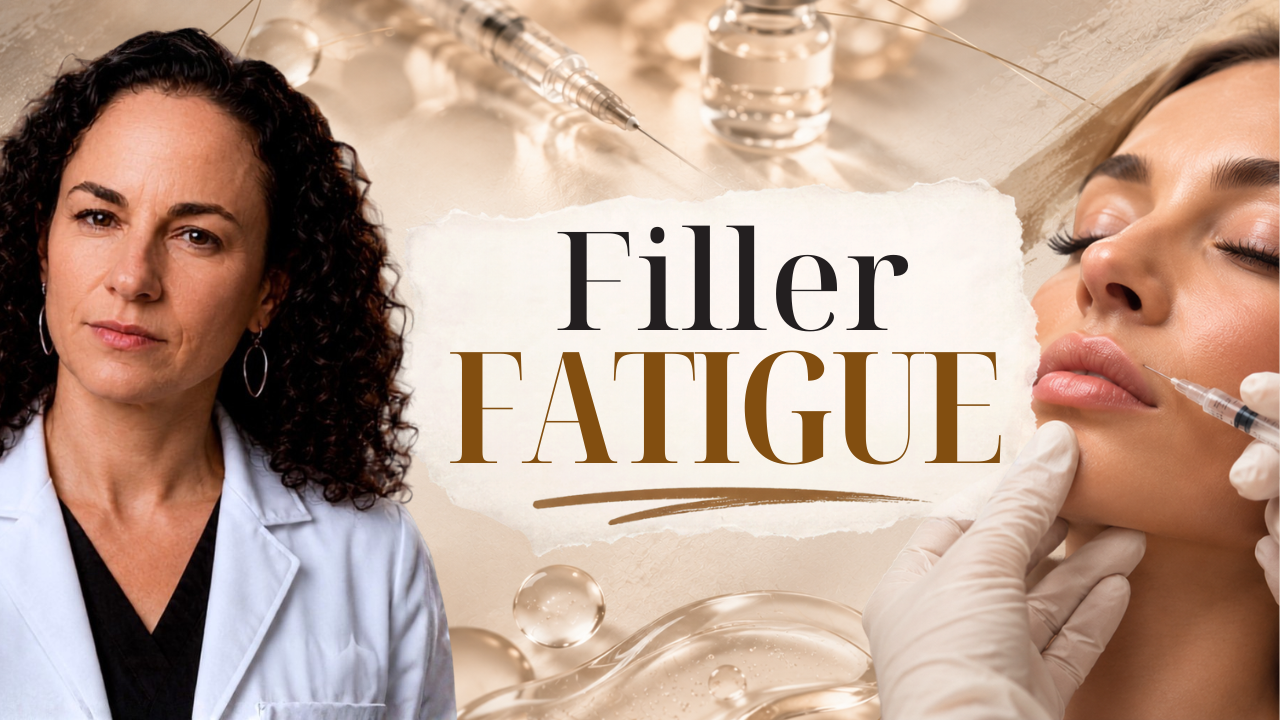
Why Filler Sales Are Falling in America
Maybe you've caught your reflection after an appointment and wondered if you went a little too far. You're not alone. Now the numbers show it.
Filler sales in the U.S. are dropping, and the Wall Street Journal is calling it the Great Deflate. Average quarterly U.S. spending on facial fillers fell from about $970 million in 2023 to $850 million in 2025, according to Guidepoint Qsight. Juvéderm, one of the biggest names in hyaluronic acid filler, lost its billion-dollar product status. I've been predicting this for years.
What I didn't predict was how the industry would respond.
The Overfilled Era Is Ending
"Nobody wants to look done anymore." — Dr. Kate Dee, Med Spa Confidential
I've talked about overfilling for a long time. Faces got overstuffed, and somehow that became normal in some circles. Some of us call it aesthetic drift. A look that isn't natural slowly gets accepted as natural.
I also have a strong opinion about where the blame belongs, and it starts with one word our industry uses every day. If you're a provider, you might not like what I have to say about your job title. In the episode, I explain why that word is part of the problem.
The GLP-1 Paradox
"More people need volume, and fewer of them want it injected." — Dr. Kate Dee, Med Spa Confidential
Weight loss drugs changed what people want their faces to look like. One Beverly Hills plastic surgeon says his filler appointments have dropped about 70% since 2023. At the same time, he's seeing more patients than ever with facial hollowing from rapid weight loss.
So where are those patients going instead? The answer surprised me. Some are skipping the needle altogether, and one category of injectable is quietly growing while classic filler shrinks.
I break down which one in the episode, and why I call it the "opposite filler."
Same Syringe, New Name
"Calling it filler or calling it hyaluronic acid gel is a marketing decision, not a safety upgrade." — Dr. Kate Dee, Med Spa Confidential
Here's where it gets truly strange. Some of the companies that make filler are now trying to get providers to stop calling it filler. One campaign has a nickname for the word that I'm still laughing about.
When an industry renames its own product, the brand has a problem. A new label doesn't change who's licensed to inject it or what's actually in the syringe. And one executive claim in particular deserves serious pushback.
Weighing Your Real Options
"You should know what's going in, not find out later." — Dr. Kate Dee, Med Spa Confidential
Hyaluronic acid filler has a well-established safety profile when it's done correctly, and it's usually reversible. Still, filler complications like vascular occlusion are rare but serious, and they belong in every informed consent conversation.
There's also something one plastic surgeon has found in patients' tissue years after their filler was dissolved. Most people have never heard it.
The popular alternative right now costs about ten times more than a syringe of filler, and you can't undo it. Before you trade one for the other, there's a cost and permanence question you need to answer honestly. I walk through the math in the episode.
Before Your Next Appointment
If this made you rethink your next filler appointment, good. Trends come and go, but your face is yours for life. Listen to the full episode of Med Spa Confidential to hear the three forces behind the Great Deflate and what I'd want you to know before you book.
Listen to This Episode
Full Episode Transcript
Read the Transcript
[00:00:00] Dr. Kate Dee: Filler sales in America are cratering. The Wall Street Journal is calling it the Great Deflate. And if you've spent any time on Instagram [00:00:07] or TikTok lately, you already know why. Nobody wants to look done anymore. I'm Dr. Kate Dee, founder of Glo Medi Spa in Seattle and founder of the Med Spa Board, and author of Med Spa Mayhem.
[00:00:20] Dr. Kate Dee: And this is Med Spa Confidential, where we pull back the curtain on everything happening in this industry — the good, the bad, and the outright illegal — because you [00:00:30] deserve to know the truth before you book. Quick definition for anyone who's not neck deep in this stuff like I am: filler almost always means hyaluronic acid gel.
[00:00:41] Dr. Kate Dee: Hyaluronic acid, or HA, is a molecule your body already makes that binds water and plumps tissue. Brands like Juvéderm and Restylane are HA fillers. That's different from a biostimulator like Sculptra, which doesn't just sit there adding volume — it triggers your own [00:01:00] body to build collagen over months. I kind of call Sculptra the opposite filler for exactly that reason, if you're building a beachfront home instead of renting one.
[00:01:09] Dr. Kate Dee: So what do the numbers look like? There was a recent Wall Street Journal article that confirmed, straight from the company's own numbers, the average quarterly US spending on facial fillers dropped from about nine hundred and seventy million dollars in two thousand and twenty-three to eight hundred and fifty million in two [00:01:30] thousand and twenty-five.
[00:01:31] Dr. Kate Dee: That's healthcare data from Guidepoint Qsight. Juvéderm, one of the biggest HA filler brands owned by AbbVie's Allergan Aesthetics, saw global revenue fall fifteen percent in twenty-twenty-five. That knocked it out of a billion-dollar product status. AbbVie has also cut jobs in that division.
[00:01:51] Dr. Kate Dee: Meanwhile, spending on facial surgery — nose jobs, face lifts — is actually up twenty-two percent in the first half of twenty-twenty-six [00:02:00] to one point eight billion. And inside the filler category itself, it's not uniform. HA fillers that plump instantly fell eighteen percent from '23 to '25, while collagen-stimulating biostimulators like Sculptra are actually growing.
[00:02:18] Dr. Kate Dee: So people aren't necessarily walking away from injectables altogether. They're walking away from the instant plump look, and increasingly away from the needle entirely, in favor of [00:02:30] surgery. Now, I've been waiting for this to happen for many years — not the surgery part, but the filler backlash part. I've been talking about how filler is overused and people look overstuffed, and somehow that became normalized, at least in some circles in this country.
[00:02:47] Dr. Kate Dee: And I and others have referred to it as aesthetic drift, where something that doesn't really look natural slowly becomes accepted as normal looking. Anyway, [00:03:00] I've done entire podcasts on this topic, and now I'm on record with my opinion that the word injector is inappropriate, because that's not all we do.
[00:03:09] Dr. Kate Dee: As a matter of fact, it's not the majority of what we do. But it's definitely the problem when you go to an injector and that's the only tool they have: injectables. It's the old "when you have a hammer" thing — everything's a nail. So why is this happening right now? I think there are three reasons converging here, and this is where it gets interesting for anyone [00:03:30] deciding what to do with their own skin and their own face.
[00:03:33] Dr. Kate Dee: So the first thing is GLP-1s. The whole country is on a weight loss trajectory right now, and the aesthetic ideal shifted with it — thinner and more natural. The Wall Street Journal actually used the term "heroin chic." I think that's taking it a little far — it's a little bit horrifying to me. That's not the natural look most people prefer.
[00:03:56] Dr. Kate Dee: But I do think that applies to some of the Hollywood stars who [00:04:00] are known for the totally overboard use of these interventions. Anyway, an overfilled face doesn't match the ideal look anymore. One Beverly Hills plastic surgeon, Dr. Daniel Barrett, says that his filler appointments are down about seventy percent since twenty-twenty-three, even though he's seeing more patients than ever with facial hollowing from rapid GLP-1 weight loss.
[00:04:24] Dr. Kate Dee: That's a real paradox. More people need volume, and fewer of them want it [00:04:30] injected. So what's the second reason? Public backlash from celebrities all down. Courteney Cox has talked publicly about regretting filler and its domino effect. Jennifer Lawrence has said she's avoiding it because it reads on camera.
[00:04:44] Dr. Kate Dee: And you're seeing the same thing from content creators like Yasminah Ferreira and Stella Vademan, who both have documented in detail how painful and drawn out it is to dissolve filler that they got years [00:05:00] ago. So what's the third thing? And I think this is the one you really should sit with. The industry itself is playing defense.
[00:05:07] Dr. Kate Dee: Evolus, one of the injectable companies, launched an actual marketing campaign telling providers to stop using the word filler — the F word — and just to call it hyaluronic acid gel instead. Their CEO said it on Instagram: "Drop the F word." And Allergan Aesthetics' [00:05:30] global president has been out doing interviews about how one syringe of filler is only the size of a blueberry, trying to reframe the conversation.
[00:05:38] Dr. Kate Dee: When an entire industry pivots to renaming its own product, that tells you something about how toxic the brand on filler has actually gotten. So where does this leave you if you're trying to make an actual decision here instead of just reacting to a trend? Well, so first of all: safety. HA filler has a well-established safety profile [00:06:00] when it's done correctly, and in most cases it's reversible.
[00:06:03] Dr. Kate Dee: That's part of why it became so popular in the first place. But there's the part that doesn't get said enough. A plastic surgeon quoted in this piece, Dr. Michelle Lee, makes the point that filler doesn't fully disappear, often even after it's dissolved — she's seen it in tissues years later. And of course, there's the dreaded complication of vascular occlusion.
[00:06:24] Dr. Kate Dee: If that happens, you could lose parts of your face, your skin, or even go blind. This is all [00:06:30] part of informed consent — you should know what's going in, not find out later. Effectiveness: filler still does what it's designed to do.
[00:06:35] Dr. Kate Dee: The problem was never the product itself — it was overfilling and poor technique. As one of the dermatologists in this piece put it: "Filler is a tool in your toolbox, a pastel in your paint palette. Used sparingly by someone who actually knows what they're doing, it still works, but it is temporary."
[00:06:57] Dr. Kate Dee: So what about reasonableness? That's always [00:07:00] my third area. This is where the math gets a little bit real here. The alternative getting a lot of attention right now is autologous fat transfer.
[00:07:09] Dr. Kate Dee: That's where they take fat from your own body and graft it into your face. That can run around $10,000, compared to roughly seven hundred to a thousand for a syringe of filler. Now, people often get multiple syringes of filler, and they do that often one or two times a year, and that can add up. Unlike HA filler, fat [00:07:30] transfer is not reversible, so you're not just picking a look — you're picking a price point and a level of permanence, and you need to actually think through both of those things before you say yes.
[00:07:41] Dr. Kate Dee: It's also really important to consider all the other treatment options. That includes biostimulators, where you're building your own collagen, and also skin tightening treatments that actually tighten loose skin. Let's talk about how crazy it is that the companies making these fillers want to rename it [00:08:00] after all these years.
[00:08:01] Dr. Kate Dee: Renaming a product doesn't change the risk you're taking with your aesthetic or with your skin. It also doesn't change who's licensed to inject it, what actually is in the syringe, or whether the person holding it knows what they're doing. Calling it filler or calling it hyaluronic acid gel is a marketing decision, not a safety upgrade. Whatever the industry calls it this year, the questions you need answers before you book don't change. To be clear about what's [00:08:30] solid here and what isn't: the sales figures, Guidepoint Qsight's numbers, AbbVie's own reported Juvéderm revenue, facial surgery spending data — those are on the record.
[00:08:41] Dr. Kate Dee: The Evolus and Allergan campaigns are real and confirmed — you can watch the ads yourself. What I would push back on a little is Allergan's own framing that the penetration rate for fillers is extremely low, and there's untapped growth to chase. That's coming from the global [00:09:00] president of the company that sells the filler.
[00:09:02] Dr. Kate Dee: Worth remembering whose numbers you're being handed, and why, when an industry executive is the one telling you the backlash is overblown.
[00:09:11] Dr. Kate Dee: Thanks for listening. If this episode opened your eyes to something you didn't know before, share it with someone who needs to hear it. Subscribe so you don't miss the next one, and drop a comment telling me your biggest takeaway — I actually read them all. Join me on this mission to keep you safe and push this industry to do better.