
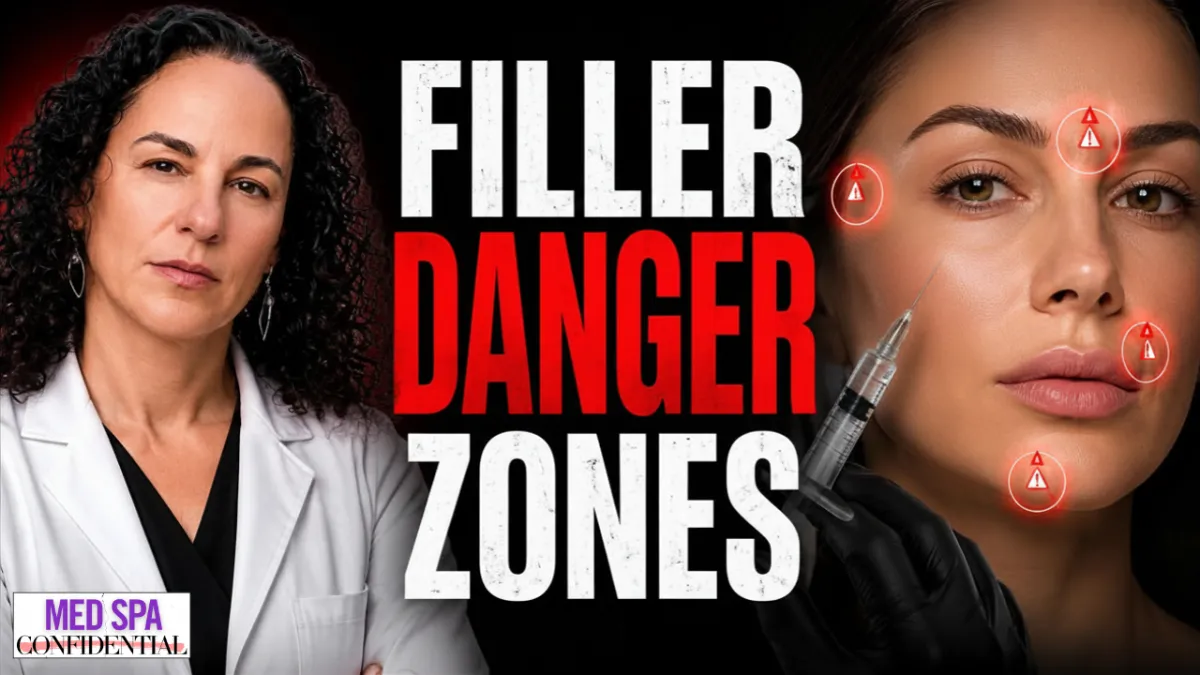
The Filler I Talk Most Patients Out Of
The Filler I Talk Most Patients Out Of
You booked the filler because someone promised it would turn back the clock. But what if the fix is riskier than the problem you walked in with?
Dermal filler is one of the most requested treatments in any med spa. Here's what worries me as a physician. The line between a quick plump and real danger is thinner than most people know.
The Look That Goes Wrong
"They're putting volume in places that didn't used to have it." — Dr. Kate Dee, Med Spa Confidential
Filler was designed to restore volume you've lost, like the little divot a lot of us get in our cheeks as we age. That's a good use. But a lot of places see loose, droopy skin and just pump in filler to stretch it tight. It works for a minute.
Then it starts to look off. That overstuffed, "why does she look weird" face has a name. It's called pillow face, and it happens when volume goes where your face was never built to hold it.
In this episode of Medspa Confidential, I explain exactly which areas I refuse to touch.
My Number One Reason
"My number one reason to talk people out of it is vascular occlusion." — Dr. Kate Dee, Med Spa Confidential
The look isn't even my biggest worry. It's vascular occlusion. That's when filler slips into a blood vessel by accident and blocks the blood flow. When blood can't reach an area, that tissue can die.
"That's when a part of you dies because it's not getting any blood flow." It's rare, but it's not zero, and it happens more than people think.
Here's what scares me. A lot of places injecting filler aren't prepared to treat an occlusion if one happens. That takes training, fast recognition, and the right medicine on hand. If your injector doesn't have all three, you're rolling the dice with your face.
I break down what a truly prepared clinic keeps ready in the fridge.
When There's a Better Way
"If there's a better treatment, don't have filler." — Dr. Kate Dee, Med Spa Confidential
If your skin is loose, filler isn't fixing that. Skin tightening is. In my office, we swapped filler for PRP and PRFM under the eyes years ago. I've never seen an occlusion from it, and you're building your own collagen over time. Slower results, sure. But longer lasting, and far safer.
I'm not anti-filler. I love it for the right job, like restoring cheeks or lips that have thinned with age. Subtle and restorative.
Before Your Next Appointment
If this made you pause before your next booking, good. That's the point. The safest patients are the ones who ask questions before anyone picks up a syringe. Ask who's holding the needle, what training they've had, and what happens if something goes wrong.
Listen to the full episode of Med Spa Confidential to hear the danger zones I refuse to inject, and the questions that could keep you safe.
Episode Transcripts:
[00:00:00] Dr. Kate Dee: So if it gets into an artery and you block the blood flow, you can get, no blood flow to an area which would cause necrosis. Hi, I'm Dr. Kate Dee, and this is my second in a series about why I say no or what I talk people out of. I'd like to talk today about dermal filler and why I more often than not tell people they don't need it rather than need it. So what is dermal filler and what's it good for, and why do I think it's sucky in other in, in some [00:00:30] areas of, of aesthetics?
[00:00:31] Dr. Kate Dee: Okay, so dermal filler is mostly made out of hyaluronic acid. It comes in a syringe, and it's a gel, and it is used to fill spaces that have lost volume, okay? That's kind of how it was designed, okay? It's made out of hyaluronic acid, which is a substance that's in your body. It's in all your joints.
[00:00:54] Dr. Kate Dee: HA serums are what we put on our skin. It kind of plumps our epidermis. your [00:01:00] body sees it as a natural substance, and your body, when it's inside of it, it will break it down over time. So dermal filler, uh, the way I think of it, it should be used to fill volume that's lost to restore an appearance that you used to have That's not there anymore.
[00:01:18] Dr. Kate Dee: And, the classic example that I give patients is, as we get older, a lot of us get, like, a divot, especially in our cheeks, like right there. I would say really common, get a little divot [00:01:30] there. But there are, you know, other areas you lose volume. If you put that volume back, then you can look a little closer to what you used to look like when you had the volume.
[00:01:39] Dr. Kate Dee: Okay. So, that's generally what it's used for. However, what's happened over the years is that a lot of people put filler in when you have just some loose, hangy skin, and your skin's a little stretched out. You're maybe my age, and you've [00:02:00] lost your collagen and elastin in your skin, and it's kind of droopy.
[00:02:02] Dr. Kate Dee: and what these places do is they plump up your, your s- face so that the skin is now more taut. And that looks weird. Why does it look weird? Because they're putting volume in places that didn't used to have it. they're trying to make your skin stretched out so your skin is smooth. but now you look weird, and that is kind of the origin of why people get pillow face or, you know, just overstuffed.
[00:02:28] Dr. Kate Dee: They look bizarre, and you look at them, and you [00:02:30] think, "Why do they look weird?" but here's why I talk people out of it, okay? If there's a better treatment, don't have filler. Treat the problem in the first place. So for instance, if you've got loose, hangy skin, do some skin tightening. Do something that's gonna actually improve your skin quality.
[00:02:46] Dr. Kate Dee: So, it's really dangerous to use filler. So my number one reason to talk people out of it is vascular occlusion, vascular occlusion, and the third reason would be vascular occlusion, okay? So that is the risk of when you put [00:03:00] filler, filler into your face, the risk that you're gonna put that filler by accident into a blood vessel and block the blood flow, okay?
[00:03:09] Dr. Kate Dee: So if it gets into an artery and you block the blood flow, you can get, no blood flow to an area which would cause necrosis. That's when a part of you dies because it's not getting any blood flow. So that is thankfully rare, but not zero, and it happens more commonly than you think. and a [00:03:30] lot of places putting filler into people are not really prepared to treat vascular occlusion.
[00:03:34] Dr. Kate Dee: So it's a big danger, and it's a danger I would not risk, unless there were a really, really good benefit and unless you're having someone do it who really knows what they're doing and is really, really careful and knows their anatomy and has the ability to treat a vascular occlusion if one were to occur.
[00:03:55] Dr. Kate Dee: So it's a really big deal. You gotta be prepared for that, and you have to have kind of [00:04:00] maybe a team of people to be prepared for that because, um, that can take hours. So if you do block a blood vessel, one, you have to notice it, make sure you, find it early, and then you have to have enough vials of Hyalax in your fridge to be able to flood it with that enzyme.
[00:04:17] Dr. Kate Dee: And that enzyme, hyaluronidase, breaks down hyaluron-hyaluronic acid. So if you did have a blockage, then you could treat it. Okay? But be careful because a lot of places out there are throwing [00:04:30] filler into people, they are just not prepared to treat a vascular occlusion. And in my place, I wanna avoid one so badly that I would rather do anything else that's better for the patient than do filler, unless filler is the thing.
[00:04:43] Dr. Kate Dee: Okay? And I will get to that in a minute, like when do I actually use it. But I'm gonna tell you what I talk people out of. First of all, tear troughs. So that's the hollows under the eyes. Okay? And we all get those as we get older. And, so tear troughs used to be treated [00:05:00] with,hyaluronic acid fillers for a really long time, and some people are still, you know, throw lots of filler into tear troughs.
[00:05:06] Dr. Kate Dee: many years ago now, my office, we converted into using, PRFM or PRP. it's activated platelet-rich plasma. it's much safer than filler. I personally do not know of a vascular occlusion from PRP. If you've heard of one, please send it to me, I'm really interested. we've been doing PRP for many, many [00:05:30] years and PRFM, and we have never had, an occlusion from that.
[00:05:34] Dr. Kate Dee: so it's much safer. It does take a few treatments, two to three treatments. it's very similar. The actual procedure is very similar. It does require a blood draw, but, in my opinion, you get longer-lasting results 'cause you're building collagen over time, rather than filling up a space with filler.
[00:05:53] Dr. Kate Dee: Because always remember, when you fill something with filler,
[00:05:56] Dr. Kate Dee: so over time it's just gonna fade away because your body's gonna break [00:06:00] it down, whereas when you're building your own collagen, you are building it over time and you keep more of that longer term. So I think that there... It's slower results, but it's also longer term, longer lasting.
[00:06:12] Dr. Kate Dee: So I prefer PRFM, for tear troughs, and I do not do filler for tear troughs anymore. I think it's too dangerous. Okay? Other places I will not do filler is in the temples. A lot of places will do filler for that. I don't like filler. There's a really big, important artery, the temporal [00:06:30] artery in there.
[00:06:30] Dr. Kate Dee: Don't wanna mess with that. We do Sculptra, for, Temples. and again, I know of one case that I've heard of where people got, an occlusion of the temporal artery after Sculptra, but actually I think that was the patient had Sculptra first and then got filler later.
[00:06:49] Dr. Kate Dee: They blamed it on the Sculptra, but really it was the filler that occluded the vessel. Sculptra is dissolved in water and should not any way in theory have the ability to cause a [00:07:00] vascular occlusion. so temples, no, won't do filler there. What about the lower face, the jawline? The problem there is, one, also some very big arteries down there, but in my opinion, filler does not last very long in the jawline.
[00:07:13] Dr. Kate Dee: The jawline is bone, right? And filler is mushy gel, and you're doing this, and you're doing this, whatever. It just... You can achieve a very nice look immediately after injecting filler there, but in my opinion, it does not last. It moves around. It smooshes [00:07:30] around. it's kind of a waste of money. So if you're gonna waste money, like, you would not want to, uh, endure any actual risk to your life or your appearance or your skin for something that's just not worth it.
[00:07:43] Dr. Kate Dee: It's not gonna last. It doesn't make sense. So, I don't do it, for jawline. What about lower face, so marionette lines and the nasolabials? Well, not my favorite. Why is it not my favorite? Well, because you're-- as you get older and your skin thins out, [00:08:00] your, your upper face is kind of slowly sliding into your lower face, okay?
[00:08:05] Dr. Kate Dee: Everything kind of droops a little bit. And so really what it is is, you're getting more volume over time in your lower face than you had before, uh, 'cause things are kind of sinking, okay? Adding more volume now is not a good look. It's not what you want, really. It's not what you're missing. You're not missing volume there.
[00:08:24] Dr. Kate Dee: You're kind of, sliding down. So I personally don't think that adding volume to someone whose [00:08:30] skin is drooping into their lower face is gonna help these lines, okay? I prefer to do skin tightening for people like that. Basically, people like me. So I have no filler in my face, okay? I've done a lot of skin tightening treatments, mostly with Genius RF microneedling.
[00:08:45] Dr. Kate Dee: I've also done a fair amount of laser resurfacing with LaseMD Ultra. Those are my kind of go-tos, okay? But, I don't like that because when you are young and you have nice big cheeks and you've got your chin, you have this triangle. This is [00:09:00] what, you know, aesthetic people are always talking about in the industry.
[00:09:04] Dr. Kate Dee: and as we get older, we get a little more squared off because we get jowls, right? And we're a little more squared off. And so, preserving this triangle is really what- you know, what you used to look like, rather than adding volume to the lower face. So I don't do that very much. Every once in a while if I have a little extra, I might smooth out a little line, but usually I don't do that Okay.
[00:09:28] Dr. Kate Dee: what do I like filler for?
[00:09:29] Dr. Kate Dee: There's [00:09:30] no reliable way to know if a med spa is following safety standards or cutting corners, until now. The Med Spa Board certifies clinics that prove they're doing things right, verified products, licensed staff, and actual medical oversight. It's the difference between rolling the dice with your skin and knowing exactly who's holding the needle.
[00:09:50] Dr. Kate Dee: If you're looking for aesthetic treatments, go to medspaboard.com to find a certified spa near you. And if you already have a med spa you love [00:10:00] and they're not certified yet, please send them our link. Med spa owners, getting certified does more than build patient trust. It should also save you a ton on your malpractice insurance.
[00:10:11] Dr. Kate Dee: Do the right thing and go to medspaboard.com. Keep listening, keep asking questions, and stay safe out there.
[00:10:18] Dr. Kate Dee: Okay. I really like it for cheeks. you can do sculpture for cheeks, and I love sculpture for cheeks. but sometimes adding volume to the cheeks is just... it's so immediate, it's so direct, [00:10:30] it's great, and it's relatively safe if you inject it in the right spot. and then the other thing I like it for is lips, because some people don't have lips.
[00:10:38] Dr. Kate Dee: Now, I do not have filler in my lips, okay? But you take, someone my age who really has lost a lot of volume in their lips, and you can restore that volume and it looks great. Um, and I have no problem with that. What I really can't stand is the ducky look. Can't stand it. Oh my gosh. Maybe that's attractive for some people.
[00:10:56] Dr. Kate Dee: I really don't like it, and so if somebody comes to me with [00:11:00] very full lips, I will say, you know, "You have very full lips. Uh, you don't need more filler." Okay? if somebody asks me to produce that ducky look, like that's what they really like and they want that, I will say, "No, I won't do that to you."
[00:11:13] Dr. Kate Dee: Because someone later in the day or next week is gonna say, "Oh, wow, those are some lips. Who did that to you?" And I don't want them to be able to say, "Ooh, that was Dr. Dee." so I talk people out of filler that I think is just not in my comfort zone. [00:11:30] So I don't wanna offer someone any possible harm when I don't think that they're gonna benefit very much from that.
[00:11:38] Dr. Kate Dee: So again, cheeks, we do fair amount; lips, fair amount, but not too much, not to the point of looking like a crazy person, not so much looking like pillow face, but subtle, restorative volume. If you used to have bigger cheeks, and now they're sunk in or you've got some divots, great solution. If you used to have bigger [00:12:00] lips, and now, like, they're really thinned out as you've gotten older, great solution, okay?
[00:12:05] Dr. Kate Dee: but a lot of these other things, it's just too high risk, okay? There are certain locations also, don't even ever have it. If someone suggests it to you, it's way too risky. So areas that are way too risky, the glabella, okay, between your eyebrows, very, very high risk for occlusion in that area. The nose, unless this person is a board-certified ENT, really [00:12:30] knows nasal anatomy and can take you to the OR if they mess it up, do not have an injector put it in your nose.
[00:12:35] Dr. Kate Dee: It's super, super dangerous. You can lose the tip of your nose. Um, and then tear troughs, I just don't... Tear troughs and, and temples, a lot of people will do that. I just think it's not worth the risk. So there you have it. That's what I use it for, mostly cheeks and lips. almost everything else, there's something better out there, and we can figure out what that is and really help you [00:13:00] look your best without looking like a pillow face
[00:13:03] Dr. Kate Dee: Thanks for listening. If this episode opened your eyes to something you didn't know before, share it with someone who needs to hear it. Subscribe so you don't miss the next one, and drop a comment telling me your biggest takeaway. I actually read them all. Join me on this mission to keep you safe and push this industry to do better.