
What a Real Medspa Consult Should Look Like
What a Real Medspa Consult Should Look Like
We've all booked a treatment and hoped the person across from us actually knew our skin. But how often do you get to watch a real consult from the inside?
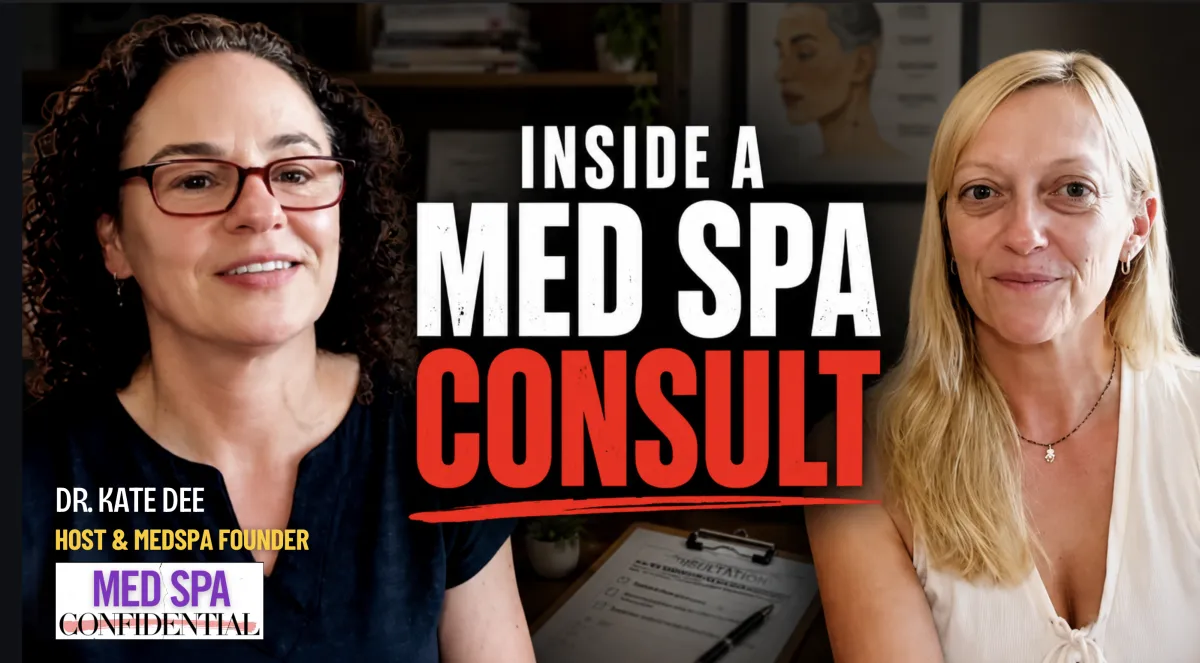
On the most recent episode of Med Spa Confidential podcast, my girlfriend Deb volunteered for exactly that. No prep, no script. She's 51, no makeup, just a little sunscreen and a lot of honest questions. What you hear is the same consult I do every day.
Start With the Why
"By the time you're 30, the cells that make collagen and elastin go dormant." — Dr. Kate Dee, Med Spa Confidential
I never open with a treatment menu. I start with what's actually happening to your skin. Three things at once. Your surface cells slow down and pile up, so skin looks dull. Your collagen cells clock out around 30, so skin thins and starts to droop. And the fat pads and bone underneath shift, usually under the eyes first.
For almost everyone over 30, two things matter most. A real at-home routine that exfoliates and feeds your skin, and something in the office that keeps your collagen cells awake, roughly three times a year. Those cells only stay active four to six months at a time, which is why one treatment a year won't hold you. Get those two right and you've done more than most people ever do.
The Cactus Red Dot
"Those are really easy to make go away." — Dr. Kate Dee, Med Spa Confidential
Deb pointed to a tiny red mark and told me she'd poked herself with a cactus, I kid you not. People live with little red spots for years, sure they're permanent. Most of them come off in a treatment or two with a small cautery device that plenty of good clinics keep on hand. If a red dot has bugged you for a decade, ask about it. It's often a five-minute fix,
Dark Circles and the Under-Eye
"The tear trough is the under-eye area, fraught with problems." — Dr. Kate Dee, Med Spa Confidential
Dark circles were Deb's top concern, and this is where I get protective. The under-eye is the thinnest skin on your body and the first place you notice age. It's also where filler goes wrong most. A bluish tint called the Tyndall effect, a blocked vessel, or product that drifts and sticks around for years. One MRI study even found old filler sitting in places it never belonged.
So near the eye, I'd rather build your own collagen than rent volume that fades in a year. If someone's holding a syringe near your eye, you deserve to know their training and their plan before they touch you.
The Collagen Powder Question
"Eating it is just a little more expensive way to consume protein." — Dr. Kate Dee, Med Spa Confidential
Deb asked about collagen powders, and I get this one constantly. They won't hurt you. But your body breaks that collagen down into amino acids and rebuilds it from scratch, so it doesn't travel straight to your skin. If you want to help your body make collagen, vitamin C does more than the scoop does. Save the money or spend it on something that works.
Before Your Next Appointment
A real consult isn't a menu. You should walk out knowing what's happening to your skin and why. In the full episode, Deb asks whether a med spa can treat migraines, and my answer surprises her, because it comes down to one detail about where your pain starts.
Listen to the full episode of Med Spa Confidential for Deb's whole consultation and the questions every patient should ask.
Episode Transcripts:
[00:00:00] Dr. Kate Dee: I'm doing something really different and special today. my girlfriend Deb is here although she's been absorbing a bunch of information from me in various pockets of the world, we've never done a formal consult. So she totally volunteered, not my idea to come on the podcast and do a consult totally cold.
[00:00:22] Dr. Kate Dee: I'm Dr. Kate Dee, founder and medical director of Glo MediSpa, and this is MedSpa Confidential, where we expose the [00:00:30] risks, the red flags, and the outright illegal practices happening inside med spas right now, because you deserve to know what's actually going into your body before you say yes.
[00:00:40] Dr. Kate Dee: So what you're gonna see is completely unrehearsed. Um, but I'm just gonna kinda do a consult the way I typically do. and so maybe a little extra funny 'cause it's Deb, but, you know- ... we'll see. So, um, anyway, Deb, thanks so much for doing this with me. You're welcome. Okay. So, I'm just gonna launch into what I would normally start with and then, And [00:01:00] she'll ask questions as, as is naturally happens. So what I like to do in these consultations is just start with the basic things that are happening to your skin as you get older. Um, so you kinda understand the foundations and the reasons why I recommend what I do. and then we kinda get into specific problems after that.
[00:01:20] Dr. Kate Dee: So we'll start with basic prevention that really applies to everyone. The way-- I use the, the age 30 as sort of a proxy for when you really need to start, [00:01:30] um, uh, doing stuff to prevent the, the, these changes. But anyway, so Deb is, 51.
[00:01:38] Deb: 51 years old.
[00:01:39] Dr. Kate Dee: And you have no makeup on right now?
[00:01:40] Deb: None.
[00:01:41] Dr. Kate Dee: Okay. So, um- Little
[00:01:42] Deb: bit of sunscreen, that's all.
[00:01:44] Dr. Kate Dee: Little. Right, which is good. so, so let's just start with the basic things that are happening to your skin. So, uh, there are three big things. So there are a ton of things that are happening as you get older, but there are three really big dominant things. So the first one [00:02:00] starts in your 20s, and that is that your, epidermis slows down in its turnover.
[00:02:06] Dr. Kate Dee: So when you're a kid, it's about four to six weeks for a new little baby keratinocyte to be born and work its way up to the surface of your skin and slough off. So the epidermis is the top layer where those cells slough off of every day. And, um, as you get older, that slows down starting in your 20s and it just gets slower and slower and slower as you get older.
[00:02:28] Dr. Kate Dee: So what that means [00:02:30] is, um, you get this buildup of dead cells that just sit there, and those cells are more dull, they're more leathery, they tend to retain all the little wrinkles and pigment they picked up along the way. and they also block the absorption of anything good you wanna put on your skin.
[00:02:48] Dr. Kate Dee: Mm. So a lot of people know they're supposed to exfoliate, right? But that's why, really, is so that you have nice fresh, young, happy cells at the surface, and those are brighter, they're less spotty, [00:03:00] and then also you absorb those topicals better. So that's the first thing. And the easiest thing to do for that is, like a daily exfoliating cleanser.
[00:03:09] Dr. Kate Dee: You don't need to do anything special. You don't need a facial. You don't need an exfoliating treatment like dermaplaning, although those are fun, and they do do stuff, you don't really need that. So, okay. So the second big thing is the dermis, the layer underneath the epidermis, right? that is a thicker [00:03:30] layer that has all the collagen and elastin and some other stuff in there that we'll talk about.
[00:03:35] Dr. Kate Dee: But that layer keeps your skin thick and springy, okay? So by the time you're 30, the cells in that layer that make collagen and elastin, those go dormant and they don't make anymore. And your body breaks those things down naturally one to 2% per year. So, but after around 30, you're not replacing it anymore, so your dermis slowly thins out, [00:04:00] and as it does that, it's no longer thick and springy.
[00:04:02] Dr. Kate Dee: So, it starts to retain the wrinkles, um, and starts to, as it thins out, starts to droop. So you get a little droopy, hangy skin as you get older. and so, uh, super important to go in there and make those fibroblasts wake up and make collagen for you. So that unfortunately, topicals are great. They will stimulate those cells to make collagen, but only if they're awake.[00:04:30]
[00:04:30] Dr. Kate Dee: So that means either microneedling or laser or, you know, for the people in their 30s and 40s, three times a year. Because generally every time you do it Uh, those fibroblasts respond with about four to six months of activity, and then they go back to being dormant, which is why- Mm-hmm ... we say every four months you do it again, right?
[00:04:49] Dr. Kate Dee: So, and then there are bigger guns for people closer to our age that where you actually can thicken and tighten the skin, but we'll get to that. So fibroblasts, keep [00:05:00] them awake. so that's number two. And then the third thing is that underneath your skin, everything under there is changing as you get older.
[00:05:10] Dr. Kate Dee: So your bones are remodeling your whole life, so it's super important to get your calcium and vitamin D no matter how old you are. but really what's happening is your, your, your skin is on a scaffolding, and that scaffolding is not static. It's changing your whole life. So one of the first things that happens is it starts in your 30s, um, are the [00:05:30] little fat pads around your face.
[00:05:31] Dr. Kate Dee: You know, when you're a kid, you have all, all this baby fat and keeps your face kind of round or oval- Mm-hmm ... right? So we lose those pockets of fat as we get older, and the first one to go is usually the one under your eye. Mm. Okay? Yes. We both have this going on. So, thank goodness- It's right here
[00:05:48] Dr. Kate Dee: for reading glasses. Um, so but, you know, the under-eye area is a little bit of a double whammy situation because it's the first place that we lose that fat pad, okay? So you get this volume loss, [00:06:00] and as you lose volume, the skin isn't held up as much, and so it's a little, uh, you know, less supported. And then it's the thinnest skin in your body, and so as that dermis thins out, then your first place that you notice that collagen loss is in the under-eye area.
[00:06:21] Dr. Kate Dee: And so that thin skin gets even thinner. And so between losing a little volume and then losing the thickness of your skin there- that's usually the [00:06:30] first place that anyone notices that anything's changing. So a lot of times I see people in their late 30s or early 40s where they're like, "Ah."
[00:06:38] Dr. Kate Dee: You know, especially when they've had a kid, they're like, "Ah, that kid's killing me." 'Cause, you know, I-- my eye, under-eye, what's going on there? And it's really just that all these things are happening, and it's just the first place that you notice it. So, where volume loss is a problem, that's where, fillers and, Sculptra, which is this [00:07:00] injectable that stimulates collagen kinda in and u- under the skin, where it replaces volume when it's lost.
[00:07:07] Dr. Kate Dee: That is where filler fits in, and so not everybody needs that. and I think out there in the med spa world, um, filler's very much overused, where you take someone like, like us in their 50s, we've got some loose, hangy skin. Um, but if you haven't lost volume, then what they're doing out there is pumping up the face filled with filler so [00:07:30] the skin is taut But they're not putting it in places where the person has lost volume before, so now they look weird.
[00:07:37] Dr. Kate Dee: They have a weird pillow face or, like, what's going on? And where you see the kind of famous people where their face doesn't look right, and you think, "What's going on?" It's because they're pumping fillers in places where they didn't lose volume, and now they look different. They look like a whole different person.
[00:07:54] Dr. Kate Dee: and we're very conservative with filler at my place. I think most people, at least in the Pacific Northwest [00:08:00] where we live, people appreciate that.
[00:08:02] Deb: We wanna look normal.
[00:08:03] Dr. Kate Dee: Yeah.
[00:08:04] Deb: Sorry.
[00:08:04] Dr. Kate Dee: Just wanna look
[00:08:04] Deb: normal. No offense to anyone-
[00:08:05] Dr. Kate Dee: Right ...
[00:08:07] Deb: with extra big
[00:08:08] Dr. Kate Dee: anything. So, but those are the three big things, okay? and my two recommendations for kind of everybody walking in the door are a really good skincare regimen at home where you are giving your skin
[00:08:20] Dr. Kate Dee: You're exfoliating the dead cells. You're giving the, your skin all the vitamins and antioxidants it needs, um, to make collagen and protect itself from the [00:08:30] sun. you're using at least one serum that stimulates collagen- Mm ... so that when you do do the laser or the microneedling, whatever, those cells, that increases your yield.
[00:08:41] Dr. Kate Dee: a really good moisturizer for your barrier, and a sunblock in the morning, and ideally a retinol at night. For most people they can tolerate that, unless they've got bad rosacea or redness. Um, so th- and so a really good regimen, and then something to keep those fibroblasts awake and working for you.
[00:08:59] Dr. Kate Dee: so [00:09:00] that's, those are my two main recommendations for kind of everybody over 30. Um, and then we generally talk about, like, what's bugging you. So, so tell me, besides, like, how to keep your skin, like, what are the things that really bother you? What are the things you wanna work on?
[00:09:19] Dr. Kate Dee: There's no reliable way to know if a med spa is following safety standards or cutting corners, until now. The Med Spa Board certifies clinics that prove they're doing things right, [00:09:30] verified products, licensed staff, and actual medical oversight. It's the difference between rolling the dice with your skin and knowing exactly who's holding the needle.
[00:09:39] Dr. Kate Dee: If you're looking for aesthetic treatments, go to medspaboard.com to find a certified spa near you. And if you already have a med spa you love and they're not certified yet, please send them our link. Med spa owners, getting certified does more than build patient trust. It should also save you a ton on your [00:10:00] malpractice insurance.
[00:10:01] Dr. Kate Dee: Do the right thing and go to medspaboard.com. Keep listening, keep asking questions, and stay safe out there.
[00:10:08] Deb: I would say, yeah, 51, perimenopause, keeping everything hydrated is a thing, so your first recommendation's great.
[00:10:16] Deb: Dark circles for me are one thing, and then also some age spots. I know I have, like, at least one here.
[00:10:22] Dr. Kate Dee: Mm-hmm.
[00:10:22] Deb: And I also think this is when I accidentally poked myself with a cactus plant. I kid you not. But I have this [00:10:30] little red dot that, like, hasn't gone away. Maybe you can see it, maybe you can't.
[00:10:33] Dr. Kate Dee: It's a little red dot 'cause that happens a lot. those are actually amazingly easy to treat. So in my place, and a lot of places have a little low-level cautery device, and a lot of people have little dots like that or, or, that one's not a cherry angioma, but a lot of people have those little cherry angiomas.
[00:10:51] Dr. Kate Dee: I'm sure you have them elsewhere where it's like a little round red thing, right? Just so y'all know, those are so easy to zap and get rid of. I've had so many [00:11:00] patients where they're like, "Wait a minute. That's been there for eight years, and I hate it." It's like, "On the tip of my nose and I can't stand it."
[00:11:06] Dr. Kate Dee: Well, actually, those are really easy to treat. Sometimes you need to zap 'em more than once, but those are really easy to make go away. Even just like zap, zap, and it's like gone forever. So that's a super easy one. as far as, as age spots or sunspots or sun lentigos is what they're called, those are actually pretty easy to treat too.
[00:11:27] Dr. Kate Dee: So there are a lot of different things [00:11:30] that address those. So one, there are over-the-counter like topicals that we use as part of a regimen, where actually I have one that I use every day because I have a lot of sun damage from... You know, I'm 58, and we didn't really have sunblock growing-- Did you have sunblock?
[00:11:47] Dr. Kate Dee: I mean-
[00:11:48] Deb: I feel like it came around in high school. Later,
[00:11:50] Dr. Kate Dee: right? And I was probably in college or med school by then. Yeah. So, yeah, when we were kids, people were out there with the sunbathing, with the metallic [00:12:00] things like, you know- Baby oil ... Van de Soleil. Ba- baby oil, right? Like, so yeah. So I mean, my arms, I don't know if you can tell, I have a lot of sun damage on my arms.
[00:12:08] Dr. Kate Dee: My face would look like that if I didn't use these serums and a lot of sunblock every day. so the serums that treat pigment work pretty well. You just, you have to use them every day, and it takes months. And but it, it will-- 'Cause they, what happens is some of them help pigment slough off, but most of them, what they're doing is preventing new pigment [00:12:30] from forming.
[00:12:31] Dr. Kate Dee: So if you allow the pigment that's there to slough off over time or help it with some exfoliating things and some other stuff, then, and suppress your melanocytes from replacing it, then over time you can actually get rid of those. But there are many different procedures that we do, that also help just get rid of pigment.
[00:12:52] Dr. Kate Dee: And one of them that would be great for you would be we have a non-ablative laser resurfacing- Mm ... that does stimulate [00:13:00] collagen. So that's one of the things I mentioned earlier, where three times a year stimulate your collagen. Well, the non-ablative laser resurfacing is very safe very little downtime, and that lifts pigment.
[00:13:11] Dr. Kate Dee: Mm-hmm. And we're gonna get into that in a second. I'm gonna pull up a, a diagram that will show you that. Um, but then there are also other treatments like peels and BBL or IPL that treat pigment that, that really help accelerate that. And anytime you're doing a treatment where you're getting rid of pigment- You [00:13:30] also wanna use one of those topicals.
[00:13:31] Dr. Kate Dee: Because what's happening with that is you're s- you're getting rid of the pigment one way or another, but you also wanna suppress your melanocytes from just replacing it. Mm-hmm. Because if you- It'll just come back ... if you do a procedure, any of these procedures, a lot of people out there are really into BBL, a lot of people out there are into laser and stuff, get rid of the pigment, right?
[00:13:50] Dr. Kate Dee: those melanocytes are already revved up and, and making that pigment in that spot or in whatever spot you're working on. [00:14:00] And so, yeah, and so you wanna suppress its replacement, otherwise it'll just come right back. So yeah, so the next time you go to Hawaii, you're into Hawaii, right? I
[00:14:08] Deb: love Hawaii.
[00:14:09] Dr. Kate Dee: She loves Hawaii.
[00:14:09] Dr. Kate Dee: Yes. Okay. So the next time you go- I probably won't though ... if, if you don't use r- religious about your sunblock and then use these, s- serums to suppress the, your melanocytes, you're just gonna come back from Hawaii with that- More ... right back, right? So that's really important. And then the, the other thing was under eye.
[00:14:29] Dr. Kate Dee: Mm-hmm. [00:14:30] Okay. Under eye stuff. Now, that's a big deal. So, back in the day, uh, when I started all this 12, oh, going on 13 years now, people were doing a lot of filler for tear troughs. That's the tear trough is the under eye area, fraught with problems, okay? So, uh, I should probably do a whole little solo episode about why I don't like that.
[00:14:52] Dr. Kate Dee: but uh, so we moved over to using PRP or PRFM in that area. so no [00:15:00] risk of vascular occlusion, um, or essentially no risk. very safe, uh, and longer lasting results. It does require- Mm ... more treatments, so it, and it requires a blood draw.
[00:15:10] Deb: Mm.
[00:15:11] Dr. Kate Dee: Downside, requires a blood draw. I hate having my blood drawn.
[00:15:14] Dr. Kate Dee: You don't care. Not at all. Okay. So if you don't mind having your blood drawn, it's not a bad procedure. So, but that involves, you know, spinning your blood down, taking off basically the serum and the growth factors and putting it here. and we generally use PRFM, which is activated [00:15:30] PRP, so the, it kind of forms a gel once you inject it.
[00:15:34] Dr. Kate Dee: and that acts like a depot for, for the growth factors, and it helps stimulate collagen in that area.
[00:15:42] Deb: Mm.
[00:15:42] Dr. Kate Dee: And then that builds up over a few months, and then you do a few treatments. Usually we do three treatments and, and then you've got your own collagen there, and that is long-lasting. So with filler, you put it in and then your body starts breaking it down day one, and usually within a year it's [00:16:00] gone.
[00:16:00] Dr. Kate Dee: and so with PRP making collagen, you do that and you build collagen over many months, but then your collagen lasts a long time and your body breaks that down 1% to 2% per year. So that's not too bad, right? You're building it over time and then you're losing it, you know, a small percentage at a time.
[00:16:18] Dr. Kate Dee: With filler, it's just gone in a year. So, a lot of places like to do that because guess what? You have to come back and, and have it again, and have it again. and it's kind of dangerous. Like, there are a lot of issues putting filler in tear troughs. [00:16:30] Besides vascular occlusion, you can have... If you put it too close to the surface of the skin, it can end up with this bluish tint that is called the Tyndall effect, but it's the way the light hits the filler.
[00:16:42] Deb: Mm.
[00:16:42] Dr. Kate Dee: Um, not cute, so we don't want that. And then, um, and then also people have trouble getting it in the right plane, and there are many, many cases where they- they did this one MRI study where they showed filler in all the wrong places, and it actually lasted a really long time. Sometimes they even got it [00:17:00] to- into where the eyeball is, okay?
[00:17:02] Dr. Kate Dee: Not a good thing, so not into that. but anyway, so that is a really good option, and the other thing is doing that laser here. We can actually get very, very close. We can't do your eyelid, right? But we can get very close and do-- and like pull your skin down and do that whole area. Mm. You really wanna get that skin, um, to be revitalized and build collagen so it stays thicker.
[00:17:26] Dr. Kate Dee: Mm. So that-- those are really-- those are important. [00:17:30] there's a whole kind of, debated thing where this, this new product, th- there's a, a purified PDGF that I'm not doing, by the way, but it's very, very controversial right now. a lot of people believe that's the way of the future. It-- What in your PRP, so in your blood One of the main growth factors we're getting and using is platelet-derived growth factor.
[00:17:54] Deb: Mm-hmm.
[00:17:55] Dr. Kate Dee: Well, they purified that.
[00:17:56] Deb: Okay.
[00:17:56] Dr. Kate Dee: And it's, it's just not FDA approved for that [00:18:00] purpose or in the form that it's actually purchasable right now. So it's kind of complicated because what you can purchase is a component-
[00:18:08] Deb: Hmm ...
[00:18:08] Dr. Kate Dee: of an FDA-approved drug, but it's not FDA approved in and of itself, and it comes in a vial that says, you know, "Not for injecting."
[00:18:15] Dr. Kate Dee: So like, it's, it's like w- we're waiting for the company that makes it to do that. But anyway, it wouldn't r- involve a blood draw, and you could just inject it, and it'd be way more powerful than PRP. Mm-hmm. So that might be down the line. But for [00:18:30] now, you could do PRP.
[00:18:32] Deb: I like to wait till the FDA approves it.
[00:18:33] Deb: I know, me too.
[00:18:33] Dr. Kate Dee: I don't know about you. Yeah. Yeah. And because nobody's really studied it, when you just inject pure stuff into your-- what happens, we don't really know. But people are out there using it all across the country, so there's probably a lot of anecdotal stories. but for now, that's not a thing that's commercially available.
[00:18:51] Dr. Kate Dee: So but anyway, so that's under-eye stuff. So I'm gonna, I'm gonna show everybody, we're gonna share the screen here, [00:19:00] and we're gonna look at a diagram
[00:19:01] Dr. Kate Dee: All right. So we're gonna show this diagram so everybody can see it. so, uh, we're gonna look at the difference between all these different treatments because people get really confused, like, "Well, what's good for me, and what's good for my daughter who's, you know, 30?" Okay? Mm-hmm. So the first thing is microneedling.
[00:19:21] Dr. Kate Dee: and microneedling, what that is, is that's a pen that, um, has multiple needles that go in and out of the dermis [00:19:30] to about that depth, okay? And what happens is we use some kind of growth factor serum or exosomes- Mm-hmm ... that penetrates down through those channels and hits the little fibroblasts and says, "Hey, make some collagen."
[00:19:45] Dr. Kate Dee: And that's what microneedling does. Hmm. Okay? It doesn't do much else. Okay? People often sell microneedling as though it did all kinds of other things. It really doesn't. It's not powerful enough to do much else, but it does stimulate collagen, and [00:20:00] it's definitely at least enough to keep those fibroblasts awake and make collagen for you so that when you use a collagen-stimulating serum or a retinol or vitamin C, um, it actually increases your yield from microneedling.
[00:20:15] Dr. Kate Dee: So this is what we say, at minimum do that- Mm-hmm ... starting around age 30 about three times a year. So then we're ... the next thing is LaseMD Ultra, which is a non-ablative laser. Uh, and normally [00:20:30] if I'm doing this in person, I'm drawing this all out, but anyway, I did this for this purpose here so that you could see what, you know, what I would be drawing.
[00:20:38] Dr. Kate Dee: But this is a 1927, uh, nanometer thulium laser-
[00:20:42] Deb: Mm ...
[00:20:42] Dr. Kate Dee: that it does not ... It's non-ablative, meaning ablative lasers vaporize the tissue. Mm-hmm. Okay? Uh, lasers can be quite strong. I mean, you ... Certain lasers you can shoot down, you know, missiles out of the sky, right? Right. So, okay. But this, what this does is, zaps the epidermis and it goes a tiny bit [00:21:00] into the dermis like that.
[00:21:01] Dr. Kate Dee: Mm-hmm. Okay? And it zaps that tissue in a fractional way, meaning it zaps this little column of tissue but leaves this little column- Untouched ... untouched. So the ... Several things happen. This column of tissue that it zaps gets damaged just enough for the skin to spit that bit out- Mm ... over the next five to seven days or so, okay?
[00:21:23] Dr. Kate Dee: so at any given time we are zapping somewhere between 20 and 40% of the skin [00:21:30] surface area. Mm. So you're getting rid of, let's just say, a third of your skin surface area each time you do one of these treatments. these little bits I've tried to draw pigment in the, in the epidermis. Most of the pigment, that sun damage that you have- Mm-hmm
[00:21:43] Dr. Kate Dee: in your temple, that's in your epidermis. Mm-hmm. Okay? So any little bits that you've zapped, um, the pigment goes with it. Mm. So you're decreasing pigment. Around a third of it, say. Right?
[00:21:55] Deb: Mm-hmm.
[00:21:56] Dr. Kate Dee: a random third, but- Right ... a third. and it's the full thickness of the [00:22:00] epidermis that you're getting rid of.
[00:22:00] Dr. Kate Dee: Mm-hmm. So you're resurfacing and you're also getting rid of pigment. And the other thing it's doing is it's sending heat waves, heat, enough heat energy into the dermis that it's actually turning those fibroblasts on. Hmm. So you get, some collagen from your fibroblasts. And that way, again, if you're using a collagen-stimulating serum, you increase the yield.
[00:22:23] Dr. Kate Dee: So the, the laser does a few things, not just collagen, but resurfacing and get rid of pigment. [00:22:30]
[00:22:30] Deb: Okay.
[00:22:31] Dr. Kate Dee: So the next thing that on the screen here is the Genius RF microneedling, and that's a thing I would probably do recommend for you. It's-- I've had many of these myself. Um, what that is, is these are also needles that go into the dermis, but they are insulated.
[00:22:49] Dr. Kate Dee: Mm. And so they just deliver a blast of RF energy inside the dermis.
[00:22:54] Deb: Mm.
[00:22:54] Dr. Kate Dee: Okay? And we do several passes where different [00:23:00] depths.
[00:23:00] Deb: Mm.
[00:23:00] Dr. Kate Dee: so you're actually causing this, coagulation throughout the dermis, and that stimulates a ton of collagen, a ton of elastin. You can imagine that's, like, orders of magnitude stronger than just heating 'em up a bit.
[00:23:15] Dr. Kate Dee: Um, and the key thing is that we're not hurting the epidermis at all. We're going through it, but we're not doing any damage to it. Mm. And we're also not going deep to where the fat is.
[00:23:28] Deb: Mm.
[00:23:28] Dr. Kate Dee: Okay? So we're not [00:23:30] harming the fat, we're not harming the epidermis, but we're causing a lot of increased collagen and elastin, so that actually can thicken and tighten the skin.
[00:23:38] Dr. Kate Dee: And when we do this treatment, we often will do this right afterwards, the laser on top of it. Mm. So because most people who want that skin tightening also want resurfacing. Mm. And of course, so do I. So I've had, I've had many of these treatments. The year I turned 50, I did five of them. We generally recommend around one per [00:24:00] decade of life.
[00:24:00] Dr. Kate Dee: So I would recommend five of those in a series. And there's no hurry to do them. We generally recommend between, uh, one to two months, but you can go up to three to four months, and you just keep building on it. So I would do- Mm ... you know, a series of five of those. and then ever since that, I've done one every six months, um, to maintain.
[00:24:23] Deb: Okay.
[00:24:23] Dr. Kate Dee: Um, so I don't know, probably my skin looks good 'cause of that. I, you know, I, [00:24:30] I, I just had a person, uh, much younger than me estimate my age at 46 and I'm 58, so I took that as a big compliment. but anyway, that's what that does, okay? And then just to cover a couple of the other things that we do, like, so BBL is very popular.
[00:24:47] Dr. Kate Dee: That's a trade name for an IPL that is, stands for broadband light, and what that's good for is, pigment, so brown things, and redness, red things. [00:25:00] so focal red things, broad spread redness- Yes ... it could zap that easily. and so what happens with that is the, the top third of pigment sloughs off. It hits the pigment, it gets darker right away, and then takes about a week or two to slough off.
[00:25:16] Dr. Kate Dee: So like the laser, you're getting rid of about a third of the pigment, but it's a different third because with BBL you're getting the surface third, and here you're getting full thickness but a random third [00:25:30] of that, okay? And then the other thing that the BBL does is sends, light energy into the dermis, and you've got vessels under there, and it zaps those vessels and causes them to shrink up.
[00:25:41] Dr. Kate Dee: So it's very good at doing brown and red things. Unfortunately, it's just not enough heat or power to go in and really cause much collagen stimulation. Mm. Now, that same company sells, a filter that claims to do skin tightening. Uh, in my [00:26:00] opinion, it's just not strong enough to actually do much. I don't really sell this or do this for that purpose.
[00:26:05] Dr. Kate Dee: Mm. You could maybe get a tiny bit of collagen out of it, but I wouldn't ... That's- it's just not strong enough for that. So unfortunately, there's no way to avoid doing something else for collagen. and then the last thing on this slide, and then I'll stop scaring s- sharing the screen, is Emface. And there are a couple other, machines that do something similar.
[00:26:24] Dr. Kate Dee: But what Emface does is it stimulates the muscles that lift the face. Mm-hmm. So, um- Those muscles, uh,
[00:26:26] Dr. Kate Dee: you know. it, there's a, there's a, a [00:26:30] pad that sticks to your skin, and it does muscle stimulation. It also heats the skin.
[00:26:35] Deb: Mm.
[00:26:36] Dr. Kate Dee: And so it's able to strengthen those muscles, lift the muscles. The- actually, the cheek applicators, they showed that overall cheek volume increased by almost one and a half-
[00:26:49] Deb: Mm
[00:26:50] Dr. Kate Dee: cc's, so that is like one and a half syringes of filler equivalent, so as measured by some computer analysis. but there's an under-eye [00:27:00] treatment, an under-chin treatment, and forehead as well. But I think the, the ... I'm not, I don't care that much about the forehead one 'cause we're so busy relaxing the forehead for most people.
[00:27:09] Dr. Kate Dee: and we'll get into Botox in a second. But, but it does those two things. So it does lift. It's pretty kind of cool, especially if you have an occasion to go to, like a wedding or a photo shoot or something. Um, but it, and it also stimulates collagen and elastin. The, the limitations of something like Emface is that it only stimulates collagen in the areas where the [00:27:30] applicators are sitting on your skin.
[00:27:31] Dr. Kate Dee: Mm. So it doesn't do everything, which is why I don't feel like it replaces the laser or the RF microneedling. Mm-hmm. Because where the real critical areas around the eyes and around the mouth, that's where we really, we're like, "Please do something," right? Yeah. And unfortunately, Emface, Emface does have a under-eye applicator, and that's kind of cool.
[00:27:52] Dr. Kate Dee: But, circumferentially around the mouth and circumferentially around the eyes, we would really like something that does all of that. So [00:28:00] I don't feel like it replaces those
[00:28:02] Deb: things. Mm-hmm. Okay. So I'm gonna get rid of our little diagram here.
[00:28:07] Dr. Kate Dee: So those are the main things. So I think what, for you, we didn't talk about Sculptura all that much, but I think you're a fantastic candidate for Sculptura.
[00:28:17] Deb: Mm-hmm.
[00:28:18] Dr. Kate Dee: Because you're generally thin. You've lost volume in your face. Mm-hmm. You've lost some collagen. So we're gonna Stick to the recommendation of that Genius and Lase, like a series of [00:28:30] five.
[00:28:30] Dr. Kate Dee: I think you would love that. But I also think that you'd be a great candidate for Sculptura. So Sculptura is called-- it's poly-L-lactic acid.
[00:28:36] Dr. Kate Dee: It is a powder that gets dissolved in water, a lot of water actually. And so when we inject that, you're kind of poofy afterwards. Like, it's not real pretty afterwards. you're just kind of a little poofy. But then it deposits the Sculptura in all the areas you want collagen.
[00:28:55] Deb: Mm.
[00:28:55] Dr. Kate Dee: And then your own collagen grows over the next, uh, few months.
[00:28:59] Deb: [00:29:00] Oh.
[00:29:00] Dr. Kate Dee: And that builds on itself as well, kind of like PRFM in the tear troughs. and it does kind of lift. We do cheeks, we do the nasolabial folds down here. The marionettes. And yeah, so you can fill out that volume, and it lifts and fills out that volume.
[00:29:13] Deb: Mm-hmm. Gets rid of my droopy little jowls here.
[00:29:17] Dr. Kate Dee: It will help with-- both the Genius and Sculptura would, would help with that. I don't really like Sculptura for people with a very full face. They might have droopy skin, but their face is full. I don't like it for that. it doesn't make people [00:29:30] look fat or anything, but it definitely is really great for people who are, are thin and have lost volume.
[00:29:36] Dr. Kate Dee: So those two things might be helpful. And then the other thing that, I'm just gonna be frank, we've already done this, okay, is, is some Botox or Dysport. Those are my two favorite neurotoxins, although there are plenty of other neurotoxins that are great that work great out here. Just kidding. How we do.
[00:29:53] Dr. Kate Dee: Um, so, so what do, what do, what does Botox do? So Botox, uh, paralyzes [00:30:00] the muscles that make certain lines. So we only use Botox for certain areas where it's safe and, and it doesn't make you look funny. So, so, so the areas that we generally do, number one area is the glabella. Can you make a mean face right now?
[00:30:17] Dr. Kate Dee: Argh. Not really. She can't even do it. Okay.
[00:30:20] Deb: No. This
[00:30:20] Dr. Kate Dee: is great. Um, isn't that great? So, so the mean-- I can do it, though. Mine's kind of wearing off. Um- ... my-- when I started doing this, I was in my mid-40s. I [00:30:30] had very, very deep glabellar lines. Um, the only message that those lines convey to people is anger or concern.
[00:30:37] Dr. Kate Dee: It doesn't convey, like, anything happy or kind. And so getting rid of those is kind of a no-brainer, unless you're an actor- ... um, in which case you wanna keep that, right, for your, for your profession. Um, the other big place we put it are forehead and also crow's feet those are all easy to do. There are some pitfalls.
[00:30:58] Dr. Kate Dee: You wanna go to someone [00:31:00] who knows what they're doing. Forehead is quite fraught. you want it to be even and you don't wanna drop someone's eyebrow or eyelid. and, and so that can be very delicate situation. crow's feet are really great to do. uh, pretty easy except for there's a lot of little vessels in there, so you wanna be really careful.
[00:31:20] Dr. Kate Dee: Um, in my practice we have a AccuVein that shows where your blood vessels are, so we try not to hit those. Um, it's not foolproof, but our rate of bruising's a little [00:31:30] lower than most places. there are a few other places you can put Botox. So the- if you have R- R- RBF, this is a clean podcast so I don't know, we, we use the B word, but-
[00:31:43] Dr. Kate Dee: this. if your corners of your mouth naturally turn down, the little- there's a little sliver of a muscle that pulls that down. You can actually put a tiny amount right there in, in that muscle and then even out the corners of your mouth. I don't really think you [00:32:00] have that
[00:32:00] Dr. Kate Dee: so we don't have to worry about that. Um, and then a couple other places it's really easy. Bunny lines, those- Uh-huh. Mm-hmm ... you don't really have... Well, you can make 'em. But, um, but those aren't real prominent in you. Um, but we can get rid of those. Some people it's very, very prominent. and then another great use is for masseters, for people who grind their teeth.
[00:32:20] Dr. Kate Dee: We do that very, very often. and it's really great to help with TMJ, teeth grinding, and migraines. the other thing that's really easy are [00:32:30] platysmal bands. We gorge- er, those guys. Um, some people are very prominent. Uh, dimpled chin also little bit hard. So anything in the lower face, uh, really takes experience.
[00:32:41] Dr. Kate Dee: you do not wanna go to somebody who does not know what they're doing. You will end up with an asymmetric smile or something really off. it's not impossible to happen when someone has a lot of experience, but, but those things are much more likely if, if the person's pretty new. So, so that's what Botox does.
[00:32:58] Dr. Kate Dee: And, and let's [00:33:00] see. Was there anything else we talked about or you, or you'd like to ask questions about that we haven't covered?
[00:33:07] Deb: I mean, I know f- for me as a, just a consumer, before I met you, I had done Botox a couple of times, and that's how I discovered that it helped me with my migraines. But it was originally developed for that, right?
[00:33:19] Deb: can somebody get migraine relief at a medi-spa?
[00:33:24] Dr. Kate Dee: Yes and no. Yeah. So, so at a med spa we do primarily cosmetic [00:33:30] injections, but, if you go to a headache clinic, um, they will do both the cosmetic stuff and the specific he- headache protocol, I think is up to, like, 120 or 140 units. But they go in the back of your head and your neck and your shoulders, and we don't specialize in that.
[00:33:50] Dr. Kate Dee: Uh, I don't know of a medi- med spa that does. I'd actually-- One of my PAs used to work at a headache clinic, and she actually could do that whole protocol. But we [00:34:00] tend not to because that should be covered by insurance, and so you kind of have to go to a headache clinic if you want your insurance to cover that.
[00:34:08] Dr. Kate Dee: But we've had tons of patients who we've done just their face, um, and their face and masseters often, and their migraines have gone away. So it kind of depends on the migraine and where it's starting. But a lot of times they do start in, in your face and, and we can cut that [00:34:30] out. So, so the answer, yes and no.
[00:34:32] Dr. Kate Dee: Like, it can be. Like, but on the other hand, if you could get your insurance to cover it, totally go to a headache clinic because, oftentimes it is covered and, I don't know a med spa that takes insurance. Like, that's unusual.
[00:34:43] Deb: Mm-hmm.
[00:34:44] Dr. Kate Dee: so
[00:34:45] Deb: any other
[00:34:46] Dr. Kate Dee: questions?
[00:34:47] Deb: Um, I think one other thing that I thought was interesting and also awesome is that, you also do weight loss support and stuff, and it's not something I'm interested in doing necessarily-
[00:34:58] Deb: but I thought that was kind of interesting. And [00:35:00]
[00:35:00] Dr. Kate Dee: hormones too. And hormones. It, it's interesting. So the whole med spa world has morphed into more of a wellness world and, it's not just about aesthetics, but about wellbeing, health, you know, uh, health coaching hormones and, and weight loss. And so we do in our, we, we do have a weight loss program, and, and also, We do manage people's hormones.
[00:35:24] Dr. Kate Dee: I think that it is very important to go to someone who knows what they're doing with that so that those [00:35:30] areas-- I-- weight loss, yes, for me. hormones, no. But, like, I have a, another doctor in my clinic who does, who does that, who's, got certified in, in, in menopause treatment. that- Mm-hmm ... is really specific that you really need to know how to manage stuff.
[00:35:46] Dr. Kate Dee: And, and one of the things in med spas in general is people, they g-they get started with, you know, someone who learns how to inject Botox, and then they learn how to inject filler, and they, they just have a very limited knowledge base. [00:36:00] And one of the things that's been very important to me is to never, ever offer something where I'm, I'm-- I don't know what the heck I'm doing.
[00:36:08] Dr. Kate Dee: So we -- So, you know, in my place, we have three doctors. We have two nurse, three nurse practitioners now, one PA, all of whom are really well trained. Mm-hmm. And so just make sure if you are gonna go to someone for, for those things, I know there's a lot of online, uh, weight loss programs now and, and, and actually hormones too.
[00:36:28] Deb: Yep.
[00:36:28] Dr. Kate Dee: They don't [00:36:30] talk to you about much. Uh, I mean, I've had a couple friends who've done that, where they know what they want, and they just kinda go. They know they're not gonna be asked very many questions. But it's really important to be able to go back to your provider and say, "Hey, uh, you know, I had this.
[00:36:43] Dr. Kate Dee: Was that related to hormones? Do I need to change my dose? Like, do I need to, you know, get on or off something else?" Like- ... it's not that simple. Um, but yes, a ton of places are offering that now. and I do think it's great because I do think that that's a huge service [00:37:00] for people. I mean, I-- it's been, for the most part, neglected in, in traditional medicine, so great.
[00:37:07] Dr. Kate Dee: We should- Mm-hmm ... be providing that. But just make sure that, uh, you know what you're doing when you do that. So, so normally I would go... I'm not gonna go through the specific regimen. Mm-hmm. So normally I would go through your skincare regimen, which we've talked quite a bit about, and we-- I've covered the basics of that.
[00:37:25] Dr. Kate Dee: And for any individual, it would be, you know, [00:37:30] most people I would recommend an exfoliating cleanser in the morning and a gentle cleanser in the evening. Um, and then a s- at least one serum that stimulates collagen, and for someone who's got pigment like you, a serum that suppresses pigment and gets rid of pigment.
[00:37:48] Dr. Kate Dee: and then, you know, really great moisturizer, sunblock, and, and, and retinols. and I will say we also-- I try to get people into a sunblock that they just love the feel of- Mm-hmm ... on their face, [00:38:00] so they'll wear it every day. And at my place, we've got a, a place where you can try them all on your hand and just figure what fits with your complexion.
[00:38:08] Dr. Kate Dee: I do like tinted sunblocks if you- Can tolerate, you know, having a tint on you. But that does, uh, block visible light in addition to UV, um- Mm ... A and B, and that's really important for, for anti-aging and for, for a lot of things. So, so that's really helpful too. and there's a new, [00:38:30] um, sunblock component that was just approved by the FDA- Hmm
[00:38:33] Dr. Kate Dee: that I, I just wrote a blog post about. it's not out yet, but maybe by the time this podcast is out, that'll be on the website. but it's been used in Europe for years and years and years, and it's really great, and it's gonna be available later this year in the US, so that's exciting too.
[00:38:51] Deb: Cool.
[00:38:52] Deb: Yeah.
[00:38:52] Deb: I have one more question.
[00:38:53] Dr. Kate Dee: Yeah.
[00:38:54] Deb: What about, liquid collagen or, you know, oral supplements for collagen? Should you be- [00:39:00] Should I be doing that to try to help? Does that
[00:39:01] Dr. Kate Dee: help?
[00:39:01] Deb: Yeah. Does it or is that-
[00:39:02] Dr. Kate Dee: yeah, and so, you know, I-- it's not bad for you, but when you eat protein, your body breaks it down into short-chain, peptides and amino, individual amino acids- Mm
[00:39:14] Dr. Kate Dee: and then you absorb it through your gut. And so, collagen is just, eating it is just kind of a little more expensive way to consume protein.
[00:39:24] Deb: Yeah.
[00:39:24] Dr. Kate Dee: Um, so actually for your cells to make collagen, so what's gonna happen is you'll [00:39:30] absorb it and, and then your cells have to make collagen all over again.
[00:39:34] Dr. Kate Dee: It's not like you can eat it and then have it go to your joints- Yeah ... or your skin. So, um, so actually your cells really need vitamin C in order to make collagen.
[00:39:42] Deb: Mm.
[00:39:43] Dr. Kate Dee: So if you're gonna eat something that helps you stimulate collagen, it's actually gonna be vitamin C rather than- Mm ... eating collagen. Now, uh, those collagen powders are great, and they're-- w- what the thing I really like about them is that they don't have any taste or smell.
[00:39:58] Dr. Kate Dee: Yeah.
[00:39:59] Deb: They're so good.
[00:39:59] Dr. Kate Dee: And so [00:40:00] you can mix them with your coffee and it doesn't mess up your coffee. You can put them in things and it doesn't change the flavor, so huge advantage there. And so if you can find a reliable source that's not too, too expensive, then it's not crazy. But it's not really-- I know there's a bunch of studies saying that maybe it helps people's joints, but then there's just as many studies showing that it doesn't really do that.
[00:40:22] Dr. Kate Dee: And, and so I don't-- I, I mean, it just- Curious though ... physiologically, physiologically [00:40:30] it's not really gonna be more beneficial than eating protein in some, in any other form.
[00:40:35] Deb: Okay. So. Well, that's good to know.
[00:40:38] Dr. Kate Dee: So normally we'll walk her out to the front desk and give her all the information.
[00:40:43] Dr. Kate Dee: So for people with all different stuff like rosacea, sunspots, melasma, other things that Deb does not have, I would give them handouts about that. Acne is one of my favorite topics. Um, so we're old people, we don't have that much acne anymore. Did you have [00:41:00] acne as a kid? No, not too bad. Not really, yeah.
[00:41:01] Dr. Kate Dee: No,
[00:41:02] Deb: a pimple here or there.
[00:41:03] Dr. Kate Dee: So, but it's really great to have, you know, all that information. Hopefully wherever you're going would be
[00:41:10] Dr. Kate Dee: able to give you information on your specific stuff. Um, and then hopefully give you enough information to either buy the, the, the skincare regimen, or at least be able to find it online. and then, and then yeah, specific, what to do for anti-aging and what to do for all the things. The- these things really do work.
[00:41:25] Dr. Kate Dee: I, I was skeptical, a lot of my patients are skeptical that [00:41:30] these things make a difference, but I think they really do. And even if in your, in your 60s and you've done nothing, um, believe me, if you do that, that Genius and Laze combination, I've had people where they're like, "All right, I'll buy one package."
[00:41:44] Dr. Kate Dee: We sell packages of three, right? "So I'll buy one package this year, one package next year. I'll get that all done over two years." Makes a huge difference. It's kind of amazing. I've had people where they're like, "You know, I went home and I haven't seen my old friends in [00:42:00] forever," and they're like, "What are you doing now?"
[00:42:02] Dr. Kate Dee: It's like it, it really does impact. And, and you know, as someone who's-- I'm 58, and I've said a million times, I have no filler in my face. Um, I just take care of my skin, and, and you know, it looks okay for 58. So I'm, I'm hanging in there. So ... And that's what we try to do for our patients. Again, we're in the Pacific Northwest.
[00:42:22] Dr. Kate Dee: We like to look, you know, natural here. so yeah. So that's my, that's my basic consult was kind of... And it's [00:42:30] 45 minutes exactly, uh- It's
[00:42:31] Deb: perfect ...
[00:42:32] Dr. Kate Dee: what we normally do it in. So hopefully this has been helpful.
[00:42:36] Deb: It has been. For you. And I love the products- For you guys ... that you've introduced me to as well.
[00:42:40] Deb: And yeah, and thank you for helping me with my migraines and my Botox and that-
[00:42:45] Dr. Kate Dee: Yeah, of
[00:42:46] Deb: course ... you know, tox- and now- And now you're ready- Now I got a whole regimen plan.
[00:42:50] Dr. Kate Dee: Right. So now you're ready for one more serum. Oh, man. Okay. All right. Well, hopefully this has been helpful for you guys as well. And, and check out the show notes.
[00:42:59] Dr. Kate Dee: We'll have, [00:43:00] maybe I'll put a link to this little diagram in the show notes and that blog post I mentioned. So until next time, I'm Dr. Kate Dee.
[00:43:08] Dr. Kate Dee: Thanks for listening. If this episode opened your eyes to something you didn't know before, share it with someone who needs to hear it. Subscribe so you don't miss the next one, and drop a comment telling me your biggest takeaway. I actually read them all. Join me on this mission to keep you safe and push this industry to do better.