Legal Isn’t Always Safe at Your Med Spa
My clinic is the first place a lot of filler patients hear that a vascular occlusion can happen. Some have had filler many times. That should bother all of us.
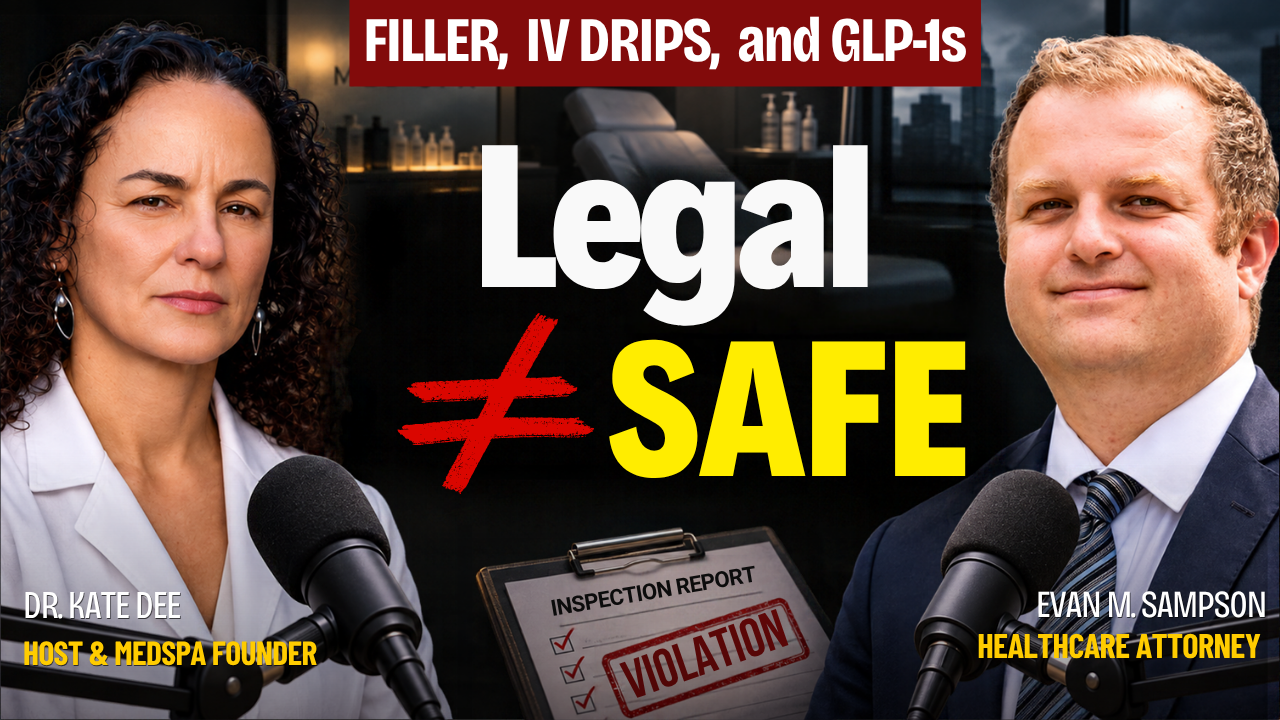
I recently sat down with Evan Sampson, a New Jersey healthcare attorney and the newest member of the Med Spa Board’s advisory board. We talked about a deadly case in the Bronx, a new law in New Jersey, and why so many people practicing in this industry don’t know the rules. The gap between legal and safe is wider than most people think.
Every Spa They Checked Had Violations
“Every single one of the spas or clinics that the auditors visited reported violations.”
— Evan Sampson, Med Spa Confidential podcast
Last December, New York City and New York State released a report after auditing spas and clinics across the five boroughs. Practicing without a license. Poor sanitation. Licenses not displayed.
As Evan sees it, the incentives to keep breaking the rules outweigh the penalties people expect. With cash-pay clinics and almost no inspections, nothing happens until someone gets hurt.
Evan explains what makes this case different from most enforcement stories. Owners, get your house in order now, before enforcement catches up.
Healthy People Don’t Need IVs
“Healthy people don’t need IVs, period.”
— Dr. Kate Dee, Med Spa Confidential podcast
A few weeks ago, a man was arrested in the Bronx after a young woman died, allegedly following an IV NAD infusion at his clinic. The case is still unfolding, and as far as I know, the medical examiner’s results aren’t out yet. He’s charged with practicing medicine without a license.
She was in her 20s and perfectly healthy. I doubt anyone told her this could kill her.
A friend of mine looked into adding IV treatments to her practice. During the training, she learned NAD infusions call for a crash cart because patients can crash. She decided not to offer IVs at all.
If you’re thinking about an IV drip, ask who prescribed it, who’s placing it, and what they’ll do if something goes wrong.
Legal Doesn’t Always Mean Safe
“Just because it might be legal doesn’t mean it’s safe, and just because you can perform a task doesn’t mean it’s legal to do that.”
— Dr. Kate Dee, Med Spa Confidential podcast
Non-dissolvable fillers are legal. Some states let unlicensed people inject under a medical director. The Med Spa Board won’t certify anyone doing either, because our panel of experts doesn’t consider them safe.
The consumer test is simple. If nobody explains a single possible complication before your treatment, walk away. Every medical procedure carries some risk, and you deserve to weigh it before you pay.
Providers, that consent conversation belongs to the person who prescribed the treatment, and it should be in your chart. I explain in the episode why lack of informed consent sits at the top of the lawsuit list.
Facebook Isn’t Your Lawyer
“A lot of people don’t go to medical school or nursing school to learn how to run a business or to read the laws.”
— Evan Sampson, Med Spa Confidential
I see posts almost every day asking a Facebook group for SOPs. Your SOPs should come from your medical director’s own medical knowledge.
Who can own a practice, who can prescribe, who can inject, and who can be delegated to are all separate questions. The answers change from state to state. Evan has a clear answer for where new owners should start, and it begins before you sign a lease.
Before Your Next Appointment
Some people breaking these rules don’t know better. Others know and gamble anyway. Either way, you’re the one in the chair.
Listen to the full episode for the team Evan says every new owner needs, why informed consent tops the lawsuit list, and why New York has a med spa on every corner despite its strict laws. Listen Now.
Listen to This Episode
The Transcript
Read the Transcript
[00:00:00] Dr. Kate Dee: If you're running a med spa and getting your legal advice from a Facebook group, you could be breaking the law without even knowing it. And here's the surprising part, even experienced physicians don't always know the rules. I'm Dr. Kate Dee, founder and medical director of Glow Medispa, and this is Med Spa Confidential, where we expose the risks, the red flags, and the outright illegal practices happening inside med spas because you deserve to know who's really treating you.
[00:00:26] Today, I'm joined by Evan Sampson, a New Jersey healthcare [00:00:30] attorney who specializes in med spa law, and recently joined the Med Spa Board's advisory board. We're looking at what happens in New York, New Jersey, and across the country as med spas grow faster than regulators can keep up. New Jersey just changed the rules for nurse practitioners, and you'll find out why some med spa owners suddenly needed a medical director.
[00:00:49] You'll learn the one conversation you should have before any treatment, and why paying upfront can make it harder to say no. You'll hear about a filler that's perfectly legal, but one I [00:01:00] refuse to use in my practice. And for med spa owners, Evan explains who you should call before opening your doors and why saving $50 today could cost you 5,000 down the road.
[00:01:11] Stay until the end because I ask Evan something that's been bothering me. New York has some of the strictest medical laws in the country, so why is there a med spa on every corner? His answer says a lot about who's really checking
[00:01:23] So Evan, thanks so much for being on the podcast today.
[00:01:27] Evan Sampson: It's my pleasure. I'm very happy to be here. before [00:01:30] we get started, I am required to make a little bit of a disclosure. lawyers are gonna lawyer, I guess. but this conversation does not create an attorney-client relationship, and this podcast does not constitute legal advice.
[00:01:42] Dr. Kate Dee: Absolutely. And it, it absolutely bears repeating that this podcast does not establish a doctor-patient relationship and doesn't constitute medical advice. but absolutely. I think it's very important that people understand, you know, this is a learning environment, and we're here to educate people.
[00:01:58] our audience [00:02:00] is, consists of people in the industry, providers, and actually attorneys and, and people in, like, you know, reps for companies and stuff, but also a lot of consumers. People are just really interested in medical aesthetics. and I think that what we talk about is so important so people make really good decisions about how to run their practice or how to choose a provider or how to figure out who's kosher and who's not.
[00:02:26] I think what I'd really love to do is start [00:02:30] out talking about what happened over this last y- this year in New Jersey, since you're in New Jersey. and there's a recent New York case I would love to talk about, too. so I did a recent podcast about this where, there's kind of a whole big kind of, hoopla about what happened with independent practice of nurse practitioners in New Jersey and how that affected the med spa world.
[00:02:53] So, do you wanna introduce that and just say, you know, summarize what, what happened and what's going on now?
[00:02:59] Evan Sampson: Absolutely. [00:03:00] So, this year, New Jersey joined the ranks of, of a number of other states, that are allowing, nurse practitioners to practice autonomously. so this would allow them to prescribe medication, in certain circumstances, right?would allow them to prescribe medication, without having a collaboration agreement with a physician.
[00:03:20] so this is brand New, to New Jersey. there are a few parameters. there's a certain amount of time period that the nurse practitioner needs to log before they can [00:03:30] graduate to that autonomous practice. and it-- the way the legislation is designed, it's really to hone in on, particular practice areas, where access has been an issue.
[00:03:40] So, it's geared, only to, primary care, and mental health. so, any nurse practitioner who thinks this law is gonna give them greater latitude to open up a med spa or operate in the aesthetics practice, is gonna be relying on, misinformation. so it's
[00:03:57] Dr. Kate Dee: My understanding is that [00:04:00] that law that just passed specifically excludes med spas and medical aesthetics.
[00:04:07] Evan Sampson: That's correct. Yes
[00:04:09] Dr. Kate Dee: So I think where, you know, people were really upset is that six years ago, during the COVID pandemic, there was an emergency order that allowed nurse practitioners to practice independently for the purposes of expanding, access to care during the pandemic. And my understanding [00:04:30] was that that was left as an emergency order for six years until this year. during that time, I think there were a number of nurse practitioners who did, go into medical aesthetics independently, using that emergency order as, you know, kind of the basis for their business. And I, I think that when the emergency order ended, which I think was January of this year, a lot of them suddenly found themselves needing to find a medical [00:05:00] director, and they had opened a business based on the emergency order, where all of a sudden they were now, you know, realizing they were not legally compliant.
[00:05:07] And, my, my, my thought on that was, you know, the original order was in order to expand access to primary care during COVID. It wasn't obviously to expand access to medical aesthetics. but it wasn't clear, I guess, right? So the new law is, is very clear. You know, med spas are out for independents, right?
[00:05:29] Evan Sampson: [00:05:30] Yeah. That, that's correct. I think the, the goal of the law is really to balance a few competing issues, right? I mean, increasing access for primary care and mental health is very important, for patients. There were a number of emergency actions taken in the wake of the, the COVID epidemic, and it's not only individual nurse practitioners who, took advantage may be the, the wrong way to characterize it, but entire industries have cropped up, right?
[00:05:55] Telehealth businesses, all sorts of, new areas of practice have popped [00:06:00] up relying on some of these emergency actions. and I think this law is an effort to strike a balance between greater access to medical care, and also protecting the public, right? you've discussed in the past, how, people with insufficient training, may, jump on some of these trends, right?
[00:06:21] purport themselves to be experts when they have a limited understanding, limited training on some of these practices. So, this law strikes a balance. I think [00:06:30] New Jersey had the benefit of also looking at some other states who have taken similar approaches. Florida immediately comes to mind as a state with a similar, scheme.
[00:06:39] hopefully it, it works out and we see the law working in the ways that the government hopes, right? Increasing access to some of these, practices and, closing the door on, on, inappropriate actions taken by people who lack specific training.
[00:06:53] Dr. Kate Dee: Well, my, my guess is that New Jersey specifically included language excluding [00:07:00] medical aesthetics because of Florida. So around the same time as the New York report that you,had mentioned when we were speaking earlier, and we can talk about that There was a report from Florida around the same time.
[00:07:12] So Florida had passed a similar law allowing independent practice specifically for primary care. And the study that came out earlier this year in Florida looked at all the independent practice NPs in Florida and what were they [00:07:30] practicing, and 60% of them were in medical aesthetics or in areas that were not meant to be covered by that law.
[00:07:39] So I think that law, I don't know intricacies about the Florida law, but I think that law was nebulous about that, and so didn't specifically say no to certain things, and I think that's possibly why New Jersey specifically said no in this case because they knew that that's what happened in Florida.
[00:07:58] and I don't know whether [00:08:00] there's any teeth in anything. So usually when politicians pass a law, they have to either spend money on enforcement or not, and most of the time they just assume a law's a law and people are supposed to follow it. But in the medical aesthetics industry, because people are cash pay and because there's no one inspecting, all these people just violate the law anyway, and because there's nobody inspecting and coming along and verifying that, you [00:08:30] know, yeah, they're legal to do what they're doing, nothing happens until someone is dead or, you know, very severely injured and there's a big you know, there's a big criminal case.
[00:08:40] and so I think that it'll be interesting to see what happens in New Jersey since that was very specific. but meanwhile, There are the existing laws and they're not obeying them. So we just see arrest after arrest of people who are pretending to be a nurse or a doctor and, and, really they just have an [00:09:00] esthetician license or whatever, or no license.
[00:09:03] that brings us to the case I just mentioned right before we got on the phone here on the, on the podcast here. I mentioned this recent case in, in New York that just happened a couple weeks ago. So, in that case, there was a, a man who has been arrested. His name is Luis Rojas Cabrera, and he, had a, had a clinic in the Bronx, and he administered IV NAD, which [00:09:30] is a very popular, you know, fad that is talked about by people like Joe Rogan and stuff.
[00:09:39] Is one, one of the many molecules people are like, "This is the best thing ever." And interestingly, so I'm, I'm not saying NAD is terrible. I've actually... You can take it as an oral supplement and, you know, but IV it can be quite dangerous, and I have a friend who is looking at adding or what it would take to add IV treatments.
[00:09:59] There's [00:10:00] no reliable way to know if a med spa is following safety standards or cutting corners, until now. The Med Spa Board certifies clinics that prove they're doing things right, verified products, licensed staff, and actual medical oversight. It's the difference between rolling the dice with your skin and knowing exactly who's holding the needle.
[00:10:20] If you're looking for aesthetic treatments, go to medspaboard.com to find a certified spa near you. And if you already have a med spa you love and [00:10:30] they're not certified yet, please send them our link. Med spa owners, getting certified does more than build patient trust. It should also save you a ton on your malpractice insurance.
[00:10:41] Do the right thing and go to medspaboard.com. Keep listening, keep asking questions, and stay safe out there.
[00:10:48] She doesn't do them. She decided not to because of the risks. But one of the things about NAD injection in particular is you need to have a crash cart 'cause people can crash and die. So she was like, the moment they were [00:11:00] talking about that in the lecture about doing this treatment, she's like, "Yeah, I don't wanna do anything that could potentially have that harmful outcome," right?
[00:11:08] so that's what happened to this lady. We-- They actually, I should say allegedly happened, because she did die, and as far as I know, the results of the medical examiner are not out yet that I've read. but this can happen with NAD infusion. So anyway, this guy, Mr. Cabrera, he did... He supposedly had a doctor's license in the Dominican [00:11:30] Republic, but not in America.
[00:11:32] and in New York, as far as I know, he had, like, a cosmetology license, and he was essentially practicing medicine without a license, and that's, I believe, what he's being charged with now. so all these, I should say, allegedly all these things, but right. So but those are what the charges are. And, and my, my question is, like, how common do you think this is where, you know, people are just practicing medicine because they know how to do a thing even though they don't have a license to [00:12:00] do it?
[00:12:01] and obviously this guy, maybe he didn't have a crash cart 'cause maybe he didn't know what he was doing. But, but either way, like, do you think this is really common? Do you... What do you think? What are you seeing in New Jersey or in the tri-state area in, in New York?
[00:12:13] Evan Sampson: it's a great question. unfortunately, it's very common. so using the New York City example, right? and a lot of times this case is interesting just because usually the regulators follow the trends after they've gotten out of hand or something bad happens. This is actually a case of the reverse, where the [00:12:30] regulators were really looking into the issue before someone died, and unfortunately, it didn't really create, you know, the right, system to prevent people from doing it.
[00:12:39] but New York City, along with New York State, issued a report after auditing a whole bunch of spas and clinics across the five boroughs. that report came out in December of last year. and every single one of the spas or clinics, that the auditors visited, reported violations. [00:13:00] Some level of violations, right?
[00:13:02] Practicing without a license, poor sanitary conditions, failing to display licenses. There was some level of violation. and it's pretty rare that you see anything, happen where, it's 100%, right? Where someone is failing something 100%. So what that report indicates, and unfortunately what this more, most recent, incident illustrates, is that this stuff is in- [00:13:30] incredibly common, that, that whatever incentives there are to continue to do that far outweigh what people feel are the penalties.
[00:13:37] and it'll continue to happen until those things, you know, meet and balance. so it's very, very important that the regulators act appropriately, act timely, and create the right schemes to prevent this stuff from happening.
[00:13:51] Dr. Kate Dee: I, I totally agree. I think that, that, you know, the people who learn a skill or they think they have a skill, [00:14:00] and then they wanna make money from that skill. Like, "Hey, I learned a skill." Like anything else, right? they wanna make money from it, and so they open a business. They don't even... So sometimes they know they need to have a license, and they just don't have it, and they say, "Oh, well, that's too hard," or, "I, I don't have time for that," or, or, "I don't even have the ability to do that."
[00:14:19] and or, they have no idea, and they learn a skill and they're like, "Oh, I'm gonna start doing it." I mean, let's compare it to cutting hair, 'cause I know that sounds ridiculous, but in [00:14:30] fact you need a, a license, a cosmetology license to cut hair. You have to go to beauty school and whatever and, and get your, your license for that.
[00:14:39] You can't just open a, a business cutting hair, even though you can learn to cut someone's hair, your friend, you know, and do it in your kitchen. That's not legal, okay? So that's so simple because, you know, well, I guess you could sp- spread lice and you could be unsanitary, but the risks we're talking about in medical aesthetics are so many orders of [00:15:00] magnitude greater than that, because just because you know how to do a certain thing doesn't mean you know how that will affect the patient.
[00:15:07] Let's say they have preexisting kidney disease that you don't know anything about and you're not a doctor, and the thing you're gonna do is gonna flood their kidneys with something that might put them into renal failure. there are all these people with IV bars, operating IV bars, where they could literally put someone into renal failure, they don't know.
[00:15:25] Or they could kill somebody because, you know, they put in too much potassium in the [00:15:30] IV and that stopped their heart and they're dead now. Or they put NAD and they didn't have a crash cart, and they didn't even know that could happen, and so they kill somebody. So it's such a bigger deal than spreading lice, as much as...
[00:15:42] Lice is terrible, so don't get me wrong. You have little kids, right? I mean, I lived through, oh, God, I think one really, really horrendous episode. So I'm not saying, I'm not poo-pooing lice. Lice is terrible. But I'm just saying, you're not gonna kill anyone by spreading lice. So I just think that this is such a big deal, and I [00:16:00] just, People's lack of awareness of what, why they need a license to practice medicine, or even that it is the practice of medicine. So, so that, that brings me to this question is do... What do you think? Do you think that, most of the violations are people who knew that they were violating the law or people who didn't know?
[00:16:21] That... Or have you encountered people coming to you wanting to set something up for their business who genuinely didn't know they needed to [00:16:30] obey various laws in practicing medicine?
[00:16:32] Evan Sampson: Absolutely. I mean, it really does range, right? I mean, there are experienced physicians, practitioners it may be impossible, but some of them don't know every rule, every law. some of these rules have been on the books for years, are enforced. there's an explanation, "Oh, so and so on Facebook told me I didn't need to," or something like that, right?
[00:16:56] So, you can have really experienced people say, [00:17:00] "I didn't know about that. I wasn't sure." And to be honest, right, a lot of people don't go to medical school or nursing school to learn how to run a business or to, read the laws or, to understand how payroll systems work or IT systems work, or, what insurance policies you need, right?
[00:17:20] All the aspects of, of running a practice. what they do is they learn to be clinicians, right? And, and hopefully they rely on people like me to educate [00:17:30] them on what the law says or what the law is. but, I can certainly understand that if you weren't told, "Hey, you gotta talk to a lawyer about this," or, they don't even understand what the risk is, right?
[00:17:41] They may not even think to ask someone like me. so there are certainly experienced people, physicians who don't know every aspect of this stuff. then there's sort of the more extreme example, right? The, the matter we just talked about in New York, where people who are unlicensed, who don't,who don't...
[00:17:59] have an [00:18:00] unlicensed facility, who are able to get their hands on, pharmaceutical products that ch- generally aren't sold to people who aren't licensed, right? They're either ordered from overseas or they're, obtained from illicit compounded pharmacies or whatever, right? I think those people probably know they're breaking the rules, right?
[00:18:19] and, and even patients, right, might be interested in pursuing those kind of treatments, knowing that it might not be appropriate because they see it as a cost [00:18:30] savings. my hope would be to educate those patients, right? Because if they're educated, they know that there are risks involved, they might not be so willing to take that chance.
[00:18:38] So I think education from both the provider side and the patient side is crucial to s- eliminate any chances of, of some of these, risks, serious injuries. hopefully we can, you know, eliminate that from the, the aesthetics world, right? Even if it's unlicensed practice.
[00:18:55] Dr. Kate Dee: It's interesting to think that somebody would grow up in this [00:19:00] country and not know they needed a license for various things. But it's not surprising to me when people come from, you know, if they have a different culture and they grew up somewhere else and, and they think, "Oh, well, this is how we do it," and don't even look into that.
[00:19:14] I can understand that. I kinda wonder whether, this Mr. or Dr. Cabrera, don't even know whether to call him that. If, I mean, he was a doctor potentially in another country, um, so I don't wanna be disrespectful, but it's possible that he didn't know he was breaking the [00:19:30] law. any, you know, a lot of these molecules, because they're not legal anyway, and millions of people are using them.
[00:19:36] So I mean, all these peptides that are very popular,they're all being used essentially in the gray market. most MDs are not using these or prescribing them because they know that legally you could lose your license if something goes wrong. So for instance, like if this had been a real doctor in New York with an MD license in New [00:20:00] York, and they administered NAD, and didn't have a crash cart they would be sued for malpractice. They'd lose their license potentially because that's not good practice. That's not standard of care. NAD is not standard of care. So real MDs would not risk their doctor's license to do that. A few might,
[00:20:18] I mean, if you, if you really were knowledgeable, you'd have to talk to the patient all about the risks of this, and we're doing this, and this isn't FDA approved, and blah, blah, blah, and here's my crash cart, and if something goes wrong, I will... You know, but so you'd have to go [00:20:30] through all of that. But if you don't have a license to lose, then there's less at stake.
[00:20:35] Although, I don't know. I wonder if this, Luis Cabrera he knew he could kill someone. I wonder if he knew he could go to jail. I don't, I don't know those things. I think it'd be, it's gonna be interesting to see this case unfold, honestly. and there are more and more of these cases.
[00:20:48] There are so many cases of recent arrests in the last year, year and a half, of people practicing medicine illegally, and they're all at various stages. the famous Jennifer Cleveland case in Texas, I have not [00:21:00] seen an update of that either. But both the unlicensed person who killed her and the medical doctor who was the absent medical director, they're both being charged with murder, among other things.
[00:21:12] So it'll be really interesting to see what happens. Do, you know, does that get pled down? We have no idea what's gonna happen with that. what I'm trying to do, hopefully on this podcast is not just- educate providers, but any consumers who wanna go, who, who are really into this stuff, give them enough [00:21:30] education to make informed decisions, because it's not my opinion that I should somehow try to stop everybody from going to these illegal places.
[00:21:39] I just want people to know what the risks are. I bet that poor woman who died in the Bronx a few weeks ago didn't know that this could kill her. She was in her 20s, she was a model, she was beautiful. She was perfectly healthy, and didn't need any IV injection. I think that's one of the things I object to most about IV clinics is that, you know, [00:22:00] healthy people don't need IVs, period.
[00:22:01] You don't need them. And Joe Rogan going on and having his soapbox, talking about how great it feels and how, you know, a boo- you just feel great, well, getting millions of people to want NAD, knowing that there's a risk there.I don't even know what the risk is of dying of NAD, but if a million people get NAD because Joe Rogan said to go do it, and a few people die, I think that that's, you know, that's on him.
[00:22:27] You know what I mean? He If he's talking about touting these [00:22:30] amazing treatments, he should also talk about, "Hey, make sure you go to a, someone who knows that they're not gonna kill you by doing this," you know?
[00:22:37] Evan Sampson: I think that makes sense. And, there's a very important legal doctrine, right? The necessity of informed consent, right? That's part of the standard of care, right? That every patient, no matter what the treatment is, and again, depends on state law, but best practice, no matter what the treatment is, they're informed of the risks and benefits of the procedure, the prognosis, alternatives, what happens if they don't move forward with [00:23:00] the treatment.
[00:23:00] and they have the right to make those decisions themselves. if a patient is going to an unlicensed practitioner, right? If they're getting a treatment, they, they may not be receiving that informed consent, right? They can't make an informed decision. They can't decide whether they're ready to move forward with the risks.
[00:23:17] So, that's one of the reasons why, why these laws exist. That's why these rules exist. And informed consent's a doctrine that goes back hundreds of years. so that's why it's important to stay within the lines of the law.
[00:23:29] Dr. Kate Dee: [00:23:30] And, people should know that of the lawsuits in medical aesthetics, the number one lawsuit relates to a lack of informed consent.
[00:23:41] so I just wanna make sure that people understand, like, if you're a consumer and walking into a place and they don't explain to you not one negative thing that could happen, one complication of the procedure you're about to have, then walk away because there are always the [00:24:00] possibility, there's always a possibility of having some kind of complication from every single medical procedure, and you need to know what those are in order to decide whether it is worth the risk to you today and it's worth the money to you today, knowing the things that could happen.
[00:24:16] And, and that is mandatory for all medical procedures, and the number one thing that's left out. So, you know, I, I've had so many patients walk into my place wanting filler or coming in for filler, and we are the first [00:24:30] place to inform them about the possibility of a vascular occlusion and what that is, how we treat it, what, that we're prepared to treat it.
[00:24:38] And people who've had filler many, many times are like, "Well, you're-- I've never heard of that." It's like, well, that is actually, to me that's malpractice. So if, if anything bad were to happen and there's no informed consent, that's your license right there. You, you're, it, you know, that's irresponsible.
[00:24:54] And I do think that one of the problems with having people who don't, who are not really properly licensed is that they [00:25:00] also don't know anything about informed consent. That's not a thing. We learned about it in med school. I'm sure nurses learning about it, learn about it in nursing school and, and it's really critical.
[00:25:09] And so someone who's unlicensed doesn't even know what that even means and what, what's supposed to be in it. And I think a lot of people, so if you're a practitioner out there, this is really important It is supposed to be a conversation between the doctor and the patient about the conduct, risks, benefits, alternatives to the [00:25:30] procedure, and also what happens if I do nothing.
[00:25:32] And the patient has to have a legitimate opportunity to say, "No, I don't want this today." And it's supposed to be between the patient and the prescribing person, not the technician or the person delegated to carry out the treatment. It's supposed to be with the person who prescribed it. Now, that conversation needs to happen.
[00:25:51] It could be that the practitioner who comes in to do the treatment says, "Hey, you know, do you have any questions after you spoke to Dr. Dee about the [00:26:00] procedure?" And the patient can say, "No, I'm good. Let's go." And they can sign it there. That's fine. But it's supposed to be that conversation. And that is the number one thing missing in med spas, in America.
[00:26:12] So I think that's super important from both sides. Whoever's out there listening to this, make sure you have proper informed consent. does that sound right to you?
[00:26:20] Evan Sampson: That sounds perfect to me. Um,
[00:26:23] I always tell my clients, you wanna notate the verbal conversation in your chart, get it in writing as [00:26:30] well, and always document informed refusal, which is important for other reasons. so that's usually what I tell my clients. You probably said it way better than I do, Yeah.
[00:26:39] Dr. Kate Dee: in f- refusal is very important in the regular medical world where you're recommending, say, you know, heart surgery to save their life, and they're like, "No, Doc, I'm not gonna do that," you know, and you want them to make an informed decision about not having this life-saving thing because if they go out and have a heart attack [00:27:00] and die, they can't blame you for not doing, not recommending the heart surgery , right?
[00:27:04] in general, in aesthetics, nothing we do is mandatory, nothing. So it's all about, is this worth it to you today? And I, I can tell you many people who've had a vascular occlusion where they're missing half their face, it wasn't worth it to them, and no one explained that that was possible. And the w- the one woman I've had on my podcast who talked about that, she had a filler that was non-dissolvable, and, and she would [00:27:30] never have agreed to that had she known that it was possible to get this and not be able to treat it. and I am also like, I'll tell everybody out there, "No non-dissolvable fillers." And on the, in the MedSpa Board, we won't certify anyone who's using non-dissolvable fillers 'cause occlusion's not treatable, and so we just won't.We have a panel of experts who all agree, no non-dissolvable fillers.
[00:27:49] So they're out there, they're legal, but we won't. We, we, we're just like, "No, don't do that." And, and I think that that's really important also to have national standards [00:28:00] where, yes, this thing might be legal either in all states or in that state, but we won't certify that 'cause we don't think that it's medically right or ethical or safe.
[00:28:10] so we also have a policy about, non-licensed people or aestheticians injecting. There are some states that allow unlicensed people to inject with a medical director. We won't certify anybody who, who operates that way 'cause we do not feel that's medically safe. So just because it might be legal doesn't mean it's [00:28:30] safe, and just because you can perform a task doesn't mean it's legal to do that, so it goes both, both directions.
[00:28:39] And I think that's why it's important to have both lawyers and medical experts on the MedSpa Board of Advising, because we wanna make sure that we have the best of all worlds. Inherently, in every medical procedure, there's risk, and that's just part of medicine, and I think that that's so [00:29:00] important. So the people who care most about mitigating that risk, meaning try to eliminate it as much as humanly possible, are, of course, the lawyers and the doctors 'cause we're like, that's our, that's what we do for a living is we're worst case scenario people, right?
[00:29:14] We wanna make sure the worst case scenario is minimized in all possible worlds, whether that's legally or medically, right?
[00:29:22] Evan Sampson: I think that makes perfect sense. And lawyers and doctors are gonna come at whatever the, the risk is from different angles. [00:29:30] so I, I would never, ever profess to be an expert on clinical risk. Never. Not my area of expertise. But I can also, I can tell you the difference between potential criminal action and what a, you know, a board action, right, from a medical board action might look like.
[00:29:47] so that's, that's sort of where I counsel my clients. But, I can tell you what the law says on what the elements of an informed consent are, just for an example. But for a specific profet- procedure, I... totally outside my league. [00:30:00] So I love working with, clinical experts on this stuff, and, I love getting their insights.
[00:30:05] but definitely, I'm happy to step into the legal realm, when I can and in trying to keep my clients safe.
[00:30:11] Dr. Kate Dee: Yeah. Well, I think let's, let's talk a little bit about that, too. So can you just summarize, what a healthcare attorney does to help their clients set up their business, run their business safely and legally? Because I think that is [00:30:30] something, it's when, when an, when somebody newly learns, medical aesthetics, whether they're licensed to do it or not, and someone says, "Oh, you really should run that by a healthcare attorney," you know.
[00:30:41] what I see on social media is people going, "Okay, that's too expensive. Let me just ask a Facebook group. What do you guys do for SOPs?" And which, I can't tell you, I see a, a post like that almost every day, and it makes me laugh out loud because [00:31:00] if, if you don't know the answer to that, you don't know enough to run a medical practice.
[00:31:04] Because the SOP comes from the doctor or the medical director, whoev- whoever's running the practice. It's their practice and, and, that comes from their medical knowledge, right? But they don't wanna consult a lawyer because they're like, "Well, I don't have money for that, so I'm gonna consult Facebook."
[00:31:21] So tell me, tell me why they cons- should consult a lawyer instead.
[00:31:26] Evan Sampson: Yeah. So, it's a really great question. there are a ton of [00:31:30] healthcare regulations at both the federal and state level which govern opening up a medical practice, or a facility, potentially. and there's also ethical guidance from medical boards, trade associations that govern as well.
[00:31:47] so there's a very complex web of laws that apply. usually, when I first meet a client, they might be o- thinking of opening up a practice, right? Let's say a med spa, they wanna open up a med spa. Well, [00:32:00] there are laws in place that govern who can own a med spa. So if it's a nurse or a PA, or even an aesthetician who wants to open up a med spa, I said, "Well, you know, in a lot of states there's this thing called the corporate practice of medicine doctrine, which you may or may not be aware of," and, and talk about a boring subject, right?
[00:32:17] The corporate practice of medicine doctrine. But, most states have it, many states have it, and it requires that a medical practice, which is gonna be providing medical treatment to patients, be owned by a physician. so, that [00:32:30] might be the first question. when it comes to, to medical aesthetics practices specifically, scope of practice issues, which we've touched on already, come up all the time, right?
[00:32:40] That's a major area of my focus whenever I'm counseling a medical aesthetics practice. So, I tend to break it up into, like, four areas. And the, the big question is: Who's allowed to do what, right? What license or what certification do you need to do what? So, it tends to be prescribing, right? So a physician [00:33:00] obviously can prescribe medication, and depending on the state, right, a nurse practitioner or a PA might be able to prescribe medication, without having a collaboration agreement with a physician.
[00:33:11] it comes to, dispensing medication, right? New York and New Jersey are very strict. only pharmacies generally, with a few exceptions, can only dispense medication. most states, I think medical practices are allowed to dispense medication. but that's an issue that comes up all the time.
[00:33:27] And when we talk about issues like [00:33:30] peptides and GLP-1s, that's becoming a much more hot button issue. compounding, right? Who's allowed to compound? Is a medical practice allowed to compound, right? is a f- you know, what licensure does a compounding pharmacy need if you're buying your, products from a compounding pharmacy?
[00:33:46] Who's allowed to do that? and, the other question that comes up, which we've already touched on, is who's allowed to administer medication, right? Is an aesthetician allowed to stick you with a needle and administer IV, like an IV [00:34:00] drip? it's a question that comes up a lot. who's allowed to do laser hair removal, right?
[00:34:05] can an esthetician do laser hair removal? so these are the kind of questions that come up all the time that I often have to counsel my, my clients on.
[00:34:13] Dr. Kate Dee: And, and just to interject, th- those specific answers are different for every state. And, and interestingly, weirdly different too. Like certain states, I think it's New Jersey, and I don't know if this is still the case or it was very recent, only a [00:34:30] physician could fire a laser. But, but I think that changed recently.
[00:34:34] I don't really know. I'm not in New Jersey, so... But there was this discussion about how for laser hair removal you c- you couldn't delegate that, and I don't actually know if that's still true
[00:34:45] Evan Sampson: And there are a few board of medicine, there are a few people who are performing, laser hair removal, like a few day spas. and they, you know, they held that laser hair removal is a medical practice. but yeah, some states have really [00:35:00] weird rules. microneedling is, is always a challenge figuring out who's allowed to do microneedling.
[00:35:05] That can differ vastly between state laws. But, yeah, it's, it's very dependent on state law and having sort of a, a, a national resource of what best practice is for some of these things, I think is, is a fantastic goal.
[00:35:19] Dr. Kate Dee: we are trying. So you and I, and other people are trying to compile that in the MedSpa Board. So, you know, we are, very different from any other organization. We are [00:35:30] literally trying to put things out there for easy access for people to be legally compliant in the med spa world. And, so yes, that's one of my goals.
[00:35:40] one of my asks from my lawyer friends is to try to compile basic guidelines. it's almost impossible because there are 50 states, obviously, and they are constantly changing. So there's a nursing board, a medical board, and a cosmetology board, and a pharmacy board, all of which are issuing opinions and statements, [00:36:00] basically constantly.
[00:36:01] So it's a moving target to try to write something down. The moment you write everything down, something has changed, which is one of the many reasons why I think that having a relationship with a healthcare attorney is so critical. Because when something does change or, if there's a very specific question like, "Can I do this?
[00:36:19] I'm about to hire an RN, can I X, Y, Z?" they can answer that for you because you are not, as a layperson, if you are not a lawyer... I'm just telling you, [00:36:30] I am a layperson. I am not a lawyer. I try to figure these things out all the time, and Claude is not gonna answer it properly. So it's-- I would-- Claude's useful for a lot of things.
[00:36:40] And I do think Claude's useful for, like, if you upload a legal document, it can kind of summarize what it says in lay language so that a layperson can understand it, 'cause legal documents are so filled with legal jargon. but I don't think that it is really good at going to-- trying to read state laws and tell you what they say.
[00:36:57] You really need a lawyer to help you with that. and [00:37:00] to stay out of hot water, to prevent getting in hot water. It's so important. And, I know my healthcare attorney would always say, you know It's really worth-- Like you're saving, you know, $50 today that's gonna cost you $5,000 down the line, and it's really an important upfront investment in your attorney relationship.
[00:37:22] I will say, though, a little plug for the legal compliance courses on the MedSpa Board. If you don't know where to start [00:37:30] and you're just not sure, that's a really great, very inexpensive way to start. Like, get the lay of the land, before jumping into opening a business or hiring an attorney. You can at least hone in what the questions you o- you have for your attorney and then hire the attorney, and it'll probably be less costly, because for less than one hour of time of attorney time you can read about or learn about all the laws and, and stuff.
[00:37:54] But anyway, so yeah, we do have those compliance courses and the, the, the one is worth four credits [00:38:00] whether you're a nurse or a PA or a doctor, so that's kinda handy, too. A really cheap CME. but yeah, I think that actually, Having those courses, I'm hoping supports healthcare attorneys like you where, you know, rather than you taking a lot...
[00:38:15] I'm imagining you're a very busy lawyer, rather than you taking the time to educate, your clients with four hours worth of knowledge, you can say, "All right. If you really want to... I mean, you can pay me to teach you this, or you can take that and come back and then we can move [00:38:30] forward with the various items on your, on your agenda."
[00:38:32] Like, I think that hopefully will help you guys. I know that Courtney Walker is another attorney who, who is working with us on the MedSpa board. She, she's like, "Oh, that'd be great 'cause I don't have time to go through that with every client." So okay, good. Well, I, I look forward to working with you to try to get something that's really helpful for people so we have that out there.
[00:38:53] and to help both, both people on the consumer side and, and people in the industry who are really trying to [00:39:00] do this right. I think there are a lot of people who really do wanna do it right, and it can be incredibly confusing because I mean, literally 50 states are all different. I imagine there's probably some things that are legal in New York that are not legal in New Jersey, and vice versa.
[00:39:15] So, and, you know, you're right there. It's like, And so, you know, a lot of people open up a clinic in the neighboring state. They- especially if they live really near the state line. and the laws are very different. We just certified a, a practice that [00:39:30] was primarily in Massachusetts, but she has a little satellite clinic in New Hampshire and, and when I talked to her, we just, we had a conversation about how New, w- one of those st- I think it was Massachusetts actually requires a certain kind of cosmetology license for certain things where New Hampshire doesn't.
[00:39:46] and so I'm like, "You know, just make sure you know about that and run that by your healthcare attorney." And I think that's, that's super important. so if, if you had a new, med spa owner or would-be med spa owner coming to you [00:40:00] today and saying, "Where should I start?" what would you, what are, like, maybe the top things you would recommend for them to start with today, before they open?
[00:40:10] Evan Sampson: I mean, usually my first recommendation is like, get a good team around you, right? So I can absolutely help you with the legal part, but you're gonna want an insurance broker, right? You're, you're gonna be providing medical services, so that insurance broker should be able to get you malpractice insurance, general liability insurance, cyber [00:40:30] insurance, right?
[00:40:30] Everything's online now, so talk to an insurance broker. if they get... Call me and they say, you know, "We're looking to open up a med spa." and I ask, "All right, great. Where are you located?" and they say, "Well, we haven't found a place yet." You probably wanna talk to a real estate broker. somebody-- I always recommend going with a healthcare-specific real estate broker because they're gonna understand the needs, right?
[00:40:56] they're gonna understand, what, what rules apply [00:41:00] specifically to, healthcare practices that might include, specific zoning requirements, workplace safety requirements. So talk to a, a healthcare-specific real estate broker. and I would say make sure you have your clinical ducks in a row, right?
[00:41:15] So, if this is your first business, you're not exactly, Maybe you know about informed consent, you know about, patient privacy laws, but you've never had to really manage that on a regular basis. Talk to someone like [00:41:30] the Med Spa Board, Dr. Kate Dee. she knows the clinical side inside and out.
[00:41:34] She knows how to run a practice. and that's usually the first thing I recommend is get that team around you, people who know exactly what they're doing. They've helped out people before, and they can make sure you start out with success. I mean, that's usually the first thing I tell them.
[00:41:49] Dr. Kate Dee: Yeah. And then talk to Evan or a healthcare attorney about what corporate structure, so who can own a medical practice. clinical practice and licensure, who [00:42:00] can provide the treatments, and delegation, who can be delegated to, right? those are all different things. And in medicine, we think if you're in the medical world already and you work at a hospital and you wanna go out, you've as- you know, wanna go out and inject Botox, those separate things as separate laws are like, wait, what?
[00:42:22] So who can own it versus who can do it, who- versus who can delegate it versus who can be delegated to.
[00:42:28] Evan Sampson: Yeah.
[00:42:28] Dr. Kate Dee: I mean, that's all [00:42:30] different and, and also can be quite different state to state. and then also knowing your local medical board. I th- I think that, Are you able... So I'm assuming that you, know your local medical board positions at any given time, so you're able to, provide advice to your clients about that, because I think that also can be quite confusing.
[00:42:51] Yes.
[00:42:52] I
[00:42:53] Evan Sampson: I usually, especially from if someone's moving across state lines, give them the understanding. New York and [00:43:00] New Jersey in all things healthcare are notoriously strict. Pennsylvania, which I also practice in, is, is fairly strict too. but New York and New Jersey have reputations as being strict.
[00:43:11] some states are not like that. Yeah.
[00:43:14] Dr. Kate Dee: So in New York City, where I grew up, I have not lived there in a very long time, but my daughter lives there, going to NYU right now, there is a med spa on every corner. So tell me, if New York is so strict, why are med spas more common than Starbucks in New York City? Or is that too [00:43:30] tough a question?
[00:43:31] Evan Sampson: I mean, I think it probably is not necessarily a legal question. It's probably like an economic question. I mean, I think I've been practicing in aesthetics for years, going back before COVID, and I've just seen the whole practice explode, right? since COVID. So I think there's clearly a demand for it, which is driving a lot of the growth.
[00:43:49] And like I mentioned before, usually the regulators have to catch up. so there's a ton of gaps in the law on this practice. I have to represent clients all the time, [00:44:00] and often you know, what I say to them is like, "This was never contemplated," right? that comes up a lot of time with compounding.
[00:44:07] it immediately comes to mind because that's an issue where it often comes up when I'm counseling clients. like the idea of, compounded drugs. Like there's been compound pharmacies for decades, and there's been rules that apply to compounding pharmacies. but the idea that so many medical practices would explore getting compounded products, explore the idea of compounding themselves, legislators [00:44:30] never thought about it before.
[00:44:30] Medical boards and pharmacy boards never thought about it before, so the rules just aren't on the books. So, the regulators are still catching up and, sometimes they're trying to enforce rules that don't exist yet. But trying to make sure that clients understand what risks are present, and how to best protect themselves is a key part of my job.
[00:44:47] Dr. Kate Dee: Yeah. I mean, I, I think that the compounding thing is interesting because, before GLP-1s, there really were not drugs that people would clamor for [00:45:00] and pay out of pocket for. So there wasn't an economic incentive to provide that. And, and now there is, especially because those drugs were only approved for diabetes and massive obesity.
[00:45:15] so the vast majority of people who are using these drugs don't meet the criteria for using it, on label. And so all these people wanna lose weight. There have been l- weight loss clinics from the beginning of time, but now we have a drug that, [00:45:30] like, is sort of a miracle drug for that. So, so there's this incentive, this financial health, I would say, a health benefit incentive, a financial incentive, and law- the law's sort of in the way.
[00:45:42] So people are like, "Well, the heck with the law," and then they're going around it. and unfortunately, you know, you can get in big trouble for that, either lose your license or, be sued or, have Eli Lilly sue you. so you know, and they have deep pockets, so you don't wanna be on the other side of that.
[00:45:58] So it's really important to [00:46:00] stay on the right side of the law with, with compounding as well, even though, like, that has almost become, you know, ordinary... You know, it's like speeding. People are just violating it and, eh, well, I'll live with the consequences. so yeah. I so appreciate all of your input today and, and into the future.
[00:46:22] I really look forward to working with you. And, for everybody out there, Evan Sampson, if you're in the tri-state [00:46:30] area, he's at Post & Schell in Mount Laurel, New Jersey. And, and we are working on compiling a list of healthcare attorneys who specialize in medspa law so that that will be available.
[00:46:42] it is still, relatively short. I think I have five or six attorneys on there so far. We're trying to get people who hopefully cover all of the states. So if you're a healthcare attorney listening to this, send me a note. And, and Evan, I look forward to working with you. Thanks so much for being on the podcast today.
[00:46:58] Evan Sampson: Thank you. It's my pleasure, and [00:47:00] thank you so much for having me
[00:47:01] Dr. Kate Dee: Thanks for listening. If this episode opened your eyes to something you didn't know before, share it with someone who needs to hear it. Subscribe so you don't miss the next one, and drop a comment telling me your biggest takeaway. I actually read them all. Join me on this mission to keep you safe and push this industry to do better.