
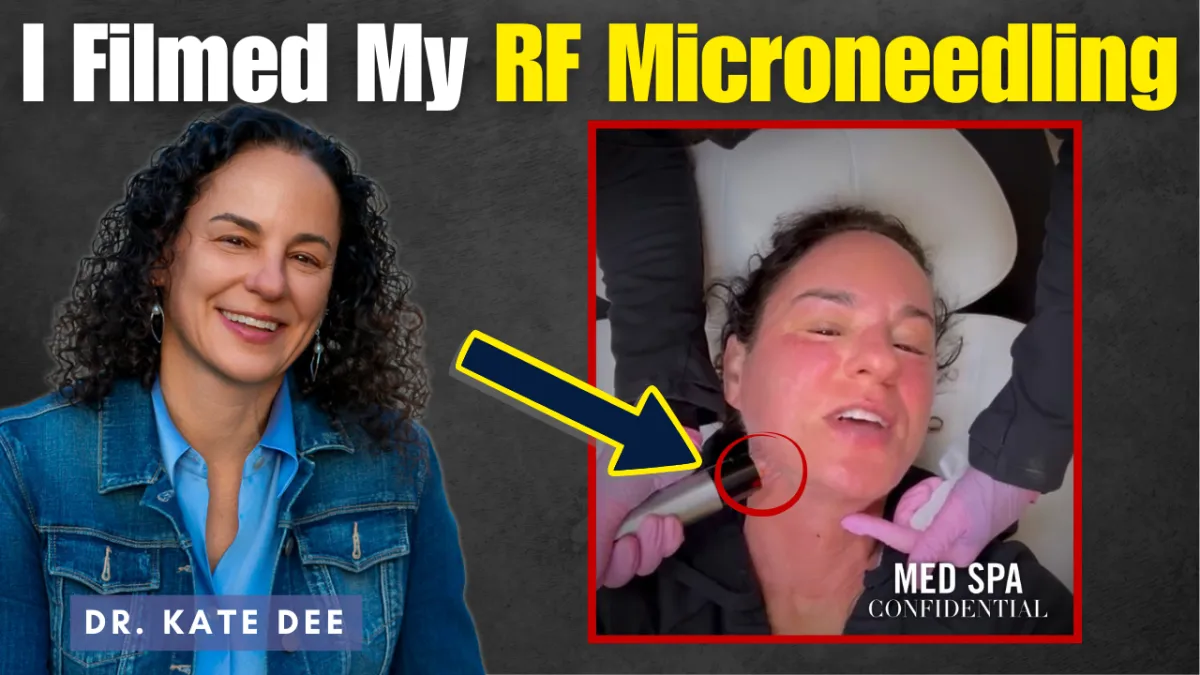
I Filmed My Entire RF Microneedling Treatment (Here's What They Don't Show You)
I Filmed My Entire RF Microneedling Treatment (Here's What They Don't Show You)
(This article is inspired by the insights and discussions presented in [episode title and link] of MedSpa Mayhem, Dr. Kate Dee)
The 3 Questions You Should Ask Before Any RF Microneedling Treatment
I've been doing RF microneedling for eight years, and I still get asked the same thing: does it really work, and is it worth the downtime?
So I decided to film my entire treatment from start to finish. No filters, no editing out the swelling, no skipping the parts where my face looks like a pumpkin.
You're going to see the numbing process, the actual procedure, and what recovery looks like when you're not trying to sell something. Here's what I learned after documenting every uncomfortable, swollen, honest moment.
When Numbing Makes All the Difference
"This procedure is really painful if you're not numb. Make sure you're going to an actual medical provider who can provide real medical-grade, very concentrated anesthetic." — Dr. Kate Dee, Med Spa Confidential
Not every medspa can legally access the topical anesthetic that makes RF microneedling tolerable. If your provider isn't a physician, nurse practitioner, or physician assistant, they can't get the 23% lidocaine and 7% tetracaine compound I use. And trust me, you need it.
I numb for 75 minutes, rub in more halfway through, and still feel some discomfort during treatment. Places cutting corners on numbing are setting you up for a painful experience you won't forget.
I've tried different anesthetics over the years, and they don't all absorb the same way. Even if two compounds have identical percentages, one might work beautifully while another leaves you gritting your teeth. That's the difference between a provider who's done thousands of treatments and someone who bought a device last month.
Why Your Device Choice Actually Matters
"There are quite a number of lawsuits from uninsulated needles. Most modern devices use insulated needles, but their mechanisms are different." — Dr. Kate Dee, Med Spa Confidential
Not all RF microneedling devices are created equal, and some have caused enough problems to end up in court. I chose the Genius device because it uses insulated needles that deliver energy evenly across all 49 needle tips. Some older devices use uninsulated needles that create excessive damage and higher risk.
Others deliver energy unevenly, stronger around the edges and weaker in the center. That inconsistency shows up in your results.
The motor matters too. Precise depth control means you're not going too deep and killing fat cells or too shallow and damaging the epidermis in ways that extend your recovery. I've seen patients from other practices dealing with fat loss and scarring because their provider either used an outdated device or didn't know how to adjust settings properly.
If your provider can't explain why they chose their specific device and what makes it safer than alternatives, that's your first red flag.
What Eight Years of Results Actually Look Like
I just got back from vacation where strangers in their fifties guessed my age way younger than 58. That didn't happen by accident. It happened because I've been consistent with maintenance every six months and I understand what realistic expectations look like.
Your best results show up six months after your last treatment. The change is slow. You won't notice it week to week, but compare a photo from before your series to six months after your final session and you'll see the difference.
I tell patients to expect one treatment per decade of life they've lived for their initial series, then maintenance every six months to keep fibroblasts awake and making collagen.
The downtime gets easier with each treatment. My first procedure had five days of recovery. My most recent one left me barely pink the next morning.
Before Your Next Appointment
If you're considering RF microneedling, you deserve to know what safe treatment actually looks like. Not the Instagram version, the real version with swelling and specific protocols that prevent complications.
Watch or listen to this episode to see my complete treatment, the cost, hear the three questions that expose dangerous providers, and learn what answers should make you walk away.
Episode Transcripts:
[00:00:00] Dr. Kate Dee: What if looking like a pumpkin for three days meant bitter skin for the next year? A few weeks ago, I filmed my entire RF microneedling and laser resurfacing procedure from start to finish. I'm gonna show you the numbing process, what the treatment actually feels like, and what my recovery looked like.
[00:00:17] Dr. Kate Dee: Stay tuned until the end, and I'll break down the cost and how often you should do this, and the questions you need to ask before booking, before we jump in. RF microneedling uses tiny needles that deliver radiofrequency [00:00:30] energy deep into your dermis to trigger collagen production and also elastin. I paired it with Laser MD Ultra for texture and pigmentation.
[00:00:39] Dr. Kate Dee: you're gonna see the entire experience. Unfiltered, the numbing, the treatment, the swelling, all of it. Please consider sharing this episode with anyone you know that's interested in RF
[00:00:50] Dr. Kate Dee: microneedling.
[00:00:50] Dr. Kate Dee: so it's super early. I've already had a little bit of breakfast, which is unusual for me, but, I don't wanna go through this, without any, food on board. So [00:01:00] that's really important. I'm also wearing loose clothing. I have like these v-neck, on, because I'm gonna do my whole face and then my neck.
[00:01:07] Dr. Kate Dee: And we generally go down to the clavicles. Not an advertisement for Brandy, but I do love her music. I'm gonna pause now and grab the anesthetic
it's now about an hour and 15 minutes before my procedure, and I am just applying, topical anesthetic to my skin. it's mostly on there already. I realized I couldn't do this in front of a camera, so I had to do it in front of a mirror. this is 23 7, so this [00:01:30] is 23% lidocaine, 7% tetracaine.
[00:01:33] Dr. Kate Dee: And, Anesthetics are not all the same. So first of all, to do this procedure, you really need a very, very powerful topical anesthetic that most places don't have. So any place that doesn't have a doctor can't get it, number one. But number two, they're not all the same. Even if you get a 23 7 from somewhere else, they don't all absorb into the skin at the same rate, the same ability.
[00:01:56] Dr. Kate Dee: So I've tried many, many different. Ones and I finally [00:02:00] found one that really works well. and I've continued to try some other ones and they just don't work as well. I had one real painful one, but, so basically, you have to put it all over the skin right up to the hairline. Otherwise that really hurts.
[00:02:13] Dr. Kate Dee: and then up to the ear and the ear lobe right there, we tend to go from the ear lobe down to the clavicle. the way this procedure works is you're using needles that are going into the dermis and, zapping the middle of the dermis, which would be really, really painful if [00:02:30] you weren't super numb.
[00:02:30] Dr. Kate Dee: So that's why we numb for, for all this time, hour and 15. I don't know why. I mean, an hour and 15 seems to work the best for us. We've tried an hour, it seems like maybe it's not enough. We've tried an hour and half. that hasn't seemed to make much of a difference. So that's generally, what we do around 15 minutes and, the vast majority of people are ridiculously numb with that.
[00:02:51] Dr. Kate Dee: I have a pretty, low pain tolerance. I really, it's hard for me. I'm pretty much an outlier, so you'll see what it's like for me to have this treatment. [00:03:00] It's not too bad. It's not pain-free, but it's not intolerable either. So I'm in my office now and it has been about 45 minutes since I put the anesthetic on my face. I'm now kind of, rubbing a tiny bit more in, because the anesthetic that's right up against your skin, that layer right, is what's getting absorbed. And so if you rub it in about halfway through, it actually is a lot more effective.
[00:03:26] Dr. Kate Dee: We've been doing this procedure now for. 11 years. [00:03:30] and we have found that that works really well. So that's what I'm doing right now. I got a mirror and, I am so numb already. It's crazy. So I can't feel much of this. A little bit kind of deep right? But at the surface of my skin, I can't feel much.
[00:03:45] Dr. Kate Dee: Okay, so we are getting into position here. haven't quite started, but my face is ridiculously numb. I can't actually feel my upper teeth partly. so, we are going to get started in just a minute here.
[00:03:57] Dr. Kate Dee: So we are turning on [00:04:00] the chiller. It's gonna blow cold air. You'll hear that in the background. so in addition to the topical anesthetic, the cold air, makes it feel better as you do the procedure.
[00:04:13] Dr. Kate Dee: So this is that cold air device. It's gonna blow cold air. She's just wiping off the anesthetic. Now this is Kim by the way.
[00:04:21] Dr. Kate Dee: So Kim is a nurse practitioner who has been with Glow Medispa for just over two years now. Right? [00:04:30] Or almost two years. so very exciting. Okay. And, um, she's done too many of these to count, so I don't know. we are about to start, I'm gonna close my eyes.
[00:04:40] Dr. Kate Dee: So we do small areas of the skin, mainly so that they will be numb. Okay,
[00:04:46] Speaker 8: good. So, uh, she's starting, I can sort of barely feel that right now. it's a little bit, I can feel a little, but yeah, it's not much. So we're almost done now. I have to say this has been like [00:05:00] really, really easy. we have updated our protocols recently and I don't know, it's kind of awesome. we've done my whole phase and n and we're just finishing up my cement here. And, when we're all done, we will do a, Lays MD treatment.
[00:05:15] Speaker 6: so we're gonna start the Lays md. So most of the time we do this right after Genius.
[00:05:21] Dr. Kate Dee: So it's a little bit spicy. It's not terrible. Definitely the air helps.
[00:05:26] Dr. Kate Dee: So at the end here, the, the skin feels [00:05:30] really pretty hot, like the cold air feels very soothing right now. Usually that dissipates over about 10, 15 minutes. So a lot of times, I especially really like the cold air blowing on it for a few minutes afterwards. it feels really good, but the skin dissipates heat really quickly so that that goes away pretty quickly.
[00:05:52] Dr. Kate Dee: so that's the. Growth factor serum ETF going on.
[00:05:56] Dr. Kate Dee: So it actually feels nice and cool. That feels really good. [00:06:00] You can tell my skin is pretty darn swollen right now.
[00:06:03] Dr. Kate Dee: So the swelling usually for the most part, goes away, in the first 24 hours or so, especially if you eat super clean. So, um, salad, protein, vegetables, Usually that swelling is, for the most part, gone the next day. If you go home and eat, pizza and beer for dinner, you're gonna still be like a pumpkin the next day.
[00:06:24] Dr. Kate Dee: So I always tell people that it's not gonna prevent the results from happening, but it definitely adds [00:06:30] to the downtime.
[00:06:31] Dr. Kate Dee: So this redness generally lasts about three to five days, but you can go back out into the world. really important to put some sunblock on if you're gonna be exposed to the, sun at all.
[00:06:43] Dr. Kate Dee: There you go.
[00:06:44] Dr. Kate Dee: so, wow, I'm so swollen. I think I am more swollen now than I have ever been after one of these procedures.
[00:06:52] Dr. Kate Dee: Hey everyone. I am back in my office. I just got back from the procedure. as you can see, my skin is [00:07:00] pretty swollen, especially my nasal labial folds look insane right now. but a lot of the redness is already faded quite a bit and I feel fine. Well, it has now been just over 24 hours since I had the procedure. I just got outta the shower. you can see that my skin is still a little bit red. You can see where the, the line, uh, goes to normal skin and my dec lette, a little bit swollen still. My eyes were a little bit puffy, but it's a lot better than it was yesterday.
[00:07:29] Dr. Kate Dee: [00:07:30] And if you go up super close, you can see there's a bunch of little. Teeny tiny little dots from the laser procedure. and that, uh, those will slough off over the next five to seven days or so. So it feels like sandpaper a little bit. Um, mostly people can't see that from far away. I personally tend to get a few little white heads from this.
[00:07:53] Dr. Kate Dee: I had a few this morning when I woke up. those are very, very superficial. [00:08:00] occasionally I will get. Something a little bigger than just a little Whitehead, but for the most part this is kind of the deal. It's pretty easy to like go back into your normal life afterwards.
[00:08:10] Dr. Kate Dee: All right. Now that you've seen the whole process, here's everything you need to know if you're thinking about doing this. So first of all, what does this cost? That's a really actually quite difficult question to ask because, the prices range hugely out there. So, first of all, it ranges based on where you [00:08:30] live.
[00:08:30] Dr. Kate Dee: And how expensive your city is, but also the quality of the service you're getting and who's doing it. So it's gonna be a lot cheaper going to an illegal place than a place like mine where a doctor or a nurse practitioner or a PA is, is doing your service. Um, so I'm just gonna tell you ballpark prices in a place like mine.
[00:09:21] Dr. Kate Dee: [00:09:00] So to do just. The face alone, we usually do a series of at least three. and so face [00:09:30] alone is on the order of magnitude of about $3,000 for three treatments. So around a thousand dollars a treatment. That's not gonna include the neck or the laser resurfacing. Those are add-ons. It takes, it costs a little bit more, but not a ton more to do those things, uh, because we try to make it, like.
[00:09:49] Dr. Kate Dee: Reasonable to do what we think is a full treatment. So count on anywhere from maybe 3000 to 5,000 in [00:10:00] your area if you're in a big city for a series of three. Okay. Um, now, uh, let's see, why genius versus other RF microneedling devices? Now, there are actually several that I think are really good devices at this.
[00:10:17] Dr. Kate Dee: I chose genius. I, because first of all, there insulated needles. They're not. Uninsulated needles. That's a, makes a really big difference. There are still some devices out there [00:10:30] that use uninsulated needles and those create a lot more damage. There are a lot more high risk. There are quite a number of lawsuits from those.
[00:10:39] Dr. Kate Dee: Most modern devices use insulated needles, though. their mechanisms are different, and it's really hard without getting into the physics of it, why I like genius best. But let me just say that the way they deliver the rf. The tips of the needles is basically the same amount [00:11:00] of energy over all the needles.
[00:11:02] Dr. Kate Dee: Each needle, each tip has 49 needles that goes in at the same time. I know that sounds like a lot. that's why we numb you like crazy. and honestly, most of the manufacturers have a similar size tip, although some have, bigger ones and they're wider apart, some have smaller ones and they have fewer needles. and the delivery of the energy, in my opinion, should be even throughout all those needles. And I will tell you that, many of them are uneven, so it [00:11:30] looks more like a square with concentric. Dots where they're stronger around the outside and weaker on the inside. I don't like that. but there are several devices that are just fine.
[00:11:41] Dr. Kate Dee: I also really like the motor on the genius. It gives a really, very precise control of the depth of the needle. Um, and that, uh, is really important for a precise treatment. So you don't go too deep. And kill the fat and you don't do go too [00:12:00] shallow and damage the epidermis in a way that makes recovery much longer.
[00:12:05] Dr. Kate Dee: So I like Genius. There are several other manufacturers and honestly, if you're going to someone you really trust and they can explain to you why they love their device, I think that's totally reasonable.how often do you need one of these treatments? Well, need is a big, thing. Okay, so does anyone really need it?
[00:12:25] Dr. Kate Dee: You know, no, you're gonna survive without this. But ideally, if you are [00:12:30] going for skin tightening, um, and you've never done anything for your skin before, uh, we generally. Recommend about one per decade of life that you've lived. So the year I turned 50, I did five of them. and we separate those by about one to two months, so it took me most of that year to get those five treatments done.
[00:12:52] Dr. Kate Dee: If you take a picture today before you've done anything. You have a whole series of treatments over, you know, [00:13:00] four to 10 months or longer. if you take a picture of six months after your last treatment, I can guarantee you're gonna see a difference. it just is very slow. It's not noticeable for your friends other than immediately when you're all red and swollen.
[00:13:13] Dr. Kate Dee: But, you will slowly age backwards. It's kind of cool. So, and then how, what about maintenance? How often do you have to do that? Well, I do one every six months. the results on your fibroblasts that make the collagen for you, they, this procedure tends to [00:13:30] stimulate those for about six months. And so for me, I do it every six months, keep my fibroblasts awake and making collagen.
[00:13:36] Dr. Kate Dee: For me, the downtime is generally three to five days. Not too bad. it does get. Easier, easier as you go. So in the first one's kind of the worst. I think the worst one for me was about five days of downtime, the very first time I did it. but frankly, it gets easier and easier. And now as you, as you can tell, you can kind of barely tell my [00:14:00] skin is just a little, little bit pink and a little bit swollen next day. another question I get a lot is, can you cover it up with makeup? And the answer is yes, but. God, it has to be a very pure mineral makeup. There are very few really good makeups on the, on the market. Most makeup has a lot of gunk in it that's gonna give you a rash or breakout or, other, issues in healing.
[00:14:25] Dr. Kate Dee: So we use a specific brand of makeup, uh, [00:14:30] to cover up after Genius. It's called Jane Irondale. It was originally developed. For dermatology offices for post procedure, it's the purest mineral makeup you can buy. I do not have any stake in Jane Dale makeup. They don't pay me any money to say that it's the only one I personally trust post procedure. as far as results timeline, as I said, your best result is gonna be six months after your last treatment, so, most people do notice [00:15:00] some. Results after the first treatment. I think definitely after your second or third treatment, you'll be able to tell a difference. The change we're producing here is a very slow change in your skin.
[00:15:12] Dr. Kate Dee: I personally, when the first year I did it, it really was halfway through that year before I really could tell. and by the end of that year, my 50th birthday was. Pretty awesome. and I just had my 58th birthday a couple days ago, so this is, and I got no makeup on. So whatever this [00:15:30] is, this is what it, what it does after, you know, eight years of treating it. who can do this safely is another question I get. You know, the, the, if it's done. By an expert and who really knows what they're doing. Really any skin type can have this done. We have done patients of every single skin type, and have not had a problem. If you do have a darker skin type, then we do pretreat you with some topicals to prevent any possible hyperpigmentation that [00:16:00] you could have. in the 11 years that I personally have been doing this, procedure on patients. We have five or six who have had a temporary hyperpigmentation, uh, that went away eventually. Nobody wants that though. Nobody wants it, so we try to prevent that. I've never had any permanent hyperpigmentation, in a patient with this procedure.
[00:16:22] Dr. Kate Dee: So questions to ask any place you're going to before you book this procedure. So who is performing it [00:16:30] and what's their license? Okay. what's the numbing protocol? Because I can tell you this thing is really painful if you are not numb. So make sure you're going to an actual medical provider who can provide you real medical grade.
[00:16:43] Dr. Kate Dee: very concentrated anesthetic. Otherwise this is going to hurt. Okay. Um, ask to see before and after pictures. I don't, a lot of people depend on before and after pictures. I think it's helpful to know that the place you're going [00:17:00] has them and has experience with enough patients to produce some before and afters, but frankly, most of the places you see out there.
[00:17:11] Dr. Kate Dee: I'm not sure. I trust their before and after, so. But if you've, if you've found a provider and you trust them, then I would wanna see those. and I would really ask them about complications. What do you do to prevent complications? What have you seen? Um, and have you ever seen fat loss or have you ever seen scarring?[00:17:30]
[00:17:30] Dr. Kate Dee: In my practice, we have never seen these things. and I know that there are some lawsuits out there, from different devices. Again, I don't think it's. The one we use. But, but I would just be careful and make sure if they say, oh, well, we've seen that a few times, I would be, I would be a little bit concerned because they really shouldn't be seeing that with this kind of procedure.
[00:17:51] Dr. Kate Dee: So is it worth it for you?
[00:17:54] Dr. Kate Dee: Well, for me, it's definitely worth it. I just came back from vacation two days [00:18:00] ago, uh, where several strangers who are in their fifties guessed my age, way younger than I am. So for me, yes, totally worth it. So that's the full microneedling experience from start to finish. I hope this helps you make a smarter, safer decision for yourself.
[00:18:16] Dr. Kate Dee: Let us know if there's another procedure you'd like me to walk you through and remember to subscribe.