
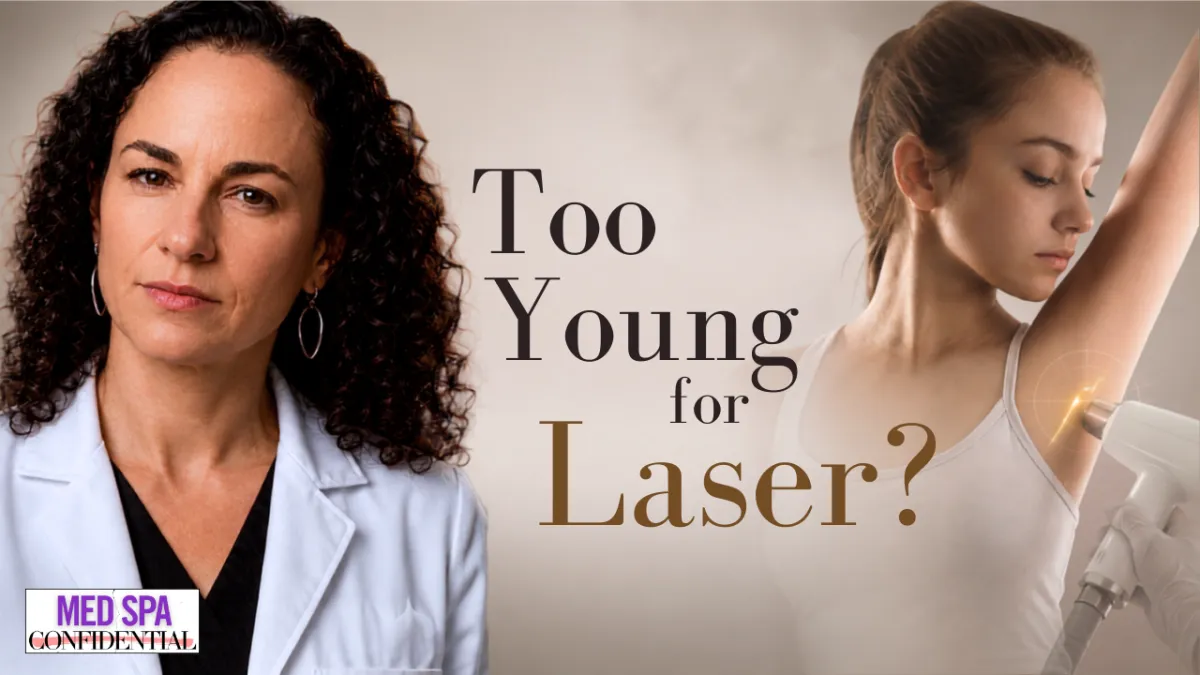
I Say NO to This Teen Laser Request
I Say NO to This Teen Laser Request
We've all been talked into something by someone who loves us. But when a parent books a laser hair removal appointment for a kid who never asked for it, we're in different territory.
This question comes up in my office more than you'd think. A friend asked me about it again recently, so I made a whole episode out of it. How young is too young? My answer isn't dogmatic one way or the other. It comes down to who's actually driving the decision, and that matters just as much for med spa owners as it does for parents.
Who Is Actually Asking?
"This conversation's really about who is asking for this treatment. Is it the teenager themselves, or is it the parent?" — Dr. Kate Dee, Med Spa Confidential
Here's the thing. In my experience, there haven't been many teenagers who walk in genuinely bothered by their own hair. Usually it's a parent who's bothered by it. That changes the entire consultation.
I've had a 17-year-old swimmer tell me she was shaving constantly and hated it. She knew what she wanted and why. That's reasonable, and we can help her. I've also watched a parent look at their kid like a flaw to be corrected while the kid sat there shrugging. That is a big red flag to me, and we will not treat that patient.
Consent Needs Two Yeses
"You cannot have informed consent if a kid is too young to understand it." — Dr. Kate Dee, Med Spa Confidential
There's no federal minimum age for laser hair removal. Cosmetic rules for minors sit at the state level, so it's a patchwork. What's nearly universal is that anyone under 18 needs a parent or guardian to sign written consent. Most dermatologists prefer waiting until 16 to 18, when hormones have settled and results hold.
A signature isn't consent, though. Real informed consent for a minor means the parent agrees and the patient wants it, understands it might hurt, and has realistic expectations. That takes a long conversation, not a clipboard.
For my colleagues, here's the part that gets skipped. Firing a medical laser is the practice of medicine in most states. Even where a trained provider can legally operate the device, and in Washington a master esthetician can under physician oversight, the decision to treat a minor is still a medical judgment call.
The esthetician cannot decide this. If your practice lets whoever is holding the handpiece clear a 15-year-old, you have a compliance problem waiting to surface. There's a specific way I shut this down without embarrassing the family. I share this in the podcast episode.
Permanent Means Permanent
"When you kill a hair follicle, that is not coming back." — Dr. Kate Dee, Med Spa Confidential
People argue about whether to call it hair removal or hair reduction. Honestly, it's a bit of a semantic thing. Your body can recruit new dark hairs over time, so touch-ups happen, but the follicles you destroy are gone. I treated my own underarms years ago and nothing has come back.
So picture a 15-year-old making a permanent choice about her body because her mother doesn't like how she looks. Do most people regret removing hair they didn't want? Probably not. But she has to be the one who didn't want it.
At 18, you make your own medical decisions, and I'll do the treatment. Before that, "my mom wants me to" is not a reason.
Before Your Next Appointment
If you're a parent, ask yourself honestly whose discomfort you're treating here. If you're a provider, decide this week who in your practice is allowed to say yes to a minor, and put it in writing before someone else decides for you.
Listen to the full episode of Med Spa Confidential for the consult questions I use with teenage patients, and the one answer from a kid that tells me to walk away every time.
Episode Transcripts:
[00:00:00] Dr. Kate Dee: Hi, I'm Dr. Kate Dee, and this is another, entry in my series of episodes about why I say no to people or what I talk people out of. and today I'm gonna talk about laser hair removal in teenagers. This has come up a lot, and someone just... Another friend of mine recently asked me about this question, how young is too young, and will you do laser hair removal on a teenager?
[00:00:25] Dr. Kate Dee: And my answer to that is, is not [00:00:30] 100% dogmatic one way or another. But, the most important thing is, besides being a good candidate for laser hair removal, and that means having relatively light skin compared to the color of the hair, that's the ideal candidate. We can do people with darker skin. We do have the right laser for that.
[00:00:50] Dr. Kate Dee: But this conversation's really about who is asking for this treatment. Is it the teenager themselves, or is it the [00:01:00] parent? And in my experience, there haven't been that many teenagers who've come to my office who they themselves really want to get rid of the hair, whether it's their legs or their armpits or somewhere else.
[00:01:14] Dr. Kate Dee: oftentimes this is driven by a parent who's bothered by this hair and less by the, less concern about for the kid, okay? so here's my take on this, okay? If there's a teenager who's old enough to be aware of [00:01:30] what the risks and the benefits are and has a parent who's supportive, so this person is underage, they need a parent to consent for them, okay?
[00:01:38] Dr. Kate Dee: So these, we're talking under 18, okay? but they understand it. They really want it. There's a strong reason behind it. They understand that it might hurt a little bit. and, and, and the parent is supportive, and they're wanting to do that. I think that it can be reasonable if that's what's happening, [00:02:00] okay?
[00:02:00] Dr. Kate Dee: On the other hand, if it's a parent who looks at their kid and sees them as flawed and wants them to take care of hair they don't like, and the kid seems indifferent, the kid is not driving this, the kid is not asking for this It's really they're just doing what their parent says. that is a big red flag to me.
[00:02:18] Dr. Kate Dee: We will not treat that patient. That is not appropriate. This is... I mean, I don't- I'm not gonna call it abuse or whatever, but this is a little bit twisted to me. That's a big red [00:02:30] flag. it's one thing for a parent to talk about the changes that come with puberty and hair, and it's a normal part of being human, and, if the kid, you know, doesn't like it and they're very young, that's, you know, that's life.
[00:02:45] Dr. Kate Dee: They're too young to know or understand. but at some point, you're nearing adulthood. I have had, not very many, but a couple of, say, 17-year-olds,say, you know, "Hey, can I do this? Is this a thing? I..." You know, [00:03:00] "I am a swimmer and, I hate this hair and it, and I'm shaving it all the time and it's very dark and it's..."
[00:03:05] Dr. Kate Dee: I don't know, whatever. There's lots of reasons why people can reasonably wanna get rid of underarm hair, leg hair, any other hair, frankly. and so it really is about infer-informed consent. So in the case of someone who's a minor, it has to be informed consent with the both the patient and the parent, but it has to be driven, in my mind, by, by the [00:03:30] patient and you cannot have informed consent if, if a kid is too young to understand it or if a kid really is indifferent and they're only doing it for their parents, you know, to please their parents.
[00:03:41] Dr. Kate Dee: we, we won't do that. And that takes quite, an extended conversation with both the parent and the patient. And that takes a lot of time and energy and education and judgment, and that's something that I do [00:04:00] personally. and I think that, you know, it- obviously I've talked about this before. I have a nurse practitioner and a PA in my practice, and they also will have an extended conversation with both the kid and the, and the parent.
[00:04:13] Dr. Kate Dee: And then they'll ask me if, if they're not sure, if they're like, "You know what? I think this is the mom driving this. I don't think the kid really wants it," I will actually, do a consultation myself to sort that out. and basically I will take the responsibility for saying no. Uh, [00:04:30] "No, you know, we-- I'm sorry."
[00:04:31] Dr. Kate Dee: And, and, and we may just say we just don't do anyone under 18. And but occasionally I have had, most... I can't think whether I've had someone younger than 17. There might've been a 16-year-old once. but you know, a 17-year-old who is, um, very well aware of, what the situation means to them personally, socially, either athletically on their team, and, and they have very reasonable [00:05:00] expectations, then I think that it can be reasonable.
[00:05:03] Dr. Kate Dee: But it is for select patients only, and it has to be very carefully determined. And so that means that, you know, it is not-- the esthetician cannot decide this. This has to be a medical decision. and I know there are plenty of places who would just, say no one under 18, and that is very reasonable. And so if you say no one under 18, very, very reasonable and, if you want to select [00:05:30] certain patients over time, being careful and selecting those patients, that is also reasonable.
[00:05:35] Dr. Kate Dee: And if you're a patient looking for this, I really would keep that in mind because, you know, if you, are young and you think you wanna make something permanent, a permanent decision, you may not be happy with that down the road, right? now, I mean, do most people regret getting rid of hair in places they didn't want hair?
[00:05:55] Dr. Kate Dee: Probably not. but it's really important [00:06:00] consideration and, so that's what we look at. And, and so the vast majority of times I will talk people out of it and say, you know, "Look, you know, when you are ready to do this, when this is something that y- is driving you and you're 100% sure you want it, then fine, let's go through with it."
[00:06:17] Dr. Kate Dee: if it's just the parent wanting their kid to look different, uh, uh-uh. No, we will not do that. That is... That, that's just not okay. I think that's really important to understand. as a parent [00:06:30] myself, you know, my opinion of whether I think they should wear these clothes or do something with their hair D- not dye their hair or dye their hair.
[00:06:38] Dr. Kate Dee: You know what? That's not for me to decide. hopefully I have, raised them to make their own really good decisions, and I have three adult kids now, so, you know, you can go ask them. Anyway, so that is my take on laser hair removal in teenagers. we have done it. it can be very, very well-tolerated and can really, really help some [00:07:00] kids, especially if they have an extraordinary amount of hair in an unusual place, uh, that they don't, they really don't want, and there's no...
[00:07:08] Dr. Kate Dee: They, they, are 100% sure they wanna get rid of that permanently. and a word about whether it's permanent or not. I mean, for the most part, it's permanent. When you, when you kill a hair follicle, that is not coming back. now over time, your hair, um, your body recruits new dark terminal hairs, and so you can grow new hair in an area where you pretty [00:07:30] much cleared all the dark hairs, and you get a new one here or there.
[00:07:32] Dr. Kate Dee: so people will need touch-ups over time. I know a lot of people call it laser hair reduction instead of laser hair removal. that's also true because let's say, you know, you get rid of a certain percentage of the hairs each time you treat it, you're not getting rid of all, every single hair, every treatment, so.
[00:07:49] Dr. Kate Dee: But in general, once you treat an area and the hair's gone, it's not coming back. So I can tell you, I treated my underarms, it was a number of years ago now. I got nothing there. There's no [00:08:00] hair coming back there. So it is permanent, okay? So it, it is, a little bit of a semantic thing. But in any event, sometimes when you're a teenager, you might want a permanent thing and then later regret that.
[00:08:13] Dr. Kate Dee: so we know that there's, there's regrets about making permanent decisions about... But again, once you're, 18 and you can make all your medical decisions, then that's up to you. And if that's what you wanna do, then, we're not gonna do that because your mom wants you to. Okay? So [00:08:30] hopefully that's clear, and, and that is my take on laser hair removal in teenagers.
[00:08:35] Dr. Kate Dee: Uh, it's not a terrible thing, but they really, really have to want it themselves. Thanks for listening. If this episode opened your eyes to something you didn't know before, share it with someone who needs to hear it. Subscribe so you don't miss the next one, and drop a comment telling me your biggest takeaway. I actually read them all. Join me on this mission to keep you safe and push this industry to do better.