Fake Ozempic Maybe in Your Pharmacy. Now What?
Check the box before you take your next shot. I wish I didn't have to say that about a drug you picked up with a prescription, but here we are.
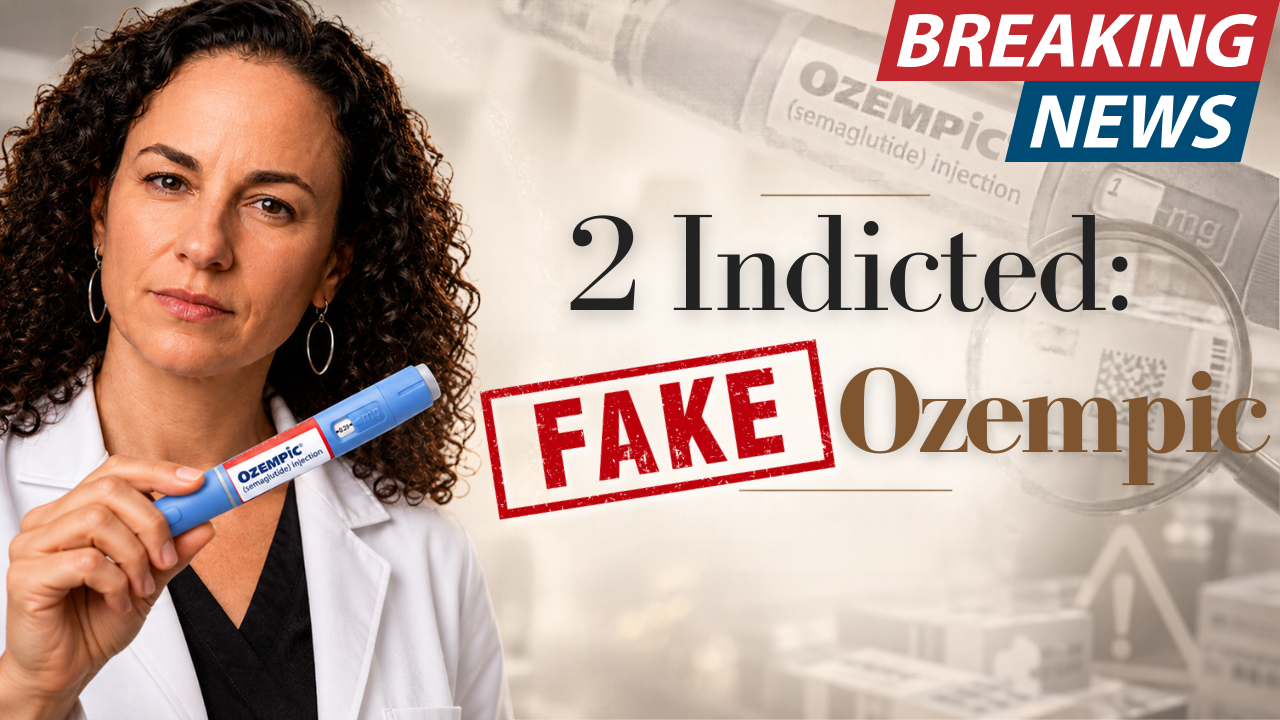
On September 29, the Justice Department announced charges against two men accused of smuggling counterfeit Ozempic from China and selling it to US drug distributors at a discount.
Not From Shady Website
"It wasn't sold on some sketchy website. It was sold to drug distributors." — Dr. Kate Dee, Med Spa Confidential
One defendant allegedly arranged the delivery of about 11,000 units to a single warehouse in Ohio in March 2024. The fakes came with counterfeit packaging, package inserts, pen labels, and even needles. The FDA said it couldn't confirm those needles were sterile.
The FDA seized thousands of fake pens in December 2023 and warned the whole country. There's a slide in one of my own lectures from that time showing fake pens next to a real one. Prosecutors say the scheme kept going for months anyway.
In the episode, I walk through one detail in the indictment, involving a group of auditors, that shows how close these fakes got to the real thing.
The Pen That Wasn't Ozempic
"It could have been a different drug, like insulin. It could have been nothing." — Dr. Kate Dee, Med Spa Confidential
In June 2023, Novo Nordisk reported that a fake Ozempic pen, reportedly bought at a US retail pharmacy, held no semaglutide at all. It held insulin. If you don't have diabetes, insulin can crash your blood sugar low enough to put you in a coma and can even kill you.
So look at your packaging. Find the lot number and serial number, and compare them to the FDA's published list of counterfeits. Real Ozempic has a unique serial number on every pen. According to the indictment, thousands of these fakes shared the same one.
Med Spa Owners, Read This Twice
"You have to know where your drugs are coming from." — Dr. Kate Dee, Med Spa Confidential
If you prescribe brand-name Ozempic, it works like any other prescription. You write it, and a pharmacy fills it. You don't buy boxes and hand them out in your office. If a supplier lets you do that, it's probably not legal, and you have to ask what's actually in the box.
Compounded semaglutide trips up a lot of good providers. Right now it can only legally come from a 503A pharmacy, for one named patient with a medical need. Research-use-only vials never go into a patient.
And that Facebook post from someone "closing their med spa" with extra inventory? Walk away. Holding a counterfeit drug for sale is a federal offense on its own.
Before Your Next Appointment
Regulators move slowly. This scheme allegedly ran in 2023 and 2024, and we're only hearing about charges now. That makes you the fastest safety check in the whole system, whether you're holding the pen or prescribing it.
Listen to the full episode of Med Spa Confidential to hear where I think those pens ended up, and to get my five-point checklist before the needle goes in.
Listen to This Episode
Full Episode Transcript
Read the Transcript
[00:00:00] Dr. Kate Dee: According to prosecutors, 11,000 units of fake Ozempic were delivered to one warehouse in Ohio, and it wasn't sold on some sketchy website. It was sold to drug distributors, the wholesalers that sit between the manufacturer and your pharmacy.
[00:00:17] I'm Dr. Kate Dee, founder and medical director of Glow Medispa in Seattle, and this is Med Spa Confidential, where we expose the risks, the red flags, and the outright illegal practices happening inside med spas [00:00:30] right now because you deserve to know before you book.
[00:00:33] On September 29th, the US Department of Justice announced charges against two men.
[00:00:38] According to news reports, both are Indian nationals living in Dubai. A federal grand jury in the Middle District of Florida, that's the Tampa area, charged each of them with six counts: one count of conspiracy to commit smuggling and to defraud the United States, three counts of smuggling, and two counts of selling, or holding counterfeit [00:01:00] drugs.
[00:01:00] So here's what prosecutors allege. From at least July of 2023 through April of 2024, these two men got counterfeit Ozempic from unauthorized sources in China. They brought it to the United States, and then they sold it to US distributors at a discount. And this wasn't a guy with a label printer in his garage.
[00:01:20] According to the Justice Department, fake product came with counterfeit packaging, counterfeit packaging inserts, the package insert that you [00:01:30] get when you're FDA approved, Counterfeit pen labels and actually counterfeit needles. Even the needles were fake. Now, what does that mean? The FDA's December twenty twenty-three warning said that the needles in the seized product were counterfeits, that their sterility could not be determined, which means an increased risk of infection potentially.
[00:01:51] So CBS News, citing the indictment, reports that in March of twenty twenty-four alone, one of the defendants allegedly arranged the [00:02:00] delivery of about eleven thousand units to that warehouse in Ohio. Thousands more allegedly went to companies in Florida. Now, here's the part that got to me. Back in December twenty twenty-three, the FDA seized thousands of units of counterfeit Ozempic and put out a public warning.
[00:02:18] And according to the Justice Department, the scheme kept going anyway for many months. I want you to really sit with that for a second because the FDA had already told the whole country that there were fake Ozempic [00:02:30] in the supply chain. There's actually a slide in one of my own lectures from that time with the fake Ozempic pens shown next to a real one.
[00:02:39] Uh, it was well-publicized, and yet providers and consumers were still buying it. I guess it was a pretty good counterfeit. these fakes were discovered in December of twenty-three, and that triggered an investigation, and it finally led to the indictment of these two men. Those fakes were continuing to sneak into our pharmacies for a long time, and it took [00:03:00] almost three years to indict them.
[00:03:01] So where does the case stand? Uh, one of the men was extradited from Italy and made his first appearance in federal court in Tampa on September twenty-ninth. CBS reports that the other man is still at large. If convicted, each of them faces up to seventy-one years in prison. And I have to say this clearly, they've been indicted but not convicted.
[00:03:22] An indictment is an allegation. Both men are presumed innocent unless and until they're proven guilty in court. So here's the [00:03:30] question I really wanted to figure out. Where did all those fake pens go? Were they being sold online? Were they going to doctor's offices or were they going somewhere a lot scarier, your regular old pharmacy mixed in with legit Ozempic?
[00:03:45] From everything I can find, it looks like the answer is the pharmacy. So I'll explain why I think that. According to the indictment, one of the companies that signed a supply deal with these defendants was in Lakeland, Florida. At one point, a [00:04:00] co-conspirator warned the defendants that the warehouse storing their product was being audited by the National Association of Boards of Pharmacy.
[00:04:08] That's the group that inspects and accredits drug distributors. So he told them to hold the next delivery until the auditors left. So this was not a guy selling out of his trunk. This product was moving through warehouses inside the real pharmacy supply chain. And the FDA's own announcement says [00:04:30] that the fake packaging was meant to deceive, and I'm quoting, "pharmacies and patients."
[00:04:35] The indictment actually lists the lot number and the serial number on the fake pens shipped to that Florida company, and they're the exact lot number and serial number the FDA put in its public warning back in December of 2023. So between September and December of '23, that one company allegedly received almost 2,500 of them.
[00:04:59] And here's [00:05:00] the thing, real Ozempic has a unique serial number on every single pen. So according to the indictment, thousands of these pens carried the same serial number. Now, here's a separate case from the same few weeks. We don't know if it's the same. In late 2023, a licensed pharmacy in Iowa bought Ozempic pens from a wholesaler, and they turned out to be counterfeit.
[00:05:24] But before anyone caught it, that pharmacy had already shipped them to a pharmacy company in [00:05:30] Michigan, which then sent them on to at least two more pharmacies. The Iowa Board of Pharmacy fined that pharmacy $25,000 and put its license on probation for five years. So is that the same fake Ozempic from this case?
[00:05:44] The timing fits, but nobody said that publicly, and I can't tell you that it is, and the pharmacy's owner says none of it reached a patient. So what I can tell you is the pattern. Warehouse to wholesaler to pharmacy to pharmacy to pharmacy, each one [00:06:00] trusting the one before it. So fake Ozempic is in the pharmacy chain.
[00:06:05] What could go wrong? Well, in June of '23, Novo Nordisk, the company that makes Ozempic, announced that a counterfeit Ozempic pen had been bought at a retail pharmacy here in the United States. And when they tested it, there was no semaglutide in it. It was insulin. Okay? That is really scary. So insulin is a totally different drug.
[00:06:26] It drops your blood sugar. If you don't have [00:06:30] diabetes and you inject a dose of insulin thinking it's your weekly weight loss shot, your blood sugar could then crash. That's called hypoglycemia, and dangerously low blood sugar can put you in a coma, and it can actually kill you. And I know this isn't theoretical because I've told you this story on this podcast before.
[00:06:48] I personally — this is hearsay, okay? But I heard of a case through someone who took care of this patient. This person thought they were taking Ozempic, and I don't [00:07:00] know if they ordered it through the internet. I'm not entirely sure. I assumed that when I heard this story, but now that we know about this federal indictment, I'm wondering whether this case is actually related to this story.
[00:07:10] In any event, it turned out the Ozempic was fake, and it was actually insulin instead of semaglutide, and they almost died of hypoglycemic shock. So that's one person and one pen, that came from a retail pharmacy. Same result, insulin where semaglutide should've been. So now I need to clear [00:07:30] something up because people use these words like they mean the same thing, but they don't.
[00:07:34] So first of all, what's name brand Ozempic? That's the brand name for the generic drug, semaglutide, which belongs to a class of drugs called GLP-1s, as we probably know. And it's made by one company, Novo Nordisk. It comes as a prefilled pen in a sealed carton. It's FDA approved for type 2 diabetes, and the same drug is approved for weight loss under a different name, Wegovy.
[00:07:59] Okay. [00:08:00] Number two, what is compounded semaglutide? That's a generic version mixed by a compounding pharmacy. It usually comes in a vial, and someone has to draw it up into a syringe. It's not in a prefilled pen.
[00:08:14] So then there's counterfeit Ozempic. So that's a fake made by who knows who, dressed up to look exactly like the real brand, and that's what this case is about. So what was in the pens in this case? The truth is, we don't even know. [00:08:30] When the FDA put out that 2023 warning, it said it could not confirm the needles were sterile, which means it might be putting you at risk of infection.
[00:08:40] And at the time, there were five reports of side effects from that fake lot, but none were serious, and they looked a lot like the usual semaglutide side effects: nausea, vomiting, diarrhea, stomach pain. But that's the thing about a counterfeit. It could have been the right drug at the wrong dose.
[00:08:59] It could have been a different [00:09:00] drug, like insulin. It could have been nothing. Could have been contaminated with endotoxin or bacteria or both. Nobody tested it for you. So let me be careful about what I know and what I don't know. So what's confirmed is those two men are charged. One's in custody.
[00:09:15] The government says thousands of units of fake Ozempic came into the country and were sold to distributors. And separately, we know Ozempic has turned up inside real pharmacies. What we don't know, which pharmacies end up with pens from the [00:09:30] scheme, how many were handed to patients, what happened to those 11,000 units in Ohio, and did any of it end up in a clinic?
[00:09:38] We really don't know. None of that's in the public record yet, as far as I can tell, as of today. So if you're a patient, here's what you do. First of all, if you want brand name Ozempic, get it from a pharmacy with a prescription with your name on the label. So two, even then, check the box. I wish I didn't have to say that, but look at the lot number and the serial number on the [00:10:00] carton.
[00:10:00] The FDA has published the lot numbers of the counterfeit Ozempic it's found, and I will put the link to that in the show notes. If it's drawn up from a vial, it's not Ozempic, it's compounded.
[00:10:20] And compounded semaglutide is made for one specific patient. That has to be from a prescription from your doctor as well. And then four, [00:10:30] make sure it's being prescribed by someone who's allowed to prescribe it. I know that sounds really simple, but these drugs are being passed out by people who wanna make money from you, who do not have a license to prescribe medications.
[00:10:42] So only doctors, nurse practitioners, and physician assistants are allowed to prescribe medications. A GLP-1 is a prescription drug, and a licensed prescriber should actually evaluate you first before they prescribe it. If you don't have the authority to prescribe drugs, there's a reason for [00:11:00] that.
[00:11:00] You don't know what you don't know, and telling authorities, "I didn't know that could happen," will not get you out of legal trouble that you will be in if anyone falls ill or dies from something you gave them. And five, know the warning signs. If you take your shot and you get shaky, sweaty, confused, or your heart is racing, that is not a normal Ozempic side effect. That can be low blood sugar, so call nine one one. Now, if you own a med spa or you're the medical director, this part's for [00:11:30] you. This case should shake you quite a bit. You have to know where your drugs are coming from. If you're prescribing actual Ozempic, that works like every other prescription medication.
[00:11:40] You write the prescription, you send it to the pharmacy, and the pharmacy fills it. It's not something you buy the box and hand it out in your office. So if you've found a source that will let you sell it that way, that is probably not legal. And after this case, you have to ask yourself what's actually in the box.
[00:11:58] Now, compounded drugs are different, and this [00:12:00] is where people get so confused, so stay with me here. There are two kinds of compounding pharmacies. One's a 503B. In plain English, that's a pharmacy that makes certain medications on purpose for office use, meaning a supply you can keep on hand if you're a doctor that you can use on multiple patients.
[00:12:18] A really good example of this is if you do procedures on the skin, you probably have some topical numbing cream from a 503B pharmacy. There's no patient name on it because it's meant to be able [00:12:30] to dispense to multiple people. So the other kind of compounding pharmacy is a 503A.
[00:12:35] That's a pharmacy that fills a prescription for one specific patient at a time. That patient's name is on the label, and it's only supposed to be used for that one patient. It can be shipped to you, so you can hand it to them as a provider, or it can go straight to the patient. Now, semaglutide is not available from any 503B pharmacy.
[00:12:55] Not right now. The FDA will not allow that. So the only legal way to get [00:13:00] compounded semaglutide is from a 503A pharmacy for one named patient as an exception when a provider decides that that patient has a medical need for it. Is there a gray area? Well, of course there is, or this wouldn't be a great episode if there weren't a gray area.
[00:13:15] So bear with me here because I might get into the weeds just a tiny little bit. Here's a scenario that I would love to hear from anyone out there who's a legal expert on this, but this is how I understand it. In many states, it's legal for a physician to compound a drug [00:13:30] themselves. So for example, a physician can prepare an IV bag for infusion or reconstitute drugs that come as a powder, like Botox or semaglutide.
[00:13:39] So to my knowledge, this is not true for nurse practitioners or PAs, but this varies by state, and I really am not a lawyer, and I don't know. But I can speak for my own state, physicians are allowed to compound in Washington state. Well, okay. So if a physician purchases a drug from a state-licensed, FDA-inspected [00:14:00] manufacturing facility, and then they compound it themselves, is that illegal?
[00:14:05] Well, at a meeting in April of '26, I asked this exact question to two representatives of the FDA because I'm familiar with this going on, and I don't know for sure. I want to know, since I'm sort of in this business, is that legal or not? Neither representative from the FDA could come up with any reason why that would be a problem.
[00:14:26] Again, this is a legal gray area, and I am not a lawyer, [00:14:30] so do not take legal advice from me. I'm just saying we're all trying to figure this out, right? So one thing is very clear, though. If a website is selling research use only vials, that's not a pharmacy, and you absolutely cannot inject those substances into a patient.
[00:14:46] So there are several things to be wary of. Besides never using research-only drugs, do not buy any of these pharmaceuticals online or from someone selling them in a Facebook group who says that they are closing their med spa and have [00:15:00] excess inventory. The likelihood of that being the truth is really minuscule.
[00:15:04] And remember, holding a counterfeit drug for sale is itself a federal offense. It's one of the things these two men are charged with. So here's the bottom line: regulators are slow. This scheme allegedly ran in two thousand twenty-three and two thousand twenty-four, and we're only hearing about charges now.
[00:15:23] And it looks like these fakes were headed for the one place we all assume is safe, the pharmacy. So [00:15:30] the fastest safety check in this whole system is you. Whether you're the patient or the provider, look at the box before the needle goes in. And every provider must have confidence in the pharmacy behind every single thing they prescribe.
[00:15:41] Stay curious, stay safe, and as always, know who's holding the needle before you let anyone near you with one.
[00:15:48] Thanks for listening. If this episode opened your eyes to something you didn't know before, share it with someone who needs to hear it. Subscribe so you don't miss the next one, and drop a comment telling me your biggest [00:16:00] takeaway. I actually read them all. Join me on this mission to keep you safe and push this industry to do better.