4 Overhyped Med Spa Treatments I Wouldn't Pay For
You've seen the posts. A glowing influencer, a "must-have" add-on, a price tag that makes you wince, and that little voice asking whether any of it actually works.
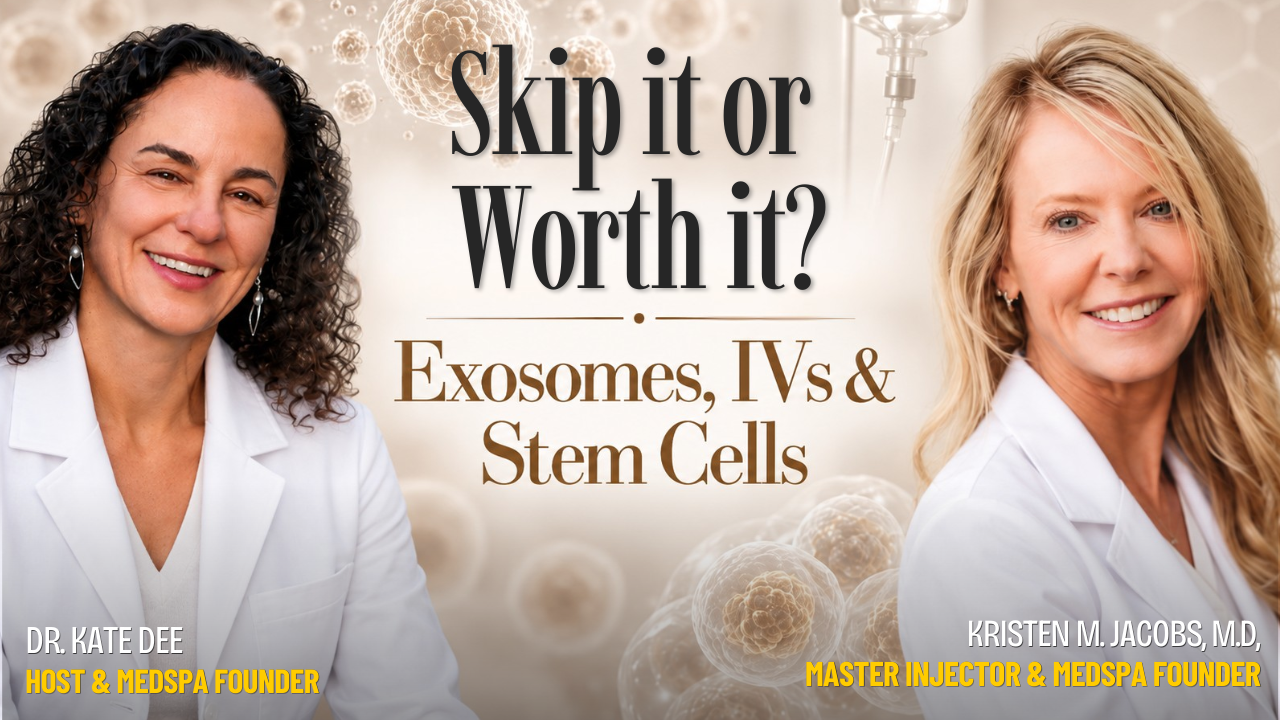
I sat down with Dr. Kristen Jacobs, founder of OohLaLa Spa in Glen Carbon, Illinois, and the newest certified member of the Med Spa Board. We've known each other for years, and we both have strong opinions about hype.
Wasting money is annoying but what worries me as a physician is how fast a trend spreads before anyone checks whether it's safe.
Exosomes Under the Microscope
"Unless they prove that there's actual exosomes under the microscope, that they aren't broken up, that they're actually doing anything, I just wouldn't pay for that." — Dr. Kate Dee, Med Spa Confidential
Exosomes are tiny packets your cells use to send growth factors to each other. That part is real science. I was skeptical of the skincare trend until a friend walked me through Plated, a platelet-derived product that was studied at the Mayo Clinic. It's topical, and the data made sense to me.
Exosomes are fragile and process them the wrong way and they fall apart before they ever reach your skin. For many of the popular brands, I haven't seen any data at all. Yet some clinics charge $1,500 to $2,000 a dose on top of microneedling.
Providers, you can't publicly claim what a product does without evidence. Consumers, ask one question: what study backs this? Dr. Jacobs pushed back with a popular skincare product.
False Hope Has a Price
"Stem cells are promising for the treatment of many things. They are not capable of doing it now." — Dr. Kate Dee, Med Spa Confidential
Stem cell clinics charge $5,000 to $20,000 to people with illnesses that have no cure. A man from Colorado with ALS flew to Seattle for a spinal injection at a med spa. He hemorrhaged and died. His family sued and won $24 million.
Before that verdict, the Washington State Attorney General had already shut the practice down for advertising stem cells as a cure for many things, including COVID. That's how most of these clinics get stopped: false advertising.
If a clinic promises to fix something your doctor calls incurable, walk away.
In the episode, I explain why I think some of these providers truly believe their own claims, and why that still doesn't make it legal.
Very Expensive Urine
"All they're doing is taking your money and providing you some very expensive urine." — Dr. Kate Dee, Med Spa Confidential
You need an IV when you're sick. Maybe you can't keep fluids down, or you have an infection that needs IV antibiotics. If you're healthy, you can get your vitamins and electrolytes from food and a drink mix.
Dr. Kristen Jacobs's turning point came at a conference, when a speaker said clinics offering NAD need a crash cart. She decided IV therapy wasn't for her practice. And there was just a recent NAD IV death in New York involving someone with no medical license in that state.
Before any drip, ask who's placing the IV and what emergency equipment is in the room.
I share the one situation where I'll admit an IV bar makes sense. Yes, it involves Vegas.
Too Far From Your Face
"It's not close enough to your skin. You cannot possibly do it enough every day." — Dr. Kate Dee, Med Spa Confidential
LED has real science behind it. Studies show collagen stimulation when the light sits within a centimeter of your skin for about 20 minutes daily. A studied mask can help if you're consistent.
Most people aren't, and Dr. Jacobs was honest that her biggest benefit is ten minutes of lying down and breathing. But those handheld wands sold at conferences for thousands of dollars? Hard pass.
Before Your Next Appointment
Dr. Kristen Jacobs and I agreed on almost everything. Then she brought up the hormone treatment she calls life-changing, and we didn't land in the same place on how she gets it. If a treatment promises a lot and can't show you data, ask for it. Your money and your safety deserve better than hype.
Listen to This Episode
Full Episode Transcript
Read the Transcript
Dr. Kate Dee: [00:00:00] Somewhere right now, a clinic is promising a cure that doesn't exist. One family believed it. Their loved one died, and the lawsuit that followed cost $24 million. I'm Dr. Kate Dee, founder and medical director of Glo MediSpa, and this is MedSpa Confidential, where we expose the risks, the red flags, and the outright illegal practices happening inside med spas right now. [00:00:22] Because you deserve to know exactly what you're paying for. Today, I sit down with Dr. Kristen Jacobs. She is [00:00:30] founder of OohLaLa Spa in Glen Carbon, Illinois, and the newest certified member of the MedSpa Board. And she's seen firsthand how fast a trend can spread before anyone checks if it's actually safe. [00:00:43] You'll discover why exosomes, one of the industry's biggest buzzwords, can fall apart before they ever do anything for your skin. You'll hear how a person with no medical license in the state killed a patient with a simple NAD IV. You'll find out why those thousand-dollar [00:01:00] handheld LED devices probably aren't doing anything at all. [00:01:04] Stay until the end. Kristen tells me about a hormone treatment she calls life-changing, and I'm not convinced that she's right. [00:01:12] Kristen Jacobs is the physician and founder of OohLaLa Spa near St. Louis. And also proudly the newest member of the MedSpa board. So congratulations. Thanks so much for getting certified.
Dr. Kristen Jacobs: [00:01:27] Thanks. I am so excited about this. I mean, [00:01:30] we all think, I hope that we all think, that we are doing everything correctly and being as compliant as we can, but I thought this was such a valuable tool to have and bring into my office just to make sure that we're doing everything that we possibly can for the safety of our patients and obviously the best results we can give. [00:01:49] So I appreciate you having it for us, and I'm so excited about it.
Dr. Kate Dee: [00:01:53] Well, thanks again. I appreciate that. You are the beneficiary of the latest thing, [00:02:00] which is the CME course that I put on there. It's free for everyone who's certified, but basically it's a four-credit course that has absolutely everything you could possibly need to know to be legal in your state. [00:02:13] Obviously doesn't cover all the state law, but, you know, I just think it's really important. Before we launch into our big topic, which is overhyped stuff in our industry, I just think it's so important because you and I have been... We've known each other for a very long time, and it [00:02:30] is hard enough when you're a physician bending over backwards to try to comply to every [00:02:35] law, to do everything properly, right? And there are so many, all these people who are entering into a medical practice, and it's completely illegal. They have no idea that what they're doing is not legal, and it's basically impossible for them to navigate that without either hiring an attorney or, you know, taking a course like that, right? [00:02:58] So I don't know. Hopefully, more [00:03:00] people will educate themselves about this stuff. So really importantly, I wanna talk today about the stuff that you and I think are overhyped in the industry because industry is just filled with hype, right? And I did a podcast recently about non-invasive skin tightening 'cause there are so many devices in that area, and I think it started probably with Thermage like a gazillion years ago, right? [00:03:30] And then basically Thermage is like a heating, outside heating, so it heats the skin and tries to trigger some collagen, right? And over the years, there's been many, many of these devices, and the latest one has gone bonkers, and I think it's totally overhyped, because just surface heating doesn't work that well. [00:03:48] It just doesn't do that much. It's okay. But, you know... So the latest one is Xerf. I'm on the record as being like super-duper overhyped. But there's so many other overhyped things. [00:04:00] So, what is your biggest pet peeve? What do you think is the most overhyped thing in the aesthetics industry right now?
Dr. Kristen Jacobs: [00:04:07] Well, there are so many, and the first thing that comes to my mind are the exosomes, and you can even throw the peptides into that whole mix. And I do think there's a place for those types of treatments, but we have to make sure that there's science behind them. And a lot of these companies are just jumping on the bandwagon and saying, “Oh, [00:04:30] hey, I have exosomes,” or, “Oh, hey, I have this.” [00:04:33] And I think it's so hard to navigate this and to know who's real and what's real and what studies and to figure it all out. I think it's extremely hard, but that's the first thing that pops in my head.
Dr. Kate Dee: [00:04:45] Well, as a physician, as a, you know, science geek, right? We read papers and we look at the science and we get informed by that. But I think most of the people who are out there touting exosomes right now have no clue what an [00:05:00] exosome is. So,
Dr. Kristen Jacobs: [00:05:00] Right. [00:05:01] So start there.
Dr. Kate Dee: [00:05:02] Okay, so back when... [00:05:04] Well, I'm probably a couple years older than you, but, like, [00:05:08] back
Dr. Kristen Jacobs: [00:05:08] We're close, I think.
Dr. Kate Dee: [00:05:09] We're pretty close. So back when we were in med school, we didn't even know about exosomes, but we talked about growth factors and that, like, one cell would secrete a growth factor, and that growth factor would go have an effect on another cell or hit a receptor. [00:05:26] And what we learned over the last 20 [00:05:30] years, 'cause you and I both went to med school, ooh, gosh, longer than that,
Dr. Kristen Jacobs: [00:05:33] Don't even-- Yeah,
Dr. Kate Dee: [00:05:34] Don't even talk about it. Okay, well, it was, for me, it was the '90s. Okay, so, but over the last 20 years, there's been a ton of research and in fact, cells don't secrete naked growth factors or hormones or neurotransmitter. [00:05:46] They're actually secreting exosomes. And so those growth factors are inside a little container, a little bubble of, you know, membrane, and it's little [00:06:00] packets, and inside the packet are a bunch of different growth factors, and that's an exosome. And in fact, that's what happens inside your body. [00:06:07] That's how one cell secretes a growth factor and it has effect on another cell. So a few years ago, people went gaga over exosomes, and everybody had to have them. And I was like, “Okay, this is hype. I'm not... You know, this is ridiculous.” And but then it started to catch hold, and I'm like, “Hmm.” [00:06:27] And I still was very skeptical until a [00:06:30] very close friend of mine, posted about a particular kind of exosome that she was using, and she's brilliant, so I texted her. I'm like, “Okay, you're gonna have to talk me into exosomes. Tell me what the science is. Why do you like that one?” And so she was an advocate of this one kind called Plated. [00:06:49] It's a, like, platelet-derived exosomes. I'm like, “Okay, tell me about the science behind those and why those and why not others.” And so I ended up talking to, like, the chief [00:07:00] scientific officer for that company and looking at the data behind that. So platelet-derived exosomes, would make sense that that kind of exosome would work because we already use growth factors from platelets with PRP and PRFM, right? [00:07:19] And so this, that particular kind of exosome was studied at the Mayo Clinic when... Now this is a couple years ago, so it's probably 22 or 23 years. And two [00:07:30] MD PhDs from Mayo spun off this company. And like, okay, okay. So anyway, so those are topical. Those come in a topical product that you put on your skin, and they do penetrate a little better than like, if you put just growth factors on your skin, it's not gonna... [00:07:48] They're not gonna get absorbed. They're not gonna really have any effect. But the growth factors inside these little vesicles can get absorbed, right? So they've studied that. So, okay. But then, like, [00:08:00] everyone and their dog started getting exosomes from everywhere else, and including plants and other
Dr. Kristen Jacobs: [00:08:07] Aren't there snails and-- Or is that...
Dr. Kate Dee: [00:08:10] I don't know about snail exosomes. There's definitely some... There is actually one product from snails that makes sense to me 'cause that's been studied. But anyway, so a couple big companies, and I'm not gonna mention them by name, but a couple big companies are very popular. But, as far as I can tell, there's no data at [00:08:30] all behind those exosomes. [00:08:32] And if you... The exosomes are very delicate, right? And so if you process them or you try to do stuff with them, they're very unstable. They break apart. So it's like by the time you're actually using it, they're not intact anymore. And so I agree. I have not seen, aside from that Plated product, which is only a topical skincare product, it's not injected. [00:08:57] A lot of these other exosomes [00:09:00] are supposedly being injected and doing things that I don't think any of it's FDA approved. So I think it's not illegal to use them topically. But I don't think there's any data behind any of them other than that one product that I know of.
Dr. Kristen Jacobs: [00:09:14] Let me challenge you this, 'cause, I mean, you are, like you said, the science nerd way, way, way more nerdy than I am. But,
Dr. Kate Dee: [00:09:21] There's no reliable way to know if a med spa is following safety standards or cutting corners, until now. The Med Spa Board certifies [00:09:30] clinics that prove they're doing things right, verified products, licensed staff, and actual medical oversight. It's the difference between rolling the dice with your skin and knowing exactly who's holding the needle. [00:09:42] If you're looking for aesthetic treatments, go to medspaboard.com to find a certified spa near you. And if you already have a med spa you love and they're not certified yet, please send them our link. Med spa owners, getting certified does more than build patient trust. [00:10:00] It should also save you a ton on your malpractice insurance. [00:10:03] Do the right thing and go to medspaboard.com. Keep listening, keep asking questions, and stay safe out there.
Dr. Kristen Jacobs: [00:10:10] The TNS Recovery Complex has been around for, oh my goodness, almost, what, 30 years now? And back, I would say at least five, but you know, time goes so fast, probably eight years ago, I was talking to the [00:10:30] formulator at that time and he said, “You know, we have exosomes.” [00:10:33] So maybe it was only five. I don't know. It was when the keyword started to come out. But anyway, he's like, “We have them. We can't pinpoint them. You know, we can't figure out how to find them.” Well, just in the last year or so, they figured out how to measure them, and they claim to have one trillion exosomes in that product. [00:10:51] So I'm gonna... In the TNS Recovery Complex, so that's the original one. [00:11:00] And so I wish that I retained things as well as I used to, but I actually have had multiple conversations with their formulators and their science, and they actually can obviously talk way better than I can about it. [00:11:15] But they do have some studies. So I would love to see what you think of that.
Dr. Kate Dee: [00:11:21] Oh, I would love to see that too. So I mean, we do have TNS in my place. So for people at home, you [00:11:30] know, SkinMedica has this product that has human growth factors in it, and that's been around for a very long time. It's called TNS. People really like it. Anything with human growth factors is always, like, a little scary or a little concerning. [00:11:45] You know, how long can you use something that's got human growth factors in it, before you worry about could this be contributing to my skin cancer risk? I don't know. That is very difficult to know because I don't think there's [00:12:00] enough data. It's... That particular product's been around a really long time, and so if there were any increased risk of skin cancer, you'd think we'd see that by now, and I don't think there's any
Dr. Kristen Jacobs: [00:12:11] There's not. No, there's not. This was the big buzz... Again, I can't keep track of time, but when-- We've been using it since 2010, so we're at now 16 years and, the-- Back when we first brought it in, that's when all that stuff came out, and there-- [00:12:30] They do actually have some science behind it that says it absolutely cannot. [00:12:33] It doesn't turn on those cell or those, I don't even know what triggers. But anyway, so that is definitely something that patients do bring up a lot about TNS. I shouldn't say a lot, but they used to more so
Dr. Kate Dee: [00:12:45] Yeah. So, well, I think it's really interesting in the world of exosomes, there's way more hype than just those two brands that you and I are talking about, and they're used in a different way. So both of us are talking about skincare [00:13:00] brands that are very well-known, well-established, medically sound medical skincare that has studies behind it. [00:13:09] So the SkinMedica TNS and Plated products. There are many others that are touted as, you know, plant-based and, people are charging a lot of money, like thousands of dollars for treatments where they do, say, a skin treatment like laser or microneedling, RF microneedling, [00:13:30] and then putting this very expensive exosome product on top of it. [00:13:35] I personally don't think that any of that's worth it. I do think maybe using Plated or some other topicals after microneedling is like especially RF microneedling can be really beneficial, and that is one use that is actually okay to use the Ariessence product for. So that's platelet-derived growth factor, [00:14:00] which is the same growth factor that's in PRP, and it's the same growth factor that's inside Plated products. [00:14:10] I don't actually know about TNS, so that's really interesting. But so those things make sense to me post-procedure to improve your results from that procedure and probably improve healing time as
Dr. Kristen Jacobs: [00:14:22] Absolutely. [00:14:23] Absolutely. We use it with all of our microneedling procedures.
Dr. Kate Dee: [00:14:26] So those things, but like all these other ones that [00:14:30] are like, you know, basically unless they prove that there's actual exosomes under the microscope, that they aren't broken up, that they're actually doing anything, I just wouldn't pay for that. [00:14:40] It's like very, very expensive. Where most of the things we're talking about are like a few hundred bucks or less. And a lot of these other ones that are, you know, one dose is $1,500 or $2,000 and it's like it's ridiculous.
Dr. Kristen Jacobs: [00:14:54] Good to be true, in my opinion. And, you know, it's funny that these things come in my, you know, mailbox [00:15:00] all the time where they, you know, you're always seeing them on Facebook or Insta, and I just delete, move on. It's just not even worth even looking at them, in my opinion.
Dr. Kate Dee: [00:15:10] Yeah. Agreed. Okay, so the over-hyped thing that I really wanted to talk about... Well, I have a couple of them, 'cause you know me and pet peeves, but sort of related to exosomes are stem cells. And I really think that convincing people that the science [00:15:30] around stem cells is past where it really is, is very detrimental for patients. [00:15:36] There are these stem cell clinics all over the country marketing stem cells as a cure for things that it just doesn't cure. [00:15:45] And they're charging many, many thousands of dollars, and generally what they're doing is offering it to people who have terminal illnesses or untreatable illnesses that are chronic that, they claim that they can make better. [00:16:00] And so they're charging, you know, 5, 10, $20,000 for a treatment, that's giving people false hope and taking their money.
Dr. Kate Dee: [00:16:07] In that particular case, it was a guy who was from Colorado who had ALS, which is Lou Gehrig's disease, which a lot of people know that, you know, is something that is incurable and kills you in about six years. And this man flew to Seattle to get a treatment at this med spa, and they injected his [00:16:30] spine, and basically he died on the table. [00:16:32] He died from this. He hemorrhaged, and it was terrible. It was a terrible tragedy and his family sued, and they just won $24 million from this [00:16:42] med spa. Yeah. And I just think that it's unconscionable to take people's money giving them these false promises, and I just... I really want everybody to know that, like, they're... [00:16:55] Stem cells are promising for the treatment of many things. They are [00:17:00] not capable of doing it now. It is not going to help. It's not going to change. There's no science that says that it's gonna help any of your body parts or cure any of your illnesses or Parkinson's or, you know, if you've had a stroke or whatever. [00:17:17] I just think that of all the over-hyped things, it's just unbelievable, and it's illegal to advertise them in that way. And before this wrongful death suit was won this year, [00:17:30] the Washington State Attorney General had already shut this person down from... because she was advertising stem cells, actually not only as a cure for a lot of things, but also as a cure for COVID.
Dr. Kristen Jacobs: [00:17:41] Wow. [00:17:42] Wow.
Dr. Kate Dee: [00:17:44] And so, actually, most of the ways that these stem cell clinics are being shut down is for false advertising because in medicine you are not allowed to advertise something that there is no scientific evidence for. So that goes for everything in aesthetics, too. [00:18:00] So if you notice, I don't know, out there in the ether, if you guys noticed- That these places using exosomes, they can't make claims about what the exosomes do. [00:18:11] They can talk to you about it when you're in the room and talk it up, but they can't make public claims saying that exosomes will do X, Y, or Z because there's literally no data to say that it will. And if they do, then that's totally illegal and that's reportable. So
Dr. Kristen Jacobs: [00:18:27] And, you know, I think this goes down [00:18:30] the whole, rabbit hole of functional medicine, and I think you know that my husband's a chiropractor, so we are, you know, very, very much into-- I don't wanna say alternative 'cause that's not what it is. It's just basically nutrition. So what's sad is that they're giving this false hope that we can, they can fix you and cure you, and probably never once talk about diet, exercise, healing the gut, [00:19:00] doing all the things that really, really matter. [00:19:02] Is that gonna cure you? No. If you have a disease, it's probably not, but you certainly should be able to function a little bit better by doing all the right things, which is hard in this day and age. So, you know, that whole time you were talking, I just kept thinking of your compliance, compliance, compliance. [00:19:18] And like you said, like, how do you take money, even though this isn't technically compliance, but how do you take money from somebody knowing that [00:19:30] you're lying? And I just, in my... I can't go to sleep at night. I can't go to sleep at night.
Dr. Kate Dee: [00:19:36] Right. I don't ... Yeah, I mean, well, here's part of it. I think a lot of people in the industry are not particularly medically informed, and they actually believe in the things they're selling.
Dr. Kristen Jacobs: [00:19:47] And that's true. I would give him that.
Dr. Kate Dee: [00:19:49] See, it's not legal for them to advertise it 'cause there's no science behind it. [00:19:53] But I do actually think, and actually, you know, that doctor who just lost the [00:20:00] $24 million lawsuit, has made public statements that make it sound like she actually believes that the stem cells do more than they do. And I don't know if it's sort of similar to, like, people believing ivermectin was gonna cure COVID, because I think some people actually believe that, and it's like, okay, people. [00:20:23] I mean, we are definitely in an era in our country where there are a lot of science [00:20:30] deniers, there are a lot of medicine deniers, there are people who believe in stuff that's like, “What?” You know, like, that is ... and I'm not saying that if there's no evidence, that means that it is a lie. That means that there's no evidence, and it's illegal to advertise that. [00:20:47] There are lots of things that have not been studied, and, or are very early stages of study. And so there's definitely a lot of things where, you know, people in aesthetics jump on something because it does work, but there's no studies yet.
Dr. Kristen Jacobs: [00:21:03] And I guess that's where I was going with it, is that, you know, you just jump on board and I'm not saying that GLPs don't have a place. That's not what I'm saying when I say my next thing. What I'm saying is that over the last couple of years, everybody has jumped on board because it was easy to make a quick buck. [00:21:19] And it goes back to, let's go back to nutrition. We're just selling this medication. We're just selling this, you know, program, but we're not talking about what needs to be done [00:21:30] along with it. Protein, exercise, you know, the thing. So I'm not saying that there's not a place for it, but unfortunately in the aesthetic industry, it's very easy for clinics, for companies to jump on board because they see that, “Oh, well this is a great revenue builder.” [00:21:46] And I just am not one of those people.
Dr. Kate Dee: [00:21:49] Yeah. I mean, ideally as a consumer, you go find somebody who can sort this stuff out for you, like Kristen or me, right? It's like, “Okay, [00:22:00] what's the deal?” And I have a whole bunch of patients over the years that we... I've been doing this only 12 years. I know you've been doing it longer than me. [00:22:08] But I have a few patients who are big time, you know, in the industry, like they're super interested, and they'll send me different posts or, you know, device pages and say, “Tell me what you think about this thing.” And then I gotta do my research and we're like, “Well,” you know. And but it's really important to either be able to sort that out [00:22:30] yourself or have a science geek in your pocket who can sort it out for you so you know like what's real and what's not, because so much in the industry is hype. [00:22:39] So we're both on record as kinda exosomes and stem cells, definitely do your research, 'cause some things are promising, but like let's just say the science is not there. I'm gonna go into something that is, probably way more controversial, and I think all of IV therapy is over-hyped. [00:22:58] What say [00:23:00] you?
Dr. Kristen Jacobs: [00:23:00] I agree. Like it's another one of those, you know, “Hey, let's make some money,” kind of thing. And I-- let's see, I think it was two years ago at-- well, maybe it was last year at AMSPA actually. I went to every single nutrition, IV therapy, NAD. You know, I went to all of that because I just have, you know, a deep, deep interest in it. [00:23:23] And I'll tell you why I thought, “Ooh, IV therapy is not for me,” besides the fact that I don't [00:23:30] know that there's a whole lot of science back there. But the gal who was speaking, I don't even remember who it was, said, “If you're gonna be doing NAD, you need a crash cart in your clinic.” And I looked at my-- I think-- I don't even know if it was my husband or whoever was sitting next to me, and I was like, “I'm out.”
Dr. Kate Dee: [00:23:45] And what did she say about it and why? Because I have a follow-up for you.
Dr. Kristen Jacobs: [00:23:50] Okay. No, she just said that, I mean, it is potentially dangerous, right? And all these people are out there just throwing NAD here, left, right, [00:24:00] any dose and whatever, and they have no idea. I mean, I have my emergency kits, but I'm not... I don't have a crash cart,
Dr. Kate Dee: [00:24:08] I'm not an ER doc, although one of my partners is an ER doc, so in my place we do have an ER doc there a lot. But so interestingly or terribly tragically, there was just recently another IV death in New York State from NAD injection. And I don't know any details, so I do know that the [00:24:30] person who killed this patient, was supposedly a naturopath, but that naturopath did not have any kind of medical license in New York State. [00:24:40] New York State does not have naturopaths. So he was, I think, from a foreign country, was trained supposedly as a naturopath, had no license in New York, and hung NAD and killed somebody. This is just recent, and I do believe he was arrested. I don't know any details more than that. But I do think that's [00:25:00] really interesting, right? Like, for me, there are so many reasons not to do IV therapy as a physician, but also as a consumer, you do not need an IV unless you are sick. Okay? So if you have a GI illness and you can't keep anything down, you might need an IV to stay hydrated. If you've got hyperemesis and you're pregnant and you're throwing up all the time and you can't keep anything down, you might need an IV. [00:25:28] If you've got a rip-roaring [00:25:30] infection, and you need IV antibiotics because a pill will not kill the microbes, yes, you might need an IV. There are lots of things where you might need an IV, but that's because you are sick and need to be treated. If you are a healthy, well person, you do not need an IV. [00:25:49] There's no amount of vitamins or electrolytes that you can't get from eating them, okay? With the one occasional [00:26:00] exception is if you've got issues absorbing B12 that... But that's an IM shot. That is not an IV, okay? So all these places popped up selling it as though they're keeping you healthy, [00:26:14] and instead all they're doing is taking your money and providing you some very expensive urine. [00:26:20] So I just... I mean, oh my God. I just think it's unconscionable as a physician, like how could you sell somebody something they absolutely do not need?
Dr. Kristen Jacobs: [00:26:29] Well, I'm not sure a lot of these clinics are physicians either, and that's what's scary too. And maybe the physician has said, you know, “I'll be your medical director,” but like there-- I think there are three in our area, and we're in a very, very small town. And from what I... I shouldn't say it, but I-- from what I understand, I don't think that physicians are involved. [00:26:52] You know, they're nurses, I do know that. But that's-- I just don't understand it.
Dr. Kate Dee: [00:26:57] Well, you know, I [00:27:00] agree. So a lot of these places don't have any physicians anywhere near it. I have seen physicians where they do offer IV therapy in their office. Although I have talked to a couple of them, a couple people who are medical directors and they're MedSpa certified. [00:27:18] They've told me like, well, they assess the people who are interested and yes, it's generally people who are having issues with dehydration is usually who comes in the door. That they're not just treating [00:27:30] everybody and convincing people that they need something they don't need. The famous case in Texas where Jenifer Cleveland died, that was a non-medical person trying to sell IVs to make money, and I think that that's very, very common. [00:27:45] I will say though, since you and I end up meeting in Vegas, I don't think it's crazy that the places like Vegas have them because people are partying and getting super sick and drunk and dehydrated, and they wanna keep partying. So like, well, that's one sort [00:28:00] of legit reason, right? Um-
Dr. Kristen Jacobs: [00:28:03] Oh, that's funny. Legit reason. [00:28:05] Okay.
Dr. Kate Dee: [00:28:06] I mean, nobody wants anybody dying of alcohol poisoning.
Dr. Kristen Jacobs: [00:28:09] That is true. That is true.
Dr. Kate Dee: [00:28:11] But yeah. You know, but in general I think that, like, it... There are so many people I've met, just friends, who didn't know. Like, they just didn't know that what they were doing was kind of, you know, not needed, right? Just put a little electrolyte solution in your water. [00:28:30] I mean, I have Liquid IV and Nuun in my house, but, you know, whatever you like, whatever flavors you like. [00:28:36] Okay. All right. So we've covered IV therapy. I think I have one more thing that's one of my pet peeves. Not that there's no science behind it at all, but those handheld LED devices. Have you seen those?
Dr. Kristen Jacobs: [00:28:52] So I've seen like the Omnilux and then there's like the knockoff versions of those and, [00:29:00] and I haven't seen one that you just hold up. But are you talking about that or are you
Dr. Kate Dee: [00:29:06] Oh, yeah. Well,
Dr. Kristen Jacobs: [00:29:07] you put on?
Dr. Kate Dee: [00:29:08] They sell those online, but they sell those at every meeting I've ever been to. So let's... So there is science behind LED, and those
Dr. Kristen Jacobs: [00:29:16] Mm-hmm
Dr. Kate Dee: [00:29:16] masks actually, if you were gonna comply, right? 'Cause those masks at least put the LED light right up against your face. And I think the studies have shown that if you have that less than a centimeter from [00:29:30] your skin, and if you do 15 or 20 minutes a day, I think it's 20 minutes a day, you can actually induce collagen from inside your skin. [00:29:39] The problem is that if you have one of those masks, I mean, I don't know about all the brands, but, let's say the Omnilux one since I think that that one has been studied. If you actually use that 20 minutes every day, you can probably make a difference in your skin. I do think that most people don't do that. [00:29:58] I think that they buy the [00:30:00] mask, and they do it for a few days, and they're like, okay, then they're too busy, and then they might do it every once in a blue moon, but it's, like, really hard to keep up that habit.
Dr. Kristen Jacobs: [00:30:09] I won't confirm nor deny that I am one of those, but I will tell you that it's from a mental perspective, just taking the time to do it. Whether or not I've seen any change with my skin, I can't say, but I can say making myself, and this is a 10-minute one, but making myself lay [00:30:30] down and just breathe is really the key benefit that I see. [00:30:38] And I get on kicks and I'll do it. It's... You're supposed to do it for two weeks in a row and then three times a week after that, and I'll get on kicks. But like I said, as far as have I seen tightening of my skin or anything like that, hard to really
Dr. Kate Dee: [00:30:51] Right. Yeah. I mean, it's gonna be a pretty minimal difference. I don't think you're gonna notice something. It's probably [00:31:00] not bad for your skin if you could actually keep it up. I just find that most people, it's very difficult to create that kind of new habit, and people, you know, do it... [00:31:11] Even things that are much faster than 10 or 20 minutes, it's hard for people to do consistently. I'm constantly begging people to take care of their skin with skincare products. Like, “You've gotta do this. It takes, like, less than two minutes,” and people are like, “Oh, I don't have time.” I'm like, “Okay.” Like, so again, those masks [00:31:30] or, you know, the high-end, really expensive LED treatments that you can go to a spa for, the problem with that is you're not gonna go to the spa every day for 20 minutes. [00:31:40] So that's probably not gonna do much. It could be, you know, great as an adjunct to your other treatment, but okay. But they make these handheld ones. They look like little flashlights or little, you know, razors honestly. They look like electric razors. But they've got, [00:32:00] you know, maybe 20 little LED lights and, you know, you're supposed to do this, and it... [00:32:05] I'm just saying that is... There's no way. So it's not close enough to your skin. You cannot possibly do it enough every day, and they're charging many thousands of dollars for those things. So I would say don't buy one. It's a big waste of money. And those, the face mask, the Omnilux or that, the Shark one. [00:32:28] Is that the Shark one that [00:32:30] makes that one? I can't remember.
Dr. Kristen Jacobs: [00:32:31] I don't think so.
Dr. Kate Dee: [00:32:33] Yeah. But I mean, so those are not, like, totally crazy, but you actually have to, like, seriously do it. And we used... There was this vaginal rejuvenation device they used to sell, and it's like, well, that also is great, but, like, you've gotta stick that inside for a good 15 minutes every day. [00:32:53] I'm telling you, nobody, nobody did that, you know? Like, it just... Yeah.
Dr. Kristen Jacobs: [00:32:58] Right. Well, I mean, it goes back to, like you [00:33:00] said, with skincare. I mean, it's hard enough just to get your skincare on your face and then adding, you know, these... There are very few people who do the at-home devices as often as they should to get the results. And I agree. I mean, you could probably get one of those handhelds on Amazon for 15, 20 bucks, and it goes back to, you know, you get what you pay for, [00:33:20] and you're not gonna see anything with those, for sure.
Dr. Kate Dee: [00:33:24] Last one, totally my hot take, and as long as my aestheticians aren't [00:33:30] listening, I won't get beaten up, but facials.
Dr. Kristen Jacobs: [00:33:32] Right.
Dr. Kate Dee: [00:33:33] Okay? Like, I love a good facial, but you don't really need a facial. Tell me, what do you think? Do you get facials?
Dr. Kristen Jacobs: [00:33:40] I don't. I-- We have Diamond Glow in our office, and so my medical assistant 'cause in Illinois that's what they are, she'll do a nice little facial after, which is really kind of funny because, I don't get Diamond Glows very often, but I was going somewhere... Well, [00:34:00] Vegas, when I saw you in Vegas. [00:34:01] I was going out there and I said, “You know what? Let me do a dermaplane. Let me do the Diamond Glow.” And then she added on a 10, 15-minute facial. Again, it goes back to my mental state. It was so relaxing. She had me, you know, feeling so good, and because the Diamond Glow exfoliates, hydrates, and extracts, I feel like there's at least a little bit of benefit for me to lay on a table for 30 to 45
Dr. Kate Dee: [00:34:25] Yeah. And I agree. So we have HydraFacial, it's very [00:34:30] similar. And I love a facial, I love the massage part of facial. So but I do think that for your skin, as far as for anti-aging, for keeping your skin healthy, you don't really need facials. They're lovely, and they can kind of accelerate some of the things. [00:34:46] But you can actually achieve all the same things with really good skincare at home. It just takes a little bit longer. But I mean, so for me, facials are luxurious, they feel wonderful, they're good for my skin. They're not harmful. [00:35:00] But you just don't really need them. So if you're worried about spending money, you probably wanna spend money on your Botox and your RF microneedling. [00:35:09] And if you really are tight on money and you don't wanna spend it like, you know ... But it's hard because I like, for me, it's like a massage. I love massage, for like body massage. I [00:35:20] feel like I need it, I want it, it feels good. It's part of my relaxation, it's part of my taking care of my body. Is it really gonna change my [00:35:30] muscles long term? No. But it feels really, really good.
Dr. Kristen Jacobs: [00:35:33] It does, yes.
Dr. Kate Dee: [00:35:35] But like, I don't know. So hopefully all the aestheticians listening, I'm really sorry. I love facials, don't get me wrong. I just don't think convincing people that they must have them, I don't think that that's really true. And so yeah.
Dr. Kristen Jacobs: [00:35:49] Yeah. I call it fluff and it's nice. Fluff is nice, [00:35:52] right?
Dr. Kate Dee: [00:35:52] Is lovely.
Dr. Kristen Jacobs: [00:35:53] Medically [00:35:54] gonna do anything
Dr. Kate Dee: [00:35:55] Yes, and I have-- we have a ton of people who come in for a medical [00:36:00] facial because, well, one, they also get dermaplaning as part of it. So like that's a huge bonus, not just the exfoliation, but it gets rid of the peach fuzz, which, you know, so that's kind of a really nice thing. And so it's as when people feel like it's part of their skincare, I think that's really valuable in a lot of ways. [00:36:18] But is it mandatory? No. Okay. All right. I'm trying to tamp down my hot take on facials, but okay. Yeah, any other thing that you think is just [00:36:30] tremendously overhyped?
Dr. Kristen Jacobs: [00:36:31] I can't think of anything. You know, I think, I don't know how you feel about bioidenticals, hormone replacement therapy is a whole 'nother hot topic. I think that there's definitely a place for that, for them, but I do think a lot of people jump on that bandwagon as well. So that's another, you know, [00:36:52] hot topic. I'm thinking of all the things that have been introduced to me over the last, you know, couple of years, and I-- like I said, there is definitely a [00:37:00] place. I mean, I definitely am not saying there's not a place for it. But that's another hot topic, I think.
Dr. Kate Dee: [00:37:06] Yes, and I will, I don't know if I can figure out, we'll throw in the show notes, but I have done a podcast before about hormone replacement where we talked about bioidenticals and why those are overhyped. People don't even understand what that means, and it really is the exact same thing as, you know, prescription. [00:37:26] It's a way for people to make more money [00:37:30] by dispensing it in their office rather than just prescribing it. But because hormone replacement therapy is covered by insurance, you don't need to pay for compounded bioidenticals. It's,
Dr. Kristen Jacobs: [00:37:44] Now, [00:37:45] I will tell you, I do pay for my compounded bioidenticals. I have not tried it outside of that, so I can't really compare. But, for me, I've-- it's been a year now and it's life-changing. Life-changing. So like I said, I threw this out there knowing that you were gonna be [00:38:00] like, “Hey, I don't know about that.” [00:38:02] But
Dr. Kate Dee: [00:38:02] I think hormones, I mean, we both lived through the 22 years of people being thrown off their hormones and being miserable, and thank goodness people are back on their hormones and they're happy. I will say that it is absolutely life-changing to take hormones once you're peri and post-menopause. [00:38:22] Like, absolutely life-changing. You'll be happier, you'll sleep better, your skin will be better. Everything will be better. Everything will be more [00:38:30] lubricated. It'll be good. So we are ... I'm all for hormones, whether you compound them or get them covered by your insurance. It's, [00:38:38] it's great. Yeah. So, well, I think this has been really great and if anybody out there has other overhyped things they would like to hear talked about on this podcast, that's like one of my favorite topics. [00:38:51] I really do think it's important to make sure that what you're paying money for actually delivers some results. So Kristen Jacobs, [00:39:00] thanks so much for [00:39:01] talking with me today.
Dr. Kristen Jacobs: [00:39:03] Thanks for having me again. I always love coming on here. It's so much fun.
Dr. Kate Dee: [00:39:07] Thanks for listening. If this episode opened your eyes to something you didn't know before, share it with someone who needs to hear it. Subscribe so you don't miss the next one, and drop a comment telling me your biggest takeaway. I actually read them all. Join me on this mission to keep you safe and push this industry to do better.