
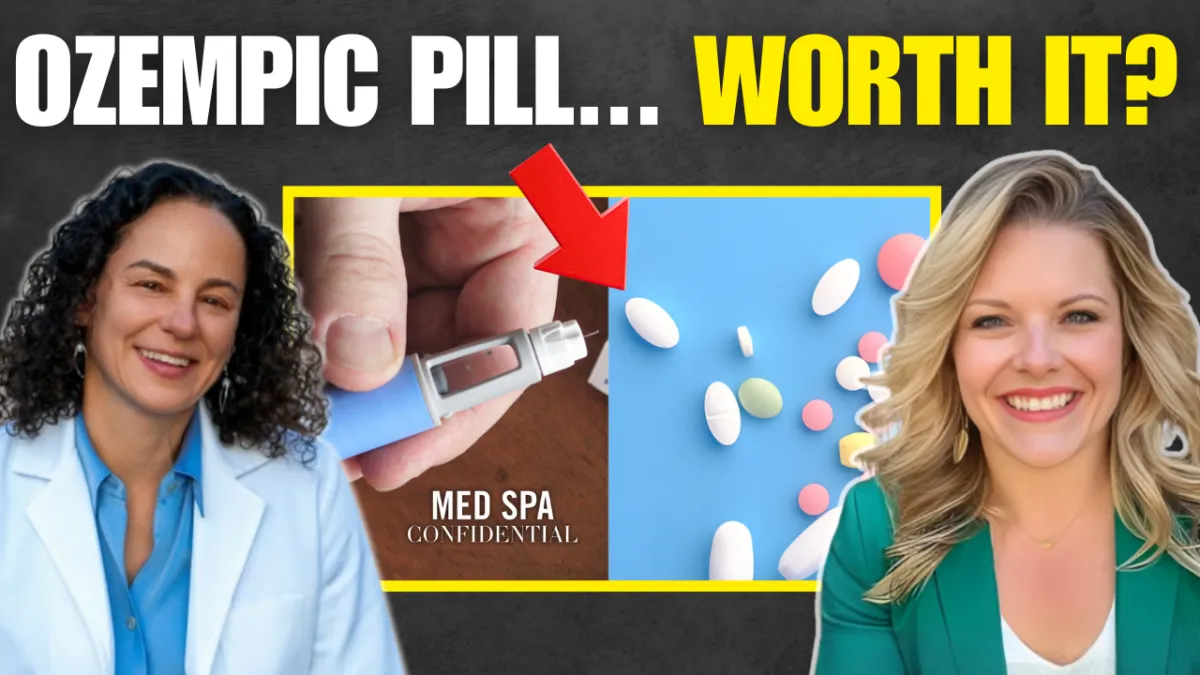
You Need To Know This Before Taking Oral GLP-1s
You Need To Know This Before Taking Oral GLP1s
Everyone's talking about the new Ozempic pill like it's the answer to everything. A daily pill instead of a weekly injection. No needles and so simple, right?
Not quite.
I sat down with GLP-1 prescriber Dr. Randi Lindstrom to break down what the pill actually looks like in clinical practice. The cost, the challenges, the absorption issues, and why the early numbers on who's taking it are already telling a story. And then there's the stopping question.
The Pill Comes With A lot of Baggage
"It has to be on a completely empty stomach, fasted, with only four ounces of water, and then you have to wait at least 30 minutes after that." — Dr. Randi Lindstrom, Med Spa Confidential
Before you swap your weekly shot for a daily pill, you need to understand what you're actually signing up for. The oral GLP-1 has a finicky absorption process that turns your morning routine into a carefully timed sequence. Four ounces of water, completely fasted and thirty minutes before you eat or drink anything else.
For women already on medication, like thyroid, that sequence gets even more complicated.
The Gap Between the Headline Price and the Actual Cost
"The starting dose is only $149, but it's really not even a therapeutic dose. It would be very much like a micro dose." — Dr. Randi Lindstrom, Med Spa Confidential
The $149 price tag got a lot of attention. It sounds affordable until you understand what that dose actually does. Or more accurately, what it doesn't do.
To match the effectiveness of the injectable, you need roughly ten times the amount of medication. And those doses aren't $149 a month. Insurance isn't covering the oral option yet either, so right now this is entirely out of pocket.
More Side Effects, Less Results
"In the head-to-head studies, because it's going through the GI tract, it seems to have a little bit more of those GI side effects." — Dr. Randi Lindstrom, Med Spa Confidential
Here's where it gets harder to make the case for the pill. The injectable already comes with nausea and GI discomfort for some people. The oral version runs a higher risk of those same side effects because it has to pass through your stomach to be absorbed.
And the weight loss results in head-to-head studies show the pill coming in slightly behind the injectable.
So the oral medications come with more side effects, higher real cost, stricter dosing rules, and slightly less effective. Dr. Lindstrom is measured in how she puts it, but her clinical hesitation comes through clearly.
Do You Gain the Weight Back After Quitting GLP-1s?
A major new study just came out on what actually happens to your body when you stop these drugs. The results landed in three very different places depending on the person, and most people have no idea which group they'd fall into.
There are also two findings buried in this research that I think every woman on a GLP-1 needs to hear. One involves cancer and the other involves fertility. Neither one is getting the attention it deserves.
Press play and don't make any decisions about your next dose, your next prescription, or whether to switch to the pill before you listen to this episode.
Episode Transcripts:
[00:00:00] Dr. Kate Dee: Have you ever wondered if that new weight loss pill is actually worth it, or if it's just marketing dressed up as medicine? Since launching the new oral GLP one has had surprisingly few takers, and once you hear why you'll understand. I'm Dr. Kate Dee, and this is Med Spa Confidential. We expose the risks, the red flags, and the outright illegal practices happening inside med spas right now because you deserve to know the truth before you book.
[00:00:28] Dr. Kate Dee: Today I sit down with [00:00:30] Dr. Randi Lindstrom, a GLP one prescriber, with real clinical experience helping patients navigate weight loss and everything that comes after You'll find out why the new Ozempic pill has some serious drawbacks. A major new study just revealed what actually happens to your body when you stop taking these drugs and the cancer connection. That's just starting to come out of the research and it's a big deal.
[00:00:55] Dr. Kate Dee: Stay until the end because Dr. Lindstrom reveals what's happening with fertility on [00:01:00] these drugs, and it's not what most women expect. what she shares today could change how you think about weight loss drugs entirely.
[00:01:08] Dr. Kate Dee: Hi, I am Dr. Kate Dee and I'm back today with Dr. Randy Lindstrom. So, Randy, can you talk a little bit about the pill? Is it good, is it bad? And why you think you will or will not be prescribing this pill?
[00:01:22] Randi Lindstrom: Yeah, I think this has been a lot of excitement about getting like an oral option for people to come out. Um, you know, we knew that this was starting to get [00:01:30] approved in November timeline. and here we are, you've got the Oral Wegovy or over Oral Semaglutide. it's kind of an interesting, segue, I think like it has, its, it maybe has its place.
[00:01:41] Randi Lindstrom: I don't think we are. There yet. Um, and so a couple things to kind of like know about it, right? So it's, it's a daily pill instead of a weekly injection. with this, it's still the GLP 1 but if kind of everybody remembers, like a GLP one is basically a string of amino [00:02:00] acids or peptides, which is, you know, essentially meat.
[00:02:04] Randi Lindstrom: So your stomach is really good at just. It's just gonna digest it as a piece of meat unless you have, a specific, molecule to help it be absorbed. And I think this is where their challenge has been, is why it's traditionally been an injectable and not an oral. And it has taken some time to get here.
[00:02:19] Randi Lindstrom:
[00:02:19] Dr. Kate Dee: to recap for, for, our listeners and people watching, 'cause we've talked about this before. This is why other kinds of proteins like collagen and stuff, when you [00:02:30] eat them, they just get digested. They don't get absorbed whole, so they don't really have the effect of.
[00:02:36] Dr. Kate Dee: Administering that same protein in a different way. And so yeah, we have been using it as an injectable because it just kind of doesn't get absorbed right. when you eat it. Okay, so to the pill, how did they, how did they fix that pill so that we actually can eat the pill and it still does something.
[00:02:57] Randi Lindstrom: Yeah, so it's kind of like the sna, it's called the snack [00:03:00] model, but it's basically something that they've had to put onto the GLP 1 that then, helps affect the pH and then helps it be absorbed through the stomach in a whole molecule. 'cause you need, you need it to stay as. Complete as a chemical property for them to act in your system as a GLP one, and not be broken down.
[00:03:18] Randi Lindstrom: And so this is why it's taken some time to do it because they also then had to study and see what is the efficacy. They kind of tested it in the blood. When you take an injectable at, you know, 2.5 [00:03:30] milligrams of Tirzepatide, what is that equal to for like a blood response of the Semaglutide, in, in your blood?
[00:03:36] Randi Lindstrom: Like how well is it absorbed? And so that have the special molecule attached to it. and then it's also affected by like the pH and your stomach and all kinds of other things. So the interesting other component to this oral medication, in addition to it now being daily, is that. Because it has a finicky rate of absorption, you have to like be very careful how you take it.
[00:03:58] Randi Lindstrom: So it has to be like on a [00:04:00] completely empty stomach fasted. So usually that's gonna be first thing in the morning and you can only have like a sip of water. It's like four ounces of water and then it has to be at least 30 minutes after that. So now you've complicated. Your day has to be very structured
[00:04:13] Dr. Kate Dee: if you have more water, what happens to the drug?
[00:04:17] Randi Lindstrom: It potentially sort of dilutes the, the, or like the pH of the stomach and so it's not gonna be absorbed as much. So like, like thyroid medication, I think you can have like a lot more water, but they're saying [00:04:30] four ounces of water,
[00:04:31] Dr. Kate Dee: Okay. So there's not very much. And so, and then for somebody on something like thyroid, which is so common, um, where we, I, I've been on it for most of my whole life. So you take it first thing in the morning and you're supposed to wait at least half an hour before you eat. Now if we're taking, um, this pill, you'd have to do the thyroid, wait half an hour and then do this pill and wait another half an hour.
[00:04:56] Randi Lindstrom: Or you have to like transition to your thyroid medication in the evening and [00:05:00] then readjust your dosing, you know, because there is
[00:05:03] Dr. Kate Dee: Right. You can't really do that.
[00:05:04] Randi Lindstrom: but like now you're, you're messing with both the thyroid absorption 'cause that has a pH absorption rate. and now this orals, um, semi Semaglutide. So yeah. So it becomes a little bit more challenging.
[00:05:15] Randi Lindstrom: and if you're having to do that daily, you gotta make some other lifestyle changes. And then, you know, in, and then the other thing in the, the head-to-head studies, like it does have, because it's going through the GI tract, seems to have a little bit more of those GI side effects. So we know the GLP [00:05:30] ones have like some nausea, vomiting, acid reflux.
[00:05:33] Randi Lindstrom: Now we're in the stomach itself trying to absorb and we're having increase of those, those. Side effects. So people who maybe have had zero complications, zero side effects, and wanna switch to the oral, you know, then may be good. But if you're already having some nausea, this is potentially gonna make it worse.
[00:05:51] Dr. Kate Dee: Right, and as far as I know, there isn't a Tirzepatide pill yet. The zep bound pill, so. So [00:06:00] for a lot of people they've gone to Tirzepatide because Semaglutide gave them too many symptoms. This pill's definitely not for them. Right.
[00:06:09] Randi Lindstrom: I, I mean, I do think everybody's individualized and maybe there's some other benefits. If people are really like needle phobic or something like that and they're having a hard time giving it at home, then, then maybe, right for compliance issues. But
[00:06:21] Dr. Kate Dee: Have, Have, you had anyone like that so far?
[00:06:23] Randi Lindstrom: I have, I had somebody who was, basically was not giving it at home or coming in, and having, [00:06:30] needing, you know, someone to specifically inject for them, on a weekly basis just could not do it themselves.
[00:06:36] Randi Lindstrom: So, but I think it's, it's more rare, I think most people like, can get comfortable with it, with the proper education and, and teaching. So,but yeah, Oh, the next thing I was gonna say about the oral pill is also like there's a little bit decreased percentage of weight loss. So it's not, I mean it's not crazy, but there is, in the study so far, it is showing that it's not exactly as effective as the injectable Semaglutide.
[00:06:59] Dr. Kate Dee: [00:07:00] interestingly from like my own personal point of view, I just feel like I've always, and I've said this before, on the podcast, that I think that Eptide is a better drug, fewer side effects. More weight loss. So this pill being even more side effects than semaglutide and not as much weight loss, although that sounds like not that big a difference.
[00:07:21] Dr. Kate Dee: so my vote would be no, unless you absolutely, absolutely had a reason why you couldn't get the injectable. Is it, and is it much cheaper? Is, [00:07:30] is the pill cheaper at all?
[00:07:32] Randi Lindstrom: Yeah, so that's the interesting thing too, right, is like there was kinda this whole big thing and sort of politics aside, you know, president Trump kind of made a big splash that he was gonna make this, more affordable for the general Americans. And, What they've chosen to do is make the, the, their starting dose, you know, only $149, but the problem with their starting dose is that it is only like 1.5 milligrams and, uh, this comes into play.
[00:07:58] Randi Lindstrom: You're like, oh, well we go up to [00:08:00] 2.4 for injectables. The problem is the conversion on this is you about need 10 times as much medication for it to be effective. So you're looking at someone who's on, like the 2.4 milligram injection needs 25 milligrams. Of Oral Semaglutide daily, for it to be like equivalent.
[00:08:18] Randi Lindstrom: And so, and those prices are not $150 a month. And right now insurance companies have still not sort of gotten on board to, reimburse the oral. This is, this is all [00:08:30] cash at this point. And, you know, I think maybe it'll get there, but right now, the, the starting dose at the potentially cost, cost effective, it's really not even a therapeutic dose.
[00:08:40] Randi Lindstrom: it's some, it would be very much like a micro dose.
[00:08:42] Dr. Kate Dee: Okay, so basically not less expensive, not as effective, more side effects.Um, but you don't.
[00:08:49] Randi Lindstrom: Dosing
[00:08:50] Randi Lindstrom: and tricky dosing daily. You have to like, you know.
[00:08:53] Dr. Kate Dee: My guess also is with people's bodies, their absorption is probably more variable, [00:09:00] right? I mean, is it that like I could take a pill and absorb less than you could? Like how consistent is that?
[00:09:09] Randi Lindstrom: And I mean that part, you know, I don't think the studies really show that exactly. They're trying to do it, you know, equivalency in the blood. and they're trying to control for all the variables. But you know, again, you've taken thyroid medication and it probably took some time to get to your, like this dosing gets you like this level in your blood and we don't really have tests to say, here's your GLP level in your blood to [00:09:30] show that you've effectively.
[00:09:31] Randi Lindstrom: Gotten that for the average, you know, person, they're doing it in these studies, but they're not, you know, it's not, somebody can go in and, and test and make sure you're, you're hitting your therapeutic level, so
[00:09:41] Randi Lindstrom: it's gonna be a
[00:09:41] Dr. Kate Dee: well that the absorption,is different with thyroid is very different. So that's why people's doses are so different. And then even when you switch manufacturers, your levels can change and your dosage can change just because you change generic manufacturers. That's really common with thyroid.
[00:09:58] Dr. Kate Dee: So my guess, I mean. [00:10:00] That's just kind of normal physiology. so basically this is interesting, um, maybe the right solution for a small number of people.but to me it sounds like it's not really like no, people aren't gonna jump on this bandwagon.
[00:10:17] Randi Lindstrom: I don't think so. It was kind of interesting. The first one came out, like, I think they only like sold like 4,000. which would be, I mean, if you think about that across, you know, the United States, that's a pretty low number. Can, you know, you expected more to be like 20,000. I think it's just [00:10:30] for all of these reasons, you know?
[00:10:32] Randi Lindstrom: and it's just, and then also if you. You know, there's no real studies on transitioning somebody. So somebody is already on, you know, the tirzepatide or Semaglutide injectable, and then they wanna move to the oral, like. How to do it. You know, we kind of know it's 10 times dosing, but are you just gonna jump from somebody at the 2.4 injectable to 25 milligrams?
[00:10:53] Randi Lindstrom: Are you gonna make them sick? And there's just a lot of that type of stuff. So like this may be somebody that you could start on the low dose who's [00:11:00] never taken any of these medications before and kind of see, see where they go. So,
[00:11:04] Dr. Kate Dee: How they do, like if they
[00:11:06] Randi Lindstrom: Yeah, because I mean, people have only been doing it for like a couple of weeks now.
[00:11:09] Randi Lindstrom: It's not like this is,
[00:11:11] Dr. Kate Dee: It's brand new.
[00:11:13] Dr. Kate Dee: It's brand new, so, we'll, we will have updates as we get more information. I, I do wanna update everybody on a couple of other, pressing questions because these drugs have been around now for several years and lots of people have questions about what happens long [00:11:30] term. do you keep the weight off?
[00:11:31] Dr. Kate Dee: Are there other benefits or even risks of being on this medication? So can we talk about, there was a recent study that talked about whether people keep the weight off if they need to keep, on maintenance.
[00:11:46] Randi Lindstrom: Yeah, so I think the, the study is the SURMONT four regain. and I think important notes of this, the, the study included people who had A BMI greater than 30, or A BMI, greater than 27, but had one other, like [00:12:00] obesity or insulin resistant, um, disease process, so diabetes, something along those lines, right?
[00:12:07] Randi Lindstrom: This study looked at people specifically on Tirzepatide for 36 weeks. So the people had to be on the Tirzepatide for 36 weeks, meeting those other categories, and those people also had to have a response to the tirzepatide and low side effects. So all those average people lost 21% of their body weight then. Then they, yeah, exactly. Amazing. Then they, split it [00:12:30] into two groups. Then, they continued, half those people on a placebo up to 52 weeks, or they continued on the tirzepatide.
[00:12:38] Dr. Kate Dee: I was gonna ask you how frequently if they were continued on it, are they doing it still weekly or are they cutting back to more of a maintenance cadence?
[00:13:00]
[00:13:29] Randi Lindstrom: [00:13:30] They, the way that they considered maintenance was. A weekly continuation so those people continue to lose weight. Another like five and a half percent of body weight loss. For that group of people. and so, but then the interesting thing about this, right? So like everybody wants to know, like, if I have to be on this medication for life, am I gonna have rebound weight gain if I come off of this?
[00:13:51] Randi Lindstrom: And the study did show that there is a, you know, a chunk of people, that did, you know, have rebound weight gain. So there's about. [00:14:00] 33% of the people who were on the placebo that gained back, 50 to 75%. So that's a, that's a big, not all of it, but that's a big gain back. enough, there was 17%,
[00:14:11] Randi Lindstrom: over.
[00:14:12] Randi Lindstrom: Yeah. So from the 36 weeks to the 52 weeks,
[00:14:14] Randi Lindstrom: the. The interesting thing was that there is 17% of these people who I would classify as people who have a disease of obesity, which is like, you know, the metabolic syndrome and stuff like that, that actually, can maintained or lost weight, continue to lose [00:14:30] weight.
[00:14:30] Randi Lindstrom: So it's not really like a, a one size fits all. I think that's sort of what it tells you. There's an interesting, in their study themselves, they have like a waterfall plot, which actually shows you like. Sort of what each person in this study, you know, is doing. And there was 4% of the people that like continued to like actively lose weight.
[00:14:48] Randi Lindstrom: So that tells me that those people really like with their disease of obesity, maybe they haven't been doing it, maybe they haven't been as obese as long, or something along those lines. And they really just needed like [00:15:00] a jumpstart, a kickstart. and then they were able to kind of continue that active weight loss.
[00:15:05] Randi Lindstrom: So, so there's 17% that had no, no rebound weight gain, and then there was 4% that actually had continued weight loss even after stopping it. So that's really interesting to me and it just kind of shows, I think that this is really like individualized by the person, how your, um, like metabolism, your genes respond to this.
[00:15:24] Randi Lindstrom: It's not going to be just one person and really should be, looked at by case, by case person.
[00:15:29] Dr. Kate Dee: [00:15:30] So, of the people who went off of it completely, it was 33% gained weight.
[00:15:37] Randi Lindstrom: Gained up to 50 to 75% back of their weight
[00:15:41] Randi Lindstrom: lost. So if they lost 20%, then they gained back, you know?
[00:15:45] Dr. Kate Dee: okay, so a third gained a lot back, but not all. And then. how many gained weight but not much or maintained? I I
[00:15:53] Randi Lindstrom: So 17% maintained.and then there was, there was a portion of people, there was, um, like [00:16:00] 20 ish percent of people that did gain back like over 75% of the weight. So they gained, gained back everything basically.
[00:16:07] Dr. Kate Dee: Okay. Okay. Okay. That's where the, the missing piece was for
[00:16:10] Dr. Kate Dee: me. Okay.
[00:16:10] Dr. Kate Dee: So a fair number. you know, so if you're off of it completely, it's only about 20 or 25% that. keep it off without maintenance.
[00:16:21] Randi Lindstrom: Well, yeah, in this study and people who I would classify who have like a disease of obesity, which is, you know, usually like a chronic state, so.
[00:16:29] Dr. Kate Dee: [00:16:30] Yeah,
[00:16:30] Randi Lindstrom: So it's kind of interesting for people who are maybe not using it, who don't have a BMI over 30 are using it for other reasons or looking to lose a smaller amount of weight.
[00:16:38] Randi Lindstrom: you know, what that means for them. I do think that the, you know.
[00:16:41] Dr. Kate Dee: Great.
[00:16:42] Randi Lindstrom: Kind of out what's out there and everyone's kind of talking about it. I think we all sort of agree that just stopping it cold Turkey is really not the way to way to do it. this study shows that some people do, do, do, still do okay when we stop a cold Turkey, but most of us would say it needs to be like a titration, a weaning, kind of looking at the individual [00:17:00] person and deciding
[00:17:00] Dr. Kate Dee: Right.
[00:17:01] Dr. Kate Dee: And I, you know, most of us, physicians anyway, who've had experience prescribing this for patients.We consider maintenance, more of a backing off, not necessarily of dose, but of, of interval. So, you know, some people four weeks, some people three weeks, some people two weeks, just you're taking it less often.and I know that for me, um, that has worked for me, so I. Lost weight on the lowest dose of [00:17:30] Tirzepatide. So, so 2.5, which again, is not really considered a, a treatment dose, but that's what worked for me. Um, and then now I'm, I'm doing it every three weeks or so. And so, that has worked for me. I've been completely stable for like a year now on that.
[00:17:47] Dr. Kate Dee: but everybody's different. So how do you, you know, how do you decide? I think. You just work with your patients and figure out what works for them and, and try to ease them off of it, but keep the weight stable.
[00:17:59] Randi Lindstrom: [00:18:00] Yeah, I think so. And like the, and that also depends on like a lot of different reasons of why they're taking it. I've had like a variety of clients have like other benefits, you know, like they feel like it controls some other A DHD symptoms or just their, you know, the. They're not able, they're able to think more clearly.
[00:18:17] Randi Lindstrom: 'cause you know that food noise has gone away that so many people talk about. And so even though they've accused their weight loss goal, they really just want like a low dose in their system for some of the other benefits. and so we kind of look at that. You know, I'm really careful. Like we don't wanna [00:18:30] lose some of those people who respond really well.
[00:18:32] Randi Lindstrom: They just have to be careful 'cause they like some of the other benefits, but then they continue to lose weight on like really low doses and you, you know, that's really not what it's about at at that point. And so it's really trying to titrate and work with them, individually on like their, you know, resistance training.
[00:18:47] Randi Lindstrom: They're eating enough food and calories and they're using it for some of the other, benefits that, that they, for their lifestyle.
[00:18:54] Dr. Kate Dee: let's move on to a couple of other long-term things regarding being on GLP ones. And [00:19:00] I know that before we had mentioned, its effects on cancer. So can you talk about that
[00:19:06] Randi Lindstrom: there's a lot of studies coming out and we're gonna have even more coming out in the next five to 10 years, as we're seeing all these benefits. But there is, there's, they're showing a decreased risk in 13 types of obesity related cancer. So these are cancers like postmenopausal breast cancer, colorectal pancreatic cancer, esophageal cancer, that are kind of linked to obesity.
[00:19:26] Randi Lindstrom: And the reason why these, these particular cancers leak to obesity. [00:19:30] Obesity has chronic inflammation. they're increasing their, your hormones with like insulin-like growth factors, your sex hormone, metabolic dysregulation. This kind of all contributes to some of these cancers that are, That are related to obesity.
[00:19:42] Randi Lindstrom: So they're seeing that obviously if you can like reduce the obesity, you're gonna reduce these cancer risks and that they already are associated. But some of the interesting information coming out, and these are all observational studies, so of note, right, we need long-term studies.
[00:19:57] Randi Lindstrom: But, so these are, these are not the, [00:20:00] controlled, regulated studies. Why am I losing my words here?
[00:20:02] Dr. Kate Dee: Randomized controlled
[00:20:03] Randi Lindstrom: Thank you. Randomized controlled, trials. these are, uh, observational, but they're showing that there is like a re reduced risk of recurrence, which means like that the cancers come back after you've beat it.
[00:20:15] Randi Lindstrom: if they are on the GLP ones with lowering their obesity and also that the risk of death. Related to these cancers while they're on GLP ones has been reduced. So whether this is, yeah, so whether this is [00:20:30] just, related to the obesity itself or versus the GLP one signaling, that's where it's starting to get interesting.
[00:20:37] Randi Lindstrom: So there is some like indicators that this may be related to, the GLP one. Receptors itself because we already have stuff like insulin and metformin and things that kind of work on insulin sensitivity. Right? and the GLP ones seem to be. working in a different signal from that. So there, there's some interesting studies in the works from that, but I think like that's a big deal when you're talking about 13 different types of [00:21:00] cancer and that this is potentially reducing the risk of getting it, the risk of recurrence, and the risk of death if you get these cancers, by reducing your obesity and potentially the GLP ones themselves.
[00:21:11] Dr. Kate Dee: I would think also that it would reduce the incidence of all the. Disease related to diabetes and obesity, like renal disease, peripheral vascular disease, heart disease. I mean, are we seeing that as well?
[00:21:25] Randi Lindstrom: Oh yes, a hundred percent. Like we do, we definitely know that, like in the metabolic syndrome, right? That [00:21:30] increases your cardiovascular risk. we know that like your visceral fat level that's on and around your organs, that that increases your risk for, strokes and heart attacks. And so if you can reduce that in and of itself, that you're gonna be reducing.
[00:21:44] Randi Lindstrom: Your heart attack, stroke risk. Interestingly enough, and I'll just, I kind of have to point this out, that if you do have the rebound weight gain, some of those factors, you know, lose the, their, effect. So meaning like a lot of people, like their blood pressure will go down on a GLP one, and then if they come off of [00:22:00] it, their blood pressure will rebound.
[00:22:01] Randi Lindstrom: you know. On it. So, so it seems to be, you know, just while on the medication, but like I said, interesting to see where these studies are gonna go. I know that, they're doing a lot of research in cancer to see if these or intrinsically reduce the risk versus just reducing the obesity component related to these cancers.
[00:22:18] Dr. Kate Dee: All right. And any other long-term issues you'd like to bring up related to being on these drugs, for a longer time?
[00:22:25] Randi Lindstrom: Yeah, I think that there, The other two things that I kind of like seen a lot of, and I actually have [00:22:30] some, you know, patients that kinda worked with them in this regard, is arthritis. We know that like the GLP ones, are decreasing the inflammatory components like CRP and CAM and sort of your immune response.
[00:22:42] Randi Lindstrom: So we're seeing a reduction in like arthritis and autoimmune components. and then also there's some, like, new studies coming out for fertility. I think that's another big deal, for people who are struggling with infertility. and we know PCOS can be a high indicator for infertility along with like fibroids and [00:23:00] endometriosis.
[00:23:01] Randi Lindstrom: and that, you know, has to do with insulin resistance. And the GLP ones work with that. So, it's, they're coming out with a new study, 'cause they're seeing. People who are on GLP ones, their menstrual cycle actually aside from weight loss, seems to come back sooner. And so if you're menstruating regular, you're ovulating, you increase your chance of pregnancy, with that.
[00:23:21] Randi Lindstrom: And so it's kind of interesting with the insulin resistance. And I'm not a fertility doc, I'm not an ob gyn, but it does, like with PCOS, your [00:23:30] hormones kind of get messed up, uh, with insulin resistance, your testosterone, increases from your ovaries themselves, and estrogen is increased from the fat cells themselves.
[00:23:39] Randi Lindstrom: And now you get these complicated, signal pathways that are getting mixed signals. And so that's why you're not ovulating appropriately.and so again, this is another area where they're looking at, in addition to decreasing your, insulin resistance with the GLP one, increasing your, weight loss, and some of that is the GLP one also increasing your actual [00:24:00] fertility because you kind of heard about it, like ozempic babies or manjaro babies and stuff like that.
[00:24:05] Randi Lindstrom: it
[00:24:07] Randi Lindstrom:
[00:24:07] Dr. Kate Dee: thank, I'm, I'm, I'm not gonna have one of those, thank
[00:24:10] Randi Lindstrom: Yeah.
[00:24:11] Dr. Kate Dee: my age,
[00:24:11] Randi Lindstrom: But I think it's important to note for people who are like, oh, you know, I don't think I can have a baby. I'm not worrying about it. And then they get on these medications like, you know, that may change for you, so you need to be prepared. we also know that it, can decrease the effectiveness of oral birth control because that's digested, right?
[00:24:28] Randi Lindstrom: And so,
[00:24:28] Dr. Kate Dee: Uh, [00:24:30] interesting.
[00:24:30] Dr. Kate Dee: have you had anyone that you've treated with GLP ones that was trying to get pregnant and actually got pregnant?
[00:24:37] Randi Lindstrom: so I kind of saw them in between, but they, thought that they couldn't get pregnant and they got on, Semaglutide and then they did get pregnant, and then I actually hadn't seen them in that timeframe. They had a successful pregnancy and then they were coming back to me afterwards, but like, yes, they were like, they were a classic like Ozempic baby, if you will.
[00:24:58] Dr. Kate Dee: That's awesome. I mean, that's [00:25:00] really exciting. I, I, you know, I am not normally. A big rah rah, let's all take drugs. Come on a doctor, you know? but I really think that like, so have we seen any negative side effects from being on these drugs for a long period of time? Anything that we should be worried about looking for?
[00:25:22] Dr. Kate Dee: Like unintended consequences or, you know, or is it all just great news?
[00:25:26] Randi Lindstrom: I think like with any medication that there's the possibility of side [00:25:30] effects. I think we know the, that general side effects that have been out there. The nausea diarrhea can increase your risk of pancreatitis or gallbladder disease. You know, there's certain people who can't take the medications, right?
[00:25:41] Randi Lindstrom: The, medullary thyroid, tumors or men's syndrome. but, and there may be that when I was looking at all the cancer stuff, that's really super interesting. There was a concern that. It said statistically insignificant, but maybe a correlation with like a, a renal carcinoma. So that is being looked [00:26:00] at a little bit more as well.
[00:26:02] Randi Lindstrom: but by and large, I think these medications, their side effect profiles versus their benefits for like all these other. Major categories, you know, you kinda have to weigh those back and forth, but they seem to be a, a pretty, safe drug overall for, for all the different risks that they can reduce.
[00:26:18] Randi Lindstrom: 'cause we know obesity and,excess weight has such an impact on so many parts of your health, that this is like a great tool to help reduce all those risks.
[00:26:28] Dr. Kate Dee: Amazing.
[00:26:29] Randi Lindstrom: of anything [00:26:30] that you like, are like out there that you're curious about, like on the wind that people were concerned about?
[00:26:35] Dr. Kate Dee: well, I'm, I'm very curious about the newer one that I don't have any experience with yet. IDE and, I, I don't know much about that one. I haven't actually personally investigated it. It's the, I think it's FDA approved just recently. Yes.
[00:26:51] Randi Lindstrom: I, yeah, I have to investigate that one too. I haven't, uh, deep dived. I was kinda looking at all the, the other research that's come out, but it'll be interesting to
[00:26:59] Dr. Kate Dee: Yeah, [00:27:00] I'm, I'm interested in looking into that. Maybe we can talk about that next time. I mean, I've, neither of us has any experience with that one. You know, basically what's happening is all these companies are trying to work on improving the results while keeping side effects low, or reducing them, or hopefully making 'em non-existent, right?
[00:27:19] Dr. Kate Dee: And so. The, the third one. So Semaglutide really acts kind of in one way and then tirzepatide acts in two different [00:27:30] ways. And they're saying IDE acts in kind of more three different ways. So I, you know, little tweaks to these molecules can really change the way they're having an effect in your body. So I'm really curious to see, you know, what comes out.
[00:27:44] Dr. Kate Dee: and I'm just, I'm, I don't know. I mean, I'm just, I'm like, I'm very excited to have these drugs now. I mean, we just didn't have them before and we were kind of shrugging wondering how to get people to eat more broccoli and that wasn't working. So I got really excited about it still,
[00:27:59] Randi Lindstrom: Yeah. And I [00:28:00] think that's,
[00:28:00] Randi Lindstrom: and I think that's the thing that like, right, is like the big deal is like, you know, I think many people know that all these health related complications come from being overweight. Um, and, but you know how. You know, tell 'em to just go lose weight and, you know, eat more broccoli and exercise.
[00:28:15] Randi Lindstrom: Like, we've proven that that's just like
[00:28:17] Randi Lindstrom: a non-starter for a lot of people. And some of these people, you know, genetically, right? Like, you know, they're insulin resistant and they're just, they're fighting an uphill battle. And to really give another tool in the toolbox for people, rather than just saying like, go lose weight, I.
[00:28:29] Dr. Kate Dee: And I [00:28:30] also think though, it, it does get harder as you get older, postmenopausal. It really is difficult. so, you know, having, having these tools to help people do it, I mean, I just, I think it's been great. so, anything else you wanna to bring up is like, new in the weight loss world?
[00:28:47] Randi Lindstrom: I don't know if it's new, but I feel like I always have to plug it. I think people have gotten like really focused on protein, which it is so important with GLP ones. But I think more than anything we know that, resistance training is somebody who's like, been [00:29:00] an athlete, is just like, you gotta prevent it from losing, muscle.
[00:29:03] Randi Lindstrom: And when we talk about this rebound. Weight gain and stuff like that too. We know that your muscle mass is your long-term fat burners, and so for people who are looking to kind of come off and maintain or go to maintenance, that I think everybody can do with some strike training and resistance training.
[00:29:17] Randi Lindstrom: Well, not just me, the research is out there. The, the votes are out. It's, it's not debatable,
[00:29:22] Dr. Kate Dee: Yeah, agreed. I mean, I ideally twice a week lift heavy things, move your muscles and you [00:29:30] know, because we, we focus on protein because the drug affects people's appetite. And if you're on enough of a dose, you just aren't going to eat enough. And so you gotta make sure that the little bit you are eating.
[00:29:42] Dr. Kate Dee: It has enough protein in it, or you will lose muscle whether you like it or not, and whether you're doing strength training or not. But ideally, you're building your muscles and improving them because they do, they have a higher metabolic rate than fat, so they burn more energy than [00:30:00] fat does. And so if you are really strong, you'll have a greater reserve as you get older.
[00:30:06] Dr. Kate Dee: you'll be able to keep it off better. It really will help you stay strong in your old age. I mean, one of the things I'm very focused on, is, is living your best self longer, right? So in medicine, we're always trying to extend life, but we, we have a tendency to just extend days of life, but not, you know, vigorous, happy, [00:30:30] active days of life, right?
[00:30:31] Dr. Kate Dee: And so the more muscle mass you have. The, the longer you will wi, you know, live a healthy life
[00:30:37] Dr. Kate Dee: basically. I mean, that's my kind of my best advice.
[00:30:40] Randi Lindstrom: And I always tell my patients too, you know, like you look at your like lower legs and like lifting, and I'm like, that's your, that's your independence. That's in and out of bed. That's on and off the toilet, right? And so we don't wanna just keep living longer. We wanna live longer, well and independently.
[00:30:55] Randi Lindstrom: And so I'm always like, yes, we can reduce a lot of risks and things with reducing obesity, but you [00:31:00] gotta have your muscle mass so that you can live well independently. And so that's my, that's always gonna be my big
[00:31:05] Dr. Kate Dee: Yeah, and I do think that what we're seeing though is when people do lose the weight to start with, now, they're more able to do the strength training and the other active things that they couldn't really do when they were more overweight. So it actually does get a little easier to do the strength training.
[00:31:22] Dr. Kate Dee: So to try to be encouraging like, you know, it, it is possible. so anyway, so Randy, I really appreciate the [00:31:30] update. I think it's been really, really interesting and I would love to have you come back again probably in a couple months when we have more data on the newer drugs.
[00:31:38] Randi Lindstrom: Yeah. I love that. Good to talk
[00:31:41] Speaker 2: If you found this helpful, do me a favor and share it with a friend who's considering any aesthetic treatments. Subscribe so you don't miss the next one and drop a comment telling me your biggest takeaway. I actually read them all. Let's keep each other safe and elevate the standards in the MedSpa industry.