The RF Microneedling Treatment That Left Third-Degree Scars
The RF Microneedling Treatment That Left Third-Degree Scars
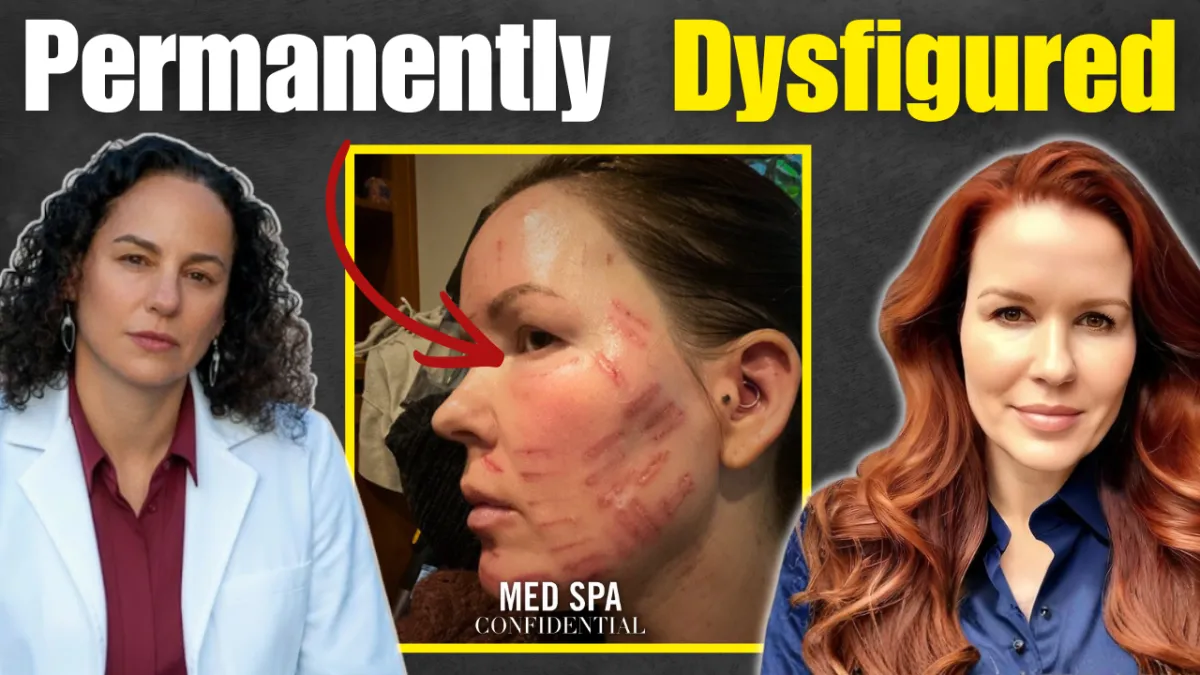
Sarah Kabalka is a nurse practitioner with 13 years in medical aesthetics. She agreed to a radiofrequency microneedling treatment from someone she considered a trusted colleague.
Two and a half years later, she's still living with third-degree scarring she'll never fully recover from. Her story is one of the most important conversations I've had on the Medspa Confidential podcast, and I think every person who's ever walked into a med spa needs to hear it.
When the Device Isn't What You Think
"What I didn't know is that it was bought offline, probably from like Alibaba or one of those companies." — Dr. Kate Dee, Med Spa Confidential
The machine looked real, the room looked professional, and the person operating it had taken extra training at a laser institute. None of that mattered, because the device itself was not FDA approved and was purchased from an online marketplace with zero medical oversight.
There was no licensed medical director backing the purchase. No one with a medical license had approved that machine for use on patients.
When an esthetician can't get a legitimate medical director to sign off on a device, some of them just buy a cheaper, unregulated version online instead. You'd never know the difference from the waiting room.
In our conversation, Sarah and I break down exactly how an illegal device ends up in a treatment room that looks completely legitimate.
The Medical Director Who Didn't Know She Was One
"I had no idea until she said that, and I said, if I had been your medical director, I would never have approved or signed off on anything like this." — Sarah Kabalka, Med Spa Confidential
The esthetician had been quietly listing Sarah as her medical director. Without Sarah's knowledge nor her consent. Sarah hadn't seen the device, hadn't been trained on it, hadn't signed a thing.
She only found out after her face was scarred.
I've now spoken to more than one provider who was listed as a medical director without knowing it. It happens more often than you'd think. So when I say "ask who the medical director is and look them up," I mean it. Their name should be on the website. They should know what's happening inside that practice.
Trust Can Override Critical Questions
"It was all about trust. It's somebody that I trusted that I had worked with and was friends with for seven years." — Sarah Kabalka, Med Spa Confidential
Sarah is a medical professional, knows the questions to ask and even tells her own patients to ask them. And she still didn't ask them, because she trusted this person.
When we trust someone, we stop treating them like a provider we need to vet. We assume they're doing things the right way. That assumption can cost you.
In the epsiode, Sarah shares the exact transparency steps she now takes with every patient before picking up a needle. It's practical, it's specific, and it's something both consumers and providers can learn from.
Before Your Next Appointment
If you've ever skipped the questions because you were comfortable with someone, this episode is for you. Ask who the medical director is. Ask what device is being used and whether it's FDA approved. Look them up. It takes five minutes and it can make all the difference.
Sarah came forward because she didn't want anyone else to go through what she went through. The least we can do is listen.
[Listen to the full episode of Med Spa Confidential now.]
Episode Transcripts:
[00:00:00] Dr. Kate Dee: Have you ever assumed a treatment was safe just because a friend recommended it? Sarah Kabalka is a nurse practitioner with 13 years in medical aesthetics. She thought she was getting a legitimate RF microneedling treatment from someone she had known and worked with for years. Instead, she developed injuries.
[00:00:20] Dr. Kate Dee: She is still living with the consequences two and a half years later. We go deeper than the one bad treatment. Breaking down how a non [00:00:30] FDA approved device can end up in a treatment room that looks completely legitimate and how trust can override critical questions and why having a medical director does not always mean real oversight.
[00:00:44] Dr. Kate Dee: Sarah also shares the exact transparency steps she now takes with every single patient. Before she ever picks up a needle and stay till the end, because the most shocking part of her story has nothing to do with the device. If you get aesthetic treatments [00:01:00] or thinking about it, you need to hear this.
[00:01:02] Dr. Kate Dee: Hi, I'm Dr. Kate d and I'm speaking today with a nurse practitioner Sarah Kabalka,
[00:01:08] Dr. Kate Dee: Sarah, thanks for being here today.
[00:01:10] Sarah Kabalka: Thank you. thank you for having me. you know, I had worked with this person for about seven years and I trusted her and she said that she had gotten a radiofrequency microneedling machine, and this was two and a half years ago, so it was relatively new technology. And I had worked with somebody who had had it done and said it was the [00:01:30] most painful thing that he had ever gone through, but he was kind of torn up the next day.
[00:01:34] Sarah Kabalka: But nothing like I was.
[00:01:36] Dr. Kate Dee: And this was a, a, an acquaintance or a friend that you'd work with Who is an aesthetician.
[00:01:41] Sarah Kabalka: she was an esthetician. She's a master esthetician.
[00:01:44] Dr. Kate Dee: in Washington State, there are not very many states that have this, but we do have a certification for. Master aestheticians that are actually allowed to do lasers and other medical things, within their scope under a doctor.
[00:01:58] Dr. Kate Dee: So in Washington that, [00:02:00] that's legal.
[00:02:00] Sarah Kabalka: It is. And she had taken, further education at the Laser Institute in, in Arizona. So I had no reason to believe that she didn't have a medical director. she said she was getting really good results from patients and I had wanted to try it because it was sort of. We all do in this industry, the newest whatever.
[00:02:25] Dr. Kate Dee: What I didn't know is that it was bought offline probably from like [00:02:30] Alibaba or one of those companies. And so she didn't have an NPI or a national certification person,an advanced practice person or, or an MD to back her up to buy these, these devices.Basically you have to be a medical, like a Yeah.
[00:02:48] Dr. Kate Dee: to buy one of these things. So if you're an esthetician and you don't have a medical director, the only thing you do is buy a cheap illegal one off
[00:02:56] Sarah Kabalka: and that's what happened.
[00:02:58] Dr. Kate Dee: okay, well you didn't know this at that [00:03:00] time.
[00:03:00] Sarah Kabalka: no, I didn't, and nor did I know she was calling me her medical director.
[00:03:06] Dr. Kate Dee: Yeah. Wait, so she was actually using you as her medical director and you didn't know it.
[00:03:11] Sarah Kabalka: No.
[00:03:11] Dr. Kate Dee: Wow. Okay. Okay. So, yeah, it was a question I asked later is, if I'm your medical director, why would you not inform me and how did you get it? Because you don't have my medical license.
[00:03:24] Sarah Kabalka: And she said she didn't need it.
[00:03:26] Dr. Kate Dee: so you don't know any of this at this point. You [00:03:30] are her, your, your longtime colleague got a new device. He thought it was legit. You showed up in her office, presumably, right.
[00:03:39] Sarah Kabalka: Right.
[00:03:40] Dr. Kate Dee: and then what happened?
[00:03:41] Sarah Kabalka: So she numbed me because I wanted to try it, and she used the wrong cartridge, unfortunately. So it started out at one and I.
[00:03:55] Dr. Kate Dee: Like the needle tip that or
[00:03:57] Sarah Kabalka: Yes, the depth. So [00:04:00] I don't know what the energy was. but she started the depth at one and I didn't feel anything. And a friend of mine again said it was the most painful thing he had gone through.
[00:04:11] Sarah Kabalka: And so I said, what happens if we go up? And she said, do you want to? She said, yeah, we can. But I didn't know she was gonna go to one. To a hundred, you know, one, two, I think it was 3.5 millimeter depth, so we're getting into subcutaneous tissue. [00:04:30] And the, the heat that was produced, the energy that was produced by those needles at that depth went straight into subcutaneous
[00:04:38] Dr. Kate Dee: Yeah, so the, the dermis is where you're. Really wanna focus that
[00:04:44] Dr. Kate Dee: energy. And so you really want a depth, and of course you need insulated needles and you want a depth of, you know, between one and 1.5 millimeters, usually, right? Maybe up to two if you have thick skin or you're an area [00:05:00] of the body that has thick skin.
[00:05:01] Dr. Kate Dee: So she's going all the way up to 3.5, which gets you into the subcutaneous fat, which is not where you wanna be, but okay.
[00:05:08] Sarah Kabalka: they created little white dots. They were sticking to my skin and I didn't know it, but my son was in the room and he knew something was wrong because the needles are supposed to just go in and out, and they just kept pulling on my skin. I guess she kept ripping off the tip and she didn't stop.
[00:05:27] Sarah Kabalka: So if she
[00:05:27] Sarah Kabalka: had
[00:05:28] Dr. Kate Dee: skin was sticking to the [00:05:30] needles, basically
[00:05:30] Sarah Kabalka: it was because she was using non insulated needles also. And the wrong tips. So these are 10 linear needles. They're non insulated. They're going way past the SMA as where you really wanna be for that collagen production into the subcutaneous fat.
[00:05:45] Dr. Kate Dee: Right. And so, and I know we've covered RF microneedling in a couple podcasts before, but if people are listening or watching and they don't know. So the reason I've come out super duper strong on, on this podcast [00:06:00] about being against anything with uninsulated needles, 'cause the damage they do is really, really huge and you can get a lot of complications from that scarring and hyper and hypopigmentation.
[00:06:11] Dr. Kate Dee: It's, it's the equivalent of doing a very uncontrolled ablative laser. It's, it's very dangerous. And, and so what you're describing is it she's using, she's doing exactly that and too deep. It's sticking to you and she's pulling it out and bits of your skin are basically coming [00:06:30] with it.
[00:06:30] Sarah Kabalka: I guess I was, I didn't know it was happening 'cause I didn't feel it.
[00:06:34] Dr. Kate Dee: Well, that's good Numbing.
[00:06:36] Sarah Kabalka: so I didn't know and then I looked in the mirror and, 'cause she said, I don't know what this is. And it was the first one. She just sort of stopped. I would be, I'd only have a couple, but then I don't know because I'm not a laser tech, and so when I used to work, family practice, I had anesthesiologist, I had family medicine, I had internal medicine docs.
[00:06:59] Sarah Kabalka: It doesn't [00:07:00] matter. At that point, they're my patient, right? They're sitting at my table. I'm her patient. I am not a laser expert. I don't know what these dots mean. I know that I've seen it with some like radio frequency bifurcation, dah, dah, dah, dah da. I've seen it with those, with some of those machines, but I don't know what it is.
[00:07:22] Sarah Kabalka: And I said, is it like frosting? And she said, you know what? I have seen it and it is frosting. And she just continued. And so [00:07:30] then after that it continued all the way down into here, through here. Here, and yes, into my subcutaneous tissue. Here, here, here. and I was at 13 years of working in this industry and I still had.
[00:07:49] Sarah Kabalka: There's no other word for it. It's botched.
[00:07:52] Dr. Kate Dee: Hmm.
[00:07:52] Sarah Kabalka: I'll never
[00:07:53] Sarah Kabalka: have, I can't get rid of these scars. They're third degree. They eventually started to split open and then [00:08:00] you could see straight down into the fat. Once they started healing, they started healing wide. And that's when I contacted a friend of mine that I used to work with in Albuquerque.
[00:08:10] Sarah Kabalka: He's a double board certified plastic surgeon and ENT doc. And I said, what do I do now? Should I suture him shut? And he said, you have to debride him. And I said, okay. So a friend of. They were, well, one was infected. We got that infection under control. I was on high dose [00:08:30] steroids. I did hyperbaric oxygen therapy.
[00:08:32] Sarah Kabalka: I did PRP, I did multivitamin IVs. I did everything I could do while I was in the healing process, but they just kept breaking open the fluid behind them. I was so swollen. They just kept popping open.
[00:08:46] Dr. Kate Dee: so you, you talked to your, your, your mentor who's a plastic surgeon. You tried all these different things over the last, what, two and a half years? And, so it really has left you with some, some permanent scarring.
[00:09:00] [00:09:30]
[00:09:43] Sarah Kabalka: it has left me with a lot of permanent scarring and it's never going away. I mean, it's, it's, and because it was 10 insulated needles, a lot of people online didn't believe it. They said that I was doing it because,It AI or it [00:10:00] was self harm, which I took huge offense to because that's scary.
[00:10:05] Sarah Kabalka: because it went viral so quickly. And so I don't want people to believe that that is a form of self harm. And sometimes it's just the lighting on a
[00:10:16] Dr. Kate Dee: Self harm. They're implying that you went to this person on purpose, who, that she would hurt you or they think you somehow did this at home and it wasn't
[00:10:26] Dr. Kate Dee: another person.
[00:10:26] Sarah Kabalka: it
[00:10:27] Dr. Kate Dee: Well, we, we know it was another person. We're not gonna say who this [00:10:30] person was or, or where this was. I think the important thing is to recognize that, there are many, many, many, people who are buying devices on the internet that are not FDA approved, and then they're literally practicing medicine without a license, and it's very risky, right.
[00:10:49] Sarah Kabalka: Right, and so that's the thing. how do you keep yourself safe? How do you know that these people are legit? Or how do you know that? The, the device that they're gonna use [00:11:00] is an FDA approved device, and that they have adequate training, they have a medical director behind 'em.
[00:11:04] Sarah Kabalka: What do you do when adverse events happen? I mean, these are all questions that people need to ask, and I didn't ask them
[00:11:12] Dr. Kate Dee: Yeah, because of trust.
[00:11:15] Dr. Kate Dee: Yes. And that's the thing, right, is, is for whatever reason, if, if you trust that person for whatever reason, and you don't ask that question, right? I have had, I've had patients who are lawyers [00:11:30] who, you know, they went to a place that was illegal and they didn't ask the question either, but that's because their F friend went there and they just trusted them because they assumed.
[00:11:40] Dr. Kate Dee: That it was legit. And I think there's this assumption, I, I had, another guest on the show that said, like, look, when you walk into a restaurant, you assume they're getting inspections and you're not asking, you know, do you have a license to sell me the cheeseburger? Right? And so when you walk into a place that looks legit, you.[00:12:00]
[00:12:00] Dr. Kate Dee: People are not used to asking those questions, you know, you know, do you have a license to do this procedure on me? and, and what I think a lot of people don't realize is that our legal system depends on. Uh, this reliance on the professional, which is just, it's the doctor. Okay. The doc. It's, it's the doctor's license that they get.
[00:12:22] Dr. Kate Dee: And you have to, you know, there's a whole lot of standards that we have to comply with, and it's our license on the line. So if we [00:12:30] do something dangerous, we could lose our license and our livelihood and we'll never be able to practice medicine again. But that, so the law relies on that check. Right.
[00:12:39] Dr. Kate Dee: But now we have, in the last, especially the last 10 years. An economy where people can purchase illegal medical devices online, just delivered to their home or their spa, and just do this. And there's no check. There's no balance. Nobody's looking. And if you don't ask that question. [00:13:00] There's always the possibility that this person's completely illegal and there is no medical director.
[00:13:05] Dr. Kate Dee: There is no doctor. So that's why I always, that's like the number one question you should ask before you go to any, any provider, okay. Is, is not just what's your license, but who's your medical director and look them up.
[00:13:18] Sarah Kabalka: What device are you using? Look it up.
[00:13:20] Dr. Kate Dee: yes. I mean that's, that's the problem. But at least if there's a medical director.
[00:13:26] Dr. Kate Dee: That person is responsible for making sure that that [00:13:30] device is legal and you're trained on it and it's safe. The medical director is there to make sure that it's safe. So the idea of having, you know, a, a medical director who doesn't know anything about the device or what you're doing, or aesthetics in general, that's, that's really not okay.
[00:13:48] Dr. Kate Dee: And then also the idea of having somebody who. It doesn't even know that they are the medical director. Now, you're not the first person I've talked to, who [00:14:00] was being used as a medical director and they didn't even know it. I've, I've talked to one other person in the past where when they tried to get their own,contract with one of the, you know, toxin providers, they couldn't because.
[00:14:14] Dr. Kate Dee: Because that company said, well, you, you're already the medical director over here. You already have an account. And, and that person had no idea. So,
[00:14:21] Sarah Kabalka: I had no idea until she said that, and I said, if I had been your medical director, I would never have approved or [00:14:30] signed off on anything like this. You have to talk to me before you buy anything that's invasive or that needs, I mean, that's something that. You do training on, right? You buy a device that is FDA approved, that company comes in and hands on trains you and your staff and everybody else, including the medical director.
[00:14:49] Sarah Kabalka: And so I would never have. I would never have signed off on something like this, especially because it wasn't FDA approved, but also because I wasn't told about it [00:15:00] or I wasn't trained on it. So those are things because if I have a, if she has a complication, say this was not my face with somebody else's face that she did this to, and she calls me as her medical director, I'm in huge trouble.
[00:15:14] Sarah Kabalka: Right? So I would never, ever sign off on anything like this.
[00:15:19] Dr. Kate Dee: Did she tell you you were her medical director just for that moment?
[00:15:24] Sarah Kabalka: No, it was after the
[00:15:25] Dr. Kate Dee: or, or literally are you on all her accounts.
[00:15:29] Sarah Kabalka: I have [00:15:30] no idea. I've called most of what I know. She has to make sure I'm not on any of her accounts.
[00:15:35] Dr. Kate Dee: Okay. Wow. Okay. So the, the crazy thing is that if you, if you go online, there are, aesthetician, spa source, you know, websites, tons and tons of them where aestheticians can buy all kinds of devices, uh, that they can use in their spas. And the, the crazy thing, there's just this giant overlap in, in actual what they're [00:16:00] allowed to do.
[00:16:00] Dr. Kate Dee: And then all these. Illegal devices. it's, it's really remarkable actually. I just was looking up a device the other day 'cause someone told me that they got treated with a device I'd never heard of and I had to look it up and, and, and actually it was taken off that company's website, um, because, uh, probably because of something like this.
[00:16:22] Dr. Kate Dee: so what, I'm just curious though, like, so when this was happening and your skin was. Sticking to the needles and she was [00:16:30] pulling out and it was getting stuck. She just kept going and doing the whole face.
[00:16:34] Sarah Kabalka: So the first one again was up here. That's when she turned the energy or the depth up, which I'm sure the machine just sort of, I don't know if she changed the energy. It probably changed on its own, based on depth. And then she kept going and as soon as she kept going, it came all from here to here. So it's, it's kind of like if you look at me on this side.
[00:16:58] Sarah Kabalka: Those are where [00:17:00] all the scars are. And then on this side it's, I got away with one
[00:17:06] Sarah Kabalka: or
[00:17:06] Dr. Kate Dee: Mm-hmm.
[00:17:07] Dr. Kate Dee: Wow. And was she, did she recognize the damage that was done? Did she do anything to treat it? Did she see you back in any kind of follow up or did she refer you to, to a specialist, to like, take care of the burns?
[00:17:21] Sarah Kabalka: no. She just said that she would pray for me.
[00:17:24] Dr. Kate Dee: Okay. Um, that's helpful. So was she concerned?
[00:17:29] Sarah Kabalka: [00:17:30] No,
[00:17:30] Dr. Kate Dee: Not concerned at all. Thought, oh, this
[00:17:31] Sarah Kabalka: not concerned at all. she kept asking me what it was.
[00:17:36] Dr. Kate Dee: Okay. This kind of reminds me of when the plasma pens first came out, which has been many years now, and there's various devices that you can just lump into that category where. It's basically, you know, a cautery in a little dot, and you, and you, you press down on the skin and if you, if you touch the skin very lightly, you'll just get the [00:18:00] epidermis and you probably won't do too much harm.
[00:18:02] Dr. Kate Dee: But the more you press, the farther down you cauterize, the more and more damage you can cause. And it's not controlled in any way. It's literally your hand, like, you know, putting this thing on the skin. And the first time I saw this demoed, I'm like, this is insane. Like, how could this be done? This, this cannot be approved.
[00:18:21] Dr. Kate Dee: This is crazy. and that was being offered by estheticians all over the place. I mean, doctors would never use that, but it was just a totally [00:18:30] normal, like, you know, estheticians thought nothing of it because it wasn't. It wasn't regulated, right? Like it just, you could just buy it and use it and, oh, it's the next best thing, you know, and it, I've just completely, I still can't believe those are in use anywhere.
[00:18:44] Dr. Kate Dee: Um, so if you're, if you're trying to avoid something besides uninsulated, rf, micro newing, avoid plasma pens, anything they call. Fibroblast, which is a ridiculous name because Fibroblast is the name of your cell inside your [00:19:00] dermis that make collagen. We love fibroblasts. They're cute, they're adorable. They make collagen.
[00:19:04] Dr. Kate Dee: We love them. but they call that treatment fibroblasts. Um, first time I heard it I was like, what are you talking about? But anyway, very dangerous. So let, let's not
[00:19:13] Sarah Kabalka: I
[00:19:14] Sarah Kabalka: totally agree.
[00:19:15] Dr. Kate Dee: okay. Well, so it's been, it's been two and a half years. We're not, we're not naming names here, but, is there, how has this affected your practice?
[00:19:23] Dr. Kate Dee: Is there anything that you, do now that you realize you, you should have been doing [00:19:30] before? How has it changed your clinical practice?
[00:19:32] Sarah Kabalka: So, I mean, it's changed everything when I first came back to work. 'cause I couldn't, obviously I couldn't work for a while. I had three patients that I had known for a really long time, and they came and, and they started crying. I mean, they didn't even know what happened, but they just burst into tears.
[00:19:49] Sarah Kabalka: And then I explained what happened and they were appalled. And I, I guess I was in sort of denial. It will, it will heal. It will heal, it will heal. And [00:20:00] then I flew down for my first treatment and it's, it turned out it was third degree, so it's not going to heal. that's the unfortunate fact. Between third degree and second degree, you get 50 50.
[00:20:12] Sarah Kabalka: At second, you get a hundred percent, a hundred percent scarring at third. Right. So I've gone through five CO twos. I've gone through all sorts of things, since then, but I have to explain it to every new patient. Mm-hmm. I've had patients just one, just one [00:20:30] the other day who is saying, I was totally afraid of you when I first met you because of the scars.
[00:20:36] Sarah Kabalka: I've had patients walk out because they don't wanna look like me.
[00:20:39] Dr. Kate Dee: Wow.
[00:20:40] Sarah Kabalka: And I can't blame 'em. I mean, in the beginning especially, I didn't wanna look like me and I still don't, but it, it's, it, that doesn't mean it doesn't hurt. Do you know what I mean? I
[00:20:51] Dr. Kate Dee: no, I mean, uh,
[00:20:53] Dr. Kate Dee:
[00:20:53] Dr. Kate Dee: absolutely. Especially, you know, in this industry it can be very, very harsh, right? yeah. [00:21:00] And, and also because you're offering skin treatments, it's, it's helpful to have, you know, good skin. you know, I mean, it's like going to a plastic surgeon who's. So good. It's like, you know, it's like, well, like what are you, what are you doing
[00:21:16] Sarah Kabalka: Or somebody who's totally over injected there. I ran across an Instagram.real the other day, and it was a, it was a split of two, two,injectors and one was completely over injected and the other looked pretty normal. Which [00:21:30] would you choose? And it was ev I mean, everybody said the same thing. You want somebody that looks normal.
[00:21:35] Sarah Kabalka: You want somebody who looks good, they don't wanna look 52, but what have you been doing to your skin? And so that was the question I got all the time. What do you do to your skin? What do you do to your skin? What do you do to your skin?
[00:21:48] Sarah Kabalka: And I don't get that anymore.
[00:21:49] Dr. Kate Dee: yeah. Well, you know, just to reassure people watching, so I mean, RF micro needling is actually a fantastic treatment, in the right hands, [00:22:00] obviously the right device in the right hands. And there was, there was recently this. FDA warning about RF microneedling and,I think that that's all about the device and who's doing it.
[00:22:11] Dr. Kate Dee: I, I personally have had so many RF microneedling treatments since I turned 50. I, I'm 58 now. Um. That I don't even know how many, probably in the high teens, but, um, yeah, I mean, I did five that year and then I've done one every six months since. So it's been a long time. [00:22:30] and so it, it's not a disaster at all.
[00:22:33] Dr. Kate Dee: if, if you are very, very careful and it's done right, it can be fantastic. But, um, it, it just. It's so hard because people are trying to cut corners in both, on both sides, right? This person was clearly cutting corners. Big, big, big corners, big illegal corners. But then also like a lot of people are like, oh, that's so expensive.
[00:22:53] Dr. Kate Dee: It is. 'cause it's an expensive device. It takes a long time to do. It takes a highly skilled person to do it. [00:23:00] So, you know, but you go to, you know, a place like my place and, and oh gosh, that's kind of pricey, and you go find something cheaper. And the, the thing is, the cheaper thing might be really super crazy dangerous.
[00:23:10] Sarah Kabalka: So,I mean, price is part of it, but there is that saying that cheap Botox isn't good and good Botox isn't cheap. You want to go to, you're not just paying for the product, you're paying for the, the person that is administering this treatment, whether or not it's filler or it's Botox, or it's RF [00:23:30] microneedling.
[00:23:31] Sarah Kabalka: You are paying that person so I can put on my white coat and bring in RF microneedling and say, I know what I'm doing and I have no idea. But these people want, they want it and I'm doing it at a low price, so they do it. And that was something that came up a lot on the forum when I started posting the photos was you did it because you're cheap.
[00:23:53] Sarah Kabalka: And it wasn't that we trade treatments all the
[00:23:56] Dr. Kate Dee: Right,
[00:23:57] Sarah Kabalka: industry, and so. [00:24:00] Right. It was all about trust. It's somebody that I trusted that I had worked with and was friends with for seven years, so there was no reason for me really not to trust her. She has other FDA approved devices. I didn't think, I didn't think she would be so
[00:24:17] Dr. Kate Dee: I am,
[00:24:17] Sarah Kabalka: to.
[00:24:17] Dr. Kate Dee: I'm kind of hoping she has a real medical director now though, if she really does do
[00:24:22] Sarah Kabalka: Well, and that's a whole other topic. I actually dropped somebody as a medical director because they were doing things that were outside of [00:24:30] their scope by a long shot. And now there are these companies where you can just like rent a medical director and I don't even know if they're in the same state, but they've never even met you.
[00:24:41] Dr. Kate Dee: Yeah.
[00:24:42] Sarah Kabalka: And so how proficient are these medical directors and how much do they know? I mean, yes, rf, microneedling in the right hands can be great. For me, it's, I'm not doing it again ever. I.
[00:24:56] Dr. Kate Dee: don't blame you. I don't blame you. but I agree with you about the [00:25:00] medical director. So that's one of the things, at the Meds Spa Board, we not only confirm that the medical director is licensed in the state, but also, um. We interview the medical director to make sure they know about aesthetics, to make sure they know who their, their, staff is, to make sure they are actually doing the job of a medical director.
[00:25:19] Dr. Kate Dee: and then of course they have to sign an attestation saying, yep, I, I, everything I just told you is true. And I, I do think that that, is so very important, [00:25:30] so. Finding a place that's legit means having a real medical director, not just an absentee one, and not just a rent. AOC and I, there's a company that I was, uh, starting to research and I won't name it 'cause I don't know yet.
[00:25:45] Dr. Kate Dee: but there's a company that literally their whole job is finding medical directors for people who need one. And I, I, I think that it's really important that, that we investigate. That company and find out like who are they actually [00:26:00] finding for this? And do they have the skills to actually supervise the, the person And are they there?
[00:26:06] Sarah Kabalka: I mean, there are laws being proposed right now in, it's like four or five different states that require the medical director to actually be in-house a certain percentage of the time. Right.
[00:26:19] Dr. Kate Dee: and a lot of these places, the medical directors nowhere near the place. Like they're not in house ever because they're not there.
[00:26:27] Dr. Kate Dee: I did a previous, episode about two [00:26:30] medical directors in California, one of whom supervised 13 or 14 spas. All over the state and, and then one spot in Maine. And I was like, there's no way you are supervising all these places. And he had a full, he had a full-time job as a palliative care doctor in, in Napa.
[00:26:49] Dr. Kate Dee: And, and I was like, there's no way he's traveling around and actually personally supervising anything. Right.
[00:26:55] Sarah Kabalka: No. And it when you get, so I was a medical director for a place in Seattle [00:27:00] and they ended up going, it wasn't anything that happened between us, it's just they wanted somebody there full time and they were bringing on. She was in an injector and, and she was a nurse practitioner. I think she was a DNP.
[00:27:14] Sarah Kabalka: And so they had, I, it was just, it was fine. It was, we were just flitting ways and um. And she's on, of course, their website, and you should always have the medical director on the website. But when I worked for her, there was an adverse event and he was able to [00:27:30] contact me to tell me about it, about, and show me pictures and tell me what happened and blah, blah, blah.
[00:27:34] Sarah Kabalka: And I was able to tell him how to treat it and what to do, because that is extremely important. I need to know what you're offering so I know how to treat what you're showing me. Because those, if you want a reputable place, that's another thing that you need to do, is you need to go online and you need to see who that owner is and who their medical director is.
[00:27:55] Sarah Kabalka: I was never on her website as a medical director ever, so it [00:28:00] was really shocking to hear that I was her medical director.
[00:28:03] Dr. Kate Dee: Wow. That's crazy.
[00:28:05] Sarah Kabalka: crazy.
[00:28:05] Dr. Kate Dee: well, is there anything else about your story that you wanted to share? I know that this has been just a, a really difficult journey, um, but I think it's been really, really helpful to be able to, to share with our audience, just especially, to not feel bad when something happened to you.
[00:28:22] Dr. Kate Dee: You just, there are so many people who are victims of these illegal places that are just, they're blaming [00:28:30] themselves and I think you need to not ever blame yourself because you trusted this person and, and you know, it's, it. That, that is so difficult to override that even if you're feeling a little like hmm, in the moment, you trust that person and you don't say anything till you have a moment to process it later.
[00:28:50] Dr. Kate Dee: You know? So I've, I've heard from so many people anonymously now, who they're telling me their stories, but they just, they don't wanna talk about it. They want, don't wanna be [00:29:00] identified because they, they, they partly feel like it's their fault. And I, I just want that message
[00:29:04] Dr. Kate Dee: to go out to everyone. It is
[00:29:06] Sarah Kabalka: that, that is absolutely still part of, and I have said it online, I mean there have been a lot of people to that said, it's your fault. It's your fault. It's your fault. And I have, and there's been, the medical community for the most part online, have been a. I mean, in my corner, they have been, I, I will fly you out here and [00:29:30] treat you.
[00:29:30] Sarah Kabalka: I will send you this to try on your skin. I will, do you know what I mean? They're just appalled and, and, and they have fought back for me, it is not her fault where I'm sitting here typing away saying, you're right. It is my fault because I trusted her. I didn't ask the right questions, which I. Always tell patients to do.
[00:29:52] Sarah Kabalka: I didn't ask for her license. I didn't ask where she bought the machine. If it was FDA approved. [00:30:00] I didn't do the things that I tell patients do because I did the exact thing I tell 'em not to do. I trusted her, and so there is a huge part of me that is still guilt ridden.
[00:30:09] Dr. Kate Dee: Mm-hmm. Well, don't be really, and I, I just, I really, really appreciate your willingness to share your story. 'cause I know how, how difficult that is. it's hard. I, I think that, you
[00:30:22] Dr. Kate Dee: know,
[00:30:22] Sarah Kabalka: is hard.
[00:30:23] Dr. Kate Dee: you know, before I got down this road, I mean, when I first started in aesthetics, [00:30:30] I, I really, I was very trusting and I just, I thought, well, this is medicine, so we're gonna, we're gonna, I had really felt like I needed to learn as much as I possibly could and do, do it really right, or I wouldn't feel comfortable and
[00:30:43] Sarah Kabalka: Right. Well, that's
[00:30:45] Dr. Kate Dee: everywhere.
[00:30:46] Sarah Kabalka: and ethics.
[00:30:47] Dr. Kate Dee: and the problem is that everywhere I turned there was someone doing it illegally. And I was like, how is, how are they getting away with that? Right? Where,
[00:30:55] Dr. Kate Dee: and I, I knew all along there were people who had been harmed, but it's like, [00:31:00] it's so hard for people to speak up and, and it, it, the problem just got harder and harder and worse and worse.
[00:31:06] Dr. Kate Dee: That, that's why I ended up writing that book. 'cause I just needed to get it outta my system. I thought okay, just. Write about it and people can read it or not. And then I then, at least I've said my piece, but, but one thing has led to another and it turns out, you know, oh my gosh, it's even bigger than I ever imagined.
[00:31:24] Dr. Kate Dee: Even worse, I, when I was first writing this, I thought maybe it's a third of these places [00:31:30] illegal. And then as we got farther along and the book was coming out, I'm like, it's probably at least half given what I'm learning. And now with the studies recently coming out of New York. Florida, it's like 60%, and they're not even looking at CPOM law violations, so I think it's probably even more than 60%, but we're right now, I'm saying that
[00:31:52] Sarah Kabalka: But Florida has different laws, like you can't sue physicians or something. So, and that's a whole different topic
[00:31:59] Dr. Kate Dee: well, lawsuits [00:32:00] aside, I'm just talking about who's complying with the law and,
[00:32:03] Dr. Kate Dee: and there's.
[00:32:04] Dr. Kate Dee: There's very, there's, there's just so many people who are just not so,
[00:32:08] Sarah Kabalka: No.
[00:32:09] Sarah Kabalka: I mean, and that's another thing I tell people when, when I'm teaching 'em, when they first walk into my office, and they've never met me, but they've been referred to by somebody because they don't advertise. so it's like somebody's referred or Google review or whatever. I always te, especially if I'm opening a new bottle of, first of all, I never [00:32:30] walked out of the room unless I'm getting filler.
[00:32:31] Sarah Kabalka: 'cause I don't have enough cabinet space to put everything. But I have a refrigerator in the room, so I always have my neurotoxin in there. And if I'm opening a new bottle, a Botox or Dysport or whatever, I don't use anything else. So I guess I'm not opening anything else. I show it to
[00:32:47] Sarah Kabalka: him. I, I take it outta the box and I say, this is it.
[00:32:52] Sarah Kabalka: Can you see it? And they're like, it's empty. And then I'm like, yeah, you see this little white ring? [00:33:00] That's it. And that's where people will over dilute. Botox. Right, and so I actually under dilute because there seems to be a, uh, a correlation between the COVID vaccine and Botox longevity. I don't know if it's true or not, but it does seem to wear off faster since COVID vaccine came out.
[00:33:21] Sarah Kabalka: So I actually do 2.3 and I'd rather have happy people, but I never walk out of the room and I don't trust when an [00:33:30] injector will walk outta the room to fill. Something I do it, unless they're really needle phobic and they cannot watch me do it, I will do everything. If I'm doing S Sculptra, I will start reconstituting sculpture right in front of 'em
[00:33:45] Sarah Kabalka: so they see every needle I pull up, they see everything I do.
[00:33:48] Sarah Kabalka: They see it step by step, and I educate the whole time I'm going through this. They probably might retain 10%, but you know the 1% that they'll retain, they'll retain that. I did it in front of ' em.
[00:33:59] Dr. Kate Dee: right, [00:34:00] right.
[00:34:00] Sarah Kabalka: the next time they go someplace and that person walks out of the room, they're gonna think,
[00:34:05] Dr. Kate Dee: Well, so I have, I have to say that like everyone's workflow is different and we actually do it. Very similarly, we do our counter in our fridge and our are all in the same room. And we, we do draw up in, in front of the patient with the patient in the room. But, but not everybody has that set up. So, you know, I have a, another spa where the,there's four rooms in a row [00:34:30] and the, the prep area is, is outside that room in a, in a separate space.
[00:34:35] Dr. Kate Dee: And so all the Botox and all the supplies are in one place. because we also have four rooms in my, in my place. And now you've gotta have like a separate fridge in every room, like a separate
[00:34:45] Dr. Kate Dee: supply and like,
[00:34:47] Dr. Kate Dee: whereas, so it can be a very reasonable workflow to not be in the room. So I don't want people to go home and think,
[00:34:53] Dr. Kate Dee: oh, that's a red flag.
[00:34:55] Sarah Kabalka: it's it's true,
[00:34:56] Dr. Kate Dee: the bigger, the bigger thing is Yeah. Is, is, is to [00:35:00] absolutely know that they're using real product one way or another, and one way to prove that is they're doing that in front of you, but. The cases, last year of botulism from fake Botox. the one nurse practitioner who actually, uh, was reported this was in Illinois, she had ordered fake Botox off of Alibaba and she thought it was real Botox, or that's what she told authorities, and it was a spoofed box.
[00:35:25] Dr. Kate Dee: Like the box was obviously fake. If you've dealt with real Botox in [00:35:30] real life. You'd pull that one up and like, where'd this come from? That looks weird. But, so, but, but she didn't know. And a patient would not know. You would see that it would look like it was a Botox vial and it wasn't. so that's something also that can be very difficult.
[00:35:45] Dr. Kate Dee: Right. So I think the, the more important thing, rather than you, you know, you can validate the, the, the vial because you can I see the vial, please. That's totally reasonable that I can go get the vial. it is very unlikely they've got a real vile of [00:36:00] Botox. Um, but they pulled it from a fake one and they're giving you fake and they're gonna show you a different vi.
[00:36:04] Dr. Kate Dee: That that's, I don't, I think that's very improbable. I think the most important thing though is to make, to make sure that they are an actual licensed medical provider and that there's an actual medical director there. those are the top two things because those people do not wanna lose their license.
[00:36:22] Dr. Kate Dee: So they are much less likely to be doing something illegal. 'cause if they do, they'll lose their license. [00:36:30] And whereas these unlicensed people, they've got no license to lose. They do whatever they want and there's nobody coming after them. And, and you know, I've had, you know, many cases reported to me where, you know, they report this nurse, so nurse lost her license doing illegal things.
[00:36:46] Dr. Kate Dee: Okay. Nurse doesn't have a license anymore. Still doing all the illegal things and they get report to the nursing board. And the nursing board says, what more can we do? We already took her license away.and so, so, you know, the people [00:37:00] with no license have gotten nothing to lose. And so you wanna look that up and make sure it's, it's valid.
[00:37:06] Sarah Kabalka: I hang everything on my wall, so there's no question.
[00:37:10] Dr. Kate Dee: And it should be on the well too. Yeah. Yeah. Well, Sarah, thank you so much for sharing your story. I really, really appreciate it and I hope this has helped people. feel okay. and if anybody has a story they wanna share, you do not have to share it with your, with, your identity. But, I really do wanna hear from you.
[00:37:29] Sarah Kabalka: Yeah, I [00:37:30] think it's really important that we put this out there and that's, I finally got to a place where I felt like, okay, I can put it out there. There was a lot of lashback and that hurts, but at the end of the day, my priority is keeping people safe and knowing how to keep people safe because I don't want anybody to go through what I went through.
[00:37:51] Dr. Kate Dee: If you found this helpful, do me a favor and share it with a friend who's considering any aesthetic treatments. Subscribe so you don't miss the next one and drop [00:38:00] a comment telling me your biggest takeaway. I actually read them all. Let's keep each other safe and elevate the standards in the MedSpa industry.