The Skin Tightening Device with NO Human Trials
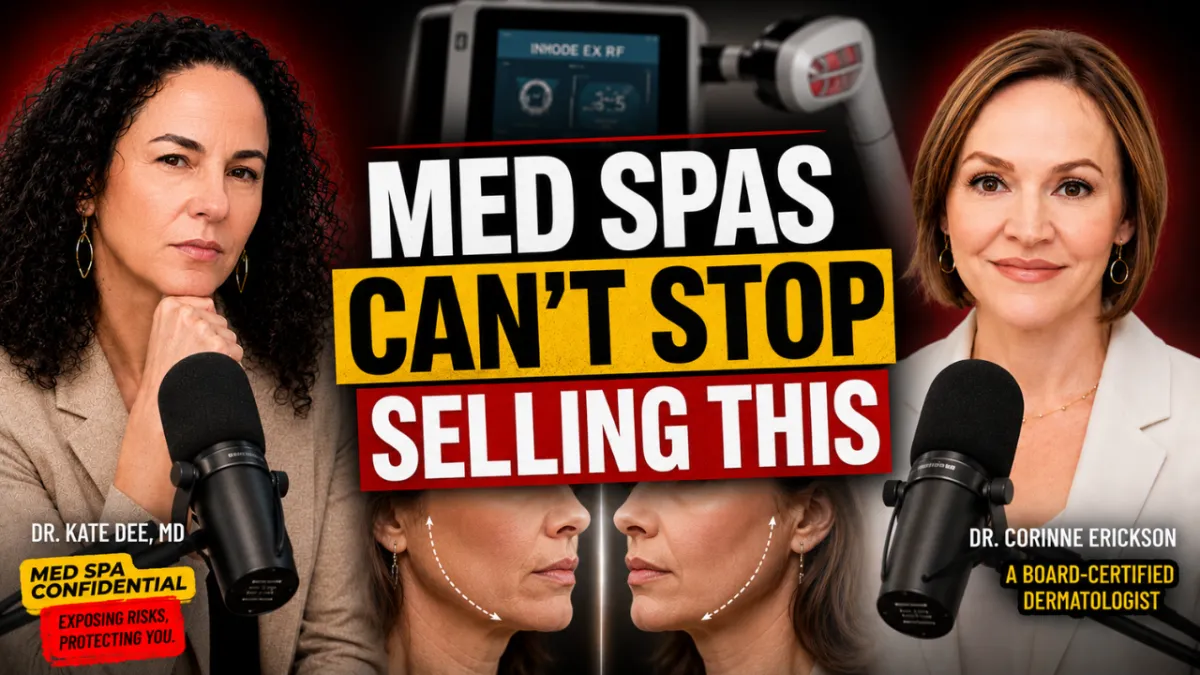
I sat down with Dr. Corinne Erickson, a board-certified dermatologist and owner of Georgia Skin Specialists in Atlanta. She's spent years evaluating RF devices and knows what the data actually says versus what the sales reps tell you.
We talked about what makes skin tightening technology genuinely safe, what makes it genuinely effective, and why one device in particular has me asking a lot of questions.
Ultherapy and Thermage: Should We Move On?
"I would not even have it done on my own face because of concerns about the discomfort, but also the potential injury." — Dr. Corinne Erickson, Med Spa Confidential
Ultherapy and Thermage had the right idea. Harness energy to heat deeper tissue, stimulate collagen, tighten skin. But both delivered results that were inconsistent, painful, and sometimes dangerous.
Ultherapy, in particular, penetrates deep enough to damage nerves and, in neck treatments, potentially the thyroid. Thermage used pulsed gas cooling that created wildly uneven temperature gradients. Patients were uncomfortable. Results were hit or miss.
What Good RF Actually Looks Like
"The epidermis maintains a cooling sensation while the heat gets delivered beneath it." — Dr. Corinne Erickson, Med Spa Confidential
The device Dr. Erickson brought into her practice is Everus, distributed by Cartessa and manufactured by Classis, a large South Korean energy-device company with a solid clinical track record. It uses monopolar RF at 6.87 MHz, which targets the dermis specifically.
That matters because what sits below the dermis is fat, and you do not want to heat fat in the face. Fat loss from improperly calibrated devices is one of the most common complaints in aesthetic medicine, and it makes skin look more saggy, not less.
What Everus does differently is a continuous cooling system. The skin stays comfortable while the heat does its job underneath. A published head-to-head study against Thermage showed statistically significant increases in collagen, elastin, and skin thickness.
One thing worth knowing: Real collagen remodeling takes months. Anyone telling you otherwise is selling you something.
The XERF Has Me Asking Questions
"Unless you are a two to three-month-old pig, there's no data on what it's going to do for you." — Dr. Corinne Erickson, Med Spa Confidential
XERF is everywhere right now on social media. It uses two RF frequencies, one of which penetrates 2.5 to five centimeters into the body. That's past the dermis, past the fat, potentially to the SMAS layer.
The claim is that deeper means better lifting. The problem is there's no human clinical data to support that. The one published study was done on pigs, and the authors initially failed to disclose they work for the company distributing the device.
I'm not saying it doesn't work. I'm saying we don't know yet. And clinics are selling it aggressively while patients are the ones finding out.
Before Your Next Skin Tightening Appointment
Listen to hear the full conversation with Dr. Erickson, including the one question she says every patient should ask before booking a skin tightening treatment.
Visit the www.Medspaboard.com
Episode Transcripts:
[00:00:00]
Dr. Kate Dee: The overhyped skin tightening device everyone's talking about right now has exactly one published study behind it, and it was done on two to three-month-old pigs. Yet clinics across the country are already selling it. I'm Dr. Kate Dee, founder and medical director of Glo MediSpa, and this is MedSpa Confidential, where we expose the risks, the red flags, and ~the outright illegal practices in happening--~ the outright illegal practices happening inside med spas right now because you deserve to know the truth before you book.
Today, I'm talking with Dr. Corinne Erickson, a board-certified dermatologist and owner of Georgia Skin Specialists in Atlanta. She's been evaluating RF skin tightening devices long enough to know which ones actually hold up. You'll find out why some older devices like Ultherapy and Thermage became known for pain and complications.
And you'll learn what truly comfortable skin tightening actually feels like~ and ~_~and~_ why the cooling technology in some devices like Eversis matters so much. And you'll hear why the immediate tightening you see after [00:01:00] treatment may not be the long-term result patients think it is. Stay until the end because Dr.
Erickson shares the one question you should ask before you ever book a skin tightening treatment
~Hi, I'm Dr. Kate Dee, and I'm back today because I really have wanted to talk about non-invasive, painless skin tightening for a while now. There are all these devices out there that purport to do that, and it has kind of a really niche role in aesthetics. So~ so thanks so much for talking to me today about this. I'm really excited.
Corinne Erickson: Oh, me too. Thank you so much for having me.
Dr. Kate Dee: ~So, so ~when we, you and I first connected, we both felt very similarly about a few devices that were like, that's old and don't, nobody wants to use those anymore. So I kind of want to name them and then dismiss them, if that's okay with you, and then talk about the ones we think are kind of viable now. So, so the first one, sort of a pet peeve of mine, is Ultherapy.
~Um, one old, old machine, old technology, super painful. Agree? We don't like that one.~
Corinne Erickson: ~No, ag-agree. Um, ~it's one that I've never brought onto my practice. I would not even have it done on my own face because of concerns about the discomfort, but also the potential injury,
Dr. Kate Dee: Yeah.
Corinne Erickson: you know, ~uh, ~lingering nerve malfunction, paralysis. Uh, that's not something I'm ready to sign up for for me or any of my [00:02:00] patients.
Dr. Kate Dee: Yeah. So as a, you know, recovering radiologist I like to call myself, you know, nothing would make me happier than to use ultrasound in aesthetics. It's, you know, been my vocation,~ um,~ for 12 years now. But it's just painful, but it, it penetrates. So the problem with ultrasound is that it penetrates and strong enough it'll damage anything underneath it.
So the big thing is, you know, it can kill the thyroid if you do the neck, and it can do nerve dam- all kinds of things. All right. Forget Ultherapy. For everybody listening, we don't like it. Okay. So then what about Thermage? We both sort of agreed, like also old technology.
Corinne Erickson: It's old technology. So this is where I think the concept of monopolar RF is fantastic, and that's energy that... Like, they were on the right track trying to harness
that. But with the pulse delivery and then pulsed gas cooling, it had a couple of significant issues. One, it was very, very painful, again, for patients.
These,~ uh,~ these devices are all [00:03:00] working by trying to impart heat deeper into the tissue, and they, in turn, can burn the epidermis. And, and so Thermage just, it was kind of like great idea, but poor execution that was painful with, again, some problematic side effects.~ ~
Dr. Kate Dee: ~Um, ~totally agree on all that. And actually when I started 12 years ago, Thermage was already kind of old back then. So
Corinne Erickson: Oh,
Dr. Kate Dee: So, okay. And the third one is,~ um,~ a device that I have had a long time ago, Exilis, which started out as Exilis Elite and then it was E- Exilis Ultra, and that actually used both RF and ultrasound also in an attempt to, ~ um,~ heat from the outside in.
And, and it had surface cooling, and the, the problem that I had with that is it was so operator dependent that it was really hard to get good results with that. Like, it wasn't a d- a bad idea, it just was really difficult to implement and get good results across the board.~ Thoughts~
Corinne Erickson: was the operator of that device [00:04:00] over a decade ago when it was brand-new technology, so it was the first iteration of it. And it was operator exhausting as well because you had to continue moving your hand in
Dr. Kate Dee: It was a workout.
Corinne Erickson: circles. And at the time when I was using it, you had to use your other hand to hold the thermometer
Dr. Kate Dee: Yeah.
Corinne Erickson: actually getting to the
Dr. Kate Dee: before... Yes. And then
Corinne Erickson: Yeah. I mean, it was...
Dr. Kate Dee: the thing where it was measuring that as you went, but still, it was really, really difficult to make that happen well.
Corinne Erickson: it was. And as soon as you would get anywhere close to that magical 40 to 41 to-- I never could get anyone to 42 degrees because then they would jerk their face away and say, " Ouch," and you had to follow them, otherwise you could burn them. You could arc the patient with that. ~So, yeah.~
Dr. Kate Dee: ~yeah, ~so I think the concept of trying to heat from the outside in is like it's nice, but it takes more technology and more skill or, you know, a more standardized treatment to make that happen. So now we have kind of like this wave of... There are multiple devices now [00:05:00] that are like next generation heating devices where it's essentially,~ um,~ less pain or no pain, and we can talk about that.
And then,~ um,~ and then better result, better cooling, better results, no damage to tissues underneath. So I know that you have one of them. I've, I have a, a, a very different technology one, so what most of these devices do is, is more like the one that you have. So let's talk a little bit about those, the one you picked and why you like it, and then some of the other ones 'cause they're very interesting to me and they all claim to do different things.
~Um, ~and the one that I, I don't like the hype... There's one called XERF that everybody's hyping big time,~ um,~ that I have questions about. ~But anyway,~
Corinne Erickson: As, as you should.
Dr. Kate Dee: so, so you have the one called Everus, it's by Cartessa, and that's a company that's based in New York. ~Um, ~so it is based in the US. They are backed by private equity.
I always look into these things because when I buy a [00:06:00] device, I know I'm marrying the company- So I kind of have to not hate the com-- Part of why I don't like XERF is I kind of hate the com... But, no, whatever. ~Um, ~they're kind of not a positive actor in the universe. But, ~ um,~ so tell me how Evers works and then how that compares to these other ones we're gonna mention.
So the w- the things that I found, I'm kind of curious to know what's on your list. The RF ones that are similar are Evers, XERF, Neurotype, which I had never heard of until I was researching for this interview, and then Jasys makes one called Density that sounds slightly better to me. So, so tell me about Evers and specifically why you like that one.
Corinne Erickson: ~Sure. ~So Everus is, yes, it is distributed in the United States by Cartessa. So Cartessa's a laser distributor and a device distributor. They don't actually produce any of their devices, which gives them this world of o- literally the whole world of options. So Cartessa goes to laser and device [00:07:00] developers, companies all over the world, and studies and selects those devices, and then brings them over and goes through the process of getting them FDA cleared, FDA approved in the US, and then they bring them over.
So Cartessa works with multiple device,~ um,~ producers, manufacturers all over the world. The Everus device is produced by Classis, and Classis is a South Korean company. It's one of the largest energy-based device companies worldwide. ~Um, ~they are backed by Bain Capital,~ um,~ and they have a strong, long history of safe, effect- effective devices in the industry.
Dr. Kate Dee: Yeah. And, and for everyone, like, you know, a lot of devices are produced in Korea. Obviously, they're kind of at the forefront of skin in general. ~Um, and, and I have, um,~ I have several devices in my practice that are, are from a Korean company, and they're [00:08:00] phenomenal. So there's absolutely no shade on Korea.
Corinne Erickson: No shade on Korea at all. In fact,~ um,~ that was something that was intriguing and interesting to me about Everus, because I care about the origin story of the device. I don't want something that is~ fresh off and, uh,~ fresh off the manufacturer platform that hasn't been used and studied with histology and safety and efficacy data over a period of time.
I've been an early adopter of things in the past, and I like being on the forefront, but I also like doing so with a good track record of safety and clinical data. And that's what Classis, just as a company, has done a really beautiful job with, with Everus.
Dr. Kate Dee: ~So, so,~ so Everus uses a monopolar RF that is at, what, 6.78 megahertz?
Corinne Erickson: 6.87 megahertz.
Dr. Kate Dee: 6.87, okay. Well, gollum, didn't know I had dyslexia. ~Um, ~so... And that's pretty,~ um,~ pretty shallow, so it's pretty much [00:09:00] targeting the skin,
Corinne Erickson: It's targeting the skin. It's targeting specifically the papillary and reticular dermis, and that is really important when we're talking about radiofrequency, as you know, because what's deep to skin? Fat.
Dr. Kate Dee: Fat. Yeah.
Corinne Erickson: do we not want to do?
Dr. Kate Dee: Well, in the face, we definitely don't wanna hit the fat,
Corinne Erickson: we don't
Dr. Kate Dee: and that's really, really important. So one of the things, one of the biggest complaints about various different kinds of treatments over the years, especially when they're done by the wrong person and doesn't know what they're doing,~ um,~ is fat loss from where you're trying to tighten the skin and then the underlying fat,~ um,~ is diminished, and that makes you more saggy, not less.
So, ~um, ~I think that's very, very important. So, so we're, we're targeting the dermis with heat, and that stimulates the fibroblasts to make collagen, right?
Corinne Erickson: That's how it, that's how it works.
Dr. Kate Dee: And, and is, is there any histology that [00:10:00] shows that it stimulates,~ uh,~ elastin as well? Have they
Corinne Erickson: It is. Actually, in the same clinical study that shows the increase in collagen production,~ um,~ there's also demonstration of the increase, and it's statistically significant, of elastin production, also of the overall thickness of the skin. The study that was published just a month, four to six weeks ago, it was actually presented at a conference I just attended,~ um,~ actually was a head-to-head study against Thermage comparing the improvement of collagen, elastin, and skin thickness, as well as the pain level.
Dr. Kate Dee: Yeah.
Corinne Erickson: it was very well done by a physician in South Korea, so...
Dr. Kate Dee: So we're stimulating collagen and elastin, and, and it doesn't hurt, right? It's got really good cooling. You
Corinne Erickson: cooling is a key. So the cooling is really important. So, so the reason we have to cool the skin with radiofrequency is otherwise the epidermis says, "Ouch, this is too [00:11:00] hot," and the patient doesn't tolerate it. We also don't want to burn the epidermis.
Dr. Kate Dee: Yeah.
Corinne Erickson: when we're talk-
Dr. Kate Dee: skin cool, people will just jump off the table and say, "What the heck are you doing to me?" So
Corinne Erickson: They will. It, it's so important. So yes. So the old way of cooling with m- RF delivery was called pulsed gas cooling, where it would basically deliver a pulse of heat and then chase it immediately with a pulse of cold gas. So it would get really hot, and then it would get really cold, and you would end up with this uneven temperature gradient trying to almost average out to kind of, to where you wanted to be while desperately trying to keep the patient comfortable.
And it, it truly didn't work very well. Ask anyone who's had Thermage. It hurts So what Everest does is through the tip that is in contact with the skin, there is continuous water, continuous cold water that's running through the tip. So the epidermis maintains a cooling sensation while the temp- while the [00:12:00] heat gets delivered beneath it, and
Dr. Kate Dee: Does it actually feel cool or does it still feel warm?
Corinne Erickson: It still feels warm because it is still warm. So you don't feel cold while heat is being delivered, but it feels warm. I would equate the majority of the treatment when I demoed it to a warm to hot stone massage on the face.
Dr. Kate Dee: Okay.
Corinne Erickson: ~Um, ~and that really is, especially on the softer parts of your cheeks, it feels like a hot stone massage.
When you do hit these classic areas where you have a very superficial sensory nerve running right over bone, that is the place where people will say, "Oh, I feel that. I, I feel that." And that is very normal. So I tell people it's not that it's painless, because pain is a very subjective sensation, and patients who hate their skin, if they hate heat, they m- they really not like those two spots on each side where it gets a little bit hot.[00:13:00]
But it's a very comfortable procedure with maybe two spa- spots per side that get a l- where you feel the heat. But by the time your brain processes it, it's moved on to the next area.
Dr. Kate Dee: lot easier to implement. So, ~um, ~so tell me a little bit of that. It's stamping. It's not movement across the skin.
Corinne Erickson: this constant circular motion. You just stamp. You do 50% overlap, so the pattern is incredibly easy to follow. And one technique that we use to minimize discomfort in those hotspots, is what I call them, is we just do a little bit more of a glide. So instead of stamping and staying, we stamp and glide just a little bit.
There's also...
Dr. Kate Dee: Yeah, there is a little bit of a technique to it. You have--
Corinne Erickson: There's a... Yeah, there's a technique, but the other nice thing about this tip, in addition to it having the co- continuous water cooling, is that it's curved. And the tip gold plate extends out to the [00:14:00] edges in a curved fashion because our face is curved, our bodies are curved. We're not flat.
And so it c- it captures and moves with the curvature, so there's no gaps. And with that, you don't have the risk of arcing the patient when you have that energy being delivered partially, and then there's a little oxygen right there. That's what can generate that burn. And the tip, it won't actually even fire if there's not adequate contact with the skin
Dr. Kate Dee: Right. So for people who might not know, who are our audience members who are not clinicians,~ um,~ what arcing really refers to is with most of these devices, if you were to have it on and pull up and there was-- there's air in between the probe and your skin, there's this zap that does not feel good. And so there is this arcing problem with many of these devices, especially the older ones.
And so that is,~ um,~ hopefully never gonna happen with their,~ uh,~ with the Everus. ~Um-~
Corinne Erickson: Yeah, it, it won't fire. So that is
a-- It,
It [00:15:00] won't fire. They really covered that, and that was important to me,~ um,~ having done Everest, and I never personally arced anyone because I was pretty quick in chasing them so they couldn't get away. ~Uh, ~but that was an important consideration.
Dr. Kate Dee: Yeah. Back when I did have Exilis Ultra, like 10 years ago, and I trained people to do it, I-- it made me really, like, nervous. Like, I'd be like, "Okay, now don't pull up." Like, "Don't pull up." Like, you know, I'd really, really have to make sure that they learn that technique. ~Um, ~so, so what kind of-- So how long is the treatment, and how many treatments do you need, and what kind of results do you see?
Corinne Erickson: ~Yeah. Yeah.~ The treatments generally last anywhere from about 30 minutes, 30 to 45 minutes, and it just depends on are you treating the lower face to address more of the nasolabial folds and, like, the marionette lines coming in the jowly area, or are you doing a full face treatment, getting,~ um,~ a little closer to the eye with the smaller eye tip to give a little li- eyelid [00:16:00] lift and the neck?
And if you're doing all of that, then you're probably delivering 1,000 pulses of energy, somewhere around there, and that could take you 45 minutes to an hour. So you're in that range. What's nice is that your patient does not have to numb at all. So they come in, they get, they get prepped. You-- We do apply a grounding pad to, to the back.
Because it's monopolar RF, we need to ground them. This is not appropriate for patients who have a pacemaker or a defibrillator.
Dr. Kate Dee: Right. Right. The RF goes through you basically, so you can't have anything where your heart might stop. ~Uh, ~does metal get in the way? What if they have, like, rods in their spine?
Corinne Erickson: If there's rods in their spine, we would try and avoid placement of the grounding pad where that energy would be traveling between it, but it is a consideration. Sometimes we just modify where we are, where we're treating if we need to. So that's a consideration with it. It is a-- We are able to do it on patients who have dental work.
That's [00:17:00] not been an issue. We may not go right over the upper lip if they have a lot of upper, you know, metal on their front teeth, but it has not been problematic. The fi- the defibrillators and pacemakers are a big deal. That's a real con- That's a total contraindication to doing this
Dr. Kate Dee: For my device too, we have-- ~Uh, uh, ~I can talk about that in a minute, but we have Emface, and that also requires a, a grounding pad, and same thing, right? You just
Corinne Erickson: You just have to know your pa- you need to know your patient's history anyway, which is the importance of having great medical supervision when you have these devices.
Dr. Kate Dee: And then, so it's usually two treatments or more, um,
Corinne Erickson: So usually, the protocols that have been studied, and I do like to stay with the data on this, are two treatments. And the spacing of the treatments is interesting. In Korea, they tend to space them out a little bit more, like 12 weeks apart. ~Um, ~ but I couldn't really decide, I couldn't figure out why that we would wait six...
why we'd wait 12 weeks [00:18:00] rather than four to six weeks as we do with Sculptra and other biostimulatory treatments. So we space them four to six weeks apart, and we do
two.
Dr. Kate Dee: And probab- I mean, what I always tell people is, you know, you're stimulating your fibroblasts,~ um,~ generally four to six month. Like, within four to six months, they're back to being dormant if you did nothing more. So I always like to do the next treatment before they poop out, you know, and just build on what you were stimulating before.
So it's probably arbitrary, but if you-- But most people in America don't have that much kind of patience to wait that long, right?
Corinne Erickson: Well, it's true, it's true, and I think with this one, people are actually looking forward to their next treatment because they walk out, the Everest, it stimulates some nice, healthy blood flow to the face. And so, and it gives you this immediate tissue contraction and tightening. It's a great thing to do if you have an event the next day because you will have this temporary
Dr. Kate Dee: That is [00:19:00] temporary, though. Let's
Corinne Erickson: It is temporary, yes.
Yeah.
Dr. Kate Dee: all of these devices, even the old not-so-great ones, did that, right? ~Um, ~and, and back then, you know, the reps would, would sell it like, "See, it's working already." And it's like, oh my God, that's edema. Okay. Like, that's not
Corinne Erickson: Right. ~Uh, ~but I talk about it like I talk about, you know, the, the water that we use along with Sculptra injections. Like, we know it's the PLLA, PLLA particles that are gonna lay down that we inject, but,~ um,~ for 24 to 48 hours after you've had Sculptra, you might have 18 cc's of fluid in your face, and that's gonna make, that might make you look great.
But you have to say goodbye to that.
Dr. Kate Dee: Yeah. Well, I always-- The, the initial poofiness, though, might be a lot, like
Corinne Erickson: Oh, it can be
a lot.
Dr. Kate Dee: poof going on with that. ~Um, ~I, I, so I do think it's interesting, though. So there are these other devices that use RF, and they're newer, and they're towning, touting very similar things. ~Um, ~cooling in the number one thing, right?
So they all have developed different ways to make [00:20:00] it ~Uh, ~more tolerable. ~Um, ~so I'm cur- did you look at neurotite or density when you were evaluating Everus?
Corinne Erickson: not, they were not out
Um,
they were not out. I learned about Everest in the perfect moment for me when I was going into summer in my aesthetics practice in Georgia, and I knew everyone was going to go to the lake or the beach or be out in the sun, and I wanted a treatment that wouldn't interfere with lifestyle.
And Everest was presented, and I liked what I saw with the clinical data that was com-compar-comparably robust to what else is out there in the space. ~Um, ~had I been looking at it now, it would've been an even easier decision because I would've looked at these other devices and said, "Where's the data?"
Dr. Kate Dee: Mm-hmm. Yeah. Well, ~um,~~ ~I think that it's really interesting that XERF is going crazy right now. So I'm kinda curious to know your thoughts on that [00:21:00] because, ~um... ~So XERF is a device that also uses RF that also claims to have better cooling, and they have two different,~ um,~ frequencies of RF, and one is the same as Everus, that's the 6.87, right?
But one is two, and two megahertz is... will make it so that it goes much deeper, and two megahertz will be basically between 2.5 and five centimeters into the body. So, I mean, how is it that they are-- ~Uh, ~so I've seen a lot of hype about how it penetrates deeper, and therefore it's better for lifting, and I just cannot figure out how those people are saying that.
It seems counterintuitive to me.
Corinne Erickson: ~Right. And I,~ I am not, I am not a physicist, and so I cannot wrap my... I'm also struggling to wrap my head around how something can claim to go deep to SMAS, so the [00:22:00] deepest tissue layer over bone, through the fat without impacting it. However, I think there's probably, there's got to be something with impedance or resistance or the ohms that, again, I am not a physicist, that I don't understand.
They can't... This claim can't have come out of nowhere. But here's the problem. Nowhere is there any data that validates this claim. There's really one Study that's been done on XERF that's been published in the literature. It was published in 2024. They actually had to issue an edit because it initially said that it was not, that the authors did not have any financial disclosures, but the authors actually work for the company distributing XERF, so they had to redact that and, and say it.
But it was a, it was a study done just to prove out safety, and it was done on two to three-month-old [00:23:00] pigs. Pigs That's the data, and that's it. There's no human clinical study that's been published on this technology. They showed that it was safe in two to three-month-old live pigs. That does not impress me because human skin and pig skin are quite different.
And I know they're used, they're used in
research as an
Dr. Kate Dee: of studies,
a lot of studies start in pigs. There are tons of really important pig studies that were the beginnings where you could show efficacy, then you would turn around and do human studies. So it, it's just very important to be able to know that these things work in humans.
And then also, like how many times have pigs complained about fat loss, okay? So that would be like my number one concern about Zurf. I don't, I don't want the company to come after me now for talking about this,~ um,~ on the, on the podcast. But,~ um,~ but that would be my concern, would be those [00:24:00] deeper,~ um,~ the, the deeper frequencies would potentially destroy fat.
And I, I really would like to see studies in humans,~ um,~ of that. And right now that company's busy selling the snot out of this thing all over the country. ~Um, ~I just find that, like, it's just really interesting. I just... I've heard a lot of people talking about it, and clearly,~ um,~ you know, as a physics geek, I'm like: "Wait a minute, that doesn't make sense."
~And, um, but I don't, you know,~ I don't know either. Like, I have not... I don't own that machine. I, I don't, I have no,~ um, you know,~ no real battle with the company that is distributing it. ~But, um, uh, I just, I don't know. So,~ so I don't know, I don't know enough about the Neurotite or Density. I think that,~ um,~ those companies...
So I mean, Neurotite is Lumenis and, and Density is Jacys and, and,~ um,~ and they're both well-known companies in the aesthetic space. They make good devices. I don't know. There's one ad- there's, there's one additional one I wanna mention that I also kind of don't like, and that is SoftWave. That is not RF, that's ultrasound. Um, and as I [00:25:00] mentioned, you know,~ um, ~I love ultrasound for diagnostic purposes. ~Um, ~and m- from everything I understand, SoftWave is also a little more painful than any of
Corinne Erickson: When I-- It was the first one that I considered bringing on, and, and I was kind of late to the SofWave party. You know, SofWave just sat there as a company or as a device not really doing much of anything until, oh, I think... I don't know if a Kardashian had it done, but that seems to be like the gateway into social media fame for a device.
But somebody had it done, and then SofWave did this massive marketing ploy. I looked at SofWave, and my esthetician looked at me and said, "My last dermatologist owned it. People were crying." Like, it hurts so much. And we treated another esthetician, and she lo- just to put this in perspective, she loves Morpheus8.
It's her favorite treatment. And she's like, "Dr. Erickson, this is way too [00:26:00] painful. We can't do this to patients." And that's what she said about SofWave. It's like, well, I don't need a lot of tears in dermatology, and I still had some significant reservations about ultrasound, um, technology.
Dr. Kate Dee: it, is it more painful than Ultherapy or is it as painful? 'Cause
Corinne Erickson: No, my understanding is it is not as painful as Ultherapy. ~Um, ~but it still is significant. And you know, it's really hard to numb out stabbing heat as a sensation. That, that requires almost sedating the patient to get them through that, which also is just not something that we do in our practice.
Dr. Kate Dee: Yeah. I do wanna mention the device that I have, 'cause I really do think that it fits in well in this category, even though it's wacky and different from the other machines. ~Um, ~'cause I have Emface, which one of the many reasons I like that... So it does two things. So it does RF heat,~ um,~ and it has been shown in many studies to im-improve collagen and elastin.
But [00:27:00] then also it stimulates the lifting muscles selectively in the face, so it kinda... When you have it, you know, it's really freaky, but, you know, your face kinda involuntarily does
this and it lifts and it...
Corinne Erickson: I had it done. It's
a, it's a cool-- It's actually kind of a cool sensation.
Dr. Kate Dee: ~it's,~ it's weird. ~Um, ~and I will say that, like, it does,~ uh,~ do long-term collagen, elastin,~ um,~ but it also does this,~ um,~ lifting that's immediate.
Like, I really like it for before events, like you were saying for Everest. Events or weddings or photo shoots or something, because it really does lift,~ um,~ tissue up into your cheeks. So your cheeks get a little better and everything gets a little lifted and, you know, at 58 I could use a little bit of that.
~Um, ~the, the drawback on Exilis, it is also,~ um,~ RF and you need a grounding pad, so same problems with that. But,~ um,~ it is these applicator pads that go on your face. And so the collagen and elastin that you get is only where those pads can go. And so they've [00:28:00] added more pads. There's one for submentum now.
~There's, there's, um... ~Anyway, there's one for under eye. ~Um, ~but okay, so the big place around the mouth where that's our biggest concern as, you know- Almost 60.~ Um, ~right, so all around the mouth. Around the eyes and around the mouth, and as close as you can get to that if you can do any treatments. One of the reasons I do love RF microneedling for me is you can get right up close to all the
places you wanna treat,~ um,~ and it's very effective for that.
So, but with, with Emface, you only get where the pad is, and, and so it's-- you can't get the-- into all the skin, which is why I've never felt that Emface was a replacement for any, like, RF microneedling or other treatment where you could do all the skin. ~Um, ~but it is super painless, and it definitely works, so it's, it's kind of a-- it, I-- it fits in this category even though it's a completely different device
Corinne Erickson: Yeah. No, it's, it is really, it is really interesting, and it, it's a fun treatment to be able to [00:29:00] offer people. ~Um, ~I was looking for a device that I could, that could be a real multitasker when I brought on the Everus. And since it's a device where you can change the size of the tip, there's this very small tip that's about a quarter, it's about maybe a centimeter squared.
It's the, the very small eye tip that you can get right up under the brow without going over the orbit. You can go right up under in the infraorbital area, and you can go across the upper lip,~ um,~ to help address a little bit of those upper lip rhytids and sometimes even get, like, a little bit of a lip flip.
I think some, some people feel that that's a little oversold. I don't ever promise that to my patients. And then there's a big body tip. And so you have the one device, but you have a larger body tip that you can use to treat the abdomen or the thighs or the, the arms. I just learned the term sleevage the other day.
That was a new one for me, but it's... We're [00:30:00] gonna be playing with it for sleevage
Dr. Kate Dee: Okay, so for those of us who wanna wear a tank top and there's That
that part, or what?
Corinne Erickson: that little little pooch. Yeah. Just work on reducing, reducing the sleevage, and you can do that with your RF microneedling as well. ~Um, there, there are other ways you ~
Dr. Kate Dee: recovery time on arms can be quite long,~ um,~ with RF microneedling. So with that, face recovers very quickly, neck takes longer. So face is like, you know, a few days. Neck is a couple weeks sometimes. ~Um, ~and then the-- I always find the lower you go in the body, the longer that takes.
So, ~um, ~so that's kind of a problem if you wanna do your arms, and your arms look not kind of normal for a long time. ~Um, ~so this potentially would be good for that. Obviously,
Corinne Erickson: Yeah. We're en- we're enjoying it for the body. I think the hardest part with the body... Well, the hardest part with any of this is, like, you see that immediate contraction. You love what you see, and then it kinda goes, dissipates, and then you have to wait [00:31:00] for it to come back. So it's, with any of these devices, it's so important to just counsel the patient, set expectations, make sure people understand that, yes, there's this great short game and you're gonna look great for, like, a day or two, or maybe three, and then that contraction relaxes.
But then it's gonna take months for true collagen remodeling and
Dr. Kate Dee: Yeah.
Corinne Erickson: benefit
Dr. Kate Dee: I think also realistically, when you go lower down in the body,~ um, if, if you, if you att-~ if you obtain like let, let's say a 10% tightening, let's just pretend. I'm gonna throw
a, a a number out 'cause it's... I don't have a number for that. But let's just say. So your s- your face has kinda all these t- points and whatever.
10% is very noticeable on your face, okay? But you get a 10% tightening on your belly, let's say post-childbirth belly or arms af- ~uh, ~you know, it's gonna be hard to tell. It's gonna be not significant enough to be like, "Wow, that was great. So [00:32:00] glad I did that." And I, I always warn patients, like that's the expe- expectation setting thing is like, if you, if you're really upset about your sleevage, I...
That's, I, I like that term, okay? ~Um, ~this may or may not,~ uh,~ you know, change your upset level about it,~ um,~ 'cause it's really, it's so hard to create that, a big enough diameter change or whatever, tightening in your arms or belly.
Corinne Erickson: and there's so many factors at play on the body. Like, oftentimes, it-- where, where I practice, there's often more sun damage on the body skin than there is on the face because people have at least been wearing sunscreen on the face. So you have this very thin, ~very, um,~ very fragile tissue that's very crepey and often dry, and then you have, you know, cellulite, which is in that area too.
So I think the body is just one of those areas where we've yet to have a device that really addresses all of those layers
Dr. Kate Dee: Mm-hmm. Yeah. Mm-hmm.
Corinne Erickson: [00:33:00] together really effectively without taking you out for, you know, weeks.
Dr. Kate Dee: Right. Well, for most people seeking those kinds of treatments, they really don't want to go to a plastic surgeon and have surgery.
Um, but
our, our, our treatments are somewhat limited. I mean, ~um, ~we also have EMSculpt Neo, which does a pretty good job,~ um,~ especially abdomen. ~Um, ~but do you do body sculpting as well?
I mean, now with, now with GLP-1s, very few people do as much body sculpting as they used
Corinne Erickson: No, we never, we never really had the demand, and one of my, one of my main criteria for bringing on a device is what are my patients asking for? And my patients were all pointing at their jowls and saying, "Can you get rid of this? And by the way, I'm gonna keep playing pickleball." So I just, I listened to my patients, and they wanted their jowls, and they didn't want to,~ uh,~ they didn't want downtime.
Dr. Kate Dee: Mm-hmm.
Corinne Erickson: Everse has been a really good fit for [00:34:00] that.
Dr. Kate Dee: Well, so, ~um, ~if somebody's looking for a painless skin tightening treatment, like, what would be your number one piece of advice if they're out in where- wherever part of the country they are, what would you tell them to look for?
Corinne Erickson: ~Um, ~well, I think that still operator who's doing the procedure still really matters. I would be very weary of the, these newer devices that of what I would consider more social media fame like XERF because,~ um,~ unless you are a two to three-month-old pig, there's no data on what it's going to do for you.
So I would just, like elim- I would just X that one out for me personally immediately. I wouldn't buy it. I wouldn't do it. ~Um, ~after that, I would find out what are the cr- kind of credentialing and experience of the pr- providers who are managing the device. And excel- and like Everus is probably not going to [00:35:00] be a physician in a lot of places because it is truly one that can be so safely delegated, and all of that depends on state rules, of course.
~Um, ~so I would look for that. And then I would just also make sure that they're setting expectations appropriately. If someone tells you that it's going to give you facelift-like results in 24 to 48 hours, you should run the other direction because that's not a reasonable expectation. They just want your money.
You want to sit down with someone who's going to talk with you about how it's working, how it's heating the tissue, how it's cooling the skin so you're going to stay comfortable and not need to numb. That you'll see this immediate improvement, and it may last 48 to 72 hours, and you'll enjoy that and schedule something fun to do the next day appropriately.
But then it's going to take time to build collagen and elastin because that takes time. And then how long does it last? It lasts as long as your new collagen and elastin last, right? Like we're not in this constant state of gaining. [00:36:00] We start losing it starting around age 18 to 20. So, but the good news is, is that there's other ways that you can support your skin to hang on to what you've invested in building.
Dr. Kate Dee: ~Yeah. So go-- ~So always use a really great skincare regimen to support the results. So, you know, if you're trying to build collagen, then use serums that stimulate collagen. You'll increase your yield from any treatment like this. ~Um, ~and I totally agree. I think that really important part of what you just said is talk to the person who's explaining this to you, make sure that they make sense and then they're logical, and then ask them their licens- find out what their license is.
Find out if they have one, and make sure they actually have the kind of ~Um, ~ability, one, to, you know, to practice medicine or to be under someone who can practice medicine. ~Um, ~because a lot of these people selling stuff to you, whether it's on social media or in these, you know, med spas,~ um,~ really can't.
They're [00:37:00] just doing this illegally, and they're selling a treatment that does not have any FDA approval, doesn't have any data. ~You know, I mean, it's, it...~ So that's my thing is find out who's doing it and find somebody who really can do that legally and ethically, and they're telling you the truth.
Corinne Erickson: Yeah. It's, it's so important, and I think that's how we're going to protect the aesthetic space and protect patients and continue to have so many wonderful med spas with excellent providers who are qualified, is, is that we have to value that. And we need to educate patients to value that and a- and ask for that and
seek it out.
Dr. Kate Dee: Well, and just a little plug for the Med Spa Board, like ask if they're Med Spa Board certified, and if they're not, ask them to get certified. You know, that's what we're trying to do is, is educate the public about all this stuff, good and bad. You know, what, what technology works, what doesn't, what has science, what doesn't, [00:38:00] what's FDA approved and what doesn't, who's allowed to practice medicine and who's not.
I mean, it's,~ um,~ right now it's just super hard for people to tell. I mean, obviously, if they go into your office, you're a board-certified dermatologist, you're clearly allowed to do what you're doing. ~Um, ~and but my place, you know, I mean, my name's on it. ~Um, ~and but my place doesn't look all that different for, you know, the average person just looking,~ um,~ than the illegal place down the street that has no doctor and no legally, you know, ~um, ~licensed people.
~Um, ~and it's hard, like people just can't tell the difference. ~Uh, ~so that's what we're doing. We're trying to educate people. ~Anyway, ~
Corinne Erickson: ~It's,~ it is important and it's, you know, it's, it's so hard because what happens is the devices end up getting blamed. Like recently, the huge FDA warning on RF microneedling. That's not the device's fault. It's excellent
technology. It's the hands that are operating the device and the probable lack of [00:39:00] supervision and training and regulating on who can do this.
These are powerful machines
Dr. Kate Dee: Well, even just knowing the physiology of the skin and knowing how deep the dermis is, okay? So, ~um, ~you know, we know where the dermis is and what's too deep, where the fat is, and we don't wanna hurt the fat. And I can just tell you, that's why the whole conversation about XERF is bugging me because, you know- We, we know we don't want to go deeper, and we don't want to injure anything deeper.
But all the people who have no medical training, they don't know physiology or physics, "Yay, deeper, stronger, better." And I'm like, "No." Like, I have, I have cases, you know, that we've talked about on this podcast where, you know, an esthetician was doing a non-FDA-approved F,~ uh,~ RF microneedling on someone. ~Um, ~and she just turned it up and went deep, and she scarred-- had third-degree scars and killed the fat, and she...
This woman has permanent scarring from that. And, and the people who are [00:40:00] not trained in medicine just do not know the anatomy or the physiology or physics in order to be using these devices properly, you know? I mean, obviously that makes me very upset, right? Because people are walking around scarred for life from that, right?
So, okay, people, do your homework.
Corinne Erickson: Do your homework. Do your homework. Ask good questions, like educate yourself. There's lots of options out there for who can deliver these treatments. You get to choose who the best fit for you is, and you should be picky. It's your skin, it's your face, it's your body.
Dr. Kate Dee: Absolutely. And the, the person should not be offended if you wanna know what their license is, because if they have one, they will not be offen- oh, here it is, right?
Corinne Erickson: It should be framed and hanging up right in front of you, so hopefully you can, you can see it. And if it's not, again, like, you need to make sure
Dr. Kate Dee: Yeah.
Corinne Erickson: in the right, in the right hands.
Dr. Kate Dee: ~Yeah. Well, I'm-- So, um, ~Dr. Erica, I'm so happy that you were able to come on today. It's a really interesting [00:41:00] topic 'cause I'm-- it's-- we've all been wanting to have these kinds of devices that can do this sort of painless, a little bit easier. I mean, obviously it's not gonna be as gangbusters a result as something more invasive, but a lot of us don't want to have, you know, the bigger,~ uh,~ procedures, right?
We-- It's really great to have a non-invasive, painless thing, no downtime. So, very exciting times we're in.
Corinne Erickson: Yeah, and Everest has not disappointed. Everest has continued to impress me,~ um,~ and my patients with appropriate expectation setting, which is so important when you're doing anything aesthetically. You need to let the patient know what the, the range of outcomes can be, 'cause also everybody's different in how their bodies are still functioning.
Dr. Kate Dee: ~Well, um, ~thanks so much for being here, and hopefully we'll talk again sometime soon.
Corinne Erickson: Thanks for having me.
Dr. Kate Dee: Thanks for listening. If this episode opened your eyes to something you didn't know before, share it with someone who needs to hear it. Subscribe so you [00:42:00] don't miss the next one, and drop a comment telling me your biggest takeaway. I actually read them all. Join me on this mission to keep you safe and push this industry to do better.