
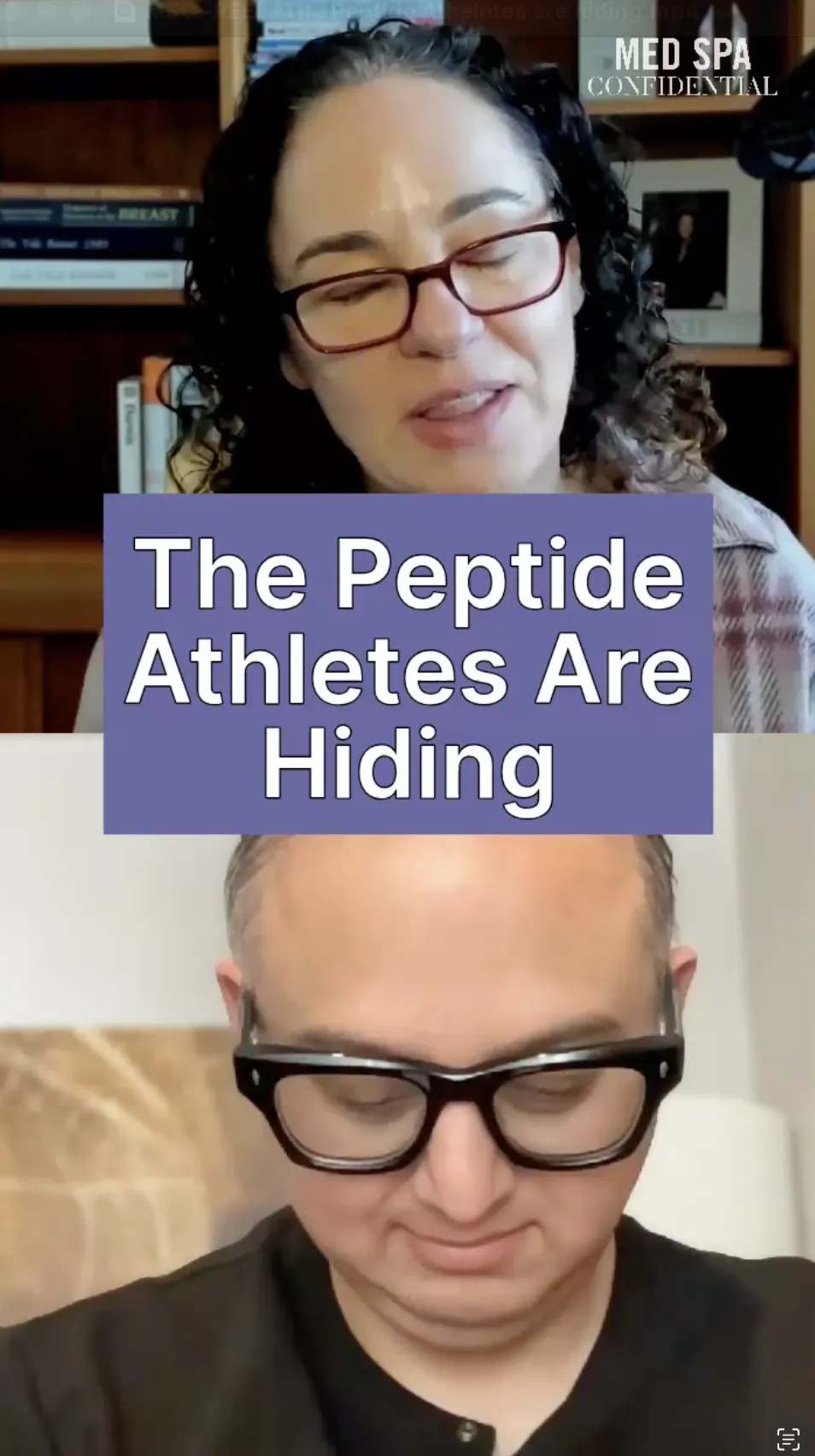
The Peptide Risks Your Provider Isn't Telling You
The Peptide Risks Your Provider Isn't Telling You.
Peptides are showing up everywhere, from wellness clinics to med spas to your social media feed. But what happens when the thing being injected into your body is on the FDA's banned list and your provider never mentioned that part?
For the Medspa Confidential podcast, I sat down with Dr. Furhan Qureshi, an internal medicine physician and med spa owner practicing outside Washington DC, to have the honest peptide conversation this industry keeps avoiding.
The Peptide Everyone's Taking
"We haven't done enough studies to know who it works for, who's a good patient, who should we avoid." — Dr. Furhan Qureshi, Med Spa Confidential
BPC-157 is the most talked-about peptide in wellness right now. Tom Brady was rumored to be using it during his later playing years. The World Anti-Doping Agency banned it from professional sports. And right now, providers across the country are offering it to patients with zero completed human trial data behind it.
Most patients don't know the FDA put BPC-157 on a list of 20 compounds that compounding pharmacies are not allowed to prepare for human use.
That list exists partly because of reported cases of severe allergic reactions, including anaphylaxis. In the episode, Dr. Qureshi explains exactly why it ended up there and what providers are doing with it anyway.
What's Actually in That Vial
"As a physician, I can tell you I am scared out of my mind to put something inside my body that I don't really know where it came from. It could kill you." — Dr. Kate Dee, Med Spa Confidential
When someone orders a peptide off the internet, there's no quality control. No standardized process. No guarantee that what's in the vial matches the label. I've talked to people who've had serious infections from products ordered off the internet. They thought they were doing something good for their bodies.
There's also a difference between compounding pharmacy types that most patients have never heard of, and that difference matters enormously when it comes to your safety. We break down exactly what that means and what to ask your provider in the full episode.
Why the FDA Just Changed Everything
Just before recording this episode, the FDA announced they're moving toward allowing compounding pharmacies to prepare many of these previously banned peptides.
That sounds like good news but it's not that simple. These peptides are still not FDA approved. They still haven't been studied in humans. The legal landscape is shifting fast, and not every provider entering this space is going to do it responsibly.
Dr. Qureshi gives his honest answer about whether he'd offer these in his own practice, and what he said is worth hearing before you book anything.
Before Your Next Appointment
There is one peptide I want every person reading this to remember: Melanotan II. It's being used for tanning and libido enhancement. It has been linked to melanoma and seizures. Nobody should be using it. That's not a gray area.
The peptide world is moving faster than the science, and that gap is exactly where patients get hurt. If you're being offered any injectable peptide right now, you deserve to know where it came from, whether your provider carries malpractice coverage, and what the FDA's current position actually is.
Listen to the full episode of Med Spa Confidential to hear what Dr. Qureshi and I believe you should ask before saying yes to anything in this space.
Episode Transcript:
Dr. Kate Dee: [00:00:00] The FDA just signaled a shift on how certain peptides may be handled soon, and it could open the door for wider use in clinics. If you've been offered one, or you think you might be soon, this is the episode you need to hear first. One of the most popular peptides being used right now has reports of severe allergic reactions, including anaphylaxis.
Another one used for tanning has been linked to melanoma. Seizures and despite all of that, both are still being sold online and used. I'm Dr. Kate Dee, founder and medical director of Glow MediSpa, and this is Meds Spa Confidential where we expose the risks, the red flags, and the outright illegal practices happening inside med spas right now because you deserve to know the truth before you book.
Today I'm joined by Dr. Ferran Kureshi. an internal medicine physician and med spa owner practicing outside Washington DC, and he's been [00:01:00] carefully observing the peptide conversation from both sides of the exam table. You'll find out exactly what the FDA changed and why it matters for anyone considering these treatments.
You'll learn why most popular peptide right now~ still has no completed human trial. Behe ~still has no completed human trial data behind it. Even as providers gear up to offer it, you'll hear which peptide I believe no one should be using.~ Full stop ~stay until the end, because we break down what legal actually means here and why the answer isn't as clear as you think.
Furhan Qureshi: ~You the ones RFK approved. By the way, maybe I'm wrong. ~
Dr. Kate Dee: ~Hi, I'm Dr. Kate d and I'm speaking today with Dr. Farran Kureshi. He is an internal medicine doctor, uh, who has a medical spa in Northern Virginia, kind of outside dc and he is passionate about the topic of peptides. So I'm, this is really timely because of all the changes with the FDA. ~Dr. Qureshi, thanks so much for joining me on this great topic.
Furhan Qureshi: Thank you for having me.
Dr. Kate Dee: So first of all, for our audience who really may not understand the definition, let's, let's define what peptide is. Do you wanna take a stab at that?
Furhan Qureshi: ~Um, uh. ~Peptides are, are essentially building blocks of, of proteins and, and they help build into something. ~Um, ~what's happened is our, our body has some naturally occurring and,~ uh,~ ever since the success of the, of the whole, you know, GLP one craze,~ um,~ there's a rise of people,~ um,~ [00:02:00] using,~ uh,~ very similar molecules,~ uh,~ to the ones we, we typically have.
And, and, and the thinking is if we increase more of it. Just like we did with GLP one, do we get, you know, an improvement of some aspect of our function? So that's pretty much what it is.
Dr. Kate Dee: Yeah, and I mean, people should understand a lot of our bodies made out of, out of protein and peptides. So you know, muscles, protein, collagen's protein. And then of course a lot of hormones are proteins and so. A peptides really just like a short chain protein or,~ um,~ some of them are even just single, single amino acids, but,~ um,~ usually they're at least a couple amino acids stuck together.
~So, um, ~so let's, let's frame the controversy here. Okay. So there are peptides that are. Essentially drugs that are FDA approved, and we're really not talking about those today, although we'll probably touch on some of the weight loss drugs that are so popular. ~But, um,~ but really we're talking about,~ um,~ peptides that are just exciting and haven't really been [00:03:00] studied.
Maybe some of them, like in animals. Okay. ~Um, ~and then they were, they were basically,~ uh,~ but the FDA, like banned them a few years ago. and then just recently, in the last couple days has said they're gonna reinstate the ability to compound these things. So can you, can you talk about,~ um,~ what the controversy is and what, what's going on, why it's so crazy right now?
Furhan Qureshi: ~Yeah, so you know, when it comes to peptides, this is. When, when,~ when somebody says peptide, the first thing they think about is Wegovy or GLP one. But the story of peptides goes way longer in history than that. I mean, the Soviets were testing,~ uh,~ peptides back during the Cold War. They were taking molecules,~ uh,~ from the body, these peptides and,~ uh,~ studying, you know, if they could synthesize more of them.
~Uh, ~what, what could happen. In fact, most of, of these peptide,~ uh,~ and longevity practices are citing those old Soviet studies to promote the, the, the, the, the use of them in, in the world of wellness and, and longevity. But,~ um,~ I guess in recent times, what, ~what has ~~happened, what, what's~ happened is [00:04:00] there are lots of peptides.
There are so many peptides that. It could take hours and we're not done talking about them. There's well over 600 known peptides and potentially more that we don't even know about. The human body is like the ocean. There's still mysteries out there that we're still digging up. ~Uh, ~AI is helping us find it, but there, there's a lot of,~ uh,~ stuff we don't know.~ Um, ~in the world of peptides, there are certain ones that have become very popular and are getting a lot of buzz. ~Um. ~and I'm sure you've heard of, you know, the, one of the more famous ones, BPC 157 It's rumored that Tom Brady himself was taking it while he was,~ um,~ you know, playing in his later career.
~And, ~
Dr. Kate Dee: ~really? Because, so let's, let's talk, ~let's just talk about that one in particular since that's the most popular one. And there's actually some data on that one.~ Um, ~I do know that that's been banned from professional sports by the doping, you know, the anti-doping agency, right? Like if he, if that rumor's true, that's kind of bad for Tom Brady.~ Um, ~but
Furhan Qureshi: Is it now?
Dr. Kate Dee: well he's retired now, but, you know, [00:05:00] like what are they gonna take away? His, uh, super Bowl rings if they find out. I don't know, but, so talk a little bit about what that one is and what it does or what people think it does and why everybody or so many people are taking it.
Furhan Qureshi: So supposedly what what it is, is basically this is a peptide that's been involved in,~ um,~ repair processes.~ Um, ~there are people who have chronic osteoarthritis, ankle injuries, ~um. ~Supposedly what it does is it helps you heal faster. So if you're somebody who has tennis elbow and someone injects you there, you may, you may get better.
Now, I wanna caution this by saying the, these statements have not been,~ um, uh, for sure, uh, uh, ~confirmed by the FDA nor endorsed,~ uh,~ these are just very limited trials and kind of hearsay. But, but that's kind of what, what's going on? And,~ uh,~ yeah, I just looked it up. You're right. Actually, the, the WADA did, ~uh.~
~Uh, ~banned it for, for doping, which is, which is interesting. ~Um, ~but
Dr. Kate Dee: in particular, that one's derived from, like stomach acid, right? Or stomach wall. ~The wall of the, I mean, ~I don't actually know how [00:06:00] they got it, but it's, it's not intuitive how you would develop that one.
Furhan Qureshi: ~yeah, I mean ~we're in a very complex world right now. ~Um, ~peptides are blending in the world of supplements. Which is blending into the world of therapeutic and, and FDA guideline and policy. And now the poor WADA, it used to be easy, you know, like, like, ~uh, ~like don't shoot EPO because you're gonna, you know, inappropriate, create more red blood cells and have an unfair advantage.
Now these guys also have to not step in and, and decide in this gray world of peptides, what should we been, I mean. That it is hard because right, like, doesn't, doesn't cre, creatinine c you know, creatine and, and, uh, whe powder, if you take it by working out, give you a boost. WADA says, yeah, but it's fair because it's not manipulating the body the way EPO did, which is what got Lance Armstrong in trouble.
That's what invented the world of doping. ~But you know, ~it's just challenging because, '~ cause~ there's that, there's that fine line. So BP one, BPC 1 57 is now [00:07:00] in that, in that category. And,~ um,~ I don't know, it's just, it's just hard to determine which one becomes dope and which one isn't, and they're gonna have to constantly update the guidelines on it.
Dr. Kate Dee: Well it's interesting 'cause that one in particular, if it does what people say that it does, it, it helps healing, right? It's anti-inflammatory. It helps healing, I guess, ~um, ~again, no human studies proving that. But if it does, does that really increase athletic performance? But we're not here to debate that because you know, I mean, we just know it's on the list.
You're not supposed to use that. And, and, but since that's the most,~ um,~ common one, the one that's most popular, so that has been spreading like wildfire amongst all these people who are into peptides. So when we're talking about peptides today, we're talking about injectable peptides. So we're not in the world of supplements.
Which are things you can eat,~ um,~ which are generally not,~ um,~ covered by the FDA. So the FDA only governs drugs [00:08:00] that you can eat or a pill, ~ um,~ if it is claiming to alter human tissue or change human function basically to treat disease. ~Um, ~so supplements in general are not considered drugs, and the FDA doesn't cover those.
And we're not talking about that today. And today we're talking about. Injectable peptides that are clearly medicines, they're being injected into the human body. See body, their purpose is to change human function. So they are for sure drugs. And so the FDA does have purview over them. And the problem is that none of these peptides has been FDA approved, meaning it, they haven't been studied in humans.
There's no data to say, yep, it does this or that. ~Um, ~enough to, to get approval. There's no company, a drug company, for instance, usually would pay for those trials. There has That hasn't happened.
Furhan Qureshi: ~The, there, there were, there,~ there were some there, there were some,~ um,~
Dr. Kate Dee: but it hasn't gone through FDA approval. So there are some studies.
Furhan Qureshi: they, correct. There were studies they started,
Dr. Kate Dee: animal,
Furhan Qureshi: ~But then they,~ but there were some, he, but [00:09:00] they were very limited. They, they, they were un, they were underpowered, they were inconclusive, or they were mixed. They never finished.
They, they basically started, but they never finished. ~Um, ~like a, A DO Cs, one of one of those, those diet ones. ~Um. ~This is popular now, but it, it was studied,~ uh,~ it was a smaller trial, but it was going through the FDA trials and the manufacturer abandoned it. ~Uh, ~they didn't find a significant weight loss, so they abandoned it.
But now it's cool because all peptides seem to be cool. I think. I think, I think the greater problem that we have now is we are generalizing. ~Um, ~what, what has happened is because GLP ones were so awesome, we have not reached a conclusion as a society that all peptides are awesome. More. More must be the answer.
~Uh, ~there can, they can do no wrong. And I don't wanna say that the GLP ones are a one head wonder. I don't wanna believe that. I, I would like to believe that there are other, other wondrous, you know, hits out, out there. ~Um, ~but we've entered a very dangerous room where, [00:10:00] where on the one hand my feeling is that the FDA has been too slow to study it.
Or to encourage study a bit. But then on the other hand, you have a world of social media where all these, you know, self-professed health coaches are making very bold claims that you have to, you know, take this peptide X Since I've been taking it, they're making these claims like, I'm running faster, I've lost this much weight.
And that's not a trial, that's not a controlled trial. There's no, there's no control. There's no variable. So I mean, ~um.~
Dr. Kate Dee: Well, and interestingly, of course, as physicians, we can't claim that medicines or, you know, injectables do something that they don't do. We could lose our license, whereas these, you know, kind of online gurus, they're not gonna lose a, they don't have a license to lose. They can kind of say. Whatever their opinion is, and nobody holds them to any science.
So what I'm trying to do, you know, in the podcast is to sort out for people what, where there is some science, [00:11:00] why this is happening. Because if millions of people are. Taking these injectables and they talk about, you know, peptide stacks and stacking, you know, these three peptides in this way, and it boosts your, you know, wellbeing and your athletic performance and, and you have all these people doing it that it's, it's.
It probably does something, it might have hidden dangers that they're just not talking about, or cancer that they'll get in 15 years that they don't know about yet. I mean, that's all very possible. There's one,~ um,~ there's one peptide called,~ um,~ Melanotan II that is probably the most,~ uh,~ scary one. And that one, I'm just gonna say right up front.
Nobody should use that one. Okay, so that one people have used for tanning, so. To get Tanner skin, but also for,~ um,~ libido and some other things. But it has been linked to melanoma and seizures and actually prolonged directions that [00:12:00] are like priapism. So, ~uh, ~so in general, that one's pretty, pretty terrible, but people are out there using it and, ~and hopefully, we'll, ~we'll show some pictures of that.
~Um. ~On our YouTube version of this, because it's pretty crazy what, like, how ultra, ultra, ultra deeply tan these people can get on that, but super dangerous. But,~ um,~ but so I really would like to kind of tease out for people, like why it's interesting to start with like, which peptides are interesting to you?
Which ones do you hope get studied? ~Um, ~once the FDA does allow compo compounding. Are you gonna use them in your practice or are you gonna watch and see what happens? Like what? What do you think?
Furhan Qureshi: These, these are great questions. So let's just be clear. The most popular ones are not new. BPC 1% didn't happen a year ago.
Dr. Kate Dee: Mm-hmm.
Furhan Qureshi: A lot, a lot of these peptides especially that are on this,~ uh,~ the category two list, they've been around for decades. ~Um, ~so I guess. We should probably start from, from where we, you know, how we got here.[00:13:00]
Peptides are not new. They've been around for a long time. They've been studied for a long time. The Soviets did a lot of research in it, you know, in certain peptides like clan and, and cm A and, and,~ uh,~ what has happened now is,~ um,~ GLP ones have been older rage. They've been wildly successful in terms of both,~ uh,~ weight loss.
~Um, ~in fact, you know, last year was the first year in the last 30 years that Americans collectively lost weight every year. The percentages were increasing obesity. This is the first time in American history in the last 30 years that the US public has gradually lost weight. Not only that, a lot of other, the good good things happen.
Fast food stocks collapsed because, you know, if you're on a GLP one, you're gonna feel sick eating a pizza or a taco. You already slow down. You know, people ask, people ask me, how does, how does GLP GLP one work if they're Northern Virginia? ~Uh, ~I tell them, well, a GLP one is like. A pharmacologic muzzle, it's basically slowing down your GI tract right when you take it.
Your body is in absorption mode. It slows down your GI tract. If you eat something [00:14:00] highly, uh uh. You know, preserved ~or, or, or, you know, um, you, you're taking ~something that, that's not natural. ~Um, ~it slows down your, your, your tra your GI track further. So it's like, it's like you're worsening I 95 traffic. We have I 95, which is our most feared highway.
It's always. Like, like slow it down. It's very famous. So I tell people it's, it's, it's like you're giving your GI tract, you know, I 95 traffic on purpose. Because if you slow it down, you can't put anything in, so you'll back up. So if you're somebody who ate, you know, five or six big slices of pizza, you're lucky if you do one slice because you just feel sick.
You, you, you can't do it. So, you know, we, we, we learned over the years, not only were they losing weight because they're not eating this bad food, ~uh. ~Other things happened. They're not drinking alcohol as much. A alcohol sales have tanked. Which is now leading to the rise of, of non-alcoholic spirits. In fact, I'm actually drinking one of these adaptogen drinks myself.
I'm, I'm drinking it right now. I offer them in my practice. I can now successfully [00:15:00] offer,~ uh,~ spirits to my clients that are non-alcoholic. ~Uh, ~and they're actually potentially help people for them, but they're not bad. There's no sugars, there's no preservatives there, there's no artificial, you know, these are kind of naturally, you know, ~uh, uh, ~health, health focused drinks.
So, um.~ um. ~Fast food stocks have dropped, alcohol, stocks have dropped. In fact, the alcohol companies themselves are not going into non-alcoholic drinks, which is a good thing. ~Um, there's~
Dr. Kate Dee: Also there's benefits to each person. You know, there's less arthritis, there are fewer knee replacements, there's less kidney disease because there's less diabetes. Like, there's just a, a ton of advantages that are happening because of GLP ones. And, and I will say that, you know, when,~ um,~ when GLP ones first came on the scene, once they became FDA approved a few years ago,~ um,~ and everyone and their dog was jumping on that, I was pretty skeptical at the time. I'm like, oh God, one more weight loss drug. But it turns out to be just incredibly different from every single thing before. So really, I'm, I'm, I'm really, I don't wanna discount [00:16:00] any of these things. Could 'cause, because could any of them become the next, you know, Ozempic or, or zet bound? Possibly, yes. I mean, obviously we need a lot more studies.
~Um, ~but so I'm just curious besides, besides that one BPC 1, 1, 5 7 or 1 57. There are the other ones that are the most popular that I could find are the growth hormone ones, so CJC 1295 and then IPA Morlin, or I, I don't even know how to pronounce that. IPA Morlin. ~Um, ~yeah, so, so what do you think about those?
~Um, ~those are, you know, basically,~ uh,~ stimulate your own growth, growth hormone in your body. And I, I worry about that. ~Um, ~also for, for the possible,~ um,~ effect of neo causing a neoplasm or making a neoplasm worse. But what do you, what do you think about those?
Furhan Qureshi: Yeah, I, I mean, ~um, ~the, the American consumer's gotten smarter. They, they know now about. You know, obesity and, and fat, but they're also worried about visceral fat, [00:17:00] visceral fat's. Quite dangerous. ~Um, ~you mentioned earlier a, a good point about, about the decline of,~ uh,~ you know, a arthritis and, and stuff like that.
We, the public mu the public. Should know that fat is not a stationary thing. Fat is not stuffing. These would be that. What, what is fat? Oh, it's like padding. No, it's not padding actually. ~Uh, ~fat is, are, are glandular. They do secrete their own hormones, for example, that they find especially belly fat, that, that secretes, you know, certain hormones that, that, that interact insulin, which is how type two diabetes seems to happen.
So, resistant diabetes, right? ~Uh, ~classical diabetes. Type one is where your pancreas doesn't make insulin. The type two came up that. It's making insulin, but it's, it's stuck. It's not, it's not effective. So, so, you know, the, back to the history of GLP ones, you know, it was more in modern times that they got approved for, for obesity, but, but they've been around for longer.
They've been, you know, back, back when I was in residency, you know, we were, we were using the Victoza was the thing. Victoza was being injected to sensitize,~ uh,~ the body to its own insulin and, and help reduce the sugar, the glucose levels. It [00:18:00] was later they found that these weight loss happened. But, ~um. ~You know, to your, to, to your question,~ um, you know, ~the, the public is, is, is extremely interested about longevity and, and, and improving, improving their, their long-term health.
~Uh, ~back in the day, you know, we were fighting to. Fight disease and, and live longer. We've kind of accepted now that we're going to live longer, but we're good at it now. We wanna live better. And that's where longevity's become, become all, all the craze. ~Um, ~so, so that's kind of what, what's what's happening there?
~So you'll notice the most popular ones happen, happen to be, happen to be.~ The most popular peptides happen to be ones mostly associated with aging. Whether, whether it's it's,~ uh,~ erectile dysfunction, ~ uh,~ or, or especially pain. Pain is a big one. So that's why BPC one seven is so hot. TB 500 is so hot. There are people out there who have chronic osteoarthritis and by injecting it,~ um,~ some of them.
Whoever they are, are, are, are finding improvements in, in their functional status. They're having less pain, they're able to go out, go for their walks again, do gardening, and they're getting the lives back. ~Uh, ~but it's, but on, on the flip side, there are some who've suffered. If you look at the online [00:19:00] blogosphere, you'll see some people write stuff like, oh, be careful.
~Uh, ~which peptides you get. I took this one peptide, I got dinner and I had ana anaphylaxis, and actually that's what. That's why we, we have a problem right now. There are about 20 peptides that the FDA put on the category to do not compound this, which include unfortunately BPC seven, TB 500. There were case reports out there, how people potentially getting anaphylactic severe allergic reactions and the DA thought, oh, this is dangerous.
Put 'em on that list. So there's a list. There's 20 compounds on this list. ~Um. ~The F FDA says you cannot compound them for human use. They're research use only. So if I'm, you know, in a lab and I'm doing,~ uh,~ a, a research project on, on rats, yeah, I can have some, some pharmacy or, or some lab synthesize it from them doing research.
What I'm not allowed to do is suddenly,~ uh,~ take those, take those peptides that were for research researchers only, and then commercially or even medically hand it out to, to a patient. But of course, you and I know. [00:20:00] We, we, you and I both know that's, that's happening right now. Some physicians, a lot of physicians are doing it,~ uh,~ not just physicians.
A lot of health gurus and health coaches are now in this business. And,~ um,~ the internet is run amuck with, with claims of, you know, I couldn't walk because of my severe back pain, but thanks to this peptide that was injected in my back. I'm not what? There's no way to verify these claims. There's no verification.
~Uh, ~and maybe, maybe it did work. Maybe it did work Good. You, you
Dr. Kate Dee: But that also could have been a bot, like it's impossible to know. Right?
Furhan Qureshi: ~it's ~possible. But, but also we, we didn't study it, right? So, so, so we don't know who it's gonna work for. See, patient selection is key, right? That's how we have so many antibiotics. That's why we have a z-pack. Doxycycline, maybe from my sore throat. Amoxicillin just doesn't work. I don't know. ~Uh, ~clindamycin does so, so, so, you know, we haven't done enough studies to, to know overall how, who, who it works for, who's a good, who's a good patient, patient selection, who, who does it work for?
Who should we avoid? Does having lupus contraindicate [00:21:00] you from getting BPC 1 57? I'm just throwing it out there. We don't know those things. It's a wild west and, and I wish, I mean, at least sos are researching it. I wish, I wish we did it too. And, and we, and we have not. So, so now what's happening is, is a lot of these health coaches now are taking it among, among, among themselves to recommend something based on research.
50 years ago in the USSR, ~um. ~That something works and I, I don't know.
Dr. Kate Dee: ~Well, I, I think there's, so~ from the point of view of a patient, and I'll just excuse myself as an example, right? So I have a, a new back pain thing and a new disc, and it's awful, right? And I'm like, wait, I'm super, you know. Healthy and active. And I ski, and I bike and I hike and I'm like, oh my God. And so honestly, if somebody, if I didn't know anything about medicine, if somebody said, Ooh, there's this peptide that could maybe make that go away, like super, I would try.
I mean, I'd try, if I thought it was safe, I'd try it because I'm like, well, I would try anything rather than have [00:22:00] back surgery. I don't wanna have back surgery. ~Um, ~but as a physician, I can tell you I am scared outta my mind. To put something inside my body that I don't really know where it came from, it could, it could kill you.
So anaphylaxis is when you have a severe,~ uh,~ life-threatening allergy to something and you don't know what's in that vial because God knows where it came from. It could come from China with all kinds of contaminants in it, or it could be so, you know, which would make it much more likely to be allergic.
You'd be allergic to it. And then also, you know, these, these vials that come from wherever. A lot of times they're contaminated with bacteria and other bugs. So I've interviewed people who've had really bad infections from these kinds of things where it was ordered off the internet. So you have to know where it's coming from.
So I honestly think that I, you know, I think it's going to make it safer. So the FDA coming along now and saying, Hey, in a few months we're gonna allow compounding pharmacies. To [00:23:00] compound it, you'll at least know that it's not contaminate, hopefully anyway. It's not contaminated with some foreign substance or whatever.
So the risk of anaphylactic shock or or infection, I hope would go way down.
Furhan Qureshi: so anaphylaxis can happen to anybody. ~I a had shrimp scampi, and I'm good. You, you might have, because I, you might have, ~you, you don't know until it happens. And, and that's the problem now, right? What if shrimp scampi? I had it at at Olive Garden. I thought it delicious. But you had a anaphylactic shock.
Does that mean the government should ban shrimp scampi for everybody? So we're, we're, we're in a very, we're in a very, yeah. So, so we're, we're renting a world now where,~ um,~ we have to just, we, we, we have to do more research. You see b BBC one seven is on that list. Something bad happened that led for it to be on that list.
~Um, ~we need to study. We need to study. Like why did it end up on that list and why are so many people who are using it? You know, it, it, I guess technically it's illegally that they're using it,~ uh,~ when that they're not supposed to be, why are they reporting? So, so many positive side effects. This is, this is where there has to be a better job of [00:24:00] researching it.
That there should be some kind of public private partnership between the government and many other, you know, enthusiasts. ~Um, ~you know, I, I, I, I wish, I don't wanna, I don't want us to lower our research or trial standards, but we must find a way to, to. Improve our knowledge about, you know, how these things work.
Who it helps if someone did have allergic, have anaphylactic. Okay, good. Let's study that person. Why did they have it? Did they have an autoimmune condition? What were, what? Who was that person?
Dr. Kate Dee: the problem is we, first of all,~ um,~ it is much less likely to have an anaphylactic reaction to a peptide that's three amino acids in length. Versus something that is in a vial that God knows what's in it. It could be anything in that vial. So something where you don't know where it came from, you're much more likely
Furhan Qureshi: there's no standardized process. That's the problem, right? There's no, the BPC send from, from my pharmacy, a might be a little bit different than the BPC from your pharmacy. P we all, we all have diff, they all have different s The standards are not the same. And that's the problem. Should be uniform.
The standard. What should the [00:25:00] standards be? ~Um, ~compounding pharmacies don't have the same quality control standards that these larger, you know, like Merck and Bay, like those, those guys have, they don't have the same. Quality control. It's like McDonald's versus Steve's pizzeria. You know, I'm just making one up.
Dr. Kate Dee: Well, yeah, so, and that, so actually the FDA regulations are different for 5 0 3 A and 5 0 3 B pharmacy. So, and that's kind of, you know, maybe a little more esoteric. I do write about that in my book, but basically. 5 0 3 B is making a kind of compounded drug that is available for purchase on a larger scale, and then that doctor can dispense it.
Okay. Whereas a five, oh, that's, that's something maybe most people don't. Are not familiar with 5 0 3 AA compounding pharmacies are the ones where you probably know about, because your doctor could have prescribed you something and it was in your name only, and it was specific for you and it was compounded for you [00:26:00] at a particular place.
And that compounding pharmacy, usually a local place in your, you know, neighborhood.
Furhan Qureshi: doesn't have to be, there can be mail ordered, but
Dr. Kate Dee: it could be mail order,
Furhan Qureshi: if I oh 3 5 0 3 A, the patient has direct access to it, whereas
Dr. Kate Dee: And the
Furhan Qureshi: is for them.
Dr. Kate Dee: the difference as far as the regulations are massive. So a 5 0 3 B is really held to the same standards as Merck or Pfizer, whereas a 5 0 5 0 3 A is absolutely not.
And there's way less into that. So it's, it's they're way more problems,~ um,~ you know, incidents. ~Um, and, and, ~and. Bad outcomes from the 5 0 3 a,~ uh, um, ~pharmacies. And there have been a, a number of famous cases of that over the years. But just to, just to, you know, separate those two things. I just, I am welcoming this in some way, in that I think that it's safer to get it from one of these compounding pharmacies than it would be to order it off the internet from China.
So for me, that's like one step.
Furhan Qureshi: Well, my, my, my, my position ~is, is, is that, is that ~I don't think A or B or C even ma you know, these things matter [00:27:00] because right now the FDA has this list of 20, 20 peptides. They said, do not. Do not compound these and don't, and don't give it, give it, give it to people. These are strictly for research and, and what's happening right now is a lot of, there are 5 0 3 a's who are inappropriately.
They're, they're, they're straight up breaking the
Dr. Kate Dee: They're doing it anyway. Yeah.
Furhan Qureshi: they're doing it anyway and, and, and they're sending it to the consumer and they're mislabeling the packages by saying, by crossing out the research use only and saying, oh, it's for physician use. And so far I haven't heard of any major. I think they're just getting warning letters and they, they're not really enforcing them.
~Uh, ~the liability remains high on the part of the, the, the prescriber of these,~ uh,~ that, that, you know, ~uh, ~they have a liability involved in this. So, ~um.~
Dr. Kate Dee: Well, I think the liability, so as a physician, you can prescribe.~ Um, ~it's, it's really,~ um,~ not really legal to prescribe drugs that are not FDA approved, but that in and of itself isn't a hundred percent proof of malpractice. So let's say you prescribe something, one of these [00:28:00] things, it's not FDA approved, someone has a bad reaction and they sue you for malpractice.
~Um, ~you may or may not lose that, but
Furhan Qureshi: ~But, but the caveat, ~but the caveat here is the F fda A said, don't do it. Right. The, that, that was 20, those was 20 peptides. They said don't do it. So for example, you know, if there was some, some mystical drug in Norway that, you know, treats, you know rheumatoid arthritis, but it's a Norway, the FDA didn't make a comment 'cause they don't even know about it.
~Um. ~Could I use it here? I mean, probably not. I, I wouldn't prescribe something that's outside. But the thing is that's, that's different. That's your judgment. That's who's saying. As, as a RA said, look, I've been to Norway and, and I, and I, and I've, I personally tried this drug. I think it's gonna help my patient.
And, and that, and that's one thing, but what's not. But if the FDA explicitly says, Hey, we don't want you. This is, this is the law, or this is the rule. Do not do this and you do it. That's a, that's a problem.~ And,~
Dr. Kate Dee: ~And ~
so now, now we're going from the FDA saying,~ uh,~ it don't do it [00:29:00] to the FDA now saying,~ um,~ as of in a few months, they, I mean, they just made this announcement in the last two days,~ um,~ that they're gonna put those,~ uh,~ I think it's all 20, but I don't, don't quote me on that
Furhan Qureshi: But there's gonna be in wave. So the first wave is gonna be 12, and then the, and then the, there's a second wave coming later. ~Melano~
Dr. Kate Dee: then they will be allowed.
So compounding pharmacies will be allowed to compound them. ~Um, ~and so at that point, they will still not be FDA approved drugs,
but they won't be FDA banned drugs that we now have gone from super duper illegal to only maybe mildly illegal. I, I am, I'm not totally clear on that. I just know that as a physician, I don't wanna put my license on the line for something that.
You know, could get me in
Furhan Qureshi: But also you, you do want to help your, your patients, right? I mean, part, part
of the reason peptide have become popular is
Dr. Kate Dee: something, if it's gonna make my back pain go away.
Furhan Qureshi: correct. So, so this is why we're talking about it right now. Let's just admit a, a fact [00:30:00] out loud that we, we are not ready to admit. We're, we're, we're, we're out of ideas. I mean, Celebrex.
Yox was the last big thing that was out there. And then of course, narcotics, which we're running away from. Now when it comes to like to like living better, the top complaint for everyone is, is pain that just happens. Osteoarthritis, these things, they're not inevitable. ~Um, ~we need something. To make our patients happy.
We want,~ uh,~ I'm sure you and I both want them to live their life to the fullest. Just because you're 60 doesn't mean you can't go gardening anymore. That that, that's not an excuse. Tom Cruise is still jumping out of airplanes in his movies. ~Uh, ~you know.
Dr. Kate Dee: Is he really doing that himself
Furhan Qureshi: Well, no. Yeah, he was, and it was the most recent movie. Yeah, he is. Oh yeah. It is the most recent mission. Impossible. I saw the video. He was hanging out of the plane. And I'm like, my God, I'm, I'm in those days, I was 30, I was 38. I'm like, I'm in pain just brushing my teeth. ~And this guy's in his age jumping out of airplanes and making multimillion dollar air.~
~But, but you know what, ~what's happening is a lot of these, these treatments and longevity treatments. We're only accessible to the [00:31:00] very super uber wealthy. ~Um, ~and, and they want, and they were happy to take the risk to do it. 'cause you know, they, they, they want to, you know, we're about to, we're about to now make it more accessible to, to the public.
~Um, ~but, and, and, and that's why we are where we are as far as f FDA approved treatments go. We only have so much for pain. You know, Mobic, aspirin, Loxicam and then we can go to the narcotics if you'd like. Those are there, we know what those can do.
Dr. Kate Dee: And surgery, which most of us wanna avoid.
Furhan Qureshi: Oh man. Those are not guaranteed income outcomes.
~Uh, ~the, any orthopedic or spine guy will tell you, Hey, I'm not making any guarantees because that's true. We, they
Dr. Kate Dee: And
then of course there are some, um.~ Uh, ~treatments that for a long time have been treated as fringey, that have now become mainstream ma mainstream, like PRP. ~Um, ~so now, like tho that's, that's actually covered by insurance and, and Medicare now PRP injections for joints. ~Um, ~that there's actually enough data after so many decades of doing that, [00:32:00] that, that, and, you know, ~um, ~and that could help, it could potentially stave off having surgery for a few years.
Furhan Qureshi: Correct.
Dr. Kate Dee: ~Um, ~and that's how these things happen, right? Like we, you know, an idea comes, we get access to a peptide or a drug or a treatment, . And then we do a trial and we do enough trials to prove that, okay, it's actually worth doing. I think one of the problems is, you know, we'll never know if something's worth doing, if people just self-inject or do a one-off and outside of a trial will have no idea.
Because we won't know if it's as good as placebo or not as good as placebo or, or better than placebo.
Furhan Qureshi: ~The, the problem with,~ the problem with with pain is, pain is a, is a subjective thing, so right cholesterol, we can debate cholesterol easily because cholesterol is something we can objectively measure. I take your blood and I check the cholesterol drug aid better than drug B. We're done. So the so not, not the question becomes, okay, good.
We're talking about pain. How, how do we know which ones work better than others? This is where the [00:33:00] trials will have to get more creative. You can't do a survey because that's not reliable.
Dr. Kate Dee: Yeah, it can't be a
survey, but for example,
Furhan Qureshi: but it can't, but it can be objective. It can be objective. You can take a trial of people who admit to have back pain and, and, and, and do a pre and post-trial test.
How many flights of stairs can patient a walk? He can only do two steps. He's in severe pain. Okay, now we do four weeks of this peptide. Let's try him again. Oh, now he's doing eight steps. On average, how many? And even that's hard because one guy's back pain may be worse than the other, but, but, but there are functional tests that you could do
Dr. Kate Dee: For that trial, you would have to compare that to an injection of something that was a
Furhan Qureshi: placebo versus if it's a double blind.
Dr. Kate Dee: you know, for anyone who's watching or in our audience who doesn't understand why that is the case, so, ~um, ~the placebo effect where you take a sugar pill,~ um,~ and someone doesn't tell you, okay, it's a sugar.
~Um, ~do you feel better? And the placebo effect has been shown to be about [00:34:00] 30% in just about every trial that's ever been
used.
Furhan Qureshi: powerful.
Dr. Kate Dee: for instance,~ um,~ there is a trial. So it used to be there were a ton of arthroscopic knee surgeries for knee pain and the, or ortho,~ um,~ orthopedist would go into your knees, scrape away all the extra gradu around your joints, clean it all up, and people would feel better.
And then there was a very, very famous trial. This is a while ago now. Where they did,~ um,~ a whole series of arthroscopic surgeries for knees compared to a fake surgery. Like they would literally spoof a surgery, go in to your, you know, but not do anything and then come out. So people would not know whether they actually had anything done or not.
Those. So the mock surgery were shown to be exactly the same results as far as pain as the real surgery. And so those surgeries kind of fell out of favor because it was shown like, well, it's not better than placebo. And I think that the problem with every, with all the [00:35:00] millions of people saying, Hey, this is great, is that you could be just seeing the placebo effect of someone injects themselves and feels like, okay, this is gonna make me so much better.
Furhan Qureshi: Dr. D, that's, that's the problem with most of these so-called peptide trials. They're weak. I mean, you and I will never fall for this crap. I mean, the, those trials are, they're surveys. There's like a hundred people, which is already underpowered already. And out of the 180 said, I felt great after I did whatever.
Well, that's objective. I, I may have liked. You know, the, the latest, fast and the Furious. That's my opinion. You may not have, we don't, the science is science is more than that for the audience. What, what they should know is whenever the, you see these drug commercials that are FDA approved, you're gonna hear this phrase a lot.
You're gonna, you're gonna hear, you know, the narrator say something like. So-and-so drug will can help you,~ uh,~ do, do this. And, and then, then he says, in a very fast, slow, slow speech, he says, this was proven in a doubleblind [00:36:00] random study that blah, blah, blah, blah, blah. He says it very quickly. That's the subtitle.
He's, he's giving you the evidence of why he's saying this drug can have this intended effect. And FDA approved it probably because of that trial. There was a trial. They use that word double blind a lot. Double blind, meaning,~ uh,~ both me, the investigator. That there's some kind of, you know, intervention. I don't know what's in it.
I'm just handing it out. And you, the patient don't know this is a controlled the placebo effect. ~Uh, ~we're, we're gonna see, we're gonna see what happens. The only people who know these are serial numbers, the lead investigators know up here. But at the time of this trial, both me, the, the nurse or doctor handing it out to you and you the patient, we, we both don't know what, whether this is the real one or the fake one.
Those are the
Dr. Kate Dee: be any influence from the label or the person handing you the drug, like this is gonna really help
Furhan Qureshi: These are accepted as the gold standard of trials. Now the problem is if you, if you try to, if for the public who tries to read these studies that these,~ uh,~ you know, non physician run wellness clinics [00:37:00] put up, they, they're very different. They're gonna give you numbers like,~ uh,~ 50 50 people had this, and four 95% felt pain relief.
It's an opinion. It's not, it's not a true paralysis, it's an opinion.
Dr. Kate Dee: Yeah.
Furhan Qureshi: 50 people's not enough either. They're underpowered.
Dr. Kate Dee: So, I mean, so bottom line, I mean, it's possible that any of these things could be quite promising. We don't know, and we don't really have enough studies. ~Um, ~so I, I do think that,~ um,~ it, it is kind of an exciting area of research, but I feel that way of many areas of research. I mean, one of the things I've been watching my entire career, which I got my MD in 1994, so that says how old I am.
I've been watching,~ uh,~ stem cells and, and hoping that stem cells would, would change a lot of different things. And, and I thought in the nineties we're gonna see by the time, you know, 30 years from now, we're gonna see so much success with stem cells. We have not seen that, that has not happened. We, there's [00:38:00] been a.
30 years of studying. ~Um, ~and, and there just isn't the kind of data to say that it does what we were sort of hoping it did. So there, there are a ton of things that are exciting about this and I do hope those studies get done. ~I wanna, um, just kind of, uh, since we're running a little low on time, just get to, um, what do you think?~
So are, is this gonna change your practice? The fact that these peptides are gonna be. Able to be compounded or what? Which one, and if so, which one of these, or which, which ones of these are you most interested in for their potential?
Furhan Qureshi: ~Well, um, ~I look at the area of pa pain medicine,~ uh,~ pain is one of the worst things out there. That's the reason people see us in the first place. My ankle hurts. I have arthritis. My back pain is the number one reason the patient sees their doctor. And ~uh, ~right now my belief is we have let a lot of our patients down.
We, we, we don't have a lot of op We, we, we have options to try to numb the pain like narcotics, but that's not definitive. We, we, we need to do [00:39:00] better. And in offering some kind of therapy that could be regenerative or, or, or, or can repair better. ~Um, ~and we need, we need studies for that. The problem with stem cells are, you mentioned stem cells earlier.
I don't wanna say they don't work. ~Um, uh, ~in fact, a lot of these so-called stem cell clinics are quite profitable. ~Um, ~if, if they totally failed, if, if it totally didn't work, they wouldn't be so successful. I think what's happening is the way our systems
Dr. Kate Dee: I just have to interrupt you. There was just,~ um,~ many, many stem cell,~ uh,~ clinics have been shut down across the country. They are guilty of false advertising because they say it cures incurable diseases. And just a couple weeks ago, there was a case settled here in Seattle for $24 million.
A stem cell clinic that killed somebody because they sold him a cure for ALS which they didn't have, ~and then ~
Furhan Qureshi: ~Well, those ~
Dr. Kate Dee: ~the clinic getting them. ~
Furhan Qureshi: Those are, those are unscrupulous
Dr. Kate Dee: Yeah. But there
really is
no, I don't want people to think that there's data there because there isn't, and a lot of those stem cell clinics are, are profitable because they are profiting off of people who have no hope.
So [00:40:00] I, I don't wanna give that message here because that it's just. I think that it's incredibly irresponsible to be making money from doing those treatments for people who have no hope of cure.
Furhan Qureshi: ~Well, that, that's a different, that that's,~ that's a different area. But in terms of, in terms of ortho, ortho are using, increasing more biologics, they are using,~ uh,~ regenerative therapies and the insurances are covering it. Now, for some of them, not, not all of them, but I, I think in the, in the world of pain,~ um,~ we, we don't have a, a lot.
New stuff. We're just kind of, we're just worried about pain pathways and numbing and, and, and,~ um,~ narcotics. But,~ um,~ there needs to be more research in, in the world of sub stem cells. I, I think the, the problem is, is that the way our system is designed right now is to like the, the standards,~ uh,~ we have to have high standards.
I get it. We, we, we have to have high standards to, to prove safety and also efficacy. ~Uh, but the average person. ~The average small clinic can, cannot, cannot afford it. Only a large mega billion dollar pharma can, can do it. And God forbid they're successful then, then they hike [00:41:00] the price because of the r and d cost that they, they claim they have spent.
~Um, ~I don't wanna say that all stem cells don't, don't work because, or there are ortho
Dr. Kate Dee: I am not saying that, I'm just
saying that just because the stem cell clinics are successful doesn't mean that they're, they're, they.~ Um, ~effective or legal.
Furhan Qureshi: No, no, no. It doesn't mean they're not effective either because the FDA does, you know, they are, they, they, they are aware of these, of these biologic,~ um,~ y you know, ~uh, ~practices. And they, they're aware of it. They're aware of these, these, these, these f FDA registered labs. ~Um, ~and, and then many ortho clinics are, are using them.
~Um, ~you know, ~uh, ~in terms of like, ~uh. ~Orthobiologics that they're using them. But I, but, but you bring up a very good topic. I, I have seen a lot of those scams where they actually happen mostly in Mexico and foreign countries. 'cause they have even lax regulation. You have people with, with terminal conditions,~ uh,~ from like a LS flying over and getting these, these treatments done.
But anyways,~ uh,~ the question is, I guess what will I, will I offer, you know, once,~ uh, uh, uh, ~these, uh, 20 peptides are eventually off of that do not compound [00:42:00] list, will I offer them? Right now my answer is maybe, I don't know. The correct answer is maybe, I mean, at least for me it is. Maybe,~ uh,~ I, I, I kind of want to, I'll, I'll probably start it on a very, very, very low scale.
~Um, ~ just maybe close, close friends and family. I, I, I would, I would hate to take a risk with, with, with the public,~ uh,~ be because. We, we, we don't know enough. ~Uh, ~it really, it's really hard to say. I mean, ~um, ~right now, if you want, you, you could technically get those, those 20,~ uh,~ compound. Legally, you either have to be a, in a research project and you do with the research grant or b, compassionate use.
~Um, ~under those two, you can get it. So if you're, god forbid, you know, terminal and, and you have this. You know, condition and you, you, you don't have much longer to live. Yeah. You can get one of those category two like bp, you, you can get it legally from, from that, under those grounds. But what's about to happen is, I, I guess the FDA's gonna argue that the physicians have more control, which, okay, [00:43:00] that's fine.
But we, we, the, the, the, the data is limited on both efficacy and, and, and also,~ um,~ SA safety. So, I mean, I don't know what, what, what, what, what will, what will you do? Will you be out?
Dr. Kate Dee: I, I, I, I won't,~ um,~ because one, so first of all, I'm not an internist and we don't really do,~ um,~ we don't really. Do that kind of medicine. In my, my med spa, we do, we do weight loss and we do, you know, ~um, ~menopause treatment. But I think what would be really interesting is if they could harness the physician, run med spas in the country and do a trial of BPC 1 57, since that's the most promising one.
Like it'd be really cool to have our own IRB and enroll people.
Furhan Qureshi: you can. You can, but it's very expensive. It's
Dr. Kate Dee: it's expensive.
and
Furhan Qureshi: Yeah.
Dr. Kate Dee: it's, you know, I mean, I left academics for a reason. Okay. So like, but it would be really interesting to do because I do think there's an appetite for that and it wouldn't be [00:44:00] hard to get participants. ~Um, ~so, you know.
I don't know. It's probably not legal to have participants pay for it.
Furhan Qureshi: Yeah.
Dr. Kate Dee: but that would be great. I think that would be great to be, to study. Well, I, you know, I think what we should do is, is come back after the summer when the rules have changed and things are moving in that direction and find out what's happening, do an update for people.
So Dr. Khi, I, I really appreciate this conversation. Thanks for being on the podcast today.
Furhan Qureshi: No, it's a, it's a pleasure, pleasure to be here. This is a juicy topic. ~Uh, ~I'm, I'm glad ~we could, we could, ~we could debate it.
Speaker 2: ~Thanks for listening. ~If you found this helpful, do me a favor and share it with a friend who's considering any aesthetic treatments. Subscribe so you don't miss the next one and drop a comment telling me your biggest takeaway. I actually read them all. Let's keep each other safe and elevate the standards in the MedSpa industry.