The Ozempic Side Effect Sending Women to Med Spas
The Ozempic Side Effect Sending Women to Med Spas
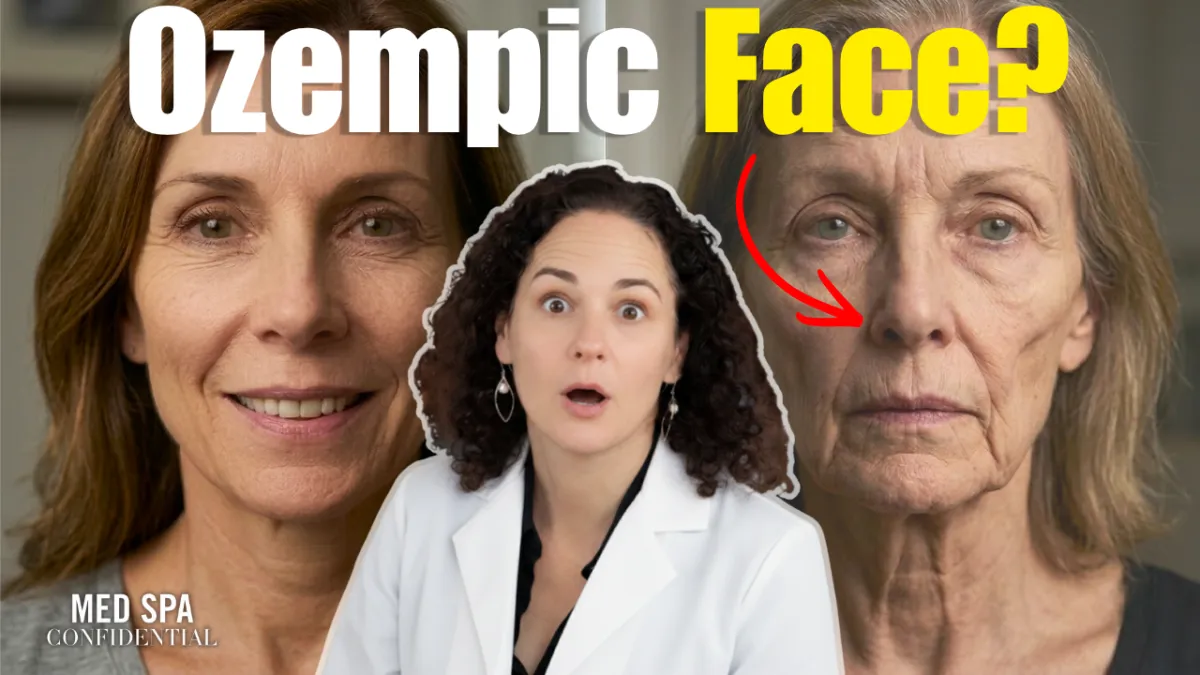
You finally hit your goal weight. Your clothes fit. Your labs look great. And then you see yourself in a photo and think, when did I start looking this tired?
If you're on Ozempic, Wegovy, or any GLP-1, there's a good chance your face is changing in ways you weren’t expecting. And some of what's being sold as a fix is a complete waste of money.
What's Actually Happening to Your Face
"It happens with any significant rapid weight loss. Ozempic just happens to be the best known of these drugs." — Dr. Kate Dee, Med Spa Confidential
This isn't a drug side effect in the traditional sense. It's weight loss biology, and it can happen to anyone who loses weight quickly.
When you lose weight, you lose it everywhere, including your face. The fat pads that give your cheeks structure, your jawline definition, and your eyes that well-rested look? They deflate, especially if you're over 40 or you've lost more than 30 pounds.
In my practice, the majority of patients who've lost significant weight on GLP-1s show some degree of facial volume loss. For some it's subtle, but for others, it's dramatic enough that they're considering stopping a medication that's genuinely helping their health.
What Won't Fix It
"As much as I love a good skincare routine, this will not replace lost volume. That's just not what they do." — Dr. Kate Dee, Med Spa Confidential
Before you spend a dollar, let's clear something up. There's a lot of noise out there about how to reverse Ozempic face, and most of it is wrong.
Creams and serums won't restore lost volume, no matter how expensive they are. Facial exercises are mostly nonsense. You can't exercise your way into more facial fat. Supplements that claim to plump your face? Also nonsense. And facial massage, while it feels wonderful, does nothing for volume loss.
I know that's not what the wellness influencers are telling you. But saving you from wasting money is part of why I do this.
What Actually Works
"Work with someone who genuinely understands facial anatomy. Not just someone with a syringe and an Instagram." — Dr. Kate Dee, Med Spa Confidential
In the full episode, I go through when to add targeted fillers and why I use them differently now. The skin tightening treatments that address loose skin separately from volume loss. Why timing your treatment wrong is an expensive mistake.
The one area of the face where the standard approach carries real risk. And what to realistically budget before you walk into any consultation room.
If you're on a GLP-1 or thinking about starting one, this episode is worth your time before you book anything.
[Listen to Med Spa Confidential Now]
Transcripts:
[00:00:00] Dr. Kate Dee: You finally did it. You lost the weight. 20, 40, maybe 60 pounds you fit into clothes you haven't worn in years. Your blood work looks great, your doctor is thrilled. And then you see yourself in a photo and think, why do I look like I age 20 years overnight? Welcome to Ozempic Face, and welcome to today's episode.
[00:00:19] Dr. Kate Dee: Hey everyone. I'm Dr. Kate Dee, founder of Glo Medis Spa in Seattle, founder of the Meds Spa Board and author of Meds Spa Mayhem. This is Meds Spa Confidential where [00:00:30] we'll pull back the curtain on everything happening in the aesthetic world. Today we're talking about one of the most common things I'm seeing in my consultation room right now.
[00:00:40] Dr. Kate Dee: The facial changes that come with significant weight loss on GLP one medications. That includes Ozempic, wegovy, Manjaro. Those are the brand names for Semaglutide Tirzepatide. And I'm gonna talk about what we can actually do about Ozempic face. Let's get into it.
[00:00:58] Dr. Kate Dee: First of all, what is Ozempic [00:01:00] face? it's the colloquial term for facial changes that happen with rapid significant weight loss, particularly from GLP one medications, and it's a real thing. I see it every single week. Here's what it looks like. Hollow sunken cheeks, deep lines from the nose to the corners of the mouth.
[00:01:18] Dr. Kate Dee: prominent under eye hollows, which was what we called tear troughs, loss of jawline definition, and sometimes loose sagging skin. Basically, you've lost the fat pads in your [00:01:30] face that give it structure and youthfulness, and you're left looking a little bit deflated, tired, older.
[00:01:36] Dr. Kate Dee: Now I wanna say this clearly. I love these medications. they're genuinely life changing and lifesaving for so many people, but the facial changes they can be. Genuinely distressing, and here's something I tell every patient. This is not specific to Ozempic. It happens with any significant rapid weight loss.
[00:01:55] Dr. Kate Dee: Ozempic just happens to be the best known of these drugs. In many ways, it's becoming [00:02:00] like Kleenex as a generic name for GLP ones, but what I'm talking about applies to anyone who's experienced rapid significant weight loss. So the phenomenon isn't new, but the volume of people experiencing it.
[00:02:14] Dr. Kate Dee: Absolutely is. So why does this happen? here's the biology. When you lose weight, you lose it from everywhere, including your face. And facial fat is often some of the first to go. And as we age, we naturally lose facial fat pads anyway. [00:02:30] They atrophy, they descend. That's, that's actually part of why we develop jowls and hollows as we get older.
[00:02:35] Dr. Kate Dee: Rapid weight loss just accelerates this process. Dramatically. Think of skin like a balloon, blow it up and then deflate it. It doesn't always go back to exactly where it was,
[00:02:46] Dr. Kate Dee: especially if it's been stretched for a while, or if you're not 25 anymore. Younger patients in their twenties and thirties often bounce back better because their skin is still has good elasticity. But if you're over [00:03:00] 40, or if you've lost more than 30 or 40 pounds, your skin may not snap back.
[00:03:05] Dr. Kate Dee: You're left with deflation and sometimes loose skin On top of that. Now, how common is this? In my practice, I'd say about 60 to 70% of patients who've lost significant weight on GLP ones have some degree of facial volume loss. For some, it's mild and they don't care, and for others it's more dramatic and often enough that they're considering stopping [00:03:30] the medication altogether.
[00:03:31] Dr. Kate Dee: I've had patients tell me and, and this is really heartbreaking, really. I finally fit into the clothes I want, but now I look 20 years older in photos. So there's an old expression and aesthetics. It's either your face or your butt. You can't have both. It's not fair, but it's a reality. So can you prevent it?
[00:03:51] Dr. Kate Dee: the short answer is not really. The long answer is that there are things that might help at the margins. Losing weight more slowly [00:04:00] gives your skin more time to adjust. Keeping up resistance training and eating enough protein helps preserve muscle mass, which provides some structure. Staying hydrated is really important.
[00:04:09] Dr. Kate Dee: Good skincare with retinoids and collagen stimulating products. But honestly, if you're losing 50 pounds, your face is going to change. That's just physics. So what really works, let's talk about solutions, uh, because there are good ones, so. The first, solution is dermal fillers. That's the most [00:04:30] obvious fix we're replacing lost volume with hyaluronic acid fillers, these areas.
[00:04:35] Dr. Kate Dee: that usually need attention. The most are the cheeks and sometimes the lower face, nasal labial folds and marionette lines. Those are the lines from the corner of your mouth down to your chin. The catch for significant volume loss we're talking about a lot of filler would potentially be needed.
[00:04:52] Dr. Kate Dee: That's expensive
[00:04:53] Dr. Kate Dee: And it's temporary. Hyaluronic acid dissolves over about a year's time, so it requires maintenance. [00:05:00] One important note on the under eye area specifically, I've moved away from using traditional fillers for tear troughs. We now use mostly PRP and PRFM, which are platelet rich plasma and platelet rich fibroid matrix.
[00:05:13] Dr. Kate Dee: For the under eye, it's safer and the results last longer. And it avoids the risks that come with filler in that delicate area. So what's the second, set of, treatments in our armamentarium? Really, I turn to Biostimulators as [00:05:30] really the most important way to restore volume when you've lost it from weight loss.
[00:05:35] Dr. Kate Dee: this is definitely my preferred approach. So Sculptra is my go-to for this. unlike fillers, Sculptra does not fill the space directly. It stimulates your own collagen production. Over time. The benefits of that, it's more gradual, much more natural looking, and it lasts two to three years. and generally improve skin quality, not just volume.
[00:05:58] Dr. Kate Dee: And for large areas, it tends to [00:06:00] be more cost effective than filler. It's also the only volumizer that I feel is safe enough for the temples. So the downside of sculpture, it takes three to six months to see full effect, and you need a series of treatments, usually three or to four sessions. So it's not instant gratification for significant ozempic face.
[00:06:19] Dr. Kate Dee: I often use a combination of S Sculptra to rebuild overall structure and volume and targeted HA filler for areas that need more precision. So [00:06:30] what else can we do? Well, I think that skin tightening plays a really, really important role. In treating Ozempic face if there's loose skin in addition to volume loss and there often is, we need to address that separately.
[00:06:44] Dr. Kate Dee: Radiofrequency microneedling like genius rf, which is what we use in my office, can thicken and tighten the skin. It stimulates a ton of new collagen and elastin.laser resurfacing also improves texture and tone. They don't replace [00:07:00] volume, but they improve the skin quality and can provide meaningful lift.
[00:07:05] Dr. Kate Dee: People have also asked me about fat transfer for patients who've stabilized at their new weight and have fat to spare. Fat transfer, which is when you take fat from the abdomen or thighs and then you inject it into the face, can be a more permanent solution. But it's a surgical procedure. It's not something we do in a med spa setting.
[00:07:25] Dr. Kate Dee: It requires the right candidate. It costs a lot of money, and there's a [00:07:30] significant amount of downtime, and you need to be able to be at a stable weight because if you lose more, you could lose the transferred fat too. People also ask me about thread lifts. My honest take, I really don't like them. Thread lifts work best for mild laxity.
[00:07:46] Dr. Kate Dee: For the moderate to severe looseness that often comes with major weight loss. The results are too inconsistent and the complication rate way too high for me to recommend them. So in general, not only for Ozempic face, but in general, I'm not a big [00:08:00] fan of threads.
[00:08:01] Dr. Kate Dee: Let's just talk about what doesn't work. Real quick. Let me save you some money. So first of all, creams and serums. As much as I love a good skincare routine, this will not replace loss volume. That's just not what they do.facial exercises. Mostly nonsense. You can't exercise your way into more facial fat, sorry, supplements, sometimes claim to plump your face, also nonsense.
[00:08:26] Dr. Kate Dee: And then lastly, facial massage. Feels wonderful. [00:08:30] Does nothing for volume loss. Okay, moving on. So here's something that doesn't get talked about enough. The psychological whiplash of dramatic weight loss is real. I mean, you spend months, sometimes years uncomfortable in your body. You finally lose the weight.
[00:08:47] Dr. Kate Dee: You feel healthier, more confident, excited, and then you see your face in a photo and think, oh God, I look ancient. I've had patients cry in my office. Not, not because they're vain, but [00:09:00] because they worked incredibly hard to achieve something huge, and now they're facing a problem. They just didn't anticipate.
[00:09:07] Dr. Kate Dee: If that's you, I want you to hear this. Your feelings are valid. It's not shallow to care about how you look, and there are real solutions.
[00:09:16] Dr. Kate Dee: let's look at timing and cost, So two things. Everyone asks, when should I do something about this? And more importantly, how much is it going to cost? So first of all, on timing. wait until your [00:09:30] weight is close to stable. If you're still actively losing any filler or sculpture, we place may look off as you continue to change, and frankly, it's a waste of money to fill an area that's going to keep deflating.
[00:09:42] Dr. Kate Dee: I would wait until you're basically at a, a stable new, Wait for you. Okay. Now, on cost, I'm not gonna sugarcoat it. Addressing significant ozempic phase is a meaningful investment. A full facial restoration might include s [00:10:00] sculptra filler and skin tightening treatments, and that can add up to many thousands of dollars.
[00:10:06] Dr. Kate Dee: And it requires maintenance over time too. So some people decide it's absolutely worth it. Some people decide that they'd rather live with the changes. some do partial corrections and addressing what bothers them the most and leaving the rest alone. There's, there's really no right answer. It's your face and your money.
[00:10:24] Dr. Kate Dee: So here's my bottom line on Ozempic face. it's real, [00:10:30] it's common. And if you're losing significant weight from GLP one medications or any other means. There's a real chance your face will show it, but you have options really, really good options. So those options can help you feel more like yourself while you're still maintaining your healthier weight and everything you work for.
[00:10:51] Dr. Kate Dee: So the key things to remember, wait until your weight is basically stable before treating. Work with someone who genuinely [00:11:00] understands facial anatomy, not just someone with a syringe and an Instagram. And be realistic about what's possible. Budget for the initial treatment and maintenance. And remember, losing weight for your health is always the right call. We can address your face afterwards. You're not vain for caring about this. You're human.
[00:11:19] Dr. Kate Dee: And thanks for listening to the Med Spa Confidential podcast. If you found this helpful, share it with someone you know who's on a GLP one medication.
[00:11:27] Dr. Kate Dee: They might really appreciate it.