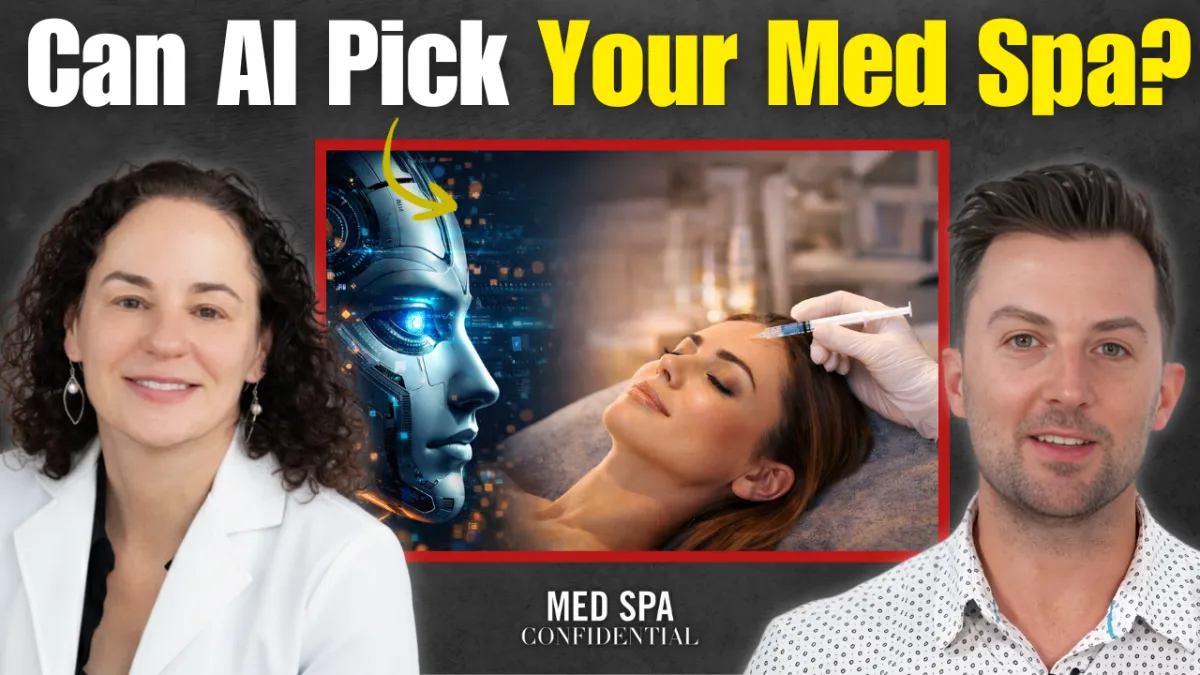
Should AI Help You Find Your Next Med Spa?
Should AI Help You Find Your Next Med Spa?
You've probably used ChatGPT or Google's AI to answer a quick question. But what happens when you ask it to recommend a med spa near you?
I sat down with Michael Antosy, who's spent 15 years in aesthetics marketing, to talk about how AI is reshaping the med spa industry. What we discovered is both encouraging and unsettling. AI isn't just finding med spas anymore. It's deciding which ones are trustworthy.
When Pretty Pictures Aren't Enough
"The best gift that we all can have is content. Real content." — Michael Antosy, Med Spa Confidential Podcast
That gorgeous Instagram feed doesn't matter much to AI. What matters is what's actually on a practice's website. In our conversation, Michael explained that when you search for "med spa near me with a real doctor," AI digs through websites looking for depth, expertise, and transparency.
I've always written all my own website content because I couldn't stand the marketing-speak that says nothing medical. Turns out, that actually matters now. AI can tell the difference between thin, generic content and real information written by someone who knows medicine.
For you as a consumer, this is huge. You can literally ask AI: "Find me a med spa within 15 minutes that has licensed providers and real medical oversight." And it will find that for you.
We talked about exactly what signals credibility to AI search, and why content quality suddenly matters more than ever.
The Trust Gap AI Can Bridge
"Don't get caught up in the hype. Providing good content, good service, good information. The core principles really have not changed." — Michael Antosy, Med Spa Confidential Podcast
Michael introduced me to something called EEAT: Experience, Expertise, Authority, and Trustworthiness. These are the factors AI looks for when deciding which practices to recommend.
Experience means robust content that covers procedures in depth. Expertise shows up in provider biographies. Your training, your certifications, where you went to medical school. Authority comes from consistency across directories, reviews, and listings. Trustworthiness includes things like ADA compliance on websites.
Here's where it gets interesting for patients: You can spot red flags using these same principles. If a med spa's website doesn't list who's actually doing the procedures, that's a problem. If there's no medical director information, AI might skip over them. And so should you.
During our conversation, we also talked about fake board certifications. Some practices claim to be "board certified" after taking a three-day course. Real board certification takes years of training and rigorous exams. I spent six years in residency and took three board exams for mine. There's a massive difference.
Michael explained how to verify credentials and what questions to ask before you book.
What This Means For You
For the first time, there's an incentive for med spas to be transparent about who's providing care. Practices that hide their providers or skimp on information will get filtered out. The ones with real doctors, licensed staff, and comprehensive safety protocols will rise to the top.
As a medspa patient, you now have a tool that can do the vetting for you. But don't stop there. Use AI to narrow your options, then verify everything. Check licenses. Ask about medical director involvement. Look for malpractice insurance.
Michael shared that story about his own hair restoration journey because it captures what you should want from any aesthetic provider. Not a salesperson. A partner.
Before Your Next Appointment
AI search is changing the game, but only if practices are willing to be transparent. If you're looking for a provider, use these new tools to your advantage. Ask specific questions. Demand clear answers. And if a practice won't tell you who's doing your treatment, walk away.
In this episode, Michael breaks down the marketing red flags that signal a risky practice and the exact questions that reveal whether a med spa is playing by the rules.
Watch or Listen to the full episode of Med Spa Confidential Now.
Episode Transcript:
[00:00:00] Dr. Kate Dee: Can you trust the results when you type meds? Spa near me into chat, GPT or Google's Gemini. Today I sit down with Michael ansi, who spent 15 years in aesthetics marketing. We talk about how AI is now deciding which practices are trustworthy. And which ones aren't? For med spa patients, it means no more guessing if that gorgeous Instagram feed is hiding a weekend trained injector or counterfeit products.
[00:00:25] Dr. Kate Dee: And for med spa owners, if your content is thin, AI is probably [00:00:30] steering patients away from you right now. Plus the truth about those trendy champagne Botox parties, everyone's posting on social media Remember to subscribe to hear the latest in med spa safety risks, industry secrets, and how to spot the red flags before you book your next appointment.
[00:00:45] Dr. Kate Dee: So Michael, thanks so much for being on the podcast today.
[00:00:48] Michael Antosy: Hey Kate, thank you so much for having me. It's a real pleasure to be here and talking. Uh, all things new and innovative in the world of ai.
[00:00:55] Dr. Kate Dee: so AI is kind of taking over the universe. I've already used it today to [00:01:00] analyze a legal document that I'm being asked to sign. So, but I think that the big thing in marketing is about AI search now, right? So. Can you, uh, speak a little bit about how that's affecting, not just how med spas are marketing themselves, but how people, how consumers are finding med spas and what they're finding out about them.
[00:01:20] Michael Antosy: Isn't it so crazy how we're using like AI in every aspect of our lives, I feel like I'm like carrying around my own personal assistant with [00:01:30] me now. So I've, I've also have done the same thing with analyzing like legal documents to make sure that whoever I'm doing business with is above board and helping to keep me aware of all the risks as well too.
[00:01:42] Michael Antosy: You know, that's really so much of, um. Just that that level of like awareness and access to information is really shaping and reshaping how, consumers are, are finding resources and how, you know, traditional SEO and websites and how that's [00:02:00] really shifted the game in terms of how practices also put their positioning online as well too.
[00:02:05] Michael Antosy: you know, one of the biggest things that we've seen in terms of just an overall like shift on the consumer side. Is that when patients are seeking out services, you know, if I'm looking up Morpheus aid, if I'm looking up neurotoxin or you know, body contouring, whatever that thing might be. What we've now seen shift with really AI [00:02:30] search is that patients are no longer like doing this doom scrolling to try to like figure out like, all right, well, which is the practice that I should go to?
[00:02:37] Michael Antosy: You know, there's a, a joke that we have in marketing. do you know the best place to bury a dead body?
[00:02:42] Dr. Kate Dee: On the second page of Google Results.
[00:02:46] Michael Antosy: Right, exactly. Yeah. So like now, like the joke has to be updated because it's now no longer on page two one. There is no page two any longer, but it's actually like below the AI search results because the thing about [00:03:00] AI search is that patients are just relying on the AI to tell them where to go to. And like now that we've been so used to like using our chat GPTs or our Geminis like.
[00:03:12] Michael Antosy: Just trusting that information that we're getting that's really altered how patients are really making decisions. And so
[00:03:18] Michael Antosy: it's also been a challenge for practices as well too, to ask like, well, how do I get my practice there? How is, how can I position myself to be the one that AI is recommending? so it's really, really been a big shift, [00:03:30] both, again, from the business side as well as from the consumer side too.
[00:03:32] Dr. Kate Dee: the interesting thing for me is the AI search. It doesn't just tell you. You know, the, the, I don't know, the three closest med spas near me, but it will tell you about them and why, you know, like if you say, find me a med spa within a 15 minute drive of my house, uh, that's has the best recommendations.
[00:03:54] Dr. Kate Dee: It will, it will list that, and then it'll tell you why it's telling you that, which is very convincing. [00:04:00] Like, is it always right.
[00:04:01] Michael Antosy: so it's telling you why, because of the information that it's able to like digest and gather from the actual website.
[00:04:10] Dr. Kate Dee: Mm-hmm.
[00:04:11] Michael Antosy: let's go back a little bit. let's go back to like 2022, and I'll never forget, do you remember like your first interaction with the chat GPT?
[00:04:21] Dr. Kate Dee: the first one, I don't, I can't really remember.
[00:04:25] Michael Antosy: I'll never forget this. And so I was driving and they were, I was listening to this podcast and [00:04:30] they were talking about this. This chat bot that it was AI generated, but you can tell the chat bot to like, write a story of my life, but do it in Shakespearean prose and like, just based around those prompts.
[00:04:41] Michael Antosy: Like that's what, so that was like my first thing about ChatGPT.
[00:04:44] Dr. Kate Dee: Yeah.
[00:04:45] Michael Antosy: And when that first came on into the market, so many people were just like using it tre so much. And it kind of evolved into this thing of like, it's like this could actually be like a better Google for a lot [00:05:00] of us.'cause it's a more precise answer that we're getting back.
[00:05:05] Michael Antosy: So what Google was doing to respond to that, was really it. It was unearthing a lot of big shifts and changes. And so just to kind of give you some context about Google. Google's always refining itself. it makes about nine algorithm updates to its platform every single day. And what it's trying to do is it's trying to deliver the best search results for a Dr.
[00:05:28] Michael Antosy: Kate Dee. [00:05:30] And arguably those could be very, very different than a micro antos. That's what we call semantic search. Every so often though, there will be a really big update that will come out onto the platform, onto the algorithm, and oftentimes Google will name these updates. So historically, there's been the medic update back in 2018, and then there's the Hummingbird update, the Panda update.
[00:05:50] Michael Antosy: But these big updates, they're very, very infrequent. They don't happen often. Since 2022 though, we have seen four core updates to the algorithm. [00:06:00] The biggest thing that Google is really doing now is to respond to this new AI world and chat GPT. And so as marketers, it's been a bit of a challenge. It's been challenging just because, things are shifting, major things are shifting in a rapid pace.
[00:06:13] Michael Antosy: Think about it like you're getting like an earthquake that a huge earthquake that's hitting your, your, your neighborhood, like every. But the constant thing, and kind of how Google has now kind of languaged these, these, the series of these big updates is what we call the helpful content update. And this is [00:06:30] going back to your question of like, well, how is it, why is it even telling me the reason why it's recommending these things?
[00:06:36] Michael Antosy: The helpful content update really boils down to two main principles. Number one is that can a search really. Find information that lives on a website that cannot be found anywhere else. So a lot of practice owners and frankly even patients in today's age, like they're thinking about like keywords like Botox near me [00:07:00] or where I live in Pennsylvania, you know, it could be like Botox in Chads for Pennsylvania.That's not enough though. Like what? It's what you wanna, what you wanna really break away from is thinking about things like these keywords and can I, can I go and learn about something like Botox in this particular area that I really cannot find anywhere else? So that's been one of the biggest shifts is that getting your content away from bots and keywords and thinking more about writing it in a, a much more common vernacular.
[00:07:28] Dr. Kate Dee: Right.
[00:07:29] Michael Antosy: The [00:07:30] second thing as well too, that we've seen in terms of really big shift with this update is the fact that, you know, if there are pages of content that actually live on a website that might be inferior. Like for example, we find like a lot of a, uh, aesthetics, wellness practices, if they have a wellness component, they might offer like a B12 shot, for example.
[00:07:49] Michael Antosy: Now not a lot of practices are really concerned about generating more B12 patients. I mean, there might be a cohort that's out there, but generally they're looking to target more higher dollar value services and [00:08:00] procedures. So they, they write really good content for the things that they want to be found for that will drive that revenue.
[00:08:06] Michael Antosy: But like, they might have some inferior content that they just need to have, but they don't really care about it. The thing about this new helpful content update is that, that that inferior content can actually be pulling down the optimization for the website as a whole.
[00:08:20] Michael Antosy: So
[00:08:21] Dr. Kate Dee: And when you say, when you say inferior content, you mean? That it's not written well or it's minimal, or it's [00:08:30] not accurate or
[00:08:31] Michael Antosy: it's.
[00:08:31] Dr. Kate Dee: familiar about it.
[00:08:32] Michael Antosy: It, it's minimal. It's not robust. And so, like, let's just use this example again of like Botox versus B12. Like maybe if, if a practice wants more, you know, filler patients, like they, they really write a lot of good content about Botox because again, it's something that they want to be found more for, but they might have like a, a sentence or two about B12.
[00:08:51] Michael Antosy: So that's what I talk about is that, that that robustness, uh, and, and that disparity can actually affect the visibility as a whole. [00:09:00] So practice owners need to be very, very strategic in terms of what are they doing. Like if they, if they're gonna have content that maybe they're not really caring about to drive visibility for, they still need to be able to beef that up, or they want to think about cutting it out.
[00:09:13] Dr. Kate Dee: So you're saying that websites like websites like mine where I wrote everything.Uh, because I'm so anal about, like I can't have, so no offense to marketers. I think marketers are very smart, but I can't have a marketer who knows nothing about [00:09:30] medicine writing about the medical procedures that I do in my spa.
[00:09:33] Dr. Kate Dee: So I just couldn't, I couldn't do it. It, it sounds so dumb. It sounds so markety. So I had to write it myself. and I actually gave myself like nerve damage for three weeks writing my website 24 7. But anyway, so you're saying that having done that actually is an advantage because I've always felt like, you know, all these places.
[00:09:53] Dr. Kate Dee: Okay, let's, that's phenomenal. I, I always wonder like who's actually reading it? you know, [00:10:00] because it's like I really thought about how I wanted to say it and what's in there and explain to patients exactly what things entail and I always felt like these. Websites for these, you know, sort of, I will just call 'em schlocky places that don't even have a doctor anywhere near it.
[00:10:15] Dr. Kate Dee: They look so glitzy and glam and people see it and then they like, they go there. You know, how do you tell the difference,
[00:10:22] Michael Antosy: Well, the best gift that you or anyone that's listening to this, that is a business [00:10:30] owner, and frankly, even on the consumer side as well too, the best gift that we all can have is content.
[00:10:34] Dr. Kate Dee: But real, like not
[00:10:37] Michael Antosy: right, right. Real,
[00:10:39] Dr. Kate Dee: are you gonna argue that it's good or bad to have AI write your content?
[00:11:00]
[00:11:27] Michael Antosy: This is not a binary answer. [00:11:30] Um, here's what I'll say to you. Like, so, okay, the consumer's listening to this, the practice owners listening to this listen up because think about as a consumer like. You know, if you have questions about something and you're really serious about investing into that, that's a good buying signal, right?
[00:11:50] Michael Antosy: It it means that, hey, like, you know, I, if I wanna understand, you know, like, gosh, how many sessions of microneedling does one need in order to see a result? Or do [00:12:00] I really, am I, am I really gonna have like a burn face after a CO2 laser? Like, those types of queries indicate that like, Hey, we're really interested in, in.
[00:12:10] Michael Antosy: Investing into this service. And so as a consumer, if you can type in a search like that, or even into a chat, GPT and A GPT is not only just giving you those answers, but it's also making localized recommendations. That's just helping to bridge that trust gap that much quicker. So it's from the consumer side, [00:12:30] it's helping them to get access to the data and the information that they need much more expeditiously on the practice ownership side.
[00:12:38] Michael Antosy: They're also generating visibility for high intent based searches. Right. not like tire tip, tire kickers or say looky-loos that might be interested in just getting a discount. you know, it's, it's, it's also making sure that when you, when AI is recommending you. It's coming from, it's making that recommendation based around [00:13:00] the depth and the resources and the richness of the information that lives on your website.
[00:13:03] Michael Antosy: So kind of boil this down, I would say like the best type of content that as an aesthetics practice you can ever have is question and answers based content. think about the common questions that patients are always asking you about a service or a subject matter, like that's what you should be answering on your website more specifically, that's what she, you should be answering on your website, on that one procedure page.
[00:13:27] Michael Antosy: In other words, for every single. [00:13:30] Service that you offer, make sure it has its own dedicated page to it, and you're really discussing that content in a rich question and answer based format. Now look, is everyone gonna read that content? Probably not. but it's, it's, it's the gasoline that makes your car go,
[00:13:45] Michael Antosy: Right? And, and that's how Google finds you and like, oh, someone asked this exact question. uh, how many. Days of downtime, am I gonna have after my RF microneedling procedure? And this, [00:14:00] this website answers that exact question or these subset of websites answer, answer that exact question. but the thing is though, that that question you might be asking nationally and not necessarily find the spa that answers that question near you, does that matter? it's a great question. I mean, generally speaking, like when we're talking about this aspect of medicine or medicine in general, like, patients wanna find doctors and providers who are in their backyard.
[00:14:29] Michael Antosy: [00:14:30] Uh,
[00:14:30] Michael Antosy: you know, I used to live in, Los Angeles and. actually in Santa Monica.
[00:14:34] Michael Antosy: And so, I mean, if I was on the west side of LA I, it's, it's like, it's almost like long distance relation, uh, long distance dating. If I had to go see a doctor in Pasadena,
[00:14:45] Dr. Kate Dee: I, I think the last time I was at a conference in LA I was in a cab from the airport to the hotel and the. Traffic was so bad that there was a butterfly that flew by faster than my cab was going. And I just [00:15:00] thought, oh my God, I don't know how people deal with it here. So I totally get that long distance thing.
[00:15:05] Dr. Kate Dee: I think, um, you know, here, here's an example of a search that I actually did, had nothing to do with med spas, but I was going to a concert in Portland, which is like a three hour drive away, and I have an electric car, so I, I googled, I, I did an AI search where I said, okay, find me a hotel within walking distance of the concert venue that has EV chargers.
[00:15:27] Dr. Kate Dee: And there was exactly one hotel it [00:15:30] found it, I booked it in five minutes. It like, it saved me hours of trying to figure out where would have an EV charger. Now I did call the hotel and confirm that it did indeed have that 'cause. Um, AI still is wrong sometimes, right? They tell you information that's completely wrong sometimes.
[00:15:47] Dr. Kate Dee: And that's definitely true of medical advice. So I'll just say, don't use this to decide whether you're gonna. Treat something or not, or decide your diagnosis. 'cause it's, AI really does say some really wrong things [00:16:00] medically. But anyway, but I was, what I was thinking would be great is if you can ask ai, you know, find me a medical spa within a 15 minute drive of my house that actually has a real, uh, aesthetically trained medical doctor that's in charge, that has licensed people.
[00:16:17] Dr. Kate Dee: Or a certified spa near me, and then it will actually tell you who that is. and hopefully they would even tell you, well, you know, these two places don't have a doctor in this place. seems [00:16:30] to have, you know, no medical people at all. I mean, I don't know, like, it'd be interesting to know if I could figure all that out from their website.
[00:16:36] Michael Antosy: so one of the things, going back to this whole helpful content update, if you're listening to this, if you're wanting to really understand how to. Survive in this new AI jungle that we're living in, there's an acronym that's called eat, and if you happen to visit my Instagram, I, I filmed a little sketch about this.
[00:16:57] Michael Antosy: it's EAT is, uh, it's EEAT. It [00:17:00] stands for experience, expertise, authority factors, as well as trustworthiness. of.
[00:17:08] Dr. Kate Dee: I like that. So, experience, expertise, author, authoritative what? Authority
[00:17:15] Michael Antosy: Yes, as well as trustworthiness. And
[00:17:17] Dr. Kate Dee: Okay.
[00:17:18] Michael Antosy: these are all, aspects of your strategy that you need to be very, very consistent with, with all of these different things. And so let me just kind of break this down if I could for the listeners. [00:17:30] That way we understand, so we talk about experience, what this really means is. AI search is really wanting to see, again, how rich is your content. We've talked a lot about this on the top of this conversation, but making sure you have dedicated pages for every single service that you offer. Are you, are you constructing content in a robust question and answer based format?
[00:17:54] Michael Antosy: Format, so the more holistic that you are covering content. Within. It just [00:18:00] only drives your credibility forward. It says to an AI search, wow, this, the author of this site really knows what they're talking about. Experience has everything to do with the provider's biography that exists on the website. And this is where I'll say a lot of folks are.
[00:18:22] Michael Antosy: They, they, they, they don't wanna be braggadocious over themselves or their training. I will also say to you that you [00:18:30] wanna get over that because this is what AI wants to really understand is that is, is the author the owner of this practice that has this website, are they a person of their craft? Do they re have they been invested into aesthetics for a long
[00:18:44] Dr. Kate Dee: and I will say that is, it's super hard to be that kind of. You know, braggy, whatever, whether it's on your website or, or on your Instagram, whatever. I can't tell you how many marketers have told me I [00:19:00] have to lead with, you know, Yale educated physician. And I'm like, oh, okay, all right. You know, that's like I would, you know, oh, can't my work speak for itself.
[00:19:10] Dr. Kate Dee: But, but I find that really, really interesting 'cause a lot of spas actually don't even have their staff or owner anything on the website.
[00:19:18] Michael Antosy: And for me, that's kinda like a red flag. It's like,
[00:19:20] Dr. Kate Dee: It's a huge red flag. Like who would go to that place that you don't even know who they are. It'll say about us and it won't say anything about them.
[00:19:28] Michael Antosy: Yes, I've seen that [00:19:30] so much as well too, Kate, and, um, but yeah, like, the thing is, is is that like when you're kind of hiding behind the curtain, if you're not talking about like the organizations that you're a part of or the trainings that you have gone to or the, the, where you have gone for, you know.
[00:19:49] Michael Antosy: Med school or just any higher level education, you're just not showing these AI platforms that, hey, like this is a, a person that really can be trustworthy to be shown more [00:20:00] of for these searches. So that's really, really important. If you've been peer reviewed, if you've, I know that you have, uh, two books that you've written.
[00:20:07] Michael Antosy: uh one book.
[00:20:09] Michael Antosy: oh, sorry.
[00:20:10] Dr. Kate Dee: I, I have written a lot of, uh, well, back in my, I was in academics for a few years and I had like 14 publications total from my actual academic career. I don't know if Google find, I mean those are all on, you know, PubMed and stuff. Does Google find those? Probably
[00:20:28] Michael Antosy: Yeah, absolutely. I mean, and [00:20:30] you know, linking those on your website are very, very important. Again, because again, it just shows that, hey, we're invested into what we're doing, that we're an expert. you know, the authority factors. Let's talk about this, and this is where I'll use that word, consistency.
[00:20:44] Michael Antosy: It's so important, being consistent with things like what we call local listings. Gonna be optimized for near me searches. Well, there's about 60 different, what we call local directories as well as 15 applications. And you can kind of think [00:21:00] about these as being like mini search engines, but platforms like Google Chatgpt, what they wanna do is they wanna trust and validate that you are a localized business, that you, that you have consistency with your name, address, and phone number among.
[00:21:15] Michael Antosy: Of your data among these profiles. And so that's very, very important to keep up with. you know, Google Review consistency is another authoritative factor. and look, I, I'll be the first to say this to you. you can't always believe what you read online, whether that be good [00:21:30] or whether that be bad,
[00:21:31] Dr. Kate Dee: Yes,
[00:21:32] Dr. Kate Dee: I had a whole chapter about that in my book because, you know, yeah. So I'm quite opinionated about that. But I, I realize, you know, when you're in this space, you have to have reviews and you just, you have to have a constant flow. Reviews from your, you know, from your patients. so that, you know, people believe that you exist, believe you're good, they feel like they, you know, have learned about your practice.
[00:21:57] Dr. Kate Dee: Um, but also, you know, for the occasional person who's [00:22:00] disgruntled for whatever reason, um, I, and luckily we don't have very many of those, but when they do, like I, I had a, somebody who called, never been to my spa. Called was gonna book an appointment, but we always take a credit card to book an appointment and they refused to give us a credit card and then, cursed at my front desk, hung up on them and immediately wrote a one star Yelp review saying How dare they, you know, require a credit card.
[00:22:28] Dr. Kate Dee: And I was just like, [00:22:30] you know what? They're doing us a favor. 'cause if anybody reads that and like, agrees that that's an egregious thing to do, then. They're probably not our person anyway, but you really need to have all your loyal patients, right, how great you are. So that that one star review like sticks out like a sore thumb, like, well that doesn't fit in.
[00:22:52] Dr. Kate Dee: So, and you know, I don't agree with what that person was saying anyway, so that's Okay.
[00:22:57] Michael Antosy: I, I think how you're looking at that is the. [00:23:00] Is the smartest way to, to, to look that actually there's some data that supports that. Like if you're a 5.0 practice, it's almost like what are you doing to influence your perfection? I Little's story behind this, 'cause I think it's actually pretty funny.
[00:23:14] Michael Antosy: but not, it wasn't funny at the time, but like, it, it serves the point here. So I had a client of mine who was just obsessed with their 5.0. And, you know, driving patient care was always top priority and, [00:23:30] um, they relied on reviews to really advocate that message. So I get a call one day from this client and they're just in a frenetic mess and they had a negative, their first like one star Google review and I'm like, congratulations.
[00:23:45] Michael Antosy: Like we've been waiting for this day to happen.
[00:23:47] Dr. Kate Dee: Yeah.
[00:23:49] Michael Antosy: But like, but no, I can't have this be my reputation. This is my reputation, this is my livelihood. Like I can't have this be the face of who I am. I'm like, listen, honestly, this is gonna help you. so like, just let, like, just let it alone. Don't [00:24:00] touch it they couldn't let it alone. So whoever was inside the practice, I don't know if it was some employee or whatever, but the, the, the provider had told somebody to like create a fake account. And to then like counteract this review. Basically like saying, well no, I disagree with you. I think that Dr. So andSo is actually a really, really great doctor and like that's what they responded to with this review.
[00:24:27] Michael Antosy: So that patient that had initially right, [00:24:30] so that they had initially left that one negative review, what they did is they re-engineered like who the person was and they were able to link the email account back to the practice itself. So this burner account became something that was completely transparent and out on the open.
[00:24:48] Michael Antosy: And then with that patient that had a gripe on, they screenshotted that and then posted it to like Google, better Business Bureau, Yelp, like any site that you could see. And then I get a call a few [00:25:00] days later asking me like, Hey, how do I fix this problem? I'm sorry, there's nothing that I can do.
[00:25:04] Michael Antosy: Like I said, just leave it alone. Um. So, yeah, you have to be very judicious when it comes to like bad reviews like that. I mean, I think in your particular case, like, yes, like, you know, you obviously your, your career, Kate was all centered around providing great outcomes and great patient experiences. And so the fact that that sticks out as an outlier actually in my book, would be something that I would find to be very credible.
[00:25:29] Michael Antosy: Um.[00:25:30] The one thing that I will say with review responses, and this is where I see a lot of practices also get into trouble, and I'll just say this as a disclaimer, I am not an attorney, but you have to always respond to reviews in a HIPAA compliant way. Yep.
[00:25:45] Dr. Kate Dee: Absolutely. And I, I think a lot of,med spa owners, especially the ones that aren't legal, because doctors know this a hundred percent and for the most part, Medical pro practitioners, like nurses [00:26:00] and PAs also know this, but we are governed by hipaa and you cannot publicly even acknowledge that someone has ever even had anything done in your clinic or that they've stepped in the door.
[00:26:12] Dr. Kate Dee: You can't publicly acknowledge that. All you can do is respond with a generic response saying, you know, we pride ourselves in our quality services, blah, blah, blah. We cannot say, Well, sorry, uh, you feel that way, but you know, your skin was [00:26:30] this or you did this, or, or even acknowledge that they, they had the service there at all.
[00:26:36] Dr. Kate Dee: Right. You can't do it. and I see this all the time,when you look at, uh, so I mean, part of my thing for this podcast is I do a lot of research. So if you look at reviews for, you know, rando med spas,there's all these responses that specifically respond to that, that complaint, right? One of them even,you know, talked about like, [00:27:00] well, you know, you brought your dog and the dog nipped at people and blah, blah da da.
[00:27:03] Dr. Kate Dee: And it's like, you cannot do that. Like you cannot do that, okay? You can't. All you can do is respond in some generic. And, you know, we pride ourselves in being fine, upstanding, you know, doctors and nurses and, and, we try to make sure that every patient has a positive experience and that's all you could do, right.
[00:27:22] Dr. Kate Dee: so yes, totally agree. I think a lot of, a lot of the, especially the illegal ones, really don't know [00:27:30] about hipaa. They don't know that they're covered by hipaa and they don't even know what that would really entail.
[00:27:36] Michael Antosy: Yeah. And, when I bring this up to clients, they're like, well, like, yeah, but like, we have such a good relationship with this person. And I'm, and my, my thought is like, look, that patient is not waiting around with bated breath. On your response. we ain't got time to wait for that. Right?
[00:27:52] Michael Antosy: Like, everyone's busy. Everyone's living their life. I mean, we've got kids, like all these other things and so like, just, just [00:28:00] protect yourself. Absolutely. Right. Don't respond, don't acknowledge their name, don't acknowledge that they've had anything done. Like just say thank you to the review.
[00:28:08] Dr. Kate Dee: Right. And you, you can't, if you know who the person is and they're complaining about something and they, they didn't come directly to you, but they complain publicly, you know, it's okay to privately message your patient and have a one-on-one talk with them like. Try to remedy the problem. and they might revise the review, based on your actual [00:28:30] service.
[00:28:31] Dr. Kate Dee: but absolutely do not reply with any kind of public acknowledgement of, of, of that. It's, it's not legal. so since we've gone onto this topic of, you know, we, we, now, we realize that there's a big, you know, two different tiers of. med Spas. I mean, there's so many illegal ones we've talked about on this podcast, but, has there been, have you been, you know, since you've, uh, worked with med spas for a long time, have you been put in, in any [00:29:00] position, even just to observe something where you're like, oh my gosh, what the heck is going on here that made you feel uncomfortable?
[00:29:06] Dr. Kate Dee: Or, I'm sure you must have over the years.
[00:29:08] Michael Antosy: don't try to get the, the rep's phone number to ask them for a date would be one.
[00:29:17] Dr. Kate Dee: Oh my God. That's a
[00:29:18] Michael Antosy: Um,
[00:29:18] Dr. Kate Dee: one.
[00:29:19] Michael Antosy: when, somebody shows up to your office, make sure that you're not coming out of a shower. Um,
[00:29:27] Dr. Kate Dee: a patient
[00:29:27] Dr. Kate Dee: walking into your office?
[00:29:29] Michael Antosy: [00:29:30] Pardon?
[00:29:30] Dr. Kate Dee: A patient? I'm confused by that one.
[00:29:33] Michael Antosy: I don't wanna, I don't wanna go too deep down on the rabbit hole, but No, look, I mean, look, I, I have seen things that like, I'm always like, how the heck is this person in business? Um, you know what you, but look, I, I've heard, this said before, and I think for this podcast, it really, it, it.
[00:29:53] Michael Antosy: The message is good to reaffirm you are a medical sp a That means you practice medicine [00:30:00] first. So, you know, I think that so many practices, they really get so caught up into the marketability of this, or this is kind of where we get into like more like the branding. I think, uh, you know, like. Having, you know, a botox party with champagne.
[00:30:15] Michael Antosy: Great. That's that, you know, that's fun to do. But like, if that becomes kind of like your brand or your essence like, hey, like we're always partying here. Like, it definitely always kind of gives me a little bit of the heebie-jeebies,
[00:30:26] Dr. Kate Dee: Well, but also, you know, people can't consent to a medical [00:30:30] procedure if they have had alcohol. So you, you, I wouldn't advertise that because it's, you know, you're really crossing a lot of boundaries. and if you are gonna serve alcohol at your event, or if you're a patient and you're gonna go to one of these events, um, and they don't at least consent you before you have your first sip of champagne.
[00:30:52] Dr. Kate Dee: I would, that's kind of scary to me. because that's also recipe for a lawsuit. You know, if someone feeds, you can't [00:31:00] champagne. Then you actually like go get Botox or whatever. It's like a Botox party. you could then sue them because you were inebriated When you signed that consent and you went, underwent a medical procedure and they served it to you.
[00:31:13] Dr. Kate Dee: That's, that is completely unethical. Like, so, and it's not like, so when I first started, I was asked to be,to do a Botox party. and I, I called my medical malpractice at the time, and, you know, they were like, well, you know, long [00:31:30] story, I, I could do this, but I didn't feel comfortable. doing it as salon or whatever, like, I, I need my lighting and I need my chair, and I need all the sterile things.
[00:31:39] Dr. Kate Dee: So, and these ladies wanted to bring, you know, wine to their Botox party. I'm like, okay, everybody's getting their Botox first, and when everybody's done, you all can, whatever. And, or one by one as people finish, then they can go join the party. But I, I'm not ha I'm not doing procedures on anyone who's already been drinking.
[00:31:58] Dr. Kate Dee: and they were okay with that, you know, because, it [00:32:00] just was too dicey, you know? but really common.
[00:32:04] Michael Antosy: Why, why open up yourself to that risk? And I, I think that how you handled it was a responsible way. It's like, look, let's, let's get, we'll have fun later. Let's get done with, get done here and make the main thing, the main thing.
[00:32:17] Dr. Kate Dee: And just to be, just to be very clear, I don't do Botox parties.this was like 10 years ago when I was first starting, and I really ha, you know, was I had one was way more clueless than I was, but [00:32:30] two, had the time, right. I just, you know, I was brand new. now we're very busy. We don't do Botox parties, but they're very common and I think the worst are the ones where there's somebody coming into a beauty salon who's not a doctor. They can't legally do that, and there's no way malpractice is covering that. So there's so many things about that that's illegal. So I know it's very common and a lot of people listening probably get their Botox at one of these places where once a month someone shows up and they all have a [00:33:00] glass of wine and get botox.
[00:33:01] Dr. Kate Dee: You know, I would not ever do that. Don't do it. Too dangerous and totally illegal anyway.
[00:33:07] Michael Antosy: Side that I think really valuable to understand this is you knowers and consumer.If you wanna understand like, the credibility of your practice, that you're considering going to look for ADA compliancy on their website,
[00:33:23] Michael Antosy: there should be something on the bottom right hand corner and most credible marketing companies will do this today.
[00:33:29] Michael Antosy: [00:33:30] But, you know, as a healthcare business, there are just certain accessibility guidelines when it comes to your digital presence that you are upheld to meet.
[00:33:39] Dr. Kate Dee: So, but just, just as a, I did look, look into this a lot over the years and there are a couple different ways to be ADA compliant. That little, that little button okay. Is an overlay. So you can take your website and put this overlay on and it's way, [00:34:00] way cheaper than building a website from the ground up.
[00:34:04] Dr. Kate Dee: A DA compliant way more expensive. You're gonna pay a developer probably many, many, many thousands of dollars to do that. But not every website that does not have the little button is not a DA compliant. Most of them aren't. But I personally hate the little button because it gets in the way and you can't get rid of it.
[00:34:23] Michael Antosy: Yeah.
[00:34:24] Dr. Kate Dee: You know? And on a, on a small device, especially, you know, old people like me who need readers, it takes up [00:34:30] a lot of real estate on a, on a cell phone. So that's not my favorite, but just, just so people know, it's not a hundred percent button or no button.
[00:34:39] Michael Antosy: and I agree with you there. It like to be really fully, like it needs to be integrated into the website's infrastructure, the pages.
[00:34:46] Michael Antosy: Um.But, regardless of that though, um, it, it is a marker. You know? So as a patient, as you're looking at this, you know, it's not just one thing, right? It's about how many parts of this really come in together, you know?
[00:34:59] Michael Antosy: So, [00:35:00] a DA can help with, with advocating credibility. Provider and how well their biography is listed can help with providing some of that exp expertise. lots of galleries and having lots of cases to showcase the breadth of the work can certainly be that. what I will say though is that we've, um, there have been a lot of lawsuits that have been happening on the business side of things for, for practice owners that do not meet that standard. Especially like it's a very easy thing for visually to see if you have it or if you don't have it. [00:35:30] by not having it, it does expose some potential legal risk. there are attorneys that will serve these, you know, very frivolous lawsuits for that, and it, and they'll say that they're a patient of record, so on and so forth.
[00:35:40] Michael Antosy: And so, yeah, you always just wanna make sure that, with how you're building out your site and presenting that, that's actually also part of the final t uh, which is, uh, having a website that is trustworthy and, and that a DA is definitely a factor that goes into that from a visibility perspective.
[00:35:56] Dr. Kate Dee: when I am looking at someone's website. I go [00:36:00] straight to the About page or meet our staff or meet our doctor's page and see who's there, right? And who's providing the services and who's the medical director. and then of course, you know, as part of the Meds Spa board, I, you know, I look up everybody's license.
[00:36:17] Dr. Kate Dee: it's amazing how many people say they're board certified. They're not. So that's one thing I've found a ton of in the last, since we launched, is, you know, one guy who says he is board certified in [00:36:30] emergency medicine and he's definitely not that right? so there are these fake board certifications, meaning not, not recognized.
[00:36:39] Dr. Kate Dee: You know, there are these week long courses where not even week, There are several organizations that offer, you know, board certification after two very short, three to five day courses. and so they might be board certified by that fake board and never got board certified in their specialty.
[00:36:57] Dr. Kate Dee: and say, you [00:37:00] know, so and so is a board certified physician, who is certified by the, and then lists. Anti-aging medicine and then Board of Emergency Medicine and it's really, they're only board certified by the fake one, not the real one. And to me, I mean as a physician, I'm just telling you that's massively significant because you know, my board certification there went into that, you know, not just four years of med school, but you know, six years of training and three exams, one of which [00:37:30] was an in-person oral exam.
[00:37:32] Dr. Kate Dee: And that's why I'm board certified, 10 years of my life as opposed to, you know, a three day course and a five day course. Like, it's not, not the same. Right. so I do think it's interesting. Do you think that AI comes up with that? Like, if you search for, you know, find me a med spa near me with a real doctor at it, it'll, it'll find that I assume.
[00:37:56] Michael Antosy: Totally. Absolutely. Yeah. And that's sort of the cool thing is that like you can, [00:38:00] you can really become as nuanced as you really wanna be. I mean, and that's where we talk about like search intention. Like you can paint with a broad stroke or. Or like try to cast out a net and just get as much, you know, visibility as you can.
[00:38:13] Michael Antosy: Or are you really trying to maybe fish with a particular bait, with a fishing line to only get one type of, you know, patient or find one type of practice that suits your interest. I think that really, as things just continue to evolve and to grow, and as, as, as [00:38:30] us, as consumers, as well as business owners, really just.
[00:38:32] Michael Antosy: Have this constant practice of just, you know, searching more intently and, and shorter, uh, or with more specificity. That's where again, a lot of the content strategy has become so important for, um, for your online presence and digital strategy. And it's, it's really interesting 'cause things are kind of coming back around.
[00:38:51] Michael Antosy: you know, like when I was first in this space, like everyone was just talking about SEO and, and, and you know, how, where am I ranking? And [00:39:00] really when social media really became a thing, it's like, okay, everyone's kind of gravitating more into social media and how much content that they're producing.
[00:39:07] Michael Antosy: And then that was more the proliferation of like, you know, paid social media ads that we would be running and, and you know, Google ads and ads definitely have their place, but if you're just thinking about, now, I'm talking now to the business owners here who are listening to this. Ads definitely have their place in terms of it being valuable.
[00:39:25] Michael Antosy: But if you're doing that. Without thinking about your content strategy, [00:39:30] you are putting together a marketing framework that is gonna be very, very, very expensive for you to continue to maintain.
[00:39:37] Dr. Kate Dee: Yeah. That's so interesting. I, I think this is the first conversation I've had about ai. That made me optimistic about this particular thing because now I think, if you are on the consumer side and you are looking for a top med spa, uh, within, you know, 15 minute drive of your house, right? You can [00:40:00] actually plug in a search that says, you know, find me a med spa that's trustworthy, that has authority, that has real doctors.
[00:40:10] Dr. Kate Dee: and, and is, you know, legally compliant and has licensed people in it, you could just plug in a, a search for that and it's gonna actually find that for you. Because before you just found med spas, it was like really hard to tell, right? It was like, well, you know who's, I think that's really encouraging actually.
[00:40:29] Dr. Kate Dee: And actually [00:40:30] that's exciting also because there's an incentive for medical spas to actually put there. Medical director on the website, there's a, an incentive for that.
[00:40:39] Michael Antosy: Well, like not only that, but it's like it's cutting out the fact. I think both on the consumer side as well as the business owner side.
[00:40:47] Dr. Kate Dee: Mm-hmm. Yeah. Well, that's, that's exciting. I mean, I think it's a, a positive turn of events. I mean, we're gonna destroy the planet creating this, but at least we'll have all this information at our fingertips. Um, and [00:41:00] since this podcast's not about, Saving the planet from environmental disaster.
[00:41:04] Dr. Kate Dee: I guess we won't cover how much water it takes for one, one AI query. I don't even know, but it's probably many, many gallons.
[00:41:13] Michael Antosy: Oh gosh. the only thing that I can equate that to is like, it, it's, it how much water it takes to like grow one almond.
[00:41:21] Dr. Kate Dee: Yes. Well, yeah. and guilty of putting omni milk in my smoothie every day too. Um, but yeah, no, it's true. I mean, I, I, I'm in [00:41:30] Seattle, so we have, we're very, very techie here and there are a lot of people in Seattle building the cloud, meaning creating data centers and, all over the country.the amount of water that it takes to, service a data center.
[00:41:43] Dr. Kate Dee: I mean, they've, they've dried up entire counties of water supplies trying to, you know, create these giant data centers. So it's, that part of it's a little scary. I'm, I'm hoping that someone comes along and solves that problem. Um, but anyway, is [00:42:00] there one piece of advice that you would offer, practice owners and then separately one piece of advice you would offer consumers, based on your experience in the last 15 years, if you had to summarize it down to one piece?
[00:42:13] Michael Antosy: alright, so the practice we're talking about just marketing in general. Um. Don't get caught up in the hype. I think the cool thing about AI is that it's a very new, it's an emerging thing, but a lot of the core principles really have not changed. so providing good content, good service, [00:42:30] good information.
[00:42:30] Michael Antosy: And so, um, that's the part where I would say make sure you're, you're sticking to the, your values and your principles and it, when it comes to effective. Consistency is the key. if there's one thing that I can say that has been a big shift with AI is that, the practices there that are winning on their digital strategies, um, they're not looking at their marketing as being siloed.
[00:42:57] Michael Antosy: They're looking at their marketing as being [00:43:00] cohesive. and all those parts speak to one another.you can't, you know. Sure. My example that I just said is like, Hey, you know, like, sure you could ba you could pay for ads, but it's a very gluttonous form of, of, of marketing that that does not build a scalable infrastructure.
[00:43:15] Michael Antosy: So, systems are gonna be the ones that win the day as well as practices that are very, very consistent. look on the consumer side, I have seen, some of the best marketed doctors, that might not be the best practitioners. [00:43:30] and the flip side goes the same way as well too. You know, like the, the worst marketed really could be some of the best clinicians.
[00:43:38] Michael Antosy: So, look, do your research. don't, don't. Make, uh, like, oh, I gotta go get this done to go get it done right now. I mean, put, put the time and investing into, you know, who is this person that you're going to be going to If it's, if it's if an FMP or a PA or a doctor, whomever, you have to make the right decision for yourself.
[00:43:57] Michael Antosy: I had a hair restoration done about 20 years [00:44:00] ago. And I was balding at a really young age, and it didn't help that I had a mother who was a, a hairstylist as well but, you know, I, I didn't feel comfortable with it. I missed my hair.
[00:44:11] Michael Antosy: I didn't see myself as a balding 20, you know, young 20-year-old. And so, you know, I got a hair, hair restoration done. I saw a few different doctors, the guy who I ultimately chose to go to, and this was the closing line for me. he had said to me, his name is, his name is Dr. Tim Carmen. He is in San Diego, and this is not a plug for him, [00:44:30] but he, he was the guy that said to me, I kept on calling him Dr.
[00:44:33] Michael Antosy: Carmen, and he was like, listen, knock it off of this Dr. Carmen He goes, if, if I'm gonna, if I'm gonna do this with you, you're gonna call me Tim, 'cause we're in this together. So that, that for me was just like, oh, like I, I've got my partner, And you know that that to me, I think is one of the most invaluable things that you can find with within healthcare people that are going to go down the journey with you.
[00:44:56] Michael Antosy: And you clearly have been very successful with that at your practice.
[00:44:59] Dr. Kate Dee: I think [00:45:00] that's really important and, you know, just, you know, I consider myself an educator, so like I give people all the information, I teach them about stuff and, and, um. Then it's, it's their choice, right? I'm not trying to sell something. You know, I think that that, you know, if you are looking for a provider and as a marketer too, like I just think when you present the providers as knowledgeable, they know their [00:45:30] craft.
[00:45:30] Dr. Kate Dee: They are your partner as a patient right then, then that has a lot more meaning than all the glitz and glam and all the pretty pictures and everything. I think that's the most important thing. So I'm, I'm, that's, that's a great story.
[00:45:44] Michael Antosy: Always be helping. I that's. that's a, you know, the, the, those that in this content is so important as well too because it's just, it's helping the patient make their decision. So if you can adopt that, servant mindset, I think that those are the, that always win the day.
[00:45:59] Dr. Kate Dee: So, [00:46:00] Michael, thanks so much for being with me on the podcast today. just for everyone listening, we will have, links to how to reach,Michael Antosy in the show notes. And, just thanks so much. It was really such a pleasure of speaking with you.
[00:46:14] Michael Antosy: Oh, thank you. I really appreciate you having me on here. I hope that this has been valuable for your listeners. but yeah, I would love to do it again sometime.
[00:46:22] Dr. Kate Dee: Yeah, it's been fantastic. Thanks.
[00:46:24] Speaker 2: Thanks for listening. If you found this helpful, do me a favor and share it with a friend who's considering any [00:46:30] aesthetic treatments. Subscribe so you don't miss the next one and drop a comment telling me your biggest takeaway. I actually read them all. Let's keep each other safe and elevate the standards in the MedSpa industry.