
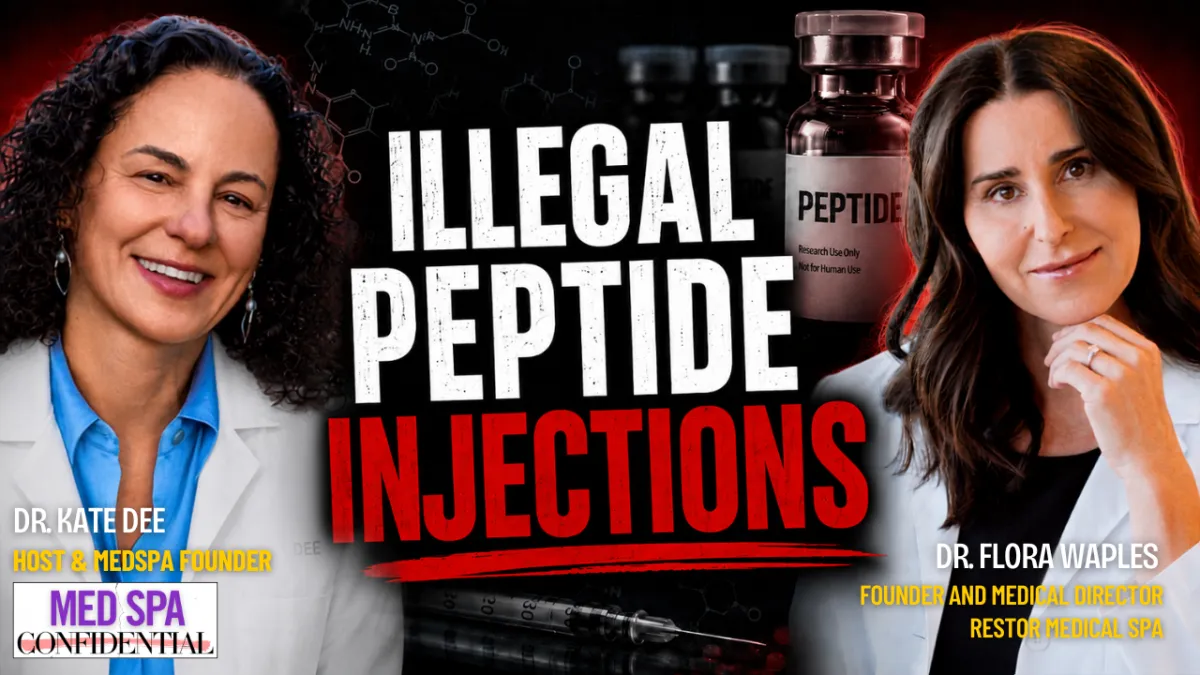
How Illegal Are Peptides, Really?
How Illegal Are Peptides, Really?
You can legally inject a peptide into your own body. But the moment someone charges you to do it, the rules change fast. That gray area is where people get hurt.
For the Medspa Confidential podcast, I sat down with Dr. Flora Waples, a Colorado physician who runs multiple med spas and prescribes peptides to her own patients. She lives this on both sides, as a doctor and as a mom whose son needs growth hormone every day.
What struck me was how much we still don't know, and how many people are injecting anyway.
Not "Are They Legal," But "How"
"It's always funny when the question is not are they illegal, but how illegal." — Dr. Flora Waples, Med Spa Confidential
Peptides like BPC-157 and the growth hormone secretagogues sit in a spot that confuses even the smartest people. Back in 2023, the FDA moved a batch of them out of the category that let compounding pharmacies make them. So the supply didn't disappear. It shifted.
Some labs started selling the same molecules as research compounds instead of medications. Same facilities, same product, that's not counterfeit but a workaround which means less oversight, not more.
Where the Line Actually Sits
"If you do not know where this thing came from, do not put it in your body." — Dr. Kate Dee, Med Spa Confidential
Injecting yourself at home is one thing. You're allowed to make choices about your own body. But once money changes hands, you're in a different world.
Here's my read, and I want to be clear it's my read, not a legal verdict. When a non-physician orders lab-grade product and injects it into a paying client, that looks a lot like practicing medicine without a license. Dr. Flora Waples pushed back on parts of this, and fair enough, neither of us is a lawyer. But I've gone over these questions with several healthcare attorneys, and the picture worries me.
Breaking someone's skin with a needle and changing how their body works is a medical act. Calling the substance a "supplement" doesn't move that line as far as people think.
The Risk Isn't Just Legal
"Don't inject anything that you can't get purity testing on and a certificate of authenticity." — Dr. Flora Waples, Med Spa Confidential
Most people self-injecting today are buying straight from overseas sellers. That's a gamble on what's actually in the bottle.
I've watched this go wrong. There was a case near me where someone bought what they thought was Ozempic online. It was insulin, and that person nearly died from the blood sugar crash. Contaminated product, wrong product, hidden fillers, it all happens more than you'd guess.
Dr. Waples gets her peptides from a compounding pharmacy that purity-tests every lot. You scan a lot number and pull up the results. That's the floor, not the ceiling.
What Might Change This Summer
There's talk of moving about a dozen of these peptides back into the compounding category. If that happens, I think it's a good thing. When you drive something underground, you don't stop it. You just make it more dangerous.
I go deeper in the episode on which peptides hold up under real science, which ones run on hope, and the one question Flora says you should always ask before anyone puts a needle in you.
Before Your Next Appointment
If this made you pause before your next booking, good. Education is how we protect ourselves and this industry at the same time.
Listen to the full episode of Med Spa Confidential to hear where the legal line really sits and the proof you should demand before you say yes.
Episode Transcripts:
[00:00:00] Dr. Kate Dee: You You can legally inject a peptide into yourself, but let someone charge you to do it, and they might be breaking the law. So where's that line? I'm Dr. Kate Dee, founder and medical director of Glo MediSpa, and this is MedSpa Confidential, where we expose the risks, the red flags, and the outright illegal practices happening inside med spas right now, because you deserve to know what's actually going into your body before you say yes.
[00:00:25] Dr. Kate Dee: Today, I'm sitting down with Dr. Flora Waples. She's a physician in [00:00:30] Colorado who runs multiple med spas and prescribes peptides to her own patients. Her son needs growth hormone daily, and she lives this on both sides as a doctor and as a parent. You'll find out which peptides actually hold up under real science and which ones are running on hope.
[00:00:45] Dr. Kate Dee: We'll get into why so many people are buying these straight from China and why that's a dangerous bet. You'll hear how a Seattle patient nearly died from something sold as one drug that turned out to be another. And Dr. Waples tells you the proof you should demand before you [00:01:00] let anyone put a needle in you.
[00:01:02] Dr. Kate Dee: Stay until the end because there's a change coming this summer that could shift this whole market, and you need to know why
[00:01:09] Dr. Kate Dee: Flora, thanks so much for being back on the podcast today.
[00:01:13] Dr. Flora Waples: Oh, such a pleasure, such a pleasure to be here again
[00:01:15] Dr. Kate Dee: So we're always talking about these sort of edgy topics. So do you wanna just... So I, I did talk to someone recently on the podcast about peptides, and, and we just didn't really cover it. And, and I, I really... I would love to [00:01:30] talk about just the different ones that are popular and what they're supposed to do, and if there's any science behind them.
[00:01:38] Dr. Kate Dee: And then I do wanna get to, like, just exactly, you know, how illegal are they?
[00:01:44] Dr. Flora Waples: It's always funny when that's the que- not are they illegal, but how illegal?
[00:01:48] Dr. Kate Dee: How, well, I
[00:01:49] Dr. Kate Dee: but let's just dive into, like, the most popular one, and I just, I would love to just know your take on it, BPC 157.
[00:01:59] Dr. Flora Waples: before we [00:02:00] jump straight into peptides, if, with-- if it's okay with you, and I wanted to start off with a little bit of, of definitions because there's a lot of confusion, or not necessarily confusion, but what are peptides? Let's start, let's start with that.
[00:02:13] Dr. Flora Waples: so the word peptide just means string of amino acids, right? So that word is not how it's being used when people talk about sort of the fact that peptides are hot nowadays, right? So what people are talking about when they talk, when they use the word peptides, sort of, let's say colloquially [00:02:30] nowadays in social media, what they are talking about is a specific group of peptides that our body makes that it uses to signal turn on and off different functions inside our body.
[00:02:42] Dr. Flora Waples: So they are specifically, they are the subset of peptides that our body can make that's used to signal turn genes on, turn genes off, stimulate tissues, suppress tissues, whatever, okay? peptides and hormones, and this is another place where people get confused a lot with definitions. A hormone is loosely defined as a signaling [00:03:00] molecule that affects lots of different genes, hundreds of different functions.
[00:03:03] Dr. Flora Waples: So something like estrogen will affect hundreds of genes. peptides can be hormones. Hormones can be peptides. There are several peptide hormones. Some peptides will only affect a very small number of genes and functions. Some will affect a larger number of genes and functions. So there's a lot. So when I think about what are peptides?
[00:03:19] Dr. Flora Waples: When I think about them, they are in the same category as hormones in that they are signaling molecules that can influence what our body is doing at any given time, and what it influences [00:03:30] depends on which peptide you pick. So I always want to just start with that kind of like rough definition. It is a signal your body uses to do something that we are harnessing for whatever we want to do.
[00:03:39] Dr. Flora Waples: So start with that. That being said, BPC-157, fascinating compound. I like to start by talking about what is the base molecule? Like where did it come from? How did it get found?
[00:03:49] Dr. Flora Waples: Then we can talk a little bit about mechanism. Some are known, some are not. We'll kind of, you know, as we go through, Then we'll talk about what type of literature do we have? Do we have animal studies? Do we have human studies? Some [00:04:00] combination? aside from the, you know, sort of cell culture level stuff, what, what do we have on this?
[00:04:04] Dr. Flora Waples: and then we can talk about, regulatory status, on last. But BPC-157 was originally found, and I think this is such an interesting like origin story. I don't know exactly the times when this was done, but, but pre-modern surgery. People realized that if, when people had, had very bad penetrating trauma to their gut People whose stomach was ruptured healed better than people [00:04:30] whose stomach was not ruptured during that, you know, traumatic event.
[00:04:33] Dr. Flora Waples: And when people, you know, sort of then enter modern science,
[00:04:37] Dr. Kate Dee: Which by the way is counterintuitive, right? So when you stab your stomach or other parts of you inside your body, you would not anticipate that that would be better than leaving your stomach
[00:04:50] Dr. Flora Waples: 'Cause the stomach is full of food and bacteria and acid. You would not think that there'd be anything beneficial in there that could aid with
[00:04:56] Dr. Kate Dee: at that.
[00:04:57] Dr. Flora Waples: Very strong acid at that. but it was noticed. It was [00:05:00] noted in, in sort of battlefield surgeons noticed this. So enter modern science. People took gastric juice and started looking, you know, for, for compounds that, that were responsible for healing, and they came up with a handful.
[00:05:14] Dr. Flora Waples: And if you think about it, it makes really good mechanistic sense. Your, your stomach is subjected to almost otherworldly layers of stress every day. I mean, mechanical stress, we eat things, have sharp edges, you know, crackers and things like that. Like you said, very-- It's essentially battery acid, and our stomach has to [00:05:30] constantly be healing from bacterial, you know, and, and viral stimulus from, you know, mechanical stress, from acid stress.
[00:05:36] Dr. Flora Waples: Our stom-- the tissue in our stomach has to be incredibly good at healing just to survive, right? And it turns out that our stomach and our gut makes this compound called... And they've named it body protection compound. BPC stands for Body Protection Compound number 157. They found it in gastric, gastric juice.
[00:05:52] Dr. Flora Waples: And it turns out that it does promote healing in, in the gut. That's been pretty well established. What they then did to make it into the peptide that [00:06:00] we know now is the problem with peptides or, or one, one of the problems with peptides is they tend to be very delicate molecules. The, the body uses them in very, very short bursts.
[00:06:10] Dr. Flora Waples: It makes it, it sends it out usually very close to the target, sends its message, and it degrades very quickly. Well, that doesn't work for a medication, so they had to make some changes to the compounds, make the linkages stronger so it can last longer, so it can deliver a longer signal. So BPC-157, while people will say is something that's natively found in your body, that's not exactly true.
[00:06:29] Dr. Flora Waples: The [00:06:30] molecule from which it came is natively found in your body. BPC-157, not natively found in the body, but that's where it came from. What-- How does it work? What mechanism do we have? Well, we don't know exactly what the mechanism is. We know some pieces of it. It seems to be pleomorphic. It seems to bind to a variety of receptors.
[00:06:47] Dr. Flora Waples: We know that it interacts with angiogenesis, which is the building new blood vessels. So, for example, we know that it c- when it binds to, there's a, a molecule called VEGF, which it stimulates, and it creates the formation [00:07:00] of new blood vessels, which is a very important part of our healing cascade. So we know it does that.
[00:07:03] Dr. Flora Waples: We have pretty good mechanistic data on that. It also has a second function, which is fascinating, and I, I actually didn't even know any of this till I got into peptides. But in order for us to heal, one very important function that has to happen is our fibroblasts, which are the cells that are responsible for making collagen, elastin, and, and building all the, the, the springs of the mattress, if you will, the molecules that are responsible for kind of holding our joints and tissues together.
[00:07:28] Dr. Flora Waples: In order for those [00:07:30] molecules, in order for those cells to work, they-- what they do is they lay down what's called this fibrin skeleton. They basically, you can think of it like the same as construction workers that are building a skyscraper. The first thing you do is you build a scaffold, and then everyone can get in there and use the scaffold to do other jobs.
[00:07:42] Dr. Flora Waples: Fibroblasts build a fibrin scap- like scaffolding, these, these rods of fibrin in tissue that's injured, and then other cells can use those to kind of find their way and do other jobs. Like macrophages can come in and clear out dead tissue. Other cells can come in and deposit stuff. You know, it's, it's basically this...
[00:07:59] Dr. Flora Waples: Well, it's a [00:08:00] scaffold. It is a scaffold which allows heal- healing to happen. BPC-157 accelerates that process. That's something we've seen in, in vitro in, in multiple studies. So that's the mechanistic data. There are probably other things it does too. Those are the two things that we know of that make sense in terms of what effects it has.
[00:08:17] Dr. Flora Waples: So what does it do? generally speaking, in-- There's been pretty good amount of data in rats, there's been some studies in humans as well, is when it is injected at the site of an injury or [00:08:30] close to the site of an injury, it speeds up the healing time of that injury by somewhere between 30% and 50%. And that's been shown.
[00:08:37] Dr. Flora Waples: There's-- They did a rat model where they were cutting the hamstring. They did a rat model where they were doing a crush injury on the Achilles. They basically clamped the, the Achilles tendon. And this has been shown several times in, in animal studies. There's very, very, very few human studies. There was one...
[00:08:51] Dr. Flora Waples: Like, no randomized clinical trials to the best of my knowledge. There was one retrospective study whereas a guy basically took a case series of his own patients, injected BPC into their knees, and, you [00:09:00] know, they got better. No controls. We don't know. That being said, there's about 20 years of anecdotal data of people injecting this, a lot, a lot of them in the bodybuilding community, and going, "Oh my God, I just healed from this tear in days instead of weeks, weeks instead of months."
[00:09:17] Dr. Flora Waples: And it is banned by all of the, performer- like the Olympic committees and stuff, which also to me said probably works. But that's what, that's what is known
[00:09:25] Dr. Kate Dee: So are they, but are they injecting it just like in a different place in their [00:09:30] belly, or are they actually injecting it where the injury is?
[00:09:32] Dr. Kate Dee: There's no reliable way to know if a med spa is following safety standards or cutting corners, until now. The Med Spa Board certifies clinics that prove they're doing things right, verified products, licensed staff, and actual medical oversight. It's the difference between rolling the dice with your skin and knowing exactly who's holding the needle.
[00:09:53] Dr. Kate Dee: If you're looking for aesthetic treatments, go to medspaboard.com to find a certified spa near you. And if [00:10:00] you already have a med spa you love and they're not certified yet, please send them our link. Med spa owners, getting certified does more than build patient trust. It should also save you a ton on your malpractice insurance.
[00:10:14] Dr. Kate Dee: Do the right thing and go to medspaboard.com. Keep listening, keep asking questions, and stay safe out there.
[00:10:21] Dr. Flora Waples: Great question. So BPC orients to sites of inflammation. So wherever you inject it, it's going to bind where it finds active inflammation. So [00:10:30] in people who are, you know, like myself, I'm almost 50, right? I got inflammation everywhere. So if I inject it, say, into my shoulder when I'm having knee pain, it will circulate through the circulation.
[00:10:39] Dr. Flora Waples: It will go everywhere. But if you're trying to... So if you're doing it for general anti-inflammatory and general achiness of age, doesn't matter where you inject it. If you have an acute injury, you just tore something in, in your leg, if you inject it as close to the site of injury as possible, you'll get more binding at the site, and so you get about 20% more improvement [00:11:00] in the healing of an acute injury by injecting it on site.
[00:11:02] Dr. Flora Waples: So it depends on what your application is.
[00:11:04] Dr. Kate Dee: Because the, the thing that strikes me, just bec- there's no study, so we don't know the answer to this, but if you have something that's doing that mechanism of action, then it makes sense to me that it's probably safe in the short term for, you know, until that Achilles is healed. But my question is, if you've got...
[00:11:24] Dr. Kate Dee: If you're exposed to it, you know, day after day, year after year, are you gonna have an increased risk [00:11:30] of cancer or benign neoplasm or other inflammatory things that are-- it's stimulating that you don't need s- or want, right?
[00:11:38] Dr. Flora Waples: That we have no idea. And that is a question to which, what we can say is that there have been no reported bad outcomes from anyone taking BPC over the last 30 years. Does that
[00:11:50] Dr. Kate Dee: And, but who would report it if
[00:11:51] Dr. Flora Waples: who reported and to where, you know? So, you know, we do not know what the long-term effects of, of...
[00:11:59] Dr. Flora Waples: There are [00:12:00] some peptides that we have good data on long-term effects. BPC, we don't. I mean, you're absolutely
[00:12:03] Dr. Kate Dee: Yeah. Because there are a couple other ones. So, the, the ones that work on your growth hormone axis, CJC-1295 and
[00:12:14] Dr. Flora Waples: Yeah, the growth hormone secreting box. Yeah
[00:12:16] Dr. Kate Dee: so I mean, those you would anticipate. So if it's stimulating growth hormone, you'd worry that that could be, stimulating neoplasms. And, but again-
[00:12:27] Dr. Flora Waples: Well, you know, yes and no. I mean, so, so the, the data [00:12:30] on neoplasms, and you'll have to correct me if I'm, if I'm wrong here, but my understanding of that data is we have, we have data on large number of animal studies that showed that increased growth hormone over time did not actually increase cancer.
[00:12:44] Dr. Flora Waples: The one-- You know what? I'm gonna have to look this up and send you a link because I I wanna call... There, there was, that came, there was a theoretical consideration, and I don't know if it was ever actually backed up by science. But that being said, the data on longevity with growth hormone comes from the [00:13:00] study of people with congenital syndromes where they are absent growth hormone.
[00:13:03] Dr. Flora Waples: And we have this, we have a mouse model of this, and of course, we also have some human families that, that have, that have deficiencies in growth hormone. And what we noticed about them is this: when people are chronically deficient in growth hormone over long periods of time, they have a longer lifespan.
[00:13:19] Dr. Flora Waples: They have a lower rate of certain diseases, primarily in the spectrum of hyperglycemia. So they have lower rates of diabetes, lower rates of hyperglycemia. And there's reasons behind [00:13:30] this, and, and this is the way that I, I think about it. I think of this, the body having, at its basic, at its most basic, we've got two big ways of acting.
[00:13:39] Dr. Flora Waples: There's two kind of paths that we can be on at any given time, and we go back and forth, right? When food is short, we are in that state of autophagy, right? We're going to be more efficient. We're gonna try and be more lean. When we are in that state of autophagy where we're really trying to, to survive with a lower amount of food, lifespans are longer, chronic [00:14:00] disease is put off for a longer time.
[00:14:01] Dr. Flora Waples: However, the downside of being in that sort of fasted state for long periods of time is it's hard to build muscle and bone, and other stuff too, but muscle and bone being the most important. The other state, which is sort of the, our anabolic state, when we have a great amount of fuel, all the fuel that we need, that's where we can, like, make muscle, make bone.
[00:14:18] Dr. Flora Waples: We feel great. We love it, but burning the candle that hot does lead to problems. So growth hormone is an anabolic hormone. If you're on it all the time, yeah, you're gonna put on muscle and bone, but you're gonna burn [00:14:30] too hot, and it's gonna lead to chronic disease in the long term. Autophagy, great state.
[00:14:34] Dr. Flora Waples: That's what your rapamycin stimulates that. You know, that's what intermittent fasting does. That's what regular fasting does. They all
[00:14:39] Dr. Kate Dee: gonna say, you're making the argument for living a paleo, primal, intermittent fasting life.
[00:14:47] Dr. Flora Waples: I'm making the argument that we need both states, and if you're in, if you're in a catabolic state all the time, you're gonna be weak.
[00:14:55] Dr. Flora Waples: You know, you're never gonna build a lot of muscle, a lot of bone. That has problems that go along with it. If you're in anabolic state all the [00:15:00] time, you're gonna have problem-- You're gonna be, you know, hyperglycemic, and you're gonna have problems there. And cycling between the two seems to make the most physiologic sense.
[00:15:07] Dr. Flora Waples: That's where the cycling growth hormone comes from. But so the idea that growth hormone is dangerous, I think comes from this idea that if people, when they don't have it, live longer. And that's true, but you gotta look at the other side too
[00:15:19] Dr. Kate Dee: Interesting. Okay, so, I mean, so those two, do you know what they're used for generally? So this CJC 1295 and
[00:15:28] Dr. Kate Dee: ipomalin?
[00:15:29] Dr. Flora Waples: so the family-- When [00:15:30] I think about peptides, I divide them into four basic categories. And, and there's no, you know, particular rhyme or reason, but I put them into sort of the, the healing group, which that would be your BPC-157, that would be your TB500, you know, Deuterium Thymosin Beta.
[00:15:43] Dr. Flora Waples: And then there's, you know, so there's the, the healing and, and repair category, which should generally be pulsed for, you know, I would say s-four to six weeks in the setting of acute injury or maybe in the setting of very hard training or something else like that pulsed. The second category is what I would call your, your metabolic peptides, [00:16:00] and I would put the growth hormone secretagogues in there and MOD-C in that category as well.
[00:16:04] Dr. Flora Waples: And the growth hormone secretagogues, you, you named the, the major one, Tesamorelin, Semorelin, Ipamorelin, CJC-1295. They all have the same basic mechanism of action, which is growth hormone, one of our necessary hormones. I put it, you know, estrogen, progesterone, testosterone, thyroid, growth hormone. It's, it's a major hormone, and it gets released under the stimulus of something called GHRH, growth hormone-releasing hormone.
[00:16:28] Dr. Flora Waples: Normally released by our [00:16:30] anterior pituitary, and it kind of tells our body to release a pulse of growth hormone. And we generally have between four and six pulses of growth hormone over the course of a day. Like all of our hormones, it, you know, is very high when we're in our teens and twenties, and it goes from about 20 micrograms per deciliter of blood, I, I may be getting the numbers wrong here, down to about 6, over the course...
[00:16:48] Dr. Flora Waples: between the ages of 20 and about 60. Our growth hormone kind of goes like that. And so when you use a peptide as a growth hormone secretagogue, basically they, they are, you know, GHRH analogs. They're [00:17:00] going to be sequences of peptides that are similar enough to growth hormone-releasing hormone itself that when you inject them, they will bind in the pituitary and cause a release of growth hormone.
[00:17:11] Dr. Flora Waples: and what you get from growth hormone is the ability to build more muscle, the ability to build more bone. It has an influence on stage four sleep, which is something we lose almost entirely as we age, and leads to s- you know, you know, improvements in immunity just because sleep and immunity are tightly linked.
[00:17:26] Dr. Flora Waples: and your hair and your skin look better because you're making more [00:17:30] collagen. So it's basically, it's an anabolic hormone that allows us to build. and so all the growth hormone secretagogues, they all have that sa-- and it also burns visceral fat preferentially. So they all have the same mechanism of action, which is they act by releasing growth hormone, which is pretty well understood, pretty well studied, and, and have a lot of human trials.
[00:17:45] Dr. Flora Waples: So I put those in the category of those are the peptides that I feel are the safest, the most well-studied, and the most well-known. That, that category
[00:17:52] Dr. Kate Dee: Yeah, I mean, the, everything
[00:17:54] Dr. Flora Waples: What's on there? We know what
[00:17:55] Dr. Kate Dee: really supports, right? Like, using-- if, if, if we had data to say that, that [00:18:00] there were no downsides long term. The only thing we have is, you know, many years of unofficial use where people haven't reported super bad things,
[00:18:10] Dr. Flora Waples: And what, what we know about growth hormone is, you know-- and that there's, there-- we have some long-term data because there are people who are growth hormone deficient who are on it their whole lives, you know? So we know that, you know, if it's in a physiologic range, that we haven't seen any increase in, in cancer rates.
[00:18:25] Dr. Flora Waples: Like my son actually, is growth hormone deficient because he has a syndrome called Laron syndrome, so he uses it [00:18:30] every day. and you know, there's no increase in cancer seen in people who are using it in physiologic levels. Now, in super physiologic levels, which is what a lot of the bodybuilders are doing, we have seen s- we have definitely seen some of that.
[00:18:39] Dr. Flora Waples: We've seen, organomegaly. we've definitely seen, you know, the, the, the cartilage on their heads grows and their noses grow, and there, there's definitely some problems with that. But, but growth hormone, you know, it-- I mean, tesamorelin is an FDA-approved drug. It's being produced as a peptide, but it is, it has full FDA approval.
[00:18:54] Dr. Flora Waples: So, so those things-- I would put those in the category of reasonable to use if you are choosing [00:19:00] to do that. It's a reasonable thing to use, and it's got good human data. The downsides of growth hormone is you're going to have an increase in blood sugar. This is something that we know. If you're gonna build muscle and bone, your body's gonna be pulling, you know, fuel, so blood sugar will go up.
[00:19:13] Dr. Flora Waples: And that's something that either you manage by doing it concomitantly with the GLP-1, or you can manage it by doing it concomitantly with fasting. Or you can just say, "Hey, I'm doing a three-month pulse where I'm trying to grow a bunch of muscle. I'm gonna roll with a slightly higher blood sugar." And usually it's like 10, you know, 10 points, 15 points, you know.
[00:19:28] Dr. Flora Waples: " I'm gonna roll with this for [00:19:30] three months, and then I'm gonna do three months where I'm, like, being really clean about my diet. I'm doing keto, I'm doing fasting, and I'm really gonna make sure that my, my insulin resistance, you know, is, is under control so you can manage it." But then the second thing is you, you're gonna get some edema.
[00:19:41] Dr. Flora Waples: Not everybody, but some people do. So in patients who have any kind of cardiac situation, anybody who's got any CHF, any kidney problems, anything like that, you wanna be very cautious 'cause you will get a little bit of fluid retention. and so you see you have to manage those things and be aware of those things, but,
[00:19:54] Dr. Kate Dee: from what I gather, from what you're saying, those three are fairly reasonable and there's, [00:20:00] there's no major red flags as far as like this is really a disaster. I wanna ask you about a couple others that, it's less clear to me. So, the first one is the TB500, which you mentioned earlier.
[00:20:14] Dr. Kate Dee: So can you talk a little bit about that and why? 'Cause it, it-- I think that it's used similarly to BPC-157,
[00:20:22] Dr. Flora Waples: Yeah. So
[00:20:23] Dr. Flora Waples: I will, I will tell you what I know. I will also tell you that is not a very well understood peptide. So [00:20:30] TB500 is, it's the same, the name that's used interchangeably, Thymosin Beta-4 is, is a name that's used interchangeably. We also have Thymosin Alpha. And so I'll talk about them both a little bit, and I'll say what we, what we know, what I know, and then, what we don't.
[00:20:43] Dr. Flora Waples: So the thymus, for those of us who are, who are not, physicians in the audience, the thymus is a gland that kind of lives in your chest. And when we are young kids, our thymus is this big, highly active gland, and its job basically is to train [00:21:00] and modulate the immune system. And as we go through the course of our lives, our thymus kind of involutes.
[00:21:05] Dr. Flora Waples: It kind of gets like, like fibrous and turns into fat, and it, and it kind of dies, for want of a better word. It doesn't die completely. Usually you have, I think, 5% activity when you're in your 60s or 70s. But the way that as the thymus kind of goes downhill, our immunity also goes downhill. Kids respond, have these very vigorous immune responses to vaccines or to illnesses or whatever, and they recover much better than people who are older.
[00:21:28] Dr. Flora Waples: So there's been a lot of interest in this [00:21:30] idea of, well, you know, the thymus seems to be linked to having a robust immune response. A robust immune response seems to be very, very important for a lot of health outcomes. So what can we study about the thymus? Well, the thymus makes a bunch of peptides. In addition to sort of training the, the T cells and the, and the B cells, the thymus also makes peptides.
[00:21:48] Dr. Flora Waples: Thymosin Alpha and Thymosin Beta are the two major peptides that we know of that are made by the thymus, and they interact with the immune system in ways that we don't really fully understand. Let me put that out there first. but Thymosin [00:22:00] Beta, our immune system is highly involved in healing, right?
[00:22:05] Dr. Flora Waples: Because when there's an injury, one of the first things that has to happen is you've got to go in and you've got to take apart all the damaged tissue, get rid of it, so the new tissue can grow, and, and it's our immune system that does that part of the job. That's why when you get an injury, it's red and it's hot.
[00:22:19] Dr. Flora Waples: That's, that's our immune system going to work So the idea behind thymosin beta, and I, again, there's not a lot of... There is some in vitro [00:22:30] data. I'm not sure how much in vivo
[00:22:31] Dr. Flora Waples: data
[00:22:32] Dr. Kate Dee: there's any human data
[00:22:33] Dr. Flora Waples: is. I'm not aware of any human data. You know, thymosin alpha is actually used in humans. It's FDA approved in the US and China and a bunch of Europe.
[00:22:42] Dr. Flora Waples: So, so the thymosin alpha is a, is a different category. The idea behind thymosin beta, to the best of my knowledge, is that you are giving it in the hopes that it will allow for quicker and easier removal of damaged tissue from a wounded area, and that's why it's [00:23:00] typically combined with BPC-157. It's like BPC-157 is the cranes, you know, in there building new stuff, and the thymosin beta is the trucks hauling away the debris.
[00:23:09] Dr. Flora Waples: That's the idea behind it. You are absolutely correct. There's not a lot of data on what it's doing. It does not seem to be hurting anyone in that, you know, the Wolverine stack is the most common peptide stack, I think, of any of them, that, that's BPC and thymosin, and it's been taken by a lot of people over a lot of time.
[00:23:26] Dr. Flora Waples: But there is no human data on that to the best of my [00:23:30] knowledge.
[00:23:30] Dr. Kate Dee: If only we could harness all this non-official data,
[00:23:35] Dr. Flora Waples: Yeah, we could collect the data. That'd be so cool. You know, it's one of those things where, you know, like the ideas behind this stuff are so magical that I think it's hard for people to restrain themselves. You know, like the idea that we can actually harness the body on a molecular level, 'cause our bodies have so many abilities that we just are not taking advantage of, you know?
[00:23:52] Dr. Flora Waples: And it's a very seductive idea. I get why people are so excited about it
[00:23:56] Dr. Kate Dee: the thing is the reality of-- Now I have studied a [00:24:00] lot about like paleo primal stuff 'cause I've been paleo for kind of a
[00:24:03] Dr. Flora Waples: Yeah. Oh, I didn't know
[00:24:04] Dr. Flora Waples: that. No
[00:24:05] Dr. Kate Dee: Yeah, and, and it's a lot easier to think about taking a peptide than essentially
[00:24:13] Dr. Kate Dee: mostly starving for three weeks and then, you know, sprinting, sprinting, killing an animal, and eating it all in, you know, a few days.
[00:24:21] Dr. Kate Dee: so people in that whole area of the wor- you know, of thought, which is not crazy, but like the, the ideas that our primal, our primal,
[00:24:29] Dr. Kate Dee: ancestors,[00:24:30] our bodies are meant to live like that. And, and so what these peptides are sort of promising or offering this potential of, hey, all you have to do is inject this peptide and you don't have to starve yourself and go chase the beast and kill
[00:24:46] Dr. Flora Waples: Yes,
[00:24:46] Dr. Flora Waples: yeah. I mean, exactly. It's the idea that all of that stuff is a, is a wasted step, right? You can just go straight to the stimulus. You don't need to have all that. And the same idea with like, you know, with, GHK-Cu for, for skin. It's like we use a laser, create a [00:25:00] wound, the wound creates a healing response, and the healing response creates collagen.
[00:25:03] Dr. Flora Waples: Well, what if we just skip all that and just go straight to creating collagen? You know, it's, it's, that, yeah, that's the idea. We don't have to do all that stuff, and it is very, a very seductive,
[00:25:10] Dr. Kate Dee: right. Okay, well, so it's so interesting. Okay, I wanna cover a couple more, and then I, I wanna get into what's happening with the status of these things. So, so one is I have talked about melanotan II,previously, and, you know, everything I understand, I, I've seen a ton of, videos on [00:25:30] Instagram of dermatologists saying, "Do not do this," and actually showing these mul- these melanomas in response to that.
[00:25:38] Dr. Kate Dee: So, increased risk of skin cancers. But it, it's... it makes you ridiculously tan. Like,
[00:25:44] Dr. Kate Dee: I've s- also seen pictures of people who, you know, were white, white, white, and they are, they are very, very uniformly dark-skinned after using this peptide
[00:25:54] Dr. Flora Waples: I will tell you, I mean, like, so the melanocortin, so I, I'm not a huge fan of the melanocortin peptides, but there's [00:26:00] basically, there's a handful of them. They all bind to the melanocortin receptor, right? And that's a receptor that's responsible for a lot of different stuff in the body.
[00:26:07] Dr. Flora Waples: It's responsible for pigment in the skin. It seems to have some... There's, there's... It's doing something with sexual response in both men and women. We don't entirely understand that. and the, you know, the thing is, the melanocortin, I believe it's four. It may be two, so we'd have to check. I don't prescribe the melanotans, so I, so I'm not 100% certain.
[00:26:24] Dr. Flora Waples: But one of them is an FDA-approved drug. It's Vyleesi. It's, it's the one that w- that's prescribed to, to females for hypoactive [00:26:30] sexual response. The problem is it, it causes a lot of flushing and nausea. so if you're using it to tan, I don't think that's necessarily a good idea because stimulating the melanocytes, as you said, stimulating the melanocytes is not necessarily the best idea in the world.
[00:26:45] Dr. Flora Waples: They can be very finicky cells. So
[00:26:47] Dr. Kate Dee: are very finicky. cells. I mean, we spend so much time trying to not piss off people's melanocytes. Like, that's one of our main goals is we don't wanna piss off your melanocytes with any of the things we do, and the idea of taking a peptide that's [00:27:00] gonna piss
[00:27:00] Dr. Flora Waples: It-- I,
[00:27:02] Dr. Flora Waples: I agree. I think that people should be allowed to do whatever they want to with their own bodies. I personally don't prescribe the melanotans because I'm like, "What are, what are we doing with the melanocytes?" And then as far as the sexual response, like what I have... You know, it's just, it-- there's so many side effects with it that it just does not seem worth it.
[00:27:16] Dr. Flora Waples: Like, Buylysia never became a blockbuster drug because nausea and sex don't go together well. So, so it's just, you know, it's just a, it's a repackaged medicine that's already been out on the market and hasn't done a very good job for
[00:27:29] Dr. Flora Waples: its proper
[00:27:29] Dr. Flora Waples: function. [00:27:30] I,
[00:27:30] Dr. Kate Dee: we're very dismissive of that one. Let's, let's push that one away.
[00:27:33] Dr. Flora Waples: it's it's one that's just, I just don't think, I don't think works for the purposes that people are trying to use it for
[00:27:38] Dr. Kate Dee: Okay, so the last two I wanna run by you are the two that were developed in Russia a long time ago, so Selank
[00:27:46] Dr. Kate Dee: and Semax.
[00:27:47] Dr. Flora Waples: Yes
[00:27:48] Dr. Kate Dee: tell me about those and, and why, why? Just
[00:27:52] Dr. Flora Waples: Why?That's a great question. there is some fascinating, fascinating mechanistic science behind those [00:28:00] two. there-- I, I will tell you that I am not as familiar with them, so I will tell you what I know, but I, I'm not by any means an expert, but I'll, I'll tell you what, what I know. And they do seem to work in humans.
[00:28:11] Dr. Flora Waples: the idea is Celex... Or taking a step back. we have a system in our brain called enkephalins, and the enkephalins are a s- a group of, of molecules that basically regulate our endogenous opioid system. So when [00:28:30] enkephalins are upregulated, what you're going to get is you're going to get reduced chronic pain because you're, you're, you're binding opioid receptors, right?
[00:28:38] Dr. Flora Waples: Within, within your own body. So you're gonna get a reduced pain response, and people feel very good
[00:28:43] Dr. Flora Waples: And so does-- it brings down stress levels, it brings down cortisol levels, it brings down pain. The, you know, the interesting thing about this molecule though is, is, and this is something that I struggle with as a clinician.
[00:28:55] Dr. Flora Waples: I'm like, okay, well, it makes people feel really good. [00:29:00] You're doing it with your body's own receptor systems. On the other hand, how much difference is there really between this and just doing opiates to feel good? Like they're, they're, they're harnessing the same system. is it morally okay to like-- On the other hand, it's the same system.
[00:29:13] Dr. Flora Waples: It's a runner's high, right? I mean, you, you, you, you activate the system when, you know, when, when good things happen to you in life as well. And so it's a physiologic thing as opposed
[00:29:21] Dr. Flora Waples: toan heroin, but
[00:29:22] Dr. Kate Dee: they addictive the way opiates are addictive?
[00:29:24] Dr. Flora Waples: Does not seem to be addictive. People do not have withdrawal. Now that's a physical thing. Are they emotionally addictive?
[00:29:29] Dr. Flora Waples: [00:29:30] People like them a lot because they feel good. You know, they feel good on them, and, and it takes away these negative things, you know? there does not seem to be a physical withdrawal. Selank is kind of similar in that it's activating... It's going to suppress cortisol secretion. and that, I'm not sure how good the data is on that, to be honest.
[00:29:48] Dr. Flora Waples: There's a couple papers, you know, saying that there seems to be this, this correlation. It upregulates or s- or stimulates in some way the endocannabinoid system. Again, not totally clear mechanistically exactly what's going [00:30:00] on. Humans have been stimulating the endocannabinoid system for millions of years.
[00:30:03] Dr. Flora Waples: This is something that humans do a lot. and it makes them feel good and, and there doesn't seem to be a lot of really bad long-term effects from it.
[00:30:11] Dr. Kate Dee: neither of them is supposed to enhance cognitive function? I thought that was kind of a big
[00:30:16] Dr. Flora Waples: I have heard people talking about that. I have not seen any reasonable mechanistic data that, that shows that that is true. I also have never used these personally, so I really, I really can't speak to that. I can't see [00:30:30] from the mechanistic studies that I've read, which again, they're from Russia and there's not a lot of them.
[00:30:35] Dr. Flora Waples: I don't see a way that-- I don't see a mechanistic way that
[00:30:38] Dr. Flora Waples: happens.
[00:30:39] Dr. Kate Dee: would happen
[00:30:40] Dr. Flora Waples: Not saying that it couldn't, but I... Yeah. Yeah, I mean, if you induce anxiety and stress, the frontal cortex works better. Like that's, that is the only way I could see that working. But that, that is true. Like when people are scared and stressed, they don't think.
[00:30:54] Dr. Flora Waples: So I
[00:30:55] Dr. Flora Waples: don't know.
[00:30:55] Dr. Kate Dee: I mean, so presumably they would reduce pain. I
[00:30:58] Dr. Kate Dee: mean, is there a role [00:31:00] for using that in chronic pain?
[00:31:02] Dr. Flora Waples: They are used in that a fairly, that, that's a pretty common reason to use them, is, is to treat chronic pain. They seem to have a pretty good effect. Now that being said, placebo also works 20% of the time. You know, and, and there are no big human trials, and so does it actually have something beyond placebo?
[00:31:17] Dr. Flora Waples: it's, it's not really known. The only, you know, the only thing we know is that, that enkephalins and endocannabinoids do help regulate pain inside the body. We know that to be a thing. How, you know... But, but beyond that, I, I mean, we don't know a lot about them. They [00:31:30] seem to make people feel good. People seem to like them.
[00:31:33] Dr. Flora Waples: That's, that's kind you know, that's what we know
[00:31:36] Dr. Kate Dee: okay. So, so let's, let's talk a little bit about what's happening legally with these things because, none of these is FDA approved in any way
[00:31:45] Dr. Flora Waples: not true. Tessamae Rowan, FDA approved.
[00:31:47] Dr. Flora Waples: There's...
[00:31:48] Dr. Kate Dee: about the ones that, I've asked you about.
[00:31:50] Dr. Kate Dee: a couple of them have been on the, you know, on the list of, for the an- the anti-doping
[00:31:56] Dr. Kate Dee: agency,
[00:31:57] Dr. Kate Dee: you know, forbidden,
[00:31:59] Dr. Kate Dee: which [00:32:00] I find also very interesting 'cause that you said earlier, well, it must be doing something if they made those
[00:32:04] Dr. Flora Waples: works.
[00:32:06] Dr. Kate Dee: Um,
[00:32:07] Dr. Flora Waples: if they bothered with it, it probably was doing something.
[00:32:09] Dr. Kate Dee: so so what happened was, so these were available for compounding for a long time, and then in '23, the FDA banned them
[00:32:19] Dr. Flora Waples: Well, make them-- put them, make them category two. so basically move them from category one into category two, with category one being not FDA approved but available for compounding, and then [00:32:30] category two is, is not available for compounding pharmacies. So what people have done to get around that, and to be fair, and I'm gonna, I'm gonna just speak frankly for, for one minute.
[00:32:41] Dr. Flora Waples: You know, like, not saying that we know everything about them, but speaking about BPC specifically, I have for myself and also I have many patients where it has made life-altering changes in things like arthritis. I have been-- I have several patients who, have Ehlers-Danlos, [00:33:00] and it has made significant life-altering changes for them.
[00:33:03] Dr. Flora Waples: and, and which makes sense mechanistically. If you have-- you know, if you're hypermobile and you're tearing up your collagen all the time, you know, I've told these patients, I'm like, "Listen," I'm like, "You know, I don't know what the long-term effects of this drug are. I don't. No one does. However, we know what your life is like now, and this is a choice that, that you make, you know, understanding that I can't tell you 30 years down the line something horrible may happen, but it may help you now."
[00:33:28] Dr. Flora Waples: And I have several [00:33:30] patients who have tried it and, and it's made significant difference in their functional. So when the peptides were moved from category one to category two, there was... You know, some of them are, I think, fluffy lifestyle fun, and some of them really can make some big differences for patients.
[00:33:44] Dr. Flora Waples: And so there was a really strong push for people to still have access, especially to BPC and the growth hormone secretagogues. So what people started doing is they started making them in labs and selling them as lab compounds as opposed to medications. [00:34:00] Same people doing it, same manufacturing facilities, same molecules, but now they're doing it under the regulatory pathway that governs supplements instead of under the regulatory pathway that governs meds because that, that, that door was closed.
[00:34:14] Dr. Flora Waples: And so that happened. And so now what you got is you got lab grade. Some of it's very good, some of it's not. There's no way to know. There's not as much oversight. Is it illegal? It's not illegal. You know, I mean, you, you can, you can make a compound and be like, "This is not for human use," and then give it to someone and [00:34:30] be like, "I don't know what happened." Yes.
[00:34:31] Dr. Kate Dee: hold on though. Hold on. It's illegal for if-- I mean, if you take a medic- anything and inject it inside a human, that is the practice of medicine
[00:34:45] Dr. Flora Waples: Well, but if the human does it to themselves,
[00:34:47] Dr. Kate Dee: If the human does it to themselves, that's just-- Well, you could do whatever. I mean, you
[00:34:50] Dr. Kate Dee: can be,
[00:34:51] Dr. Flora Waples: stuff is generally done- Yeah,
[00:34:53] Dr. Flora Waples: exactly. It's done by patients at home. Yeah.
[00:34:55] Dr. Kate Dee: Yeah, no, no. no. So but what I, what I wanna be clear though is that like, so if you order it and do it to [00:35:00] yourself, you know, you- that's one thing.
[00:35:03] Dr. Flora Waples: Yes
[00:35:03] Dr. Kate Dee: you are, some kind of pr- purveyor of these things, right? So as a physician, I'm allowed and you are allowed to practice medicine, and we are actually allowed to prescribe things that are non-FDA approved. However, we're held to a standard of care,
[00:35:22] Dr. Kate Dee: meaning if something goes wrong, we're responsible, and we're held to the standard of care of...
[00:35:28] Dr. Kate Dee: So if you're doing something [00:35:30] really fringy and you hurt somebody, then, you're in big trouble and you
[00:35:34] Dr. Kate Dee: could lose your license or you could be sued for malpractice. So but let's take, say, you know, someone who cannot practice medicine, either a lay person who's a business person or say like a nurse, who can't practice medicine on their own.
[00:35:48] Dr. Kate Dee: If they order these things laboratory grade and inject it into a human, that's illegal. That's actually a felony
[00:35:56] Dr. Flora Waples: and that's... Yeah.
[00:35:57] Dr. Kate Dee: medicine without a license
[00:35:58] Dr. Flora Waples: I mean, I'm-- and this, I'm [00:36:00] not exactly sure the, of the legal question here, and so I'm, I'm not gonna pretend I know exactly.
[00:36:04] Dr. Kate Dee: I mean, I just, I, I just reviewed a case that I'm about to do a recording on, which is exactly that, but this particular nurse ordered, a semaglutide that wasn't, you know, that was laboratory
[00:36:16] Dr. Flora Waples: the semaglutide's still, semaglutide is still a medication, right? So semaglutide is still regulated by the FDA because it's in, it's in the medication category.
[00:36:23] Dr. Flora Waples: I
[00:36:24] Dr. Flora Waples: am not
[00:36:24] Dr. Kate Dee: the skin barrier with a needle,
[00:36:27] Dr. Flora Waples: True.
[00:36:28] Dr. Kate Dee: that's the practice of medicine.[00:36:30]
[00:36:30] Dr. Flora Waples: Is that true when it's an
[00:36:32] Dr. Flora Waples: injection of something which is not a medication? So Ford, let me ask you this.
[00:36:34] Dr. Kate Dee: It is actually
[00:36:35] Dr. Flora Waples: Injecting, injecting B12.
[00:36:37] Dr. Flora Waples: B12 is a supplement. You don't need a license to inject it
[00:36:40] Dr. Kate Dee: Well,
[00:36:41] Dr. Flora Waples: Again, I'm not a lawyer, so
[00:36:43] Dr. Kate Dee: So I mean, I, I've, I've been, I've been putting together a legal compliance course, and I've lectured now a couple times to lawyers about healthcare law, med spa law. and so actually if you break the skin with a needle, me to y- you know, a human taking a needle, putting [00:37:00] a needle into another human past the skin, that's the practice of medicine.
[00:37:03] Dr. Kate Dee: So for instance, es- aestheticians, can't do microneedling or whatever because they're breaking... They, they can't do that.
[00:37:12] Dr. Flora Waples: I
[00:37:12] Dr. Kate Dee: Um,
[00:37:12] Dr. Flora Waples: are you sure that that is
[00:37:14] Dr. Flora Waples: true? I
[00:37:15] Dr. Flora Waples: mean,
[00:37:16] Dr. Kate Dee: sure this
[00:37:16] Dr. Flora Waples: in
[00:37:16] Dr. Flora Waples: Colorado, they're, they're allowed to do that in Colorado without a medical director
[00:37:20] Dr. Kate Dee: No, there are n-n-no. You can't inject somebody. They can inject themselves and do whatever you want, but also you can commit suicide. That's technically probably not le- [00:37:30]
[00:37:30] Dr. Kate Dee: you know.
[00:37:31] Dr. Kate Dee: but it is it is absolutely true if you, if you stick needles into people and put something in them,
[00:37:37] Dr. Kate Dee: you're, you're, you're invading their body and giving them a substance that you're intending to do to, to change the bodily function with it.
[00:37:47] Dr. Flora Waples: I mean, I, I feel like,
[00:37:48] Dr. Flora Waples: I feel like it seems like there must be carve-outs in that for supplements because people inject supplements all the time. And not saying that they're not breaking the law, 'cause there's laws out there that people just ignore. But [00:38:00] I would assume that only counts for things which are considered medications
[00:38:03] Dr. Kate Dee: I can only, I, I can only tell you that that is, I've been over this with several healthcare attorneys. and, you know, because, because people are getting all kinds of things off the internet, right? And, and some of these things are knockoffs of real drugs, and other things are, are completely, you know, not drugs at all, right?
[00:38:23] Dr. Kate Dee: You can-- Let's say you inject concrete in someone to give them a butt lift. That's illegal. [00:38:30] That is a, and you're, it's, it's illegal for so many different reasons. It's not just illegal, because it was a needle or a, you know, a big needle probably. But that's happened, right? That has happened. So to say that it was a supplement and not a drug, that's like saying, "Well, you know, concrete is not a drug, so therefore it must be okay."
[00:38:48] Dr. Flora Waples: that's a good point. I mean, you know, definitely it's illegal to inject spackling into people. There, there was that case in Vegas sometime where they did that, Yeah,
[00:38:54] Dr. Flora Waples: Um,
[00:38:54] Dr. Flora Waples: no, that does sound-- That's a valid point. I think, you know, the, the-- generally speaking, these are used by people injecting themselves.
[00:38:59] Dr. Flora Waples: [00:39:00] but okay. All right. Valid point
[00:39:01] Dr. Kate Dee: Yeah, I mean, the, the first, really I learned a l- kind of a fair amount about this was from a completely different podcast that was just talking about peptide stacks and where everyone's getting them because they can't get them from the legal places anymore, so they're buying them from China.
[00:39:18] Dr. Kate Dee: Most of the peptides that people are self-injecting, they're buying from ch- like directly from China.
[00:39:24] Dr. Flora Waples: I get mine from a compounding pharmacy. So there are compounding pharmacies that still do it. they just do it, you know, it, it's [00:39:30] something that is very quiet and not on their websites, but you still can get it from like, like the legitimate, truly. but you can still get them from like sterile compounded sources.
[00:39:39] Dr. Flora Waples: I agree that a lot of people get them from China. That's probably not a very good idea.
[00:39:42] Dr. Kate Dee: So this is also very interesting because, there, there was, two, two speakers at, from the FDA at the AMSPA meeting recently, and they talked about this, and I grilled them for about an hour and a half afterwards. and, and basically, there are FDA-approved manufacturing facilities [00:40:00] that are allowed to make the substance in the first place,
[00:40:04] Dr. Kate Dee: okay? And then there's FDA-approved compounding pharmacies. So generally, the compounding pharmacies buy the substances from the FDA-approved manufacturers. And then generally, doctors, you know, prescribe something for
[00:40:17] Dr. Kate Dee: their patients from a compounding pharmacy. so doctors are allowed to compound.
[00:40:24] Dr. Flora Waples: 嗯
[00:40:24] Dr. Kate Dee: I don't know if that's true in every state.
[00:40:25] Dr. Kate Dee: It's definitely true in Washington. So it's like, okay, so if a doctor [00:40:30] orders from the FDA-approved manufacturer,
[00:40:33] Dr. Kate Dee: and then compounds it for their patient, is that legal? And they were like,
[00:40:39] Dr. Kate Dee: "Yeah.
[00:40:39] Dr. Kate Dee: Well, I
[00:40:39] Dr. Kate Dee: don't see anything wrong with that."
[00:40:41] Dr. Flora Waples: seems like it would be. I mean, it's-- there's so
[00:40:43] Dr. Kate Dee: Totally legal. So I'm like, "Oh, okay. That's kind of good to know." So the thing is, if you're not a doctor though, you can't compound or if, unless you have a compounding pharmacy license.
[00:40:53] Dr. Kate Dee: So, you know, if you're a nurse or if you're a layperson with a business who owns a med spa, that's [00:41:00] probably illegal, and you order from one of those things, no, you cannot compound 'cause you don't have the license to compound. But I think, you know, the, the reason I wanted to talk about, like, how illegal is it, is because there's all these little subtle gray areas in it.
[00:41:14] Dr. Kate Dee: And, and the thing is that, you know, it's legal to buy it yourself and to self-inject, but it's not legal for... I mean, it-- you can't make money, buying it illegally and then injecting it into people, especially if you're not a doctor. [00:41:30] If
[00:41:30] Dr. Kate Dee: you
[00:41:30] Dr. Kate Dee: are a doctor and you can buy it from a legit FDA-approved facility and inject it in people, you're still taking a
[00:41:35] Dr. Kate Dee: risk because you're using your medical judgment, and, and a full disclosure with that patient, right?
[00:41:42] Dr. Kate Dee: You're taking a risk, like if anything goes wrong, your, your, your butt's on the line. But, there's everything, all this in between that's really hard to assess, like who can do what and where is it coming from and how do you know? 'Cause I think the biggest thing is I do not wanna put something in my body where I [00:42:00] don't know where that came from.
[00:42:01] Dr. Kate Dee: I don't... You know, it could be contaminated with bacteria. It could be an entirely different substance. and all these things have been documented over the last few years with all kinds of different products, not just
[00:42:13] Dr. Kate Dee: Botox or Ozempic, but like all these different things where people have gotten horrible infections
[00:42:19] Dr. Kate Dee: because, you know, it was a contaminated product.
[00:42:22] Dr. Kate Dee: People have gotten very, very bad allergic and, and inflammatory reactions because it was laboratory grade with other stuff in [00:42:30] there that wasn't meant to be put into
[00:42:31] Dr. Kate Dee: humans. and then there have been people who have almost died because it wasn't that substance at all. It was something else. Like,
[00:42:38] Dr. Kate Dee: there was a case here in Seattle where someone almost died because they, they had gotten Ozempic, fake Ozempic off the internet, and it wasn't Ozempic, it was insulin. And this
[00:42:49] Dr. Kate Dee: person almost... Yeah, this person almost died from
[00:42:52] Dr. Kate Dee: hypoglycemic shock, right? So,
[00:42:55] Dr. Flora Waples: That's a
[00:42:55] Dr. Flora Waples: big difference.
[00:42:57] Dr. Kate Dee: really big problem, right? So, and the-- So [00:43:00] the problem is, like, if you do not know where this thing came from, do not put it in your body, right? And, and so I do think that having a physician like you, who really knows their stuff and knows where it's coming from and can vouch for it and, and can monitor it and also manage if there's any problems, I think that's really, really important.
[00:43:21] Dr. Kate Dee: As we start getting into... Like, people are gonna s- With this FDA decision, people are gonna really start doing this more, and it's [00:43:30] gonna be a lot more
[00:43:31] Dr. Flora Waples: So I mean, you're talking about
[00:43:32] Dr. Kate Dee: semi above board.
[00:43:33] Dr. Flora Waples: back in, in category one
[00:43:35] Dr. Kate Dee: Yeah. Well, there's 12 of them that they're saying that, you know, I think that the timeline was July or August that
[00:43:42] Dr. Flora Waples: at July, at the July meeting. and it was, I think there's, there's 15 on the list and it was, yeah, it was the BPC, definitely was there. the GHK-Cu, the thymosin, both the thymosin molecules. Cell-Link I think was. and yes, I think if, if it does go back to category one, which I think, you [00:44:00] know, they've been telegraphing that they think it will, and, you know, the-- RFK definitely also telegraphing that he thinks it should.
[00:44:08] Dr. Flora Waples: And if it does, then I think that will be a positive thing because if people are gonna do it anyway, it should come from a sterile compounding facility that has certificates of authenticity and purity testing. Like, like the place I get my peptides from, I mean, they, they purity test each bottle and there's, there's the lot number on the bottle.
[00:44:25] Dr. Flora Waples: You can go to their webpage, you can put the lot number in, you can pull up the purity and, and COA testing on every, [00:44:30] on every lot, and that's what it should be. I mean, if you, you know, given all the things we don't know about these molecules, we should at least know that. so I think that that would be a good thing.
[00:44:39] Dr. Flora Waples: I hope they do it, 'cause people are crazy and they're gonna do whatever anyway.
[00:44:42] Dr. Kate Dee: I think so too. I mean, I, you know, I'm, I'm not the hugest, fan of the current, management of the FDA, but I, I think that what happens when you make things illegal is that people go underground and things get more dangerous. And I, I, I can only-- Like this, I know this is gonna be a [00:45:00] remote, remotely related, but when I was in college, the drinking age across the country went from all kinds of ages at different states, New York was 19, to 21 universally my freshman year of college.
[00:45:13] Dr. Kate Dee: And where everybody had just gone to keg parties before, now most of the people in college no longer were of age. And what happened back then, this was in the '80s, people started drinking way more hard alcohol and getting way sicker. And I actually had a [00:45:30] classmate who died of alcohol poisoning because he couldn't just go to a kegger and he and his roommate split a bottle of tequila, and one of them didn't wake up.
[00:45:39] Dr. Kate Dee: But I feel like this is-- I mean, I know it's kind of like a stretch, but I think this is very similar to that because, you know, you drive things underground and then more and more dangerous things happen.
[00:45:50] Dr. Flora Waples: if, if one thing, you know, if we've learned anything about prohibition of, over the years, is that it tends not to work very well. things that people really want, they're gonna find, you know, regardless of, of whether it's good [00:46:00] for them or not. so I, I'm, I'm kind of-- I agree with you. I would much rather have it be much more highly regulated and much more above board.
[00:46:06] Dr. Flora Waples: That'd be,
[00:46:07] Dr. Kate Dee: Yeah.
[00:46:07] Dr. Flora Waples: be good for all of us,
[00:46:09] Dr. Kate Dee: for anybody out there who's really super stoked to try peptides, maybe wait, until this happens. but for sure if you're gonna try them, I would do that with a doctor who's super smart like Dr. Waples here, who can really guide you through it and help figure out like if it really is gonna be helpful and make sure it's [00:46:30] safe, and make sure that product is safe
[00:46:32] Dr. Flora Waples: also, any peptide that you get from, from any, any source, if you can't get lot number-based purity testing and proof that there's, you know, no contaminants, proof that it is in fact, you know, a certificate of authenticity that says this is in fact a molecule that's in this bottle. If you can't get that from whoever's supplying you, whether it's a company or an individual, if, if you can't get that kind of testing, you really should not be injecting it.
[00:46:56] Dr. Flora Waples: like, you know, Kate said, there-- you know, odds are good, [00:47:00] probably good it'll be fine, but you don't wanna be that one person where it's not fine. So, so don't inject anything that you can't get purity testing on and a certificate of authenticity showing that it is what it's supposed to be.
[00:47:10] Dr. Flora Waples: That, that's baseline
[00:47:12] Dr. Kate Dee: Well, Flora, thank you so much for talking with me today about this. It's been so interesting. Hopefully people found that really helpful
[00:47:21] Dr. Flora Waples: I hope so. I like-- I, I feel like I answered a lot of the questions with, "We don't know." But that's the
[00:47:26] Dr. Kate Dee: because that's, that's the truth and that's what you don't get from all [00:47:30] the hype people. All right. Well, thank you so much. Next time
[00:47:33] Dr. Flora Waples: right.
[00:47:34] Dr. Kate Dee: something. All
[00:47:35] Dr. Kate Dee: right. Bye-bye. Thanks for listening. If this episode opened your eyes to something you didn't know before, share it with someone who needs to hear it. Subscribe so you don't miss the next one, and drop a comment telling me your biggest takeaway. I actually read them all. Join me on this mission to keep you safe and push this industry to do better.