
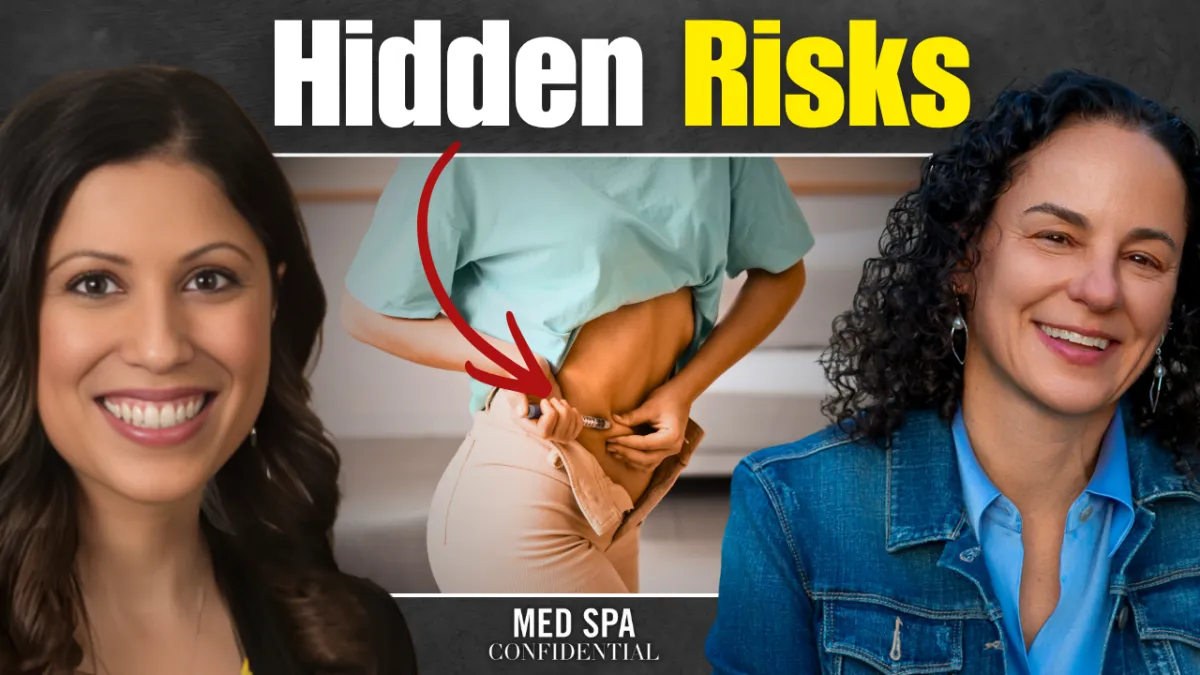
Med Spas are Selling Hormone Therapy…BUT Who's Checking?
Med Spas are Selling Hormone Therapy…BUT Who's Checking?
You've been told your symptoms are normal, that you're not quite there yet, or that your labs look fine. But something still feels off. What if the problem isn't your hormones, but who is managing them?
I'm Dr. Kate Dee, founder of GLOW Med Spa and host of Med Spa Confidential. Hormone therapy is rapidly expanding into med spas right now, but there is no single national standard for how it is offered, and oversight can vary widely.
What you will learn from my conversation with Dr. Radhika Sharma, an OB-GYN in Wisconsin who specializes in menopause care, may change how you think about your options.
The Training Gap Nobody Admits
"A week, maybe." — Dr. Radhika Sharma, Med Spa Confidential
That is how much menopause training Dr. Sharma says she received during her OB-GYN residency. She went on to pursue additional training and build her practice around this work. Most physicians do not.
So when you walk into your doctor’s office exhausted, not sleeping, and feeling like something is off, and you are told everything looks normal, there may be a reason. It does not mean your symptoms are not real.
The Pellet Implant Problem
"We can do better, more effectively, with better monitoring." — Dr. Radhika Sharma, Med Spa Confidential
Hormone pellets are widely marketed as convenient and consistent. What is not always explained is what happens when the dosing cannot be adjusted after placement.
Dr. Sharma was approached early in her hormone therapy work by a company promoting pellets as simple and profitable, with patients returning regularly. That raised important questions for her. There is a reason she chose not to adopt that model, and a reason I do not recommend pellets.
We break down what to ask before agreeing to any treatment that cannot be easily adjusted once it is in your body.
The Telehealth Trap
"You're going to be spending sixty or seventy dollars for three months." — Dr. Radhika Sharma, Med Spa Confidential
That can be the cost of hormone therapy through a traditional provider using insurance. So why are many women paying ongoing monthly fees for convenience-based platforms?
Traditional medicine has often failed women by dismissing symptoms or delaying treatment. As a result, many women look elsewhere. The concern is that some of these alternatives may not include a full evaluation or ongoing monitoring.
If something else is causing your symptoms, it may not be identified.
The Red Flags You Might Be Ignoring
"If you are having to continue to pay more and more out of pocket, that needs to be a really big red flag." — Dr. Radhika Sharma, Med Spa Confidential
If something has felt off and you have not been able to get a clear answer, this episode is for you. Listen to the full episode of Med Spa Confidential to hear Dr. Sharma’s full red flag list, what she looks for in a first appointment, and the one question she says every woman should ask before starting hormone therapy.
Episode Transcript:
MSC - Hormone Therapy Boom: Who’s Putting You at Risk? (Find Out) | ft. Dr. Radhika Sharma
Dr. Kate Dee: [00:00:00] The med spa industry is one of the fastest growing places for women to go for hormone therapy. There's just one problem. There's no national standard for who's allowed to prescribe it, and almost no one is checking. ~ ~You need to know what that actually means for your health.
I'm Dr. Kate d, founder ~of~ and Medical Director of GLO Medi Spa, and this is Meds Spa Confidential where we expose the risks, the red flags, and the outright illegal practices happening inside meds spas right now because you deserve to know the truth before you book.
Today I'm joined by Dr. Radhika Sharma, an ob gyn in Wisconsin who specializes in hormone therapy and menopause care. You'll find out why most doctors, including ob GYNs, finish their entire residency with shockingly little menopause training, and learn the specific red flags that mean your current hormone provider.
Maybe in over their head and once and for all are those constantly advertised. Telehealth hormone brands [00:01:00] actually worth it. Stay until the end because we're going to break down what the heck bioidentical even means because the wellness industry is counting on you never finding out. I'm speaking today with Dr. Radhika Sharma. She is an ob gyn in Wisconsin, who's an expert on hormones and also co-host of the podcast, the Double Scrub, which she does with her husband, Dr. Scott Curtis, also an ob gyn, where they talk about the intersection between family life, medicine and women's health.
~So I'm so excited to talk about kind of hormones and also who is the right person to manage your hormones and how do you figure that out? ~ So thanks, thanks for being here today.
Dr. Radhika Sharma.: Thanks for having me. Dr. Dee
Dr. Kate Dee: ~so, um, ~there's a huge range of providers now offering hormone therapy, ob, ob, ob GYNs, internists, functional medicine docs, nurse practitioners.
frankly, a lot of med spas. So from your perspective as an ob gyn, what's the minimum a provider really needs to know before they start managing a patient's hormones and, and where do you see that bar being missed?
Dr. Radhika Sharma.: ~Yeah, so~ I think that in terms of [00:02:00] minimum standards, I think having the interest in menopause is really important. Do I think you need to be necessarily Menopause society certified? I don't, but I do think at least it helps set a bar. Um, there are a lot of courses that are offered now, including through the Menopause Society.
So I think that having at least some sort of background where you've taken the initiative to take, you know, whether it is continuing medical education courses and get a certification, I think the certification helps because then we know, okay, this person has done the extra work. Do I think that,~ um,~ it needs to be a certain discipline, for example, like OB GN or internal medicine or family practice?
I don't think so because I think as we are learning more, menopause care is so all encompassing in terms of, you know, neurologically and metabolically and, you know, in the women's health spectrum. So I don't [00:03:00] think it necessarily needs to be a certain physician, but I do think in order to take care of someone in, you know, the realm of menopause, I think a nurse practitioner or a physician at the minimum in in my eye.
Dr. Kate Dee: Yeah, well, you have to be able to prescribe medicines, number one, and, and so a lot of nurse practitioners actually can't in where they, it depends on the
Dr. Radhika Sharma.: Depending on the state, right? Yep.
Dr. Kate Dee: approximately, approximately half. ~But even then,~~ you know, um, so, um,~ and what about PAs, do you think there are some PAs who could this?
Dr. Radhika Sharma.: So here's, here's where I come in with the N-P-N-P-A, and this is where we first connected and I loved it. ~Um, ~I think nurse practitioners and physician assistants are an extremely important part. Of medical care in streamlining care, in terms of assisting our medical system that is already route with issues in terms of a volume issue, right?
Like there aren't enough doctors who are able to treat, but I [00:04:00] think, and I have a, I have a. Someone in my sphere right now who's becoming a nurse practitioner, and the conversation has been, well, you know, her husband is like, you can go out on your own and make a ton of money in the state she's in. Okay.
And her concern is, I don't feel like I'm appropriately equipped to do so. And so, kind of piggybacking off the question of physician assistant or nurse practitioner. I think if they're in conjunction with a doc or with another, you know, professional. I think that that in terms of like an md a do, then I think working together is totally reasonable.
~Um. ~Do I think that they should be doing it on their own? I think that's where it becomes dicey. ~Um, ~I have med spas in my own area where the nurse practitioner is running the med spa, and I looked under the hood because I was like, who's covering this person? Right. And ~um, ~it was someone from a different state completely.
Dr. Kate Dee: is in Wisconsin. Do nurse practitioners have independent practice?
Dr. Radhika Sharma.: So [00:05:00] in, for the most part, they, they can, but many don't. ~Um, ~and I think that that's important. ~ ~
Dr. Kate Dee: I mean, is it legal for them to do it without
I believe
Dr. Radhika Sharma.: it is legal in Wisconsin for them to do it without Wisconsin is uh I think they can independently practice. ~Um, so. ~
Dr. Kate Dee: ~Um, well, so, um, ~that's really interesting about menopause society because, so, you know, we've talked a little bit about this. The amount of training you get in ob gyn ~ ~for menopause is. How much, how much did you get
Dr. Radhika Sharma.: A week, maybe
Dr. Kate Dee: a
Dr. Radhika Sharma.: people say a month. I'm gonna be honest, it wasn't a month. It was probably a week. Stop, lecture series. I mean, maybe.
Dr. Kate Dee: and I think that that's true across all the disciplines. There's, there's really not an emphasis on menopause. And I will say that. As a postmenopausal woman of 58. The reason I know about it is from personal interest and then also because all your friends who are non-doctors go, all right, what should I do?
And you know, since I've been through it [00:06:00] already, I'm like, well, oh my God, get the patch before it's too You know, like, so, ~um, so~ I think that, you know, if you have the background and the interest. And just like a keen desire to be like, oh my God, there are all these people who are being underserved. I think that anybody who has that kind of interest to get trained and really has that dedication and has prescribing authority in their state, right.
That's illegal.
Dr. Radhika Sharma.: We talk about prescribing authority, we could probably a whole podcast on prescribing authority.
Dr. Kate Dee: we could, that's another, but you know, whether or not it's should be or not. I, I, you know, to me that's, that's not. Really my purview. ~Um, ~but I, you know, I obviously, my emphasis always in life and on this podcast is people should be doing what's legal, ~ ~ and ethical. ~um, so, so,~ so a lot of med spas have added hormone therapy, ~ ~ and,~ um,~ people are doing,~ uh,~ all kinds of things.
And I'm curious to know,~ uh,~ your take on, ~um. ~Bioidentical hormones and whether that matters. And then I really wanna know your opinion on [00:07:00] pellets, 'cause I have strong ones of my own.
Dr. Radhika Sharma.: ~Okay~
Dr. Kate Dee: and then should everyone be on, on some degree of hormones, postmenopausal, and, you know, estrogen and progesterone. And then lastly, testosterone.
So
Dr. Radhika Sharma.: Yeah. Lots.
Dr. Kate Dee: can we,
Dr. Radhika Sharma.: it down, that's totally fine. ~Um, ~so here's the thing with bioidentical hormones, and I think with hormone therapy in general, we will hear on social media and med spas that menopause is incredibly nuanced. And anyone who has either taken courses or really spent the time to learn about hormone therapy, it is not a one size fits all.
I mean, I see a lot of women in my practice who are. In perimenopause or menopause. And I don't think that there's a, a one size fits all, uh, formula. And I don't think that there's an algorithm that we can follow to be like, okay, this worked for this person. You know, it's, it's all a matter of like, experience from one person to the next.
What works, what doesn't? Looking at them as a whole individual. ~Um, ~in terms of [00:08:00] bioidenticals, I mean, I. Speak about them a lot because there are women who are like, I don't want a medication. I don't want another medication to take. And what I explain to them is that a bioidentical is just that, right? That your body sees it as, oh, it looks similar to estrogen.
So when women start taking it, they might actually notice. If they're in the throes of like late perimenopause, early menopause, they, and that estrogen is really going down. They might notice when they're taking this bioidentical, they're noticing a significant difference in their symptoms. They're like, oh, my hot flashes have decreased.
Oh, I'm not feeling, you know, maybe my libido's improved. Maybe. Okay. But it is, it's, it's going to be,~ um,~ relatively finite in time because at a specific time. For everyone It's different. Your body's gonna start realizing this is not the real stuff and it's not going to be responding as it would if the person was taking estrogen or estradiol.
And I see this a lot in practices [00:09:00] outside of medical practices, whether it be someone who's like, and I don't wanna, I'm not putting anyone down. I don't wanna, you know, say that 'cause not everyone's the same. But if you look at like. Homeopathic practices or functional medicine practices, they may introduce the idea of like a compounded formula or a bioidentical initially, or you know, there's a lot that's thrown around like, oh, you're progesterone dominant, or you're estrogen dominant and you know, based on certain testing.
So we're gonna give you this compounded. Formulation or a bioidentical, and then when it stops working, well, then what do you do? Right? So I say like, Hey, it's not wrong for you to try it. I'm a very big proponent of, I wanna, I want women to advocate for themselves and feel empowered to do so, but I also want them to understand that there's a limitation with a bioidentical, that it's not really approved for the treatment of menopausal symptoms.
But if you wanna try it. You can try it. It's just not going to, it's not going to work the same as it would if it was estrogen.
Dr. Kate Dee: Right. So,~ um,~ interestingly, I feel [00:10:00] like our definitions of bioidenticals, I think we need to define that. Are, are you referring to just natural substances that mimic.~ Um, ~estrogen, are you talking about,~ um,~ literally identical hormones that,~ um,~
Dr. Radhika Sharma.: I would say if we're talking about bioidentical, when I think about it, I think about formulations that are going to be looking like, you know, for example, like soy or other phytoestrogens that people are taking. ~Um, ~whereas if we're talking about things like prometrium, like a micronized progesterone or something like that, that's going to be a bioidentical from a, a chemical standpoint.
But if we're about over the counter, which is, I think what I'm seeing is the industry is. Pushing a lot of bioidenticals for women in terms of, Hey, this is not estrogen it, but your body looks at it as estrogen. This is gonna help with your hot flashes, or this is gonna help with your vaginal dryness.
On and on and on. I like to tell people like there's limitations to that for sure.
Dr. Kate Dee: Yeah. So what is your typical starting point for if [00:11:00] somebody really looks like they, um need to be on hormones to, or having all kinds of symptoms. ~Um, ~what would be your starting point?
Dr. Radhika Sharma.: So honestly, I spend a lot of time in conversation honing down the symptoms because my concern is, you know, I had a patient even last week who's like, Hey, I came, I'm, I'm coming in. 'cause in the last two years I'm having hip pain, nothing else but hip pain. Okay. And, you know, my primary care physician said it's probably my hormones.
You know, she's in her mid to late fifties. So really a lot of the time is spent talking about the symptoms. When they're happening and then making sure we're ruling things out that could be causing these symptoms as well, right? Mm-hmm. Unfortunately, what's happening in perimenopause and menopause, and I'm sure you're hearing and seeing this as well, that every symptom is now thought to be.
Perimenopause and menopause. Like where's itching in your ears formation. The idea of, you know, ~um, ~well, you know, I'm having gum bleeding or my hips are hurting, or I'm [00:12:00] having pain everywhere and so I don't want it to be, what I try to do first is make sure it's not a catchall for everything, right? Like, are you having palpitations?
Have we ruled out why you're having these palpitations? So really figuring out if the symptoms are, have been. A cause of something else. That's the number one thing. And then a discussion in terms of like, what have we done in terms of,~ um. ~What have we done is lifestyle interventions because sometimes a lot of it is like, Hey, I just put on 10 pounds in the last like year and someone's telling me it's perimenopause or menopause, and,~ uh,~ everyone says that an estrogen patch is going to take my 10 pounds off.
And I like to tell them like, actually, you might put on weight when you go on estrogen and you have to be aware of, you know, of that. So really a discussion of the symptoms and seeing what interventions we've taken and then a discussion of, hey. What are our goals of treatment? Right? Understanding that like, I may not, may be able to bring you back to a perfect standpoint, ~ um,~ but I'm gonna start somewhere.
I don't believe in the [00:13:00] smallest dose for the short, shortest amount of time. I think that's archaic. But I am okay with like, Hey, do we wanna try a patch? Do we wanna try a pill? Do we wanna try oral? When it comes to,~ um,~ do we wanna try, you know, uh, va vaginal estrogen first. I have a lot of women who are like.
I don't want systemic estrogen, but I really like the idea of a vaginal estrogen. So really looking at the symptoms and saying, I'm not gonna, I'm not gonna give you like a treatment plan just based on the fact that you're in perimenopause or menopause. And then definitely discussing, you know, if someone is in per mepa.
Do I wanna put progesterone on right away? Do we want a hormone stack and take our time? And then I definitely talk about testosterone as an option as well. A hundred percent. I am very much on the train of protest testosterone. ~Um, ~I think that, do I think it's the full missing link? I don't know. I'm not a hundred percent sold, but I do think it's a very important factor and I have seen it change Quality of life for women.
Dr. Kate Dee: Oh, absolutely. So [00:14:00] have I. A hundred percent Yeah.~ Um, ~ I think it's really interesting though because we've kind of talked about. The fact that menopause has been neglected by traditional medicine for so long, which is why so many places are popping up right now to deal with this. It's in the popular psyche.
There is like an article in the New York Times, you know that doctors have missed this for years and years, and so now all of a sudden people are paying attention to it and I do think it's really interesting. Do you think that this pendulum has swung. More in that direction and so many people are just lump, oh, you've got, you name it, it must be from menopause.
Go find a menopause specialist. I mean, are, are you? That seems to be what you're saying, which I think is kind of funny. 'cause if that pendulum swung that quickly, that would be really, really fast,
Dr. Radhika Sharma.: I would say. I see. I think there's been a swing for sure. ~Um, ~I think [00:15:00] if, if you are on any sort of social media right now and you're in perimenopause, menopause, or menopause. Your algorithm is pointing you towards some sort of health wellness. And it's not just like the hormones, right? It's the weight loss, it's the food, it's the behavioral health, like, it's huge.
So yes, I think a lot of these women, their symptoms can be because of perimenopause or menopause. ~Um, ~but I do find that sometimes I'm like, are we getting this? Because people are like, I just don't know what to do. You know?~ ~
Dr. Kate Dee: ~I think I think it's so important to see the reason,~ I think it's important to see someone who is. A, a physician who really understands medicine because,~ um,~ know, perimenopause can look like anxiety, it can look like depression, it can look like thyroid issues. It can look, but like a DH it can look like so many different things.
~ ~ and of course things like the hip pain and other physical things like. It could be any of [00:16:00] those things in the differential diagnosis. And yes. Is it important to treat a menopause like a hundred percent? Like I would not be talking, I a really important topic, obviously, you know, for me. But I also think that you need somebody who can actually look at the whole picture.
something that could actually be wrong besides your hormones. Right. And and I, I really do think that, that the trouble I have with kind of, even, especially the online ones where, you know, a, a patient, a person decides, oh my God, I, I should be on hormones. All my friends are on hormones. And they say great it is.
And then they do one of these. famous telehealth providers that advertises on the Super Bowl, and then they get who didn't know them at all Yeah and they get their prescription, which is what they want in the first place. So they're being, they're being served exactly what they wanted, Mm-hmm way, that estrogen that's being prescribed for them is costing them money out of pocket.
Dr. Radhika Sharma.: Mm-hmm
Dr. Kate Dee: [00:17:00] Which it wouldn't if they just went to their doctor and or a doctor who actually can prescribe them medicines because these things are covered. Okay. These, these hormones are
Dr. Radhika Sharma.: Generally pretty darn cheap, right?
Dr. Kate Dee: expensive
Dr. Radhika Sharma.: I do digging all the time, like, Hey, actually like, 'cause people say, what are you gonna prescribe me? I'm like, I'm actually gonna look at my formulation and see what I can find that has equivalent dosing and is the cheapest. And if insurance isn't gonna cover it, then I'm gonna call Cost Plus or GoodRx and figure it out and we're gonna, you know, you're gonna be spending 60 or $70 for three months.
Dr. Kate Dee: right, exactly. So
Dr. Radhika Sharma.: And don't understand that. They don't understand.
Dr. Kate Dee: really I think it's because traditional medicine has failed in providing this care. people are like, screw it. My, my doctor won't prescribe this for me. I'm just gonna go get it from X brand. I don't even wanna tout them because I, I don't think people it though that person doesn't know you, that person really just is there to sell you a product that you do [00:18:00] not need to really pay for because covered by insurance and that's.
It's like the opposite bill, but they do such a good job of customer service. The people love that. Right. ~Um, ~so I, you know, I'm, I do think that it's great that more clinics are offering this service for people. if they're doing a great job of it, I think that's awesome. And then, you know, you can pay them for doing their great job of seeing you and then just pay for the, the estrogen patch or whatever it is that's being prescribed to you.
Because it's going to, in the end, gonna be so much cheaper, and by the way, safer and better for your health.
Dr. Radhika Sharma.: ~Yes. Um, and I think the thing that you made so clear is when you see someone like a doc or a nurse practitioner or a PA underneath.~
Dr. Kate Dee: ~If you're talking right now, I just wanna let you know that my screen froze and it'll catch up. I don't know why, but just give it a moment,~
~huh?~
~Uh oh.~
~I don't know either. I can't see you right now. I can hear you though. Okay.~
~Well, if you can hear me, this is still recording.~
~10% uploaded. Interesting.~
~Um.~
~I've never had this particular problem either, so, um,~
~okay. Looks like it's,~
~so, if, you know, if you hit camera,~
Dr. Radhika Sharma.: ~know ~~There we go.~
Dr. Kate Dee: ~ah, there we go.~
Dr. Radhika Sharma.: ~Um, it actually, I don't know why, but it said that to change to my phone, so I don't know if my internet went out or something. I apologize. That's never happened. Yeah. Anyways,~
Dr. Kate Dee: ~It's okay.~
Dr. Radhika Sharma.: ~Okay, so were talking, we were at, um, I was talking about treating people. I don't know where you heard last, but treating people like further their thyroid.~
~Do you want me to pick up there or do you wanna move forward? Whatever you want.~
Dr. Kate Dee: ~Um, yeah, go ahead and, and go from there. Yeah.~
Dr. Radhika Sharma.: ~And are we, we're still recording. Okay, So, yeah,~ So yeah what I'm finding is that, you know, someone comes in for maybe palpitations and their provider may have sent it that sent them, or they were, they came in thinking like, Hey, it's perimenopause, but then I'm like, okay, you've also gained 20 pounds and maybe your hair's falling out, but you haven't had your thyroid checked.
So a lot of it, like you said. ~ ~It's more than just, Hey, I'm coming to a menopause clinic and [00:19:00] thinking I'm gonna get a test done and then get hormones and that's gonna fix it all when it could very well be something different. And even the patient, like I was telling you about with the hip pain, I was like, Hey, tell me about your family history of osteoporosis.
Have you had a DEXA scan? Have you, you know? So looking at the whole picture and saying, I'm not gonna slap hormones on everything and say that that's the solution.
Dr. Kate Dee: Right. Do you think there's any danger,~ um,~ to go ahead and, know, get the hormones without ~ha you know, um, ~having that workup? I mean, if somebody,~ uh,~ is told by their doctor, oh, go see a, a hormone specialist, ~ ~ and then they go, oh, you know, that's too much of pain. I'm gonna just get it online.
Dr. Radhika Sharma.: Sure.
Dr. Kate Dee: What are the dangers there?
Dr. Radhika Sharma.: I think the, the concern is not looking at a person through the lens of that person, right? It's saying, Hey, look, it's a one size fits all. And I think the problem becomes, especially when I find the one thing I find [00:20:00] is sometimes now I'm seeing patients after they've already seen someone online or a functional, you know, medicine or a homeopath, and the issue is they're like, well, we've tried this.
Now I have all these side effects. And so I think the concern is saying, well, if this doesn't work or if this isn't the answer, what else could it be? You know, making sure, are we looking at people's cardiovascular risk, especially depending on their age. A lot of people haven't seen a primary care in years, so now, you know, especially with new cholesterol guidelines and, and you know, new,~ um,~ prevention strategies.
I think a lot of these women like deserve to have, make sure that their lipid panels have checked and their metabolic panel has been checked. We're checking fasting insulin, and I'm not saying everyone gets, you know, 20 labs to do, but the concern is, are we missing things that are obvious because now we're just looking at, hey, just come online and, and you can get it done.
I worry about follow up because a lot of women won't follow up because now they have to pay for another visit for a [00:21:00] follow up. It's not like it's included.
Dr. Kate Dee: ~right, right. ~Actually, I don't, I don't, since I have not participated myself, I don't actually know what's included. I think that they do monthly memberships and
Dr. Radhika Sharma.: of them, but not all of them because not wants to pay for monthly memberships.
Dr. Kate Dee: ~Right, ~right. Well, but you have to keep buying the medicine,
Dr. Radhika Sharma.: Mm-hmm.
Dr. Kate Dee: and that's how they their money. I have seen,~ um,~ one patient who was doing that for weight loss.
And,~ um,~ in the end,~ uh,~ had like a vitamin B12 toxicity because they were providing, you know, one of the GLP ones with B12 in it or something. And, and it was too much. And, um, I do think that whole issue is really fraught because, you know, the compounding pharmacies are busy compounding things. don't really need, but it's a way around the compounding laws, right?
The, the, ~um,~ patent laws. and I don't think that that's true for hormones because, ~ ~ hormones have been way outta patent for forever, as far as I can tell.
Dr. Radhika Sharma.: Yeah, [00:22:00] exactly.
Dr. Kate Dee: But that's why they're cheap. That's why it's so easy to do it, because they're not, they're not expensive, whether it's the patch or a, a topical cream or, you know, a pill.
These are, these are, you know, basically generics that are really pretty easy to, to provide and they're covered. So I think the, the biggest thing is making sure that you're getting the appropriate treatment that's right for you.
Dr. Radhika Sharma.: Yeah I
Dr. Kate Dee: getting back to a prior question though,
Dr. Radhika Sharma.: yeah
Dr. Kate Dee: so for anybody listening or watching,~ um, so, you know,~ a pellet is something that gets inserted under the skin that acts as a depot, a reservoir, and feeds your system with. Whatever's in the pellet, presumably hormones,~ um,~ over time what is your opinion on pellets and why?
Dr. Radhika Sharma.: ~So, um, ~~you know, it's interesting. ~When I started my interest in hormones, I somehow automatically got,~ uh,~ put on some list somewhere and ~pellet, um, uh~ a pellet company, um, approached me and they told me [00:23:00] how, oh, this is easy. You literally need to. Find a box, put up a sign and start seeing people, and you can charge people from X to Y and you're gonna have people come back all the time.
So, ~uh, ~you know, I really looked under the hood. I read the book of the person who started the company and how it was life changing. And then I started really looking into it. And my problem with pellets is that they're super dosed, in my opinion. ~Um, ~and we can do better. As you said, for cheaper, we can also monitor it more and we can have effective,~ um,~ we can have effective therapeutic effective treatments without the use of pellets.
So I think, unfortunately, I'm not a proponent of pellets. ~Um, ~I've. Spoken to people who have been doing pellets for like 20 plus years, who were kind of like the OGs, the compounding pellets, and oh, you know, it's such a great avenue for your patients so [00:24:00] happy and you make all this money. So I unfortunately think you can do it better, more effectively with better monitoring with what we have.
And I don't think you need pellets. I I think the money
Dr. Kate Dee: ~so for anybody listening or watching, um, so, you know, a pellet is something that gets inserted under the skin that acts as a depot, a reservoir, and feeds your system with. Whatever's in the pellet, presumably hormones, um, over time~~. And so ~the issue I have with it, besides cost and fact that it's kind of a gimmick to make a lot of money,~ um,~ is that what happens is what, what Dr.
Sharma said is that it's super dose. And what that means is you, you put in a,~ um,~ boatload, I can't, this is a clean podcast, so I'm not the word I really wanted to say, but you put in a boatload of, of hormones. All at once in a depot, and the curve, meaning the amount that goes into your bloodstream really high in the beginning and then slowly tapers off.
So in the beginning, you've got way too much, and at the end you've got not nearly enough. And, and so it's not even, and, and if you do have way too much, like some people, it's fine, they don't have symptoms, but a lot of people do have symptoms and if you put in way too [00:25:00] much, you can't take that pellet out.
You know, you can't undo it, just gotta ride it out. And so, ~um, ~you know, especially if it's like testosterone and you'd be like. A raging maniac for a while before that mellows out. ~So like,~ so you know, it's very, very convenient in the sense you don't have to remember it, you don't have to replace it, you just go in every however many months.
~Um, ~but it costs a lot more and it does not provide an optimal amount of whatever drug you want to administer. So, ~ ~ I'm with you totally with you on the, we could do it so much better. Without that, and I guess I'm willing to just say it in a little more kind of way, but,~ um,~ yeah, I'm not a, I'm not not a big fan of pellets.
I, I, I do think it has its purpose, especially if someone needs a drug and they are not gonna follow up. But for somebody who is, you know, postmenopausal and looking for hormones,~ um,~ I don't think that that,~ um,~ patient population overlaps very much with [00:26:00] someone like that.
Dr. Radhika Sharma.: and I think that the, the problem is, as you said, because the industry was so far. I shouldn't even say the industry, but even like health, like medicine, we were so far, far, far behind, you know and we were still not prescribing hormones pretty readily. Right. ~Um, ~people were like, I don't wanna feel, I don't wanna go into my fifties feeling like junk.
And people are saying, you know, they're getting these pellets and they're feeling amazing, and their hair looks amazing, and their face looks amazing. You know, and then you talk to the people who are like, yeah, you know, my hair's falling out. And ~um, ~yes, as you said, like. My rage has gotten worse. And now they're sitting in our office and saying like, what do I do now?
I mean, I hear a lot of people who aren't injectable testosterone too. And the, the thing with injectable testosterone is sometimes we just see more side effects. And so we have to talk about that and talk about changing dosage or lots of oral testosterone users, even in women. And so then we have to talk about how the absorption is different in oral versus testim.
So, ~um. ~I think the [00:27:00] testosterone is very important link in perimenopause and menopause, and I think it can be used well, and I've seen patients where it has been a great addition to hormone therapy. ~Um, ~but I don't think you need a pellet. I, I not, I don't, I'm not a big fan of injectables, so I don't even prescribe injectables generally.
Dr. Kate Dee: and, and it can be applied to the skin or it can be, you know, applied to the mucosa of the mu vagina. both of those have huge benefits without having to be,~ um,~ as, as systemic as, you know, injectable or pill form. ~Um,~ do you have a preference for one of those?
Dr. Radhika Sharma.: I like, I, I generally will prescribe Testim and I'm a big fan of. Like, I'm always surprised when I talk to people who are doing injectable testosterone or sometimes even pellets that like they're not having their lipid panels followed and no one's at testosterone levels. I generally will follow my patients and testosterone very closely because I wanna make sure that they're not [00:28:00] having the side effects and that they're not, and generally with testing or even with the, ~ uh,~ gel applied topically, I don't see a lot of that.
But I also wanna make sure aid they're getting. You know, they're getting benefit from using it while also me making sure I'm monitor it. And I think that's the other problem sometimes with the telehealth in certain, you know, in certain platforms is they're like, here, this is fix you, but you know, let's not look at everything else that might be going along along with like lifestyle factors and cholesterol and things like that.
Dr. Kate Dee: ~Yeah. Yeah, yeah. So~~, um, ~if someone who's watching or listening to this is currently on hormone therapy, what are the red flags that should make her say, Hmm, maybe I need a second opinion.
Dr. Radhika Sharma.: ~Yeah. Um, I would say I have a really, you know,~ if you are being told you need to continue adding, you know, supplements or, you know, you're, you're talking about they're checking your levels and you're not quite in menopause yet, or not seeing big changes. Things like that, and they're trying to increase dosage, dosages, or add [00:29:00] things, that is a huge flag if you're having to continue to pay for tests. That, you know, there's,~ uh,~ one test in particular I can think of that I hear a lot of patients who ha, you know, have paid a ton out of pocket for that's the Dutch test, you know, or if they're saying, Hey, I'm going to give you something to help lower your cortisol or change your adrenal pattern, things like that.
I think those are things to start being like, wait, what? What are you adding? Help with my cortisol because my cortisol's out of whack and menopause. Like I think you really need to be sitting at buyer beware. And then if you start asking questions like, Hey, if this doesn't work, what do we do? There's not really an answer.
I think it's time to look to somebody else, because often if you are going to someone who may not be like a doctor or someone who has a certification in menopause therapy, they are going to have like, okay, we're just gonna give you, you know, B12 shots as you said, to see if that'll help your energy. Or let's add this supplement and let's add this [00:30:00] compound.
And maybe we'll give you a little bit more of injectable testosterone if it seems like you are adding and changing. Constantly and you're having to pay more and more out of pocket. That needs to be a really big red flag
in my mind. Um, and if you're not having improvement in your symptoms, a worsening of your symptoms and there's, you don't know where you're going next, I really try to set out a very.
Clear plan with my patients and say, this is what I need to see you next. Like, we're not falling off the radar. It's not gonna be you're on hormones and I don't see you for another year, like an annual visit. Like, I'm gonna see you every four to six months, then I'm gonna see you every three months. Then I'm gonna see you every four months.
We're seeing each other regularly to be sure you have physical and symptomatic improvement. And if you're not, then we're gonna have to change things and look at things differently.
Dr. Kate Dee: ~Mm-hmm. So, um, the last question I wanna ask you is,~ so if somebody is really interested in this topic, they're, they're, they're watching this and thinking. Hmm. ~Uh, ~you [00:31:00] know, maybe I should go see somebody. Like what are the main symptoms that,~ um,~ that if they have,~ uh,~ they should really think about seeing somebody who knows about menopause.
Dr. Radhika Sharma.: When we look at, you know, common symptoms that women are experiencing in perimenopause and menopause, right? And things that are actually, quote unquote, I like to use, quote unquote, but FDA, approved, right? If you are having consistent. Vaginal issues. That's a big one, right? It's vaginal irritation, vaginal dryness, pain with intercourse, low libido.
If that is something that's persisting, I really urge you to find someone who is a menopause specialist or an expert. If you start noticing that you know your hot flashes are waking you up at night and they're affecting you during the day. Your brain fog is getting worse difference with like brain fog than, you know, 'cause now everybody's worried with brain fog.
Am I gonna have dementia? And there's really good tools to say, Hey, is it brain fog or is it a higher risk of dementia? Right. ~Um, ~not great ones, but at least things that we [00:32:00] then it's, those are things to start saying, Hey, should I go find someone? If you are having, also noticing that your periods are getting very erratic, right?
~Um, ~not just spacing out, but if they're getting closer together and heavier. It might be something else that we need to make sure that you're seeing like an OB, GYN and a menopause specialist who can understand what's going on. ~Um, ~for sure. And then one of the biggest things I see is that mood liability, right?
Like, you know, especially when we're seeing women, they're 46, okay? My kids are getting older. My job's changing. I'm having a lot more anxiety and depression around things. That didn't bother me before that I felt like I had all my stuff together and I don't, like, I feel like I'm losing it. I'm angry all the time.
I'm sad all the time. Things are, you know, I think you start seeing someone,~ um, seeing,~ starting with a primary care is great, but if you're in that age range and you're having multiple of these symptoms very well might be perimenopause or menopause.
Dr. Kate Dee: I think the only thing I [00:33:00] might add to that list is sleep issues. I think that that's really huge. I think once people's progesterone plummets, it's like impossible to fall asleep or stay asleep. So that's another one. ~ ~ so what would be, so if somebody's sitting there thinking, okay, I gotta find somebody, what are the main questions they need to ask when they're trying to find a provider in their area?
Dr. Radhika Sharma.: Yeah, can I piggyback off the progesterone for one thing? Um. Last year, the Menopause Society or? Yeah, it was earlier this year. They had a conference and they were, there was a big debate over, so progesterone isn't used as an FDA approved for sleep disturbances, but a lot of the times we know that when we're giving women progesterone, they are feeling.
More relaxed, their anxiety goes down and they're able to sleep. So I'm a huge proponent of saying yes, like even if you don't have a uterus and you are having sleep disturbances like you've had a hysterectomy or whatever, [00:34:00] I am a big proponent of progesterone because. It is, it's a huge fix all for so many things.
The better you sleep, the better your metabolism is, the better your mood is. Sometimes it's decreasing hot flashes. So all the things,~ um,~ if someone is the questions to ask. Right. ~Um,~
Dr. Kate Dee: Well, but before you go to that, I just wanna share my, my personal experience that is, is exactly that. So, I had a hysterectomy and,~ um,~ I was put on estrogen for, for symptoms. Oh, you don't? They said, oh, you don't need progesterone. I was like, oh, okay. ~Um, ~but I was researching it my own, on my own. I'm like, I really like, can't sleep for my life.
I went and I talked to my doctor, I'm like, you know, could I just add that? 'cause I can't freaking sleep. And she's like, oh yeah, that's why I take it. And so, um,~ um, ~you know, because, so even if you don't have a uterus, so technically you don't need progesterone. The reason we need both when you have a uterus is to [00:35:00] balance the stimulation of your endometrium.
I, I don't wanna launch all into that, but yes, if you have a uterus, you can't be just on estrogen. That is a problem. You end up at risk for polyps and endometrial cancer, so don't do that. But if you don't have a uterus, I still think you need progesterone because otherwise you're not gonna sleep.
Dr. Radhika Sharma.: I feel like there's a reason your body produced progesterone for so like an adequate amount progesterone for so many years. We can't anticipate that everything's gonna be homeostatically normal if we take out the progesterone. Like, it just, I, I just think that I am a big proponent of progesterone and I'm, and I'm proponent of testosterone as well.
Dr. Kate Dee: Yeah. So, okay. Getting back to question, so if somebody's really interested, what should they ask?
Dr. Radhika Sharma.: So I think that they need to ask, you know, do they treat people who are perimenopausal and menopausal? Because believe it or not, even in my community, there are people who have called their doctors who have been their OB GYNs for years and years and years, and they say, we don't do hormones. I don't really know what that means as an OB, GYN, that you don't do hormones.
But there [00:36:00] are clinics out there that just don't do it. I think if are going to see a nurse practitioner, a pa, I think you're gonna wanna in, in your state, you wanna see that they're in some sort of coworking relationship with a medical doctor. I think it's important. I'm gonna I'm just gonna say it.
I think it's important to have an MD or a DO working in conjunction with a nurse practitioner. ~Um, ~and then in terms of. Being Menopause Society certified, I think it can't hurt, especially if you're like, do I go to a med spa or do I go to someone who is Menopause Society certified? I think more and more we, we have to have some sort of,~ um,~ platform to say what's, you know, and then truly it's like, are you going in and getting the one size fits all prescription?
'cause if that's the case, then you probably need to look for somebody else.
Dr. Kate Dee: ~Yeah, I mean, I,~ I think like in my own clinic,~ um,~ I have a colleague who is an ER doc,~ uh,~ but also a woman and also,~ um,~ super duper interested in, in hormones and, and, and health. And she did get [00:37:00] certified. ~ ~ and I think someone like that who has like a personal interest and, and can literally diagnose.
Anything who walks in her er if she's not a bad,~ uh,~ option, right. Someone like that. I think, yeah, I mean, that's the thing, right? Like I'm a radiologist, a breast cancer person turned, you know, aesthetics like, but I think that if you're very smart and you're a physician and you get all the training and you learn about it.
~ ~especially if you're a woman. I, I have to say that like, I mean, you know, I'm not saying anything bad about your husband, the ob gyn, but like, don't think I'd feel comfortable. I don't, you know, they don't know what it's like. And, and, and once you've been through this stuff.
Dr. Radhika Sharma.: Mm-hmm.
Dr. Kate Dee: You have so much empathy because it's such a rough existence going through it and dealing with those symptoms and, and, it's such a balance to, to maintain what makes you feel human and healthy and smart and sharp and well rested and athletic and energetic like and to be a good [00:38:00] mom and a good doctor and a good parent, it's such a balance, right? And I think that having a physician who understands all of those things is so important, which is why, I mean, if I were, you know, in Wisconsin, consulting you.~ ~~Um,~
Dr. Radhika Sharma.: ~ I love it.~
Dr. Kate Dee: ~I~~ I I that's, ~
Dr. Radhika Sharma.: ~Women in this stage of life in Per, I mean~~, ~I love when I get to see a woman before she goes into menopause, to be honest and do, it's almost reminds me of the days of like preconception counseling. We don't get that as often anymore, but when we see women in perimenopause and they're asking all these questions and they're talking about like, Hey, look, my family member had this, and you know, or the other mark that we're, that we're really missing is like premature ovarian failure and premature menopause.
Like that's. A big, and you know, we're changing the terminology 'cause we don't wanna make, it sounds like the ovaries are failing, but if the ovaries stop working, like we still need that estrogen. I just saw a woman who was too, she went into menopause and they were like, oh no, you don't really need hormones.
I'm like, no, you do. ~You really do. ~
Dr. Kate Dee: Yeah, I, I think the other piece of information is that if you're [00:39:00] in your forties and still cycling regularly, but, but you can't sleep and you have night sweats and there's other stuff going on, like probably your hormones are falling apart, ~ ~ even though you're still getting your period regularly. So I know that that was happening to me and I didn't realize, you know, I did go to my ob gyn and she's just like, well, you know. You're only 44 and you're cycling regularly, you know, you'll probably, and I didn't skip a period until I was 55, so like,
Dr. Radhika Sharma.: can you imagine and not done anything your 10 years
Dr. Kate Dee: I didn't, I, I suffered.
Dr. Radhika Sharma.: oh my dear.
Dr. Kate Dee: for a very long time,~ um,~ before I figured it out. I know. And that, and the thing is that now with, with about menopause, I think it's just so important for people to understand that, you know, not every doctor knows about it, but there are some who are really fantastic.
Dr. Radhika Sharma.: ~Yeah~
Dr. Kate Dee: there are also some other, you know, providers who are also really fantastic if they have [00:40:00] the knowledge and experience and training
Dr. Radhika Sharma.: Yep
Dr. Kate Dee: to manage those things. So
Dr. Radhika Sharma.: Yep
Dr. Kate Dee: that our country's finally kind of come around on, on that and we're able of women.
Dr. Radhika Sharma.: Yes. I, I couldn't agree more and truly, I mean, whether you're listening to this from a patient standpoint or a physician standpoint, there is, there are not enough docs who are doing this. And so, you know, get out there and get certified and get the information. 'cause it's not that hard. It's, it's doable.
You can get the, you know, you made through medical school, I promise you, you can get, you know, make it through.
Dr. Kate Dee: it's fantastic 'cause we help so many women like better in their and their bodies.
Dr. Radhika Sharma.: So satisfying. It really is.
Dr. Kate Dee: Well, Ika, thank you so much for being on podcast today. It's really been a pleasure.
Dr. Radhika Sharma.: It has been. Thank you very much for having me.
Speaker 2: ~Thanks for listening. ~If you found this helpful, do me a favor and share it with a friend who's considering any aesthetic treatments. Subscribe so you don't miss the next one and drop a comment telling me your biggest [00:41:00] takeaway. I actually read them all. Let's keep each other safe and elevate the standards in the MedSpa industry.