
Hours, Days, or Weeks? How to Plan Your Med Spa Downtime
Hours, Days, or Weeks? How to Plan Your Med Spa Downtime
You've finally booked that treatment you've been researching for months. But when your injector says "minimal downtime," what does that actually mean? Can you go to work the next day? Will you be hiding behind sunglasses for a week?
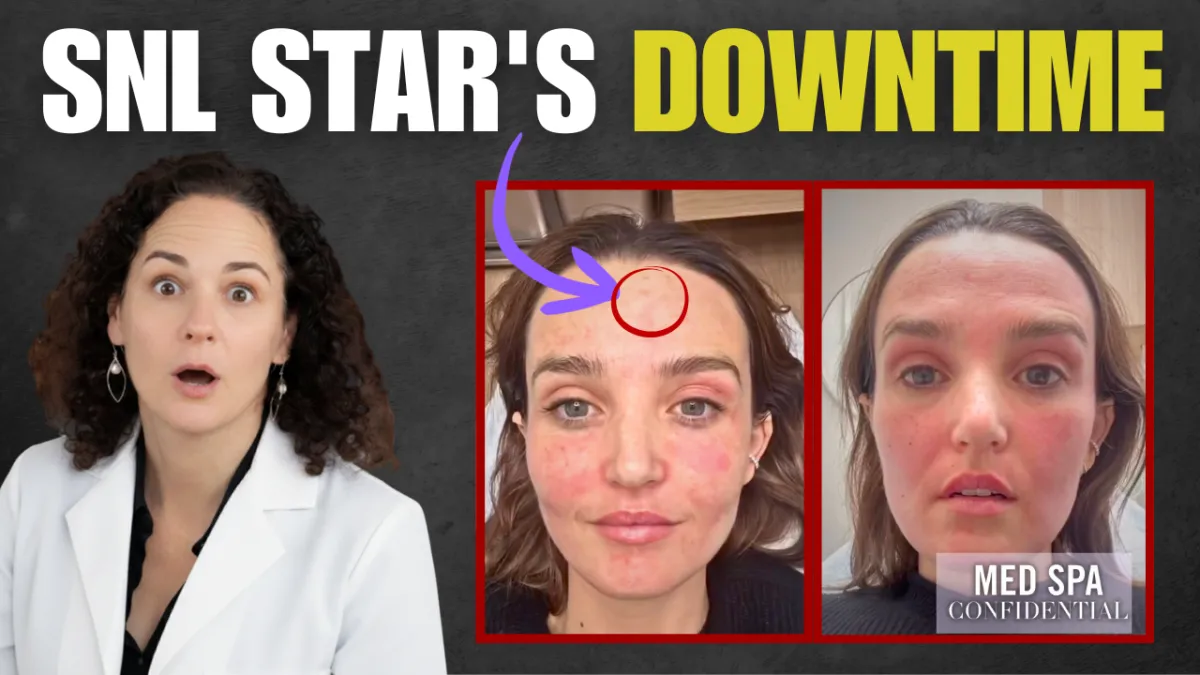
SNL's Chloe Fineman recently posted something most celebrities would never share: raw photos of herself mid-recovery from various med spa treatments. Her face was swollen, red, and covered in dark spots. She looked nothing like the filtered before-and-afters flooding your Instagram feed. On the latest episode of Med Spa Confidential, I break down exactly what treatments she likely had and what each recovery timeline really looks like. Because here's the thing: you can't plan your aesthetic journey without understanding what "downtime" truly means.
When "Minimal" Means Different Things
"These treatments do have some downtime and you are gonna be puffy sometimes and you are gonna be red or have some sequelae, but they do generally go away." — Dr. Kate Dee, Med Spa Confidential
I love that Chloe called out the Connecticut excuse. We all know someone who mysteriously disappears for a few days and returns looking suspiciously refreshed. The industry often markets final results while glossing over real recovery, leaving patients underprepared. When you don't know what day three actually looks like, you can't plan properly. You can't ask the right questions. And you definitely can't recognize when something's gone wrong.
Looking at Chloe's photos, I could identify treatments based on specific patterns. That grid-like pigmentation? Classic IPL or BBL response. The exaggerated upper lip suggests overfilling, likely worsened by swelling.
Too much filler placed incorrectly. Each treatment has its own recovery signature. Some procedures leave you red for hours. Others keep you puffy for days. A few require you to completely disappear from public life for one to two weeks.
Your Skin Tone Changes Everything
"The risk of complications is a little lower in someone like Chloe than in someone like me. Even my skin's sort of medium tone." — Dr. Kate Dee, Med Spa Confidential
Here's what most clinics gloss over: recovery timelines and risk levels vary dramatically based on your complexion. Chloe has very fair skin, light eyes, and blonde hair. That puts her at lower risk for certain laser complications compared to someone like me with medium-toned skin and brown eyes. If you have darker skin, some aggressive treatments become significantly riskier.
I prefer non-ablative laser resurfacing for most patients. Yes, it requires more sessions. But the recovery is measured in hours, not weeks. And it's much safer across different skin tones.
Compare that to Fraxel, which Chloe mentioned by name in interviews. That's an ablative laser requiring one to two weeks of serious downtime. Your face is basically off-limits. You're not leaving the house.
Ablative vs. Non-Ablative: What's the Difference?
Ablative lasers like Fraxel and CO2 literally vaporize the top layer of your skin, forcing new skin to grow back. That means dramatic results but also significant downtime.
Non-ablative lasers heat the layers beneath your skin without destroying the surface, so you get collagen stimulation with recovery measured in hours instead of weeks.
Before you book, ask your provider directly: "How does this treatment perform on my specific skin tone? What complications am I at higher risk for?" If they can't answer clearly, that's your red flag.
The Real Timeline Nobody Shows You
"Look for great treatments, look for ones with minimal downtime. Look for providers who are really skilled in what they do." — Dr. Kate Dee, Med Spa Confidential
Most treatments I do have recovery times measured in hours to a day. You might be red. You might be a little swollen. But you can function. IPL treatments bring pigmented spots to the surface before they slough off. It looks worse before it looks better, but it's temporary. Filler makes your lips crazy swollen initially, then settles within days.
But scan your calendar before booking anything. Got a wedding next weekend? Skip the laser. Important work presentation on Thursday? Don't schedule filler on Tuesday. The "downtime" your provider mentions isn't just about physical healing. It's about when you'll feel comfortable being seen.
On Med Spa Confidential, I explain exactly what days one, three, and seven look like for different treatments. Because planning realistic recovery isn't about vanity. It's about making informed decisions that fit your actual life.
Before Your Next Appointment
If you've ever felt blindsided by how you looked post-treatment, you're not alone. The industry sells results, not reality. Chloe's honest recovery photos do more for patient education than any polished marketing campaign ever could.
Listen to the full episode of Med Spa Confidential to learn which treatments need real planning, what questions to ask about your specific recovery timeline, and how to spot the difference between normal healing and something requiring immediate attention.
Episode Transcripts:
[00:00:00] Chloe Fineman: Every year, hundreds of women will say they're going on a trip or visiting family in Connecticut, but really they'll be going ham at a med spa
[00:00:10] Dr. Kate Dee: Hi, I'm Dr. Kate d and I wanted to tell you today about how much I admire Chloe Fineman and here's why. So she's an actress on SNL. She's 37 years old, and she recently put out this Instagram reel all about what she calls [00:00:30] botched. Med spa, procedures, and basically none of the pictures look botched to me.
[00:00:35] Dr. Kate Dee: the, the whole, thing is pretty hilarious, is kind of a spoof. And I wanted to share with you what she said, but also, what it looks like she probably had done from these pictures. and her basic point is. Uh, a lot of people who care about their skin go and have these procedures at med spas.
[00:00:56] Dr. Kate Dee: They pretend they're going to visit their aunt in Connecticut, but really they're going to the [00:01:00] spa and they're hiding in their apartment for a few days while they recover. and at the end of it, she's like,
[00:01:05] Dr. Kate Dee: This year I pledged to stop the cycle. Just kidding. I'm going Friday.,
[00:01:09] Dr. Kate Dee: So let's see the pictures that Chloe, put out there. So first of all, it opens with her, showing her skin. She's clearly had a procedure. Her skin is very red and she's got some hyperpigmentation on her cheeks. that is very common.
[00:01:26] Dr. Kate Dee: After certain procedures, oftentimes those procedures are [00:01:30] done to get rid of pigment. And what happens is the pigment gets a little darker, uh, and then it sloughs off, and then, uh, it's much lighter afterwards. And sometimes you have to do a few treatments in order to get rid of the pigment. And so the thing that maybe she had for this treatment could be an IPL, which is intense pulse light.
[00:01:49] Dr. Kate Dee: Also known as BBL, which is broadband light. But what happens is for the pigmented spots in your face, they get darker right away before they slough [00:02:00] off. They kind of look like coffee grounds. So it's possible that's what she had here. I don't know. I'm not her doctor. and actually, uh, she lives in New York.
[00:02:08] Dr. Kate Dee: She does SNL although the Place that she talks about going. And she's been very public about her participation in the med spa world, is actually in Marin County, in, in California. so, that's my, what I think maybe she's done here is, is some kind of IPL, in this next one. It's really interesting.
[00:02:29] Dr. Kate Dee: She looks very [00:02:30] different, doesn't she? And she's very red and splotchy. in this case, she doesn't really have the brown spot so much, which she's got a lot of red splotches. This one's a little bit harder to tell. She's kind of got a lot around her left eyelid, and that's pretty unusual because we don't typically do stuff there.
[00:02:48] Dr. Kate Dee: There's a few things we can do. Um, in the upper, like right below your brow, but right around the eye. She's very red there. So it's actually really hard for me to tell what this [00:03:00] was. This, you could, your skin could look like this from a peel, but again, you would never put the peel close to your eye like that.
[00:03:07] Dr. Kate Dee: It could be looking like this from various kind of facial treatments, uh, that are like facials. Um, uh. Could be some microneedling. It's kind of interesting. She's not that swollen here, so she didn't have a really big, big procedure. So this one's kind of hard to tell. now here, clearly she's gotten some lip filler and it does not look good.
[00:03:29] Dr. Kate Dee: [00:03:30] Okay, so her upper lip looks ridiculous here. So, either they put just way too much in her upper lip. If, if this were, I mean, I, this is just pretty, it's pretty bad. So typically, uh, when we do filler for lips, it's because people have lost volume in their lips and they wanna plump them up a little bit.
[00:03:50] Dr. Kate Dee: And you can do that very subtly, and it, it can look really good if you do it. carefully and not too much. Clearly she's had way too much [00:04:00] here. Her lips look a little ridiculous and they're clearly swollen, so chances are if you, once the swelling's gone down, this will look a little better. But clearly some will put way too much because generally your lower lip should be a little bigger than your upper lip.
[00:04:13] Dr. Kate Dee: And here her upper lip is way crazy huge, and the lower lip looks pretty, pretty good. So, if this were my clinic, She walked in, like looking like that. We would dissolve a little bit of that in the upper lip, so it looks a little better. now your lips will swell up after you have [00:04:30] a filler.
[00:04:30] Dr. Kate Dee: There's no question they're gonna look crazy. And, and you might love that or hate that. If you really love it when the swelling goes down, you won't be happy anymore and you want more. but most people are like, oh my God, what did I do? And then a couple days later, the swelling's gone. It looks pretty good, but here, this, there's something wrong because.
[00:04:47] Dr. Kate Dee: The uppers way too big. let's see what's next. So this one, she's just really red. It's kind of hard to say what she's had here. She's a little swollen also. you can see because her nasal labial folds just like [00:05:00] puffy. She just has a very puffy look. here this is really interesting because she looks much closer to herself.
[00:05:06] Dr. Kate Dee: Here you can see a lot more, Pigment. so maybe she's had a laser or another BL, where you can see the pigment's very prominent on her skin. Again, she's very red there. Out here she's crazy swollen. Do you see that the difference? She's a pretty slender person and here her whole lower face is really, really swollen.
[00:05:25] Dr. Kate Dee: we see that sometimes with some laser and [00:05:30] some, uh, RF microneedling. She's a little young for RF microneedling, but you know, she's kind of famous actress. Maybe she's doing that kind of early. let's see,
[00:05:38] Dr. Kate Dee: ES let's just cover sandwiches for just one second. So, I did a whole episode about salmons, which is really using salmon sperm. Which, essentially is DNA, it's a source of pure DNA and they happen to get it from salmon. If you wanna know more about that, I did a whole episode about it. It was [00:06:00] really interesting.
[00:06:01] Dr. Kate Dee: salmons was something that, John Oliver and that show used to describe this salmon sperm facial that people have been getting. So, that also, uh, was a really fantastic segment on John Oliver.
[00:06:15] Speaker 7: The procedure is said to be a natural way to achieve a baby face with Botox like effects. this procedure costs 800 bucks, and maintenance treatments are recommended every four to six months.
[00:06:25] John Oliver: Look, if staying young and beautiful requires $800 quarterly injections of [00:06:30] salmons to the face, then count me out.while the boom in salmon, sperm, facials might be terrible news for all the salmon who hope to be fathers one day.
[00:06:37] John Oliver: It is great news for your friend. Doug's been quietly hoarding ES for the last five years.
[00:06:42] Dr. Kate Dee: It was kind of based on my book, and he's just making fun of it. In actuality, you can use DNA broken up into little bits derived from salmon's sperm.
[00:06:53] Dr. Kate Dee: and that can actually cause a significant amount of collagen, uh, buildup in your skin. So that's [00:07:00] actually good. So it's not totally crazy.
[00:07:01] Dr. Kate Dee: Now, s Sculptra is an actual injectable that we use that generates collagen kind of in and under the skin. when you do it, your, your, your face is super puffy when you're done. 'cause it goes in with diluted in a whole bunch of water. you can sometimes have bru. She doesn't actually look like she's had that in this particular picture.
[00:07:22] Dr. Kate Dee: In this particular picture, you can see again, her skin is very red and she's got all these pigmented spots that have come [00:07:30] to the surface. So my, my guess is this is, again, A BBL or an IPL rather than sculpture. sculpture we tend to do in people my age, 'cause I'm, Oh my gosh, 20 years older than than Chloe.
[00:07:43] Dr. Kate Dee: sculpture is something that we do that tend, it will, it will lift, it will build volume, and it will really help, with drooping skin. So it refills volume. So it's very helpful. And people who are relatively thin, they've lost some volume and they've got some drooping skin in, they're a bit wrinkly, [00:08:00] so this doesn't look like that.
[00:08:01] Dr. Kate Dee: But you know, for all I know, she could have had. S Sculptra. I like the idea sculpture plaster makes it, you know, sound a little ridiculous. But s Sculptra is actually not a ridiculous treatment. Whatever the hell this is in here. She just looks, uh, uniformly swollen. So I don't know what that was. again, we're back to the pictures that we saw in the beginning where she's very red and you can see these, marks on her skin that are very kind of grid-like.
[00:08:27] Dr. Kate Dee: Pigment. Um, this could be RF [00:08:30] microneedling, but probably not. This is probably a fractional laser or a BL or IPL.
[00:08:43] Dr. Kate Dee: And here I think she's just trying to get a double chin and not look great. I think that's pretty funny. It's not that bad. I will say she's incredibly swollen in this picture. Can you tell, I mean, obviously she's just, her [00:09:00] whole lower face is poofy and swollen. so wherever she's doing this, she's clearly doing it when she's not filming SNL, because this would take a few days, uh, to recover from.
[00:09:17] Dr. Kate Dee: So I just love Chloe for putting this out there because, you know, there is a reason that the med spa industry is a $20 billion industry. It's probably more, I've been saying that word now for a year. [00:09:30] It's probably more than that. a year later. The industry just keeps growing and growing, but there's a reason it's because.
[00:09:36] Dr. Kate Dee: It really, a lot of our treatments, as long as you stick with the safe ones and go to a really good provider, they really help your skin. They really help you look like you've got, fresh, younger skin and it really helps to get rid of those sun spots. It really helps to tighten up those wrinkles, gives you a better tone and texture.
[00:09:55] Dr. Kate Dee: So we, we really do have some good treatments and it's just important to do your homework. Make [00:10:00] sure you're going to someone really fantastic. and remember that, that these treatments do have some downtime and you are gonna be, you know, puffy sometimes and you are gonna be red or have some, whatever the sequelae are, but they do generally go away.
[00:10:14] Dr. Kate Dee: And luckily, for the most part, if you go to a safe place, anything that does happen that's, you know. Downtime is temporary and will go away. And that temporary could be a few hours to a few days. if you [00:10:30] do, uh, laser treatments that are way more aggressive. In one of the articles that they interviewed Chloe about, she mentions Fraxel by name.
[00:10:38] Dr. Kate Dee: It's a pretty aggressive, resurfacing laser that most of them have Two wavelengths. one that's non-ablative, but one that's ablative and that. One has quite a lot of downtime. one to two weeks of your face is sort of off, you can't leave the house kind of thing. That's a pretty aggressive one. I personally, prefer [00:11:00] non-ablative laser resurfacing because the recovery is much, much quicker.
[00:11:04] Dr. Kate Dee: Yes, it does require more treatments, but it's much safer. So in someone like her, she's got very, you know, light skin, light eyes, light complexion. the risk of complications is a little lower in someone like Chloe than in someone like me. Even my skin's sort of medium tone. I got brown eyes and anyone with darker skin, it can be quite risky.
[00:11:25] Dr. Kate Dee: So I don't generally recommend, a more aggressive [00:11:30] laser-like Fraxel. Or a CO2 laser. Those have a much longer recovery time, one to two weeks. Most of the things, that we do have a very short recovery time. It measured in hours today, so, and then very rarely could you have a permanent bad complication.
[00:11:47] Dr. Kate Dee: The most dangerous thing is filler, and we've talked about that. You can have some very bad consequences for with if you do filler and that person, gets an occlusion, meaning puts [00:12:00] filler in a vessel and then doesn't know how to treat it. And that's very, very common out there. So look for great treatments, look for ones with minimal downtime.
[00:12:08] Dr. Kate Dee: Look for providers who are really skilled in what they do, and look, hopefully. For a certified spa that's certified by the Men's Spa Board. Anyway, thank you so much, Chloe Feynman. I think you're amazing.
[00:12:20] Dr. Kate Dee: Thanks for listening. If you found this helpful, do me a favor and share it with a friend who's considering any aesthetic treatments. Subscribe so you don't miss the next one and drop a [00:12:30] comment telling me your biggest takeaway. I actually read them all. Let's keep each other safe and elevate the standards in the MedSpa industry.