Facelift Rip-Off: The Trend People Are Paying Thousands For
Facelift Rip-Off: The Trend People Are Paying Thousands For
Everyone's seen the before-and-afters. The tight jaw, lifted cheeks and the surgeon's website says "deep plane specialist" in bold letters, but not everyone using that term is actually doing it. And the difference between a real deep plane and a technique that just borrows the name lives on your face for years.
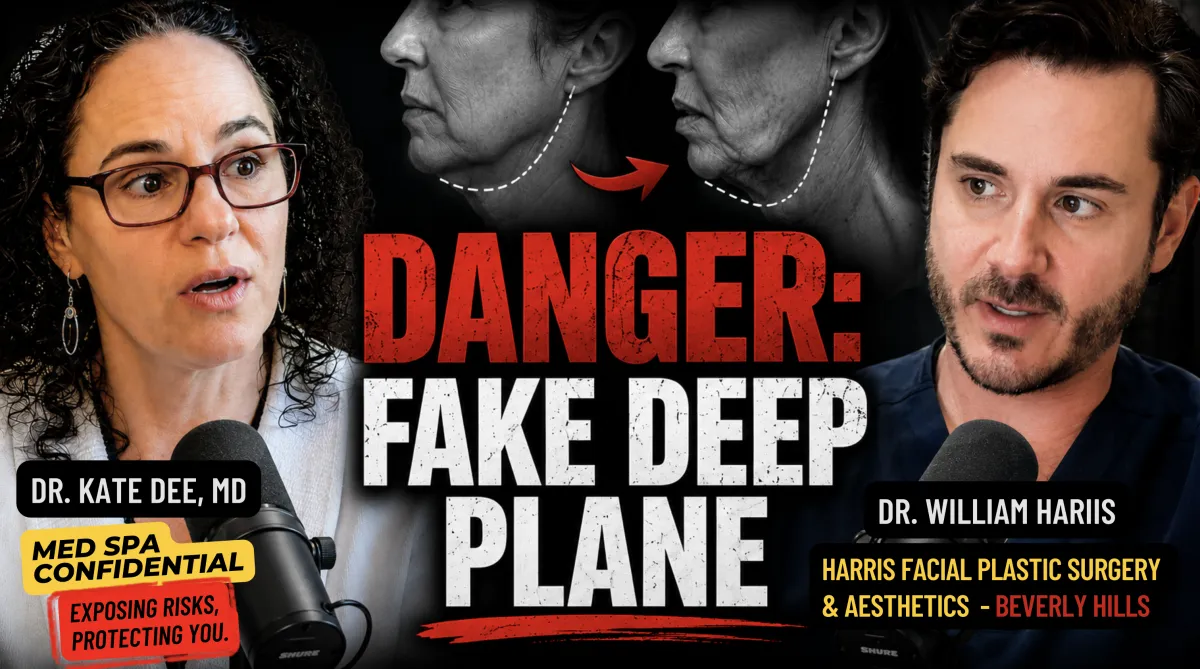
On the MedSpa Confidential podcast I sat down with Beverly Hills facial plastic surgeon Dr. William Harris to talk facelifts, medical tourism nightmares, and the one word on a surgeon's website that should make you stop scrolling.
When the Name Doesn't Match the Procedure
"Tension's gonna be kind of the biggest enemy to a great natural result." — Dr. William Harris, Med Spa Confidential
Deep plane facelifts have become the gold standard in facial rejuvenation. But the marketing has outrun the training, and a lot of patients are paying premium prices for something that isn't what they think they're getting.
The real difference isn't just how deep the surgeon goes but more about releasing the tether points, the ligaments that hold facial tissue down to the bone. When those get released properly, tissue moves naturally, without tension, without that pulled or windswept look. When they don't, you end up with a result that looks tight in the wrong places and doesn't hold up over time.
A lot of SMAS lift surgeons do excellent work. But one telltale sign of a less comprehensive technique? The cheeks still sit heavy even when everything else looks lifted.
Thread lifts have the same problem because you're pulling against a fixed point without releasing anything. Dr. Harris advises every patient against them. The complication rate is high, the longevity is poor, and if something goes wrong, surgical removal is your only option. That's not a place you want to end up.
This Word on the Website Should Stop You
"When it comes to your face and neck in particular, you wanna have the most breadth of training on that surgeon before you go through with it." — Dr. William Harris, Med Spa Confidential
If a website says "cosmetic surgeon," that person is not a board-certified plastic surgeon.
No plastic surgeon calls themselves a cosmetic surgeon. That title has no standardized training requirement. A family medicine doctor can legally call themselves a cosmetic surgeon after a short course.
That doesn't mean every result is bad, but if something goes wrong during surgery or in recovery, the question becomes whether they have the training to handle it. Certain anatomies are more complex. Complications don't announce themselves in advance.
The two legitimate pathways to performing facelifts are a full plastic surgery residency (roughly seven to eight years total after med school) or an ENT residency followed by a one-year facial plastic surgery fellowship. Look for board certification from the American Board of Plastic Surgery or the American Board of Facial Plastic and Reconstructive Surgery. If you see neither, ask why.
Always consult two or three surgeons before deciding. The consultation frees are worth it for the peace of mind that you will be living with the results for years and even decades.
Medical Tourism Fail
"If you have a complication when you come home, then you're going to a surgeon or a physician who doesn't know what was done, and they're trying to start from zero." — Dr. Kate Dee, Med Spa Confidential
Dr. Harris recently treated a patient who flew to Turkey for a hair transplant and came home with necrosis covering nearly 30 percent of his scalp. The tissue died. The infection risk reached the bone. Treatment involved antibiotics, surgical debridement, hyperbaric oxygen therapy, and PRP to support healing. Whether the transplanted hair will even survive is still uncertain.
He had a friend who went to the same clinic and came back with a great result. That's exactly how this pattern repeats.
What nobody prices into the medical tourism equation is the cost of fixing it at home. A physician who had no part in the original procedure, doesn't know what products were used, and has no surgical notes to work from is now your first line of defense. You're not just starting over, but starting over with damage already done.
The same principle applies to fillers ordered from overseas suppliers. Gray-market and counterfeit products are still circulating. What's in that vial isn't always what the label says. Dr. Harris and I got into this during our conversation, and the cases he's seen are ones you won't forget.
Before Your Next Appointment
"If you find a provider that's gonna tell you no and guide you in the right direction with a long-term thought process, then that's the best." — Dr. William Harris, Med Spa Confidential
When a result goes badly, it's rarely just bad technique. It's usually a combination of a patient who wanted something unrealistic and a provider who said yes anyway. A surgeon with only two tools in their kit will almost always recommend those two tools. A surgeon who refers you out when they're not the right fit for your goals is worth a hundred of those.
Dr. Harris also walked me through what he actually sees when he takes on revision cases, which techniques tend to break down and why, what's fixable and what isn't, and what patients wish they had known before their first procedure.
Listen to the full episode of Med Spa Confidential to learn what patients wish they had known.
Transcripts:
Dr. Kate Dee: [00:00:00] Deep plane It's a buzzy topic, especially if you read the tabloid craziness about Kris Jenner's facelift. Those three words are everywhere: ~surgeon websites, Instagram ads, before and after reels.
Here's the problem: not everyone using that term is actually doing it, and the difference between a real deep plane and a technique that just borrows the name, it lives on in your face for years. I'm Dr. Kate Dee, founder ~of of~ and Medical Director of GLO Medi Spa, and this is Meds Spa Confidential where we expose the risks, the red flags, and the outright illegal practices happening inside meds spas right now because you deserve to know the truth before you book.
Today, I'm with Beverly Hills facial plastic surgeon, Dr.
William Harris.
By the end of this conversation, you'll know the one question that separates a real deep plane surgeon from someone just charging for one. You'll understand what actually causes that windswept, pulled look and how to read a surgeon's results before you ever sit in their chair. Dr. Harris also walks us through what [00:01:00] happens when medical tourism goes wrong, because someone has to fix it, and it's not usually the person who caused it.
~Hi, I'm Dr. Kate Dee, and I'm back today speaking with a Beverly Hills plastic surgeon, Dr. William Harris. He, uh, is an ENT facial plastic surgeon, and we're gonna talk about, among other things, deep plane facelifts and a whole bunch of other stuff that you might be interested in if you're moving past non-invasive stuff and you're interested in plastic surgery~~.~
~So hey,~ Dr. Harris, Thanks. so much for being on the podcast
Dr. William Harris: Thanks. for having me, Dr. Dee. It was~ it was a very nice intro.~
Dr. Kate Dee: ~so walk us through... I, I know this has... is kind of somewhat controversial, right, in the plastic surgery world right now~~.~ So walk us through technically what separates your extended deep plane facelift from a standard deep plane, and then from the techniques that get marketed as deep plane, but really anatomically aren't.
What, what's actually happening there?
Dr. William Harris: It, It's somewhat complex, um, but the deep plane surgery in general involves releasing some of the deeper tether points on the face in order to move tissue in a very natural way, but also get a really impactful lift where older techniques didn't get as good of a midface lift in other areas.
This allows you to really get a nice lift on the tissue. Extended deep plane just has to do with how much we're elevating that tissue. And so if we're able to elevate that tissue farther and release more tether points, then we can move that tissue in a very natural way without any windswept look.
Dr. Kate Dee: ~Wind sw- okay. ~you know, people do their own homework and, and they're [00:02:00] trying to... If they're looking for a true deep plane facelift like you do,~ um,~ what specific questions should they ask to find out what that surgeon's actually doing?
Dr. William Harris: that's tough in some ways because a lot of people market themselves as deep plane surgeons now, and so they're gonna answer certain ways. But I think one question you can ask is. Are you releasing
the a centimeter is not enough. how much do you... I mean, what are we talking here? I don't even that on my
it's not so much about the distance, it's about what you're releasing in the process. But when you're just lifting up the edge of the deep plane, you're not releasing those, those tether points and those [00:03:00] ligaments.
Dr. Kate Dee: Maybe you can explain a little bit since,~ um,~ most people don't really know. But, like, what... I mean, obviously, you know, I'm 58. I don't know. We could do this. Probably looks better down below. Yeah. Um, so but what exactly are you doing when you say tether points, without getting too graphic? you know, I don't know.
People might get queasy here. Yeah. Yeah.
Dr. William Harris: So, so basically you have your skin, and then beneath that you have a, a muscular layer called your SMAS layer, which turns into your platysma muscle in the neck. And so what we're doing is releasing tether points that hold the tissue down to the bone, essentially in the midface, the lower face, the neck.
And so when we release all those, that tissue can be placed. Where we want it. and Where it came from in a very natural way without pulling against a fixed point. And so that also gives more longevity for the lift. 'cause you don't wanna age back to that point.
Dr. Kate Dee: so that, that kind of lifted look where it's like looks tethered- Okay ... ~uh, ~like why do, why does that, why does that [00:04:00] happen?
Dr. William Harris: Essentially it comes down to tension. So tension's gonna be kind of the biggest enemy to a great natural result. And so any evidence of tension on the skin or the deeper tissue is gonna translate to a pulled unnatural look overall. And the deep plane does a great job at taking away that tension from the skin primarily.
And then the surgeon is up to kind of the the one that's gonna dictate how much tension's on the deeper layer.
Dr. Kate Dee: So can you tell when somebody's had a, a, a facelift that's deep plane versus not? ~And, like, what...~ We did a podcast recently about Nicole Kidman and Jamie Lee Curtis. and a lot of it was trying to sleuth out, you know, what is Nicole Kidman doing so her face is just not moving. Mm. And I think you can completely accomplish that with a, injectables alone, but does a facelift,~ um,~ affect that as well?
Dr. William Harris: to answer the first question, you know, there's a lot of great SMAS lifts being done and a lot of great SMAS lift surgeons and SMAS lift is kind of the prior technique to deep [00:05:00] plane,~ um,~ lifting where we're just kind of pulling on that muscular layer. But one telltale sign is, is the cheeks don't get elevated as much, so the lower face will be.
Lifted and more tight, the neck will be taken care of, but the cheeks still sit kind of heavy. And so someone like, I'll use Barry Manilow as an example. When you look at him, you see the cheeks are kind of settled here, where everything else looks tight.~ Um, ~and it's a, it's a mismatch, so it's not in harmony.
And I think that's, you know, something people notice, but they can't put their finger on of why it looks unnatural. And then past that with a bad result. You're gonna get this windswept look with all kind of tension lines along the face.
Dr. Kate Dee: tugging. Mm-hmm. Right?
Right?
~Um, ~I, 'cause I f- I feel like we see that with thread lifts as well. Um- Yes. that tugging look is so- the same, Right. At least.
Dr. William Harris: same concept because you're pulling against a fixed tissue
without
releasing.
Dr. Kate Dee: like, uh, yeah. Do you think that threads have any role? I mean, I've sort of been [00:06:00] anti-thread just because of the high complication rate, besides not looking so great,
Dr. William Harris: So I, I always advise my patients against threads. ~Um,~ and it's not that I haven't seen good results, but the, the amount of bad results I've seen and the risk involved and the longevity and honestly cost of what you're paying is not worth it. And if you have a complication, surgical removal of the thread is kind of your option.
And that's not a great,
Dr. Kate Dee: No, it's a terrible option. I know I should do a whole podcast
Dr. William Harris: The risk is too high.
Dr. Kate Dee: The risk is too high. I've been so anti-thread every time someone says, "Oh, should I be doing threads?" I'm like, "No. No, not at all." Um, mostly 'cause I, I had interviewed someone who's, who's teaching a course on, on threads in a meeting I was at, and I asked him, like, 'cause he was kind of an expert, like, "What's your complication rate?"
And it was really high. It was like... You know, and that's the expert doing it.
Dr. William Harris: Some, some people's risk tolerance is higher. Even as a provider, I, anything with that [00:07:00] high of a risk, I, I
Dr. Kate Dee: That wouldn't do
it.
Yeah. Well, uh, you know, as a non-surgeon, why would I risk something that would require a surgeon to fix it? Like, that sounds terrible.
Dr. William Harris: For a short-term gain.
Dr. Kate Dee: Yeah. Yeah, yeah. ~Um, ~I am curious though, do you do. much non-invasive work in your practice?
Dr. William Harris: I do. And I, I've really started doing more as my patient population has grown to younger patients. ~Um, ~that obviously changes the needs and goals. ~Um, ~so a lot of, a lot of non-invasive devices. ~Um, ~so microneedling with radiofrequency, um, Zerf, which is a new device out of South Korea, which is, Not involving needles, but it's a radiofrequency device that's, um, that's nice because it tightens two different layers in the tissue and then we do a lot of fat injections in office for skin improvement, which is amazing.
And I think the forefront of kind of skin rejuvenation.
Dr. Kate Dee: Is that, um, autologous fat or...
Like... Yeah. Yes.
So-
Dr. William Harris: I
I don't deal with meta bariatric
Dr. Kate Dee: fat,
from the, from the patient's own body. So au- autologous, ~for those of our listeners and viewers who, who don't know,~ is [00:08:00] when they take fat from your own body somewhere else, maybe somewhere potentially you don't need as much, and then, and then, I mean, you kind of make it into injectable form, Right.
And then-
Dr. William Harris: So it's, it's important to know where it comes from. I think typically it's the belly or the thighs, or the flanks. It's not liposuction, so it's not done with a big device. It's Done by hand with a syringe, and then we can process it down to various different sizes, even to a point called nano fat, where there's no volume and it's just stem cells and growth factors that we can put very superficially
to rejuvenate the
Dr. Kate Dee: rejuvenate the
Dr. William Harris: love that.
Dr. Kate Dee: that. So you mentioned a younger,~ um,~ cohort of your patients that you've been kind of at the for- the forefront of the Forever 35 trend. So the idea that younger patients are coming in to maintain structure rather than- reverse decades of aging, like at my age.
So how has that changed the conversation,~ um, ~
There's no reliable way to know if a med spa is following safety standards or cutting [00:09:00] corners, until now. The Med Spa Board certifies clinics that prove they're doing things right: verified products, licensed staff, and actual medical oversight. It's the difference between rolling the dice with your health and knowing exactly who's holding the needle.
If you're looking for aesthetic treatments, go to medspaboard.com to find certified med spas near you, and if you already have a med spa you love and they're not certified, please send them our link. If you're a med spa owner doing things right, get certified and show your patients you're not cutting corners.
As a bonus, certified spas also save a ton on malpractice insurance. Do the right thing and go to medspaboard.com. Keep listening, keep asking questions, and stay safe out there
Dr. William Harris: I think one of the biggest things for me having younger patients is I love having them early so I can help them avoid some of the pitfalls that they could potentially get into. And so I'm a very,~ um,~ natural, you know, aesthetic provider, but also [00:10:00] of the notion you should be conservative and in moderation with any of these treatments, whether it's fillers or energy devices.
And so if I can get someone early in my practice and kind of give them a, a plan moving forward of how to avoid some of the issues you see with people, then that, that makes my my life better,~ um,~ to be able to do that for them. And then, um, your second question related to what are we doing differently for those younger patients surgically?
Yeah. So, I mean, I've operated and done neck lifts on 28-year-olds, and people say, oh, well they haven't had aging at 28. And it's, that's correct. There hasn't been a lot of aging, but there's a lot of genetic things that happen with the neck that people just don't like contour laxity. And so we can address these things minimally invasive.
And get them 10 years of benefit without pumping a bunch of fillers or energy devices for 10 years,~ um,~ and get them a big change. But fundamentally, it's the same surgery. It's just lesser incision [00:11:00] sizes. Less downtime and less to be done
Dr. Kate Dee: t
Dr. William Harris: some cases, not always. It depends.
Dr. Kate Dee: some
Dr. William Harris: Well, congenitally, if someone has a. A larger neck, whether they have more fat in the neck, maybe their submandibular glands are large. The muscle fullness is more, you just have to do more work in terms of contouring before you actually do the lift of the neck itself.
Rarely, rarely. I, I typically don't do it alone. I'm not a huge fan of liposuction under the jawline and chin without some kind of tightening of the muscles. because I feel like it leads to problems down the road.
Dr. Kate Dee: So what about for a young person who just genetically has a big submental fat pad? Like even, even someone like that
Dr. William Harris: Sometimes, but the truth is that it's rarely that the fat is just below the skin. It's typically below the platysma, and a liposuction device won't ever get below the platysma, and so you just have to be careful because you take away that healthy [00:12:00] fat layer. That's what gives the skin the vibrance.
And also holds it up so you can get laxity two, three years down the road, even if you looked amazing
Dr. Kate Dee: Yeah. And I, I think actually, like, ~um, ~back when Kybella was a thing, which hopefully most people watching and listening to this are not using Kybella anymore, but,~ um,~ back when that first came out,~ um,~ they claimed that you could get rid of this fat and then the skin would get tighter once you give the fat...
Like, once you get rid- And, and I found that that was completely not true. That, in fact, you could take a young person and get rid of all their fat, but the skin hung exactly where it was before. You could barely tell that there was no fat there anymore.
Dr. William Harris: Yeah, there's, there's some component of that. I, I, Kybella in general in my experience, has been very unpredictable. So it may melt fat in one area and not another. Sometimes you can get a paradoxical effect where it actually makes inflammation that then. Makes the fat look bigger. And so you actually have worse fullness than you had before, and that's a very bad outcome.
But, ~ ~ [00:13:00] again, it's a risk that's too high for me to wanna take.
Dr. Kate Dee: I'm not a big Kybella fan, and honestly, out there, since Kybella has gone out of favor, the people doing it now are the people who are kind of unscrupulous. And I, I see the... I, I'm on in several Facebook groups of aesthetic providers in the States, and one of them's all doctors, and the doctors aren't doing this.
But,~ um,~ some people are out there getting, you know, ~uh, ~knock-off, like, you know, ~uh, ~deoxycholic acid that is off of Alibaba or ordered from God knows where. And- Yeah ... ~um, ~and that stuff. can be tainted. It could be God knows what in that vial. So anyway, don't get Kybella, and
Dr. William Harris: Ordering fillers from Canada and other places around the world and
injecting
Dr. Kate Dee: hor- it's horrible. I mean, we are doing... I mean, at the Med Spa Board, we're doing everything we can to make that stop, um, and get people to get certified and be legally compliant. ~But anyway, Um- ~I think that's
good.
Yeah. But definitely wh- wherever you go, make sure they're using real product.
That's super important. ~Um, ~so I'm [00:14:00] curious about your use of, like, growth factors like PRP. ~Um, ~I think that you integrate that kind of thing with your facelift procedures. Can you talk a little bit about that, and why that works, and why you use it?
Dr. William Harris: Yeah, so PRP, um, is basically taking someone's blood. and We take a vial or two vials of blood. Spin it down and we remove kind of the red blood cell products and condense it down into a growth factor-rich,~ um,~ plasma. And then sometimes we'll take it even further into platelet-rich fibrin, which is a more concentrated version, and then we can inject that into tissues to basically improve healing time.
And also the appearance of skin for face lifting. I like to use it underneath the deep plane flap in order to help that healing process. Where the flap peels back down to the deeper, deeper tissues, and that also improves recovery time
beneath the flap.
Dr. Kate Dee: Wow, that's really, that's really interesting. And, and is there any data on that? Because, you know, we've been using PRP and aesthetics for [00:15:00] a long time, and we don't have a lot of data, mostly anecdotal, but It's-- It is primarily anecdotal, but I will say, you know, bruising in my patient population is, is shorter. Typically, at a week, their bruising is all gone. It's very minimal. That's not just related to PRP. I'm not saying that It has a lot to do with tissue handling and the way everything is done, but I do think it helps in my experience and improves your recovery time and overall result.
Are there any other biologics that you use in ~Y- Well, yeah, anything. Growth factors, exosomes, ~
Dr. William Harris: ~I think the ~
~biggest...~ use exosomes w- with microneedling use PRF, PRP for scalp hair rejuvenation, um,~ um, ~under-eye,~ um,~ volume improvement. ~Um, ~fat transfer is huge in my office. So as I talked about, a lot of different forms of fat you can do. ~Um. ~And then rhinoplasty, I I use rib, but those are the primary biologics. Cartilage. But, um,~ um,~ the cartilaginous portion of the rib, but
Dr. Kate Dee: Sure.~ Okay. Makes sense. Um, that's interesting. Of all the... I did, um,~ I did do, plastic surgery rotation in med [00:16:00] school, and it was phenomenal and so interesting, but I never did get- Yeah ... to sit on any kind of rhinoplasties. That would've been fun.
Dr. William Harris: Yeah.
it's one of the ones that usually gets people. We gotta make sure they're not gonna faint on those. I've seen a couple go down.
Dr. Kate Dee: Really? I never did faint in med... Did you ever faint in med school?
Dr. William Harris: No, I didn't. But at some point, you know, nothing. Nothing causes that anymore.
Dr. Kate Dee: ~Uh, ~well, yeah, after... Although, I have to say, I've seen a couple episodes of The Pit,
and that stuff is graphic, man. I
Dr. William Harris: I saw one
Dr. Kate Dee: gross ... I'm a doctor and I worked in an ER, and I'm like, "Oh, God. I don't wanna see that." That's
Dr. William Harris: Actually, I, I, I know the er,~ um,~ supervisor for the show who kinda gives the medical input on what looks realistic and what would actually happen.
I don't, I don't know if medical realism was the goal there.
Dr. Kate Dee: No, it was all about who was having sex in the call room back in the- Okay Whole different storyline.
I really, I never saw that show until,~ um,~ later, but since I did my residency in Seattle, it really kind of sucked me in because I'm like- Yeah,
"Oh, there are some things that are kind of accurate in
Dr. William Harris: There's [00:17:00] definitely some accuracy there
Dr. Kate Dee: So anyway, getting back to facelifts. ~Um, so~ I'm curious to know a little bit... I, I know that you have done a number of revision facelifts, that you are okay doing that. You're correcting work done by other surgeons. So I'm curious, you know, without naming people, what are the most common problems that you see,~ um,~ when you see a botched result?
Is it, is it technique failure? Is it patient selection? Is it something else entirely? Like, what are, what are you seeing that needs to be revised?
Dr. William Harris: I think it, it really ranges entirely,~ um,~ from incisional healing to. Longevity, I feel like three, four years out that the, the result is not there anymore. ~Um, ~the neck in particular, you know, is one of those areas that, that can break down faster.~ Um, ~and then someone wants a correction of just the neck. and oftentimes, unfortunately, you can't do just the neck. You have to kind of redo the whole, the whole thing to get the best result. ~Um, ~and then I would say, yeah, [00:18:00] evidence of tension. And, and the windswept look is a pretty common problem, especially people coming 10 to 15 years down the road and now they know they have the option of a deep plane lift. that can potentially correct it.
Dr. Kate Dee: ~So are sometimes people... ~So sometimes you're correcting something that happened recently And it doesn't look good. ~Um, ~and other times it's just either it's not lasting as long as it should, or we're just, you know, 10, 15 years more of aging and you're
Dr. William Harris: And yeah, they're ready to do something again,
Dr. Kate Dee: Yeah. Correct. So of, of all those, besides this w- windswept lift, I kind of love that, I'm...
Um, are there any other specific problems that you see more routinely that are just, "Ugh, people keep making this mistake," and it's, just doesn't look good or?
Dr. William Harris: ~Most common issue. Um. You know, as I said,~ I think it kind of runs the gamut. You know, incisional healing is really important and, and everyone kind of talks about, oh, it's suture technique and it's how you close the skin, but, but really it's the whole surgery. So the whole surgery dictates how that incision's gonna close and how well [00:19:00] it's gonna heal.
' cause if you're able to take the tension off the skin effectively, then the suturing is very important. Needs to be meticulous, but it's not as important. Because that skin's already gonna be twisting. It's not gonna have tension. So all you need to do is throw the sutures in there to kind of tether it for a little longer, and that's really what it comes down to.
The whole technique dictates the incisional healing.
Dr. Kate Dee: And that makes total sense to me. And just so I-- since I, you know, I'm not a surgeon, but,~ um,~ I-- that plastic surgery rotation was very early in my med school career. And after that, I did a bunch of other, you know, general surgery, other surgical subspecialties, and I was sort of horrified by the way people sewed people up, Right.
Like, "Well, that's not gonna heal right," you know? And- Right. And So, for, for everyone kind of listening to this, like maybe you can explain why careful lining up of the tissues without tension makes it heal [00:20:00] better, why plastic surgeons are so good at that. ~Like, what do you guys do that makes it beautiful in ~
~the end?~
~So, I mean- ~
Dr. William Harris: ~you know,~ for me, my, my training has always been entirely on the face. And so no matter what we were doing in residency, whether it was cosmetic in nature. Every time we close that skin, after any incision, whether it's a thyroid surgery or submandibular gland removal, you're gonna have a very visible incision that needs to look as good as possible.
And so tissue handling technique training for plastic surgeons, head and neck surgeons is just so extensive compared to a lot of specialties. And you learn what's gonna really heal better in the long term. And one example of that, for instance, is a suture. of An incision can look perfect, initially, perfectly lined up, but if you don't evert the skin edges effectively, ultimately when it heals, you'll get a dip in the skin.
So, you know, eversion of skin effectively, ~ um,~ is gonna heal better down the road, even though initially it doesn't look as good. But these are things you have to explain to facelift patients, for instance, of why does that [00:21:00] incision look like that?~ Um, ~but all these things are kind of. Knowing what's gonna happen down the road in terms of healing.
Dr. Kate Dee: And that, that's so important. So, you know, when I have a patient who wants to go get a thing removed, you know, when it's on your face, it's obvious. Like, okay, go, go to, go to a facial plastic surgeon or a plastic surgeon who can, who can do that and make it look beautiful. But- A lot of people don't realize, like, if it's on your back or somewhere that's gonna show when you're in a bathing suit
Dr. William Harris: Still
Dr. Kate Dee: whatever- Sure
people Still care. And I always tell them, like, "If you want that to look nice, go to someone who can sew that up because otherwise it's gonna- you're gonna have a big old scar on your back,"
Dr. William Harris: Yeah, And that, you know, I, I think not to disparage any colleagues, there are a lot of great, er surgeons, general surgeons who do a great job closing. But on the whole, the, the level of training and experience in soft tissue handling is just very different when you get into plastic.
Dr. Kate Dee: when it's trauma, when you're doing something fast or for [00:22:00] OBGYN, you know, you're, you're doing an emergency C-section, you're not worrying about these things.
Dr. William Harris: you're just trying to save a
Dr. Kate Dee: to save a life. ~Um,~
absolutely.
~Um, ~but I just, I can just tell you- Yeah, like, you know, the, in, with, in plastics, of course, it matters what layer you're sewing, the what, and So things can still move. ~Um, ~I've seen people- Yeah ... suture up, like, one giant layer, and I'm like, "Oh my God." That's it. ~Um. ~remember
Dr. William Harris: that plastic rotation?
Dr. Kate Dee: Well,
Oh my God, and this was a very long time for me, so, but
Dr. William Harris: yeah. Yeah, that's very true. There's a lot of glide planes in the face, and Yeah, that's good. Yes. Placement is really important.
Dr. Kate Dee: Yeah, and I, I, but it really made a huge impression. ~I was... A- and, um, and I just respected those surgeons so much between, you know, plastic and reconstructive, it's, ~you're, you're reconstructing something that has been destroyed in one way or another, whether it's surgically or by trauma, And, you're trying to make this look normal again, and it's the most creative thing I've ever seen.
It was like trying to create human, you know- Yeah ... tissue and beauty out of other parts, you know?
Dr. William Harris: ~Yeah,~ and and I've done a ton of that. My practice now is primarily, you know, cosmetic,~ um,~ but in residency did a lot of [00:23:00] cancer reconstruction and it really is some of the most creative work there is in terms of giving function and, you know, appearance and, and facial health back.
Dr. Kate Dee: ~Mm-hmm. Yeah. It's just,~ it's really beautiful and,~ um,~ elegant really, the surgery.
Yeah. very, very
noble. so if somebody is looking to have a facelift or any other plastic surgery done,~ um,~ and they're trying to make a decision, you know, of who to go to if they're interviewing, you know, three different surgeons,~ um,~ what should they ask?
What should they look for?
Dr. William Harris: So I think, you know, do your research before you set up your consults in the first place. And I, I would recommend everyone talk to, you know, two to three surgeons before they make a decision. ~Um,~ o- obviously at a certain point it's cost-restrictive in some cases 'cause there's a fee for consult. But it is your face, so I would say at the end of the day, it's worth paying that consult fee, um, in order to get the right surgeon.
And then I think one big thing is make sure there's a personality match and an understanding where you feel like your surgeon actually [00:24:00] listened, understood your goals, and that their aesthetic aligns with yours. Then it's kind of getting down to looking at all their before and afters, making sure that's the look that you're going for.~ Um,~ if it's a natural look, if it's not a natural look, it wouldn't be with me, but then that's your, that's your person.~ Um,~ and then making sure obviously they're qualified, so either, either board-certified by the American Board of, of Plastic Surgery or American Board of Facial Plastic and Reconstructive Surgery.~ Um,~ you can call yourself a cosmetic surgeon and be of any specialty with very minimal training, so I think that's something to look out for. If it says cosmetic surgeon, you need to be more wary.
Dr. Kate Dee: So, and, and I have, I have talked about this, but I think that's really,~ um,~ important to repeat that. So if you see a website or a, you know, name on the door and it says, you know, cosmetic surgery,
Dr. William Harris: Mm-hmm.
Dr. Kate Dee: that is not a plastic surgeon because no plastic [00:25:00] surgeon calls himself a cosmetic surgeon.
So there are these cosmetic surgery courses and even some even fellowships, but ~they haven't done... Um, ~you can actually do that from family medicine, from, from any other specialty. So you don't even have to be a surgeon to call yourself a cosmetic surgeon. So, it doesn't mean every single person who's done that's a terrible surgeon,
but- No, and I, I think I, I just wanna add on to that, A lot of people say, well, I went to a cosmetic surgeon. I got a great outcome, and that's great. But the problem is that if you run into an issue, do they know how to deal with it? Or if you have a complication or if you have something in the aftercare period, are they gonna know how to deal with that?
Dr. William Harris: Certain people's anatomy are much more straightforward than others. Some people are tougher, and so I think when it comes to your face and neck in particular, you wanna have the most breadth of training on that surgeon before you go through
Dr. Kate Dee: Yeah. So the, I mean, so the two pathways that, that,~ uh,~ plastic surgeons have, or, you know, surgeons have to become, [00:26:00] uh, to do a facelift are, are they can either do a full residency in plastic surgery, which is generally five years of general surgery and then I think a two-year plastic surgery fellowship.
Two,
three years. ~Um, ~or three, three years. So Yeah. sorry, really long time. ~Um, ~or you can do,~ um,~ ENT, ear, nose, and throat, like, or otolaryngology, and that's a four-year residency, right? ~And then you do- Five, Five. Five. Okay, that's four after re- okay, so internship, right, Okay, ~
~five ~
~years. ~
Dr. William Harris: It's, integrated now. So typically you don't do a separate internship, so five years of residency, one year of fellowship. And then the other alternative would be to do a six-year plastics. ~ ~Yeah. So there's three different ways.
Dr. Kate Dee: and all of that means it's ridiculous amount of time in order to have that subspecialty, right? ~Like it's, it's a really long time. Um, I mean, for me It was, you know,~ six years of residency and fellowship after med school to do, ~you know, um, uh,~ radiology and, ~and~ that was a decade of my life, you know?
And it's the same, it's the same or worse. I would say plastic surgeons and neurosurgeons are probably the most highly trained, ~um, ~doctors,~ um,~ that we have. Right. ~Um, ~but I think that really matters,~ um,~ who you go [00:27:00] to. So, ~uh, ~so this is a question I, I like to ask,~ um,~ everyone who,~ uh,~ especially ER docs and surgeons, like what are the absolute craziest things you've seen,~ uh,~ that have walked into your office that you think, "Oh my God, I can't believe this happened"?
Dr. William Harris: ~Um, ~I, I'll, I'll go most recent I guess. ~Um, ~'cause there's a lot, but most recently I had a gentleman who had, ~um.~ Fairly significant scalp necrosis. ~Um, ~probably 30% of his scalp from a hair transplant that he underwent in Turkey,~ um,~ that he, you know, had price shopped and had a friend who actually had done it and had an amazing result.
~ ~And so that's kinda where I was going earlier. It's like, just because one person has an amazing result ~ ~doesn't mean that that the percentage of amazing results is high. And You have to be careful listening to a friend, same clinic. Yeah. And it sounded like it was kind of a conveyor belt type situation, but Yeah.
Dr. Kate Dee: ~Interesting. Yeah.~
~'Cause, um, because, uh, ~I think Korea [00:28:00] are the top two countries in the world for hair transplants and,~ um,~ and it's just cheaper there. People fly there and, ~um... ~And so that- that's really interesting 'cause obviously, you know, we're not there. But so, so he had, he had a necrosis of his scalp, which means you, the, the skin dies, which means your hair also dies. Right,
Dr. William Harris: Right. Tissue underneath the skin, actually,
in his case.
Yeah. So then you're dealing with, you know, is it down to bone and then is there infection risk more so than that, that can go through the bone and it's a, it's a bad complication. ~Yeah. Huge.~
~didn't. He did. ~He did. Okay. We put him on antibiotics, we did a lot of debridement. ~Um, ~and then he did a lot of hyperbaric oxygen therapy,~ um,~ as well as a topical ointment,~ um,~ antibiotic. So we kinda hit it from every possible angle. And then,~ um,~ later we did some PRP to kinda help the tissue along as it was healing.
Dr. Kate Dee: Did any of the transplanted hair survive?
Dr. William Harris: It's it's yet to be seen, but I think it'll be sparse. ~You can,~ you can transplant into [00:29:00] scar tissue. It typically does not have as good of a, a take, obviously, 'cause it's not healthy tissue. But you can, you can do it.
Dr. Kate Dee: So that not only cost him the flight to Turkey, the cost of the transplant itself, and then the cost just Right. of coming to see me. treat it. Right. That was insane. Yeah. So that's, you know, that's one of those things when you do medical tourism, if you have an issue when you come home, then you're going to a surgeon or a physician who doesn't know what was done, and they're trying to start from, from zero and, and help you. But it just, it makes it tougher.
~Yeah. The, the first case I ever heard about of medical tourism that ran into trouble was ~I was at a conference when I was first starting in aesthetics, and this was... There was a Harvard laser course that I was taking, but they were doing ~controver- ~controversial cases or something, and it was a guy who had flown to London- Hmm
to get a,~ um,~ penile enlargement-
Mm-hmm.
with filler. And they put 12 syringes of Voluma in his penis. Hmm. And, um, and that did not go well 'cause it cut the circulation off to
his penis. That sounds like it
Dr. William Harris: [00:30:00] like a
Dr. Kate Dee: And he basically had a gangrenous,~ um,~ situation going on. ~Yeah. ~
~That sounds-~ And so it did dissolve because it was at least a hyaluronic acid filler, But, Yeah. but- He did not want...
So the funny thing is he didn't want it dissolved because he paid so much money for it. he's like, "I pa- I paid money for that." But then they had to dissolve it all. Yeah.
Dr. William Harris: There's a lot of people doing that in LA and, um, there's a lot of complications. ~Um, ~so I, I would recommend against that, one of my colleagues is,~ um,~ a specialist in basically rehabbing and re improving those,~ um,~ situations. And the stories I've heard from him are pretty,
pretty
Dr. Kate Dee: So he actually specializes in fixing people after they've had this go
Dr. William Harris: it's not his primary specialty, but he's become the go-to guy to fix these issues. Yeah.
Dr. Kate Dee: The go-to guy to fi- well, so you heard it here first,
Dr. William Harris: I won't say his name 'cause he might not wanna be known for that, but he does a lot of it.
Dr. Kate Dee: Okay. But, You know, call Dr. Harris's office if you need a You can get the name from the name ~Um, ~that's so it. Can it be done safely? ~I mean, do you know about this? Like, c- 'cause, you know, it's not something I do in my practice. ~
Dr. William Harris: Well, Luckily [00:31:00] what what you're saying is the easiest route is dissolving if it's a dissolvable filler. A lot of these fillers especially that are done in Miami from the stories he's told me, are not dissolvable. They're permanent fillers. So that involves a long incision to remove all of these. And that's the same with the face.
So if you have issues with permanent fillers in the face, surgical removal is the.
option.
Dr. Kate Dee: And I, and I've said it a million times, I'll say it again. No, no non-dissolvable fillers ever. So- Got it ... never. No Bellafill, no Radiesse. Uh, some people use Radiesse as hyper dilute as a biostimulatory. I'm
like, "Okay." Okay.
Um, fine. But,~ uh,~ but otherwise super dangerous. So
one of the criteria we have For the MedSpa Board is we will not certify anyone who's using non-dissolvable fillers.
I don't understand why anyone who has any medical intelligence would use them, like, 'cause they're just risky.
Dr. William Harris: Yeah, and, You know, some people have done them tastefully and, and had great results, but I think, again, I don't use Radiesse. Uh,~ I~ think the risk profile's
Dr. Kate Dee: profile's too high.
Agreed. But especially- And it's an option is there [00:32:00] anything else you'd like to leave our listeners and our viewers with? Usually I'll ask, you know, if there's any... If you had to give people one piece of advice or two pieces of advice,~ uh,~ when they're thinking about plastic surgery,~ uh,~ what would you say?
Dr. William Harris: yeah, I would say find a provider, obviously with all the qualities we, we talked about earlier, but find a provider that will, will say no. And stop you from yourself in some cases. ~Um, ~'cause typically when I see a really botched job, whether it's a lot of fillers, bad surgery, bad surgery, or whatever it may be, it was a combination of maybe the patient wanted something that shouldn't have happened and was unrealistic, but then the provider To do it and it wasn't the best combination. So it's certainly on the providers too. ~Um, ~but if you find a provider that's, you know, gonna tell you no and guide you in the right direction with a long-term thought process, then that's the best. And if you go to someone who only has two [00:33:00] tools, those two tools will probably always be the answer.
And so go to someone who gives the full breadth of options and will refer you out to someone if, if they don't do it.
Dr. Kate Dee: Yeah, absolutely. If you're finding yourself doctor shopping because nobody's telling you the answer you wanna hear, it's probably 'cause it's not a good answer.
Dr. William Harris: That's correct. There will always be someone that will say yes. I tell people that all the time. Say, you can go down the street one block. There'll be someone to say yes, but I wouldn't do it.
Dr. Kate Dee: Thanks for listening. If this episode opened your eyes to something you didn't know before, share it with someone who needs to hear it. Subscribe so you don't miss the next one, and drop a comment telling me your biggest takeaway. I actually read them all. Join me on this mission to keep you safe and push this industry to do better.