A Used Car Salesman Can Legally Own Your Surgery Clinic in Florida
A Used Car Salesman Can Legally Own Your Surgery Clinic in Florida
You researched the surgeon, checked their Instagram and read all the reviews. But did you check whether the medical director of the clinic is still alive?
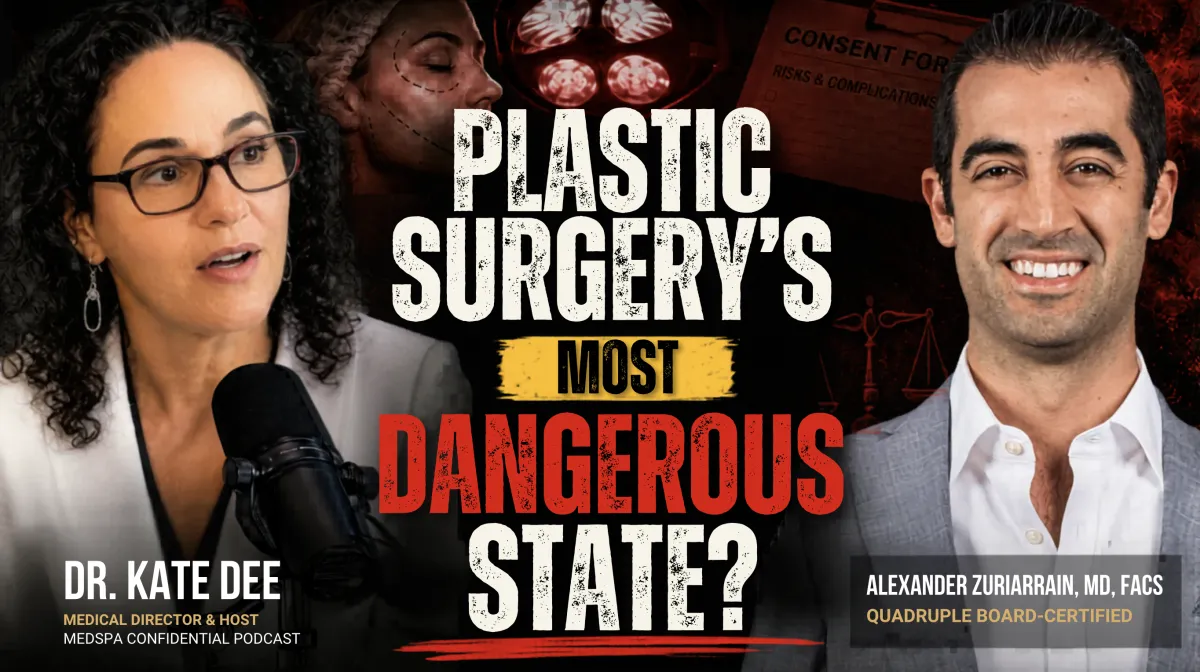
This week on Med Spa Confidential, I sat down with Dr. Alexander Zuriarrain, a Miami plastic surgeon with four board certifications who also works as a medical-legal expert witness.
That means he reviews the cases where surgery went very, very wrong. What he's seen inside those case files should change how you vet any clinic before you book.
The "Awake Facelift" Trap
"She called me kind of freaked out because for her it was a four-hour surgery that she felt like was torture." — Dr. Kate Dee, Med Spa Confidential
A patient called me after getting a facelift with local anesthetic only. No sedation. Four hours, fully aware, in a room inside a med spa. She wanted to know if that was normal. It's not.
Here's the thing. Awake facelifts are marketed to people who fear general anesthesia, and the pitch works. But Dr. Zuri told me, "By far the ones that have the most complications are the ones that are done awake."
The risks come from how the anesthesia is managed, and they can be deadly. In the Medspa Confidential episode, Dr. Zuri walks through exactly how these surgeries can turn into emergencies on the table.
Bad Outcome or Malpractice?
"A bad outcome can happen no matter what. That's even in the best of hands, even with the best technique." — Dr. Kate Dee, Med Spa Confidential
This is the part most patients never learn until they're angry and searching for a lawyer. A disappointing result is not the same thing as malpractice. Dr. Zuri reviews these cases for a living, and he says the vast majority are bad outcomes, not negligence. Often the complication was right there in the consent form the patient never read.
So read your consent. Ask for it ahead of time. Ask your surgeon to walk you through the big risks out loud. We break down the three things that actually have to be true for a case to count as malpractice, and it's not what most people think.
Ask If the Medical Director Is Alive
"Not only ask who is the medical director, but ask if they're still alive." — Dr. Kate Dee, Med Spa Confidential
I wish I were joking. Dr. Zuri has seen high-volume plastic surgery centers in Florida operating with a deceased physician listed as medical director. Others rent a retired doctor's name for a couple hundred dollars a month.
Florida does not broadly restrict non-physician ownership of medical practices the way some other states do. That means a non-doctor can own the business side of a cosmetic surgery clinic, as long as the clinical side is handled through the proper licensed professionals and regulatory structure.
As Dr. Zuriarrain put it, the owner could be someone with no medical background at all, even “a used car salesman” who saw plastic surgery as a good business.
Dr. Z also shared one resource for vetting a clinic that almost nobody checks, plus a type of complication insurance some surgeons offer that could save you thousands if something goes wrong.
Before Your Next Appointment
If this made you want to re-check the clinic you've been considering, good. That instinct could protect your face, your savings, or your life.
Listen to the full episode of Med Spa Confidential with Dr. Alexander Zuriarrain to hear the key questions to ask before anyone operates on you.
Episode Transcripts:
[00:00:00] Dr. Kate Dee: What happens when you go under the knife in a state where nobody's required to tell you who owns the clinic or whether the medical director is even still alive? I'm Dr. Kate Dee, founder and medical director of Glow Medispa. This is Medspa Confidential, where we expose the risks, the red flags, and the outright illegal practices medspas right now, because you deserve to know the truth before you book.
[00:00:27] Dr. Kate Dee: Today, I sit down with Dr. Alexander [00:00:30] Zuriarrain, or Dr. Zuri, a Miami-based plastic surgeon with four, get it, four board certifications and years of experience as a medical-legal expert witness, which means he's reviewed the cases where things went very, very wrong. You'll find out why awake facelifts carry risks most patients never hear about.
[00:00:52] Dr. Kate Dee: You'll walk away knowing exactly what separates a bad cosmetic outcome from actual malpractice. [00:01:00] And there's one resource for vetting your surgeon that almost nobody thinks to check. Stay until the end, because Dr. Zuri reveals a detail about deceased medical directors that will change how you research any clinic going forward
[00:01:16] Dr. Kate Dee: Dr. Zuri, thanks so much for being on the podcast today.
[00:01:20] Dr. Alexander Zuriarrain: Thank you, Dr. Dee. Very much appreciate you, you having me on. This is great. Thank you
[00:01:24] Dr. Kate Dee: Well, we've had some great conversations so far. So I really wanna, start with [00:01:30] your, like, four different board certifications and talk about that 'cause that's super unusual. So you have board certifications from the American Board of Surgery and the American Board of Plastic Surgery. Okay, those two are, like, basic for any plastic surgeon.
[00:01:45] Dr. Kate Dee: But then also the American Board of Cosmetic Surgery and the American Board of Facial Cosmetic Surgery. So having those four is pretty unusual. Can you, like, tell us what they all mean and, and what that entailed to get that?
[00:01:58] Dr. Alexander Zuriarrain: Yeah, it's extremely [00:02:00] controversial, the world of cosmetic surgery versus plastic surgery. It feels like these two camps are, are kind of battling out the world of what we would call in the plastic surgery world aesthetic plastic surgery, and what the, other camp would call cosmetic surgery. so to get to where I, I, I am today, I basically went through a five-year general surgery residency program, and then I got my board certification in, in-- by the American Board of Surgery, and then I went on to the Cleveland Clinic, [00:02:30] and I spent three years becoming a plastic and reconstructive surgeon.
[00:02:35] Dr. Alexander Zuriarrain: at that point, I decided that, I was interested in more of the world of cosmetic surgery, and I wanted to kinda hone in on that, so I did an additional one year of training, through what's called the American Board of Cosmetic Surgery, and I spent a year basically doing facial cosmetic surgery and body, cosmetic surgery, and then [00:03:00] I took that additional board.
[00:03:02] Dr. Alexander Zuriarrain: there are a couple of avenues to get into the cosmetic surgery world. You don't have to actually be a board-certified plastic surgeon to enter into the world of cosmetic surgery. You can go as an, OBGYN, a gynecologist. You can go in as a orthopedic surgeon, ENT, ear, nose, and throat surgeon. So they accept different surgical subspecialties to do this one-year training program, fellowship program, [00:03:30] to become a cosmetic surgeon.
[00:03:31] Dr. Alexander Zuriarrain: It's super controversial 'cause the plastic surgeons will say, "Hey, why do you need to do another year of cosmetic surgery? 'Cause we basically taught you everything you needed to know about being an aesthetic or a cosmetic plastic surgeon in your plastic surgery residency program." But some of us feel like we want more additional training.
[00:03:49] Dr. Alexander Zuriarrain: and what's different about the cosmetic surgery training is that you actually can get a board certification in cosmetic surgery, whereas if you do an extra year as a plastic surgeon under a plastic [00:04:00] surgery aesthetic fellowship, you don't get an additional board certification.
[00:04:04] Dr. Kate Dee: Do they study the same things or, you know...
[00:04:07] Dr. Alexander Zuriarrain: They pretty much do, you know? But I, you know, I would say my biggest argument, and we'll get into this later on about me being an expert witness and about me dealing with, medical legal cases for both the cosmetic surgeons and the plastic surgeons and the eternal battle between the two, where the plastic surgeon says, "Well, the cosmetic surgeon is unworthy.
[00:04:28] Dr. Alexander Zuriarrain: they're not as, as [00:04:30] studied," or, "They haven't spent enough time."
[00:04:32] Dr. Kate Dee: Well, in all fairness, most people who do that fellowship are not sur- you know, they're not surgeons. Or, I mean, they could be an OBGYN, but like you, they will take, you know, family medicine or other subspecialties, right? No?
[00:04:46] Dr. Alexander Zuriarrain: no. No, they won't. No, they won't. No.
[00:04:49] Dr. Kate Dee: Okay. So because, most people who call themselves a cosmetic surgeon didn't go through plastic surgery,
[00:04:57] Dr. Alexander Zuriarrain: No, they did not. They did not[00:05:00]
[00:05:00] Dr. Kate Dee: Yeah, but you're both.
[00:05:01] Dr. Alexander Zuriarrain: I'm both. I'm both because I felt that I had an opportunity to be both, right? And I also didn't want my patients when, when they came for a consultation with me, I didn't want them to think that there was somebody else out there that somehow knew more than I did about what I do.
[00:05:19] Dr. Alexander Zuriarrain: I wanted to be at the Mount Everest at the peak of my specialty
[00:05:24] Dr. Kate Dee: Yeah. So, so just for anyone, our audience, one of the key things is if you're having [00:05:30] someone operate on your face, then you want somebody who has extraordinary experience operating on the face, which would be like a plastic surgeon or a ENT with, you know, facial plastic surgery fellowship, right?
[00:05:44] Dr. Kate Dee: And then, but then there's the rest of your body, and you having done like, you know, gazillion years of surgery, including general surgery, you've operated all over the body. And so for you to do now cosmetic body procedures is a logical extension, right? [00:06:00] There are some people who do, who actually... So I'm not saying that fellowship, but there are ones where it's a one-year fellowship where you have not been a surgeon, and they will take class- they will take family medicine people and inter- all kinds of other people who have not been trained in surgery.
[00:06:16] Dr. Kate Dee: So it is a very big difference between someone who calls themselves a cosmetic surgeon who literally has only one year of experience in surgery and training versus someone like you who's got, as far as I can tell, something like 13 years. I, [00:06:30] I was trying to add it up in my head. Yeah.
[00:06:32] Dr. Alexander Zuriarrain: Right. Right.
[00:06:33] Dr. Kate Dee: So it's ki- that's a big difference, right?
[00:06:36] Dr. Alexander Zuriarrain: Yeah. Yeah. There's-- It's a big difference to do just one year of, of cosmetic surgery. I don't deny that. what I would argue is that when we become plastic surgeons, we spend so much time doing reconstructive surgery that we don't actually spend more than about a year of our time in total with aesthetic surgery.
[00:06:56] Dr. Alexander Zuriarrain: So I do believe, in my opinion, that even if you're a plastic surgeon, that [00:07:00] you should seek additional time in training in cosmetic or aesthetic plastic surgery. you gotta do some more time because, in my opinion, if you're just a general surgeon and just a plastic reconstructive surgeon without any other exposure to more nuanced aesthetic or cosmetic techniques, I think you're at a disadvantage
[00:07:23] Dr. Kate Dee: Yeah. That's very interesting because, so also for our audience who might not completely know, right? So [00:07:30] reconstructive is when, plastic surgeons go and they reconstruct a chunk of your body or your face or whatever that's been injured, either because you had to have surgery and remove a big cancer, or you had trauma and something got ripped off or, you know, just to be really grotesque about it.
[00:07:49] Dr. Kate Dee: And so it's a really kind of creative way of reconstructing body parts out of other body parts to make you look basically, you know, aesthetically normal, right? [00:08:00] Super different from doing cosmetic things like facelifts and other stuff to make people look, you know, more beautiful or younger or less wrinkly.I just think it's really, really interesting. So let's, let's talk... Can we talk a little bit about facelifts? So, I have talked to another, plastic surgeon about this a little bit, and I'm really curious to know your stance on it. So you perform true deep plane facelifts, right? That are clearly, that, that's a term that [00:08:30] gets debated and, and interpreted in different ways.
[00:08:34] Dr. Kate Dee: and so as a medical legal expert, and an expert witness, so you've, you've likely seen cases that were related to misrepresentation that might have caused actual real harm. So how often does the technique misrepresentation show up in the cases you've been called to review and, and what does it actually look like legally and medically?
[00:08:56]
[00:09:46] Dr. Alexander Zuriarrain: Yeah, I think the, the, the most important aspect in my medical-legal, you know, reviews of, of facelift cases, is really when they're done under sedation or what we [00:10:00] call awake facelifts.
[00:10:02] Dr. Kate Dee: Mm-hmm.
[00:10:02] Dr. Alexander Zuriarrain: that unfortunately draws the idea of an awake facelift, draws a very large crowd of patients that are terrified of having any general anesthesia, right? unfortunately, what I see a lot of times is facial plastic surgeons, facial cosmetic surgeons, anybody doing facelifts, that if they, they try to market themselves as an awake [00:10:30] facial s- plastic surgeon or facelifts, they do it almost, in my opinion, sometimes it can end up being more like a marketing scheme, and what ends up happening is that when you look at the cases, when you look at the cases of the complications related to facelift surgery, by far the ones that have the most complications are the ones that are done awake.
[00:10:52] Dr. Alexander Zuriarrain: And the complications can be lethal, deadly complications due to the titration [00:11:00] and basically the manner in which the anesthesia is given.
[00:11:04] Dr. Alexander Zuriarrain: When you're doing sedation, you have to be extraordinarily careful. If you go a little bit beyond the dose that the patient requires to stay in that very gray limbo of being asleep and not being awake, if you go too far, the patient will stop breathing and it becomes an immediate airway emergency
[00:11:24] Dr. Kate Dee: Right, right. So by awake, it really means you're just not under [00:11:30] general. So you're still getting very heavy sedation, but you're not intubated, meaning there's not a, a tube down your throat. So, but, but what Dr. Zuri's saying here, okay, is, is that God forbid you get a little too much and you're not breathing, now all of a sudden there's an emergency and they've gotta stick that tube down.
[00:11:48] Dr. Kate Dee: I know that when I was in residency, that was very much an issue with people getting sedation for MRI, and they would be in the scanner and you didn't even-- You couldn't monitor them at all, so that was, [00:12:00] like, super dangerous. I'm dating myself 'cause nobody, this, I don't think this would ever happen now, but it used to be that, you know, that this was a little less regulated.
[00:12:09] Dr. Kate Dee: So now it's, like, you have to be very, very careful about monitoring, otherwise people can't be sedated for things like that. So, but you're not talking about being awake awake, like completely aware of what's going on, just with, like, a local anesthetic.
[00:12:22] Dr. Alexander Zuriarrain: No. No, it's typically not awake awake, but what ends up happening is that in order for it to make it comfortable, even under like a [00:12:30] light sedation, they have to inject enough local anesthesia, they have to inject enough lidocaine, either, either through tumescent infiltration, which is like mixture of, of liquid with anesthesia to make it tolerable.
[00:12:42] Dr. Alexander Zuriarrain: And so that has a compounding effect as well throughout a three to four-hour operation. You keep giving more lidocaine, more lidocaine, more lidocaine. The patient keeps complaining, keeps groaning, keeps making noise. You think they have pain, and then they end up in a lidocaine toxicity, which then causes an [00:13:00] immediate arrhythmia or death on the table because it's very difficult to reverse
[00:13:04] Dr. Kate Dee: Right. So that's, that's like a couple different ways you can die, which sounds terrible to me. what are your thoughts on this? I had a p- a patient call be- really 'cause of this, podcast. and she had gone to someone who kind of wasn't working in a real office, and they offered her, awake, facelift, but with local only, like no sedation at all.
[00:13:28] Dr. Kate Dee: And, and she called [00:13:30] me kind of freaked out because for her it was a four-hour surgery that she felt like was torture 'cause her face was being peeled off and she was completely aware of everything.have you ever seen a medical legal case like that, and, like, what are your thoughts on that?
[00:13:44] Dr. Alexander Zuriarrain: No, I haven't seen as just a strict local case. I would be even more, more worried for that patient because if they're not getting any IV sedation, if they're not getting anything extra, just the lidocaine to do that, I, I don't know how people tolerate [00:14:00] things. But, you know, it's impressive how patients will tolerate procedures under local just because of their, their deep fear, their deep, deep, deep-seated anxiety related to general anesthesia.
[00:14:14] Dr. Alexander Zuriarrain: And what I found, I have an undergraduate in psychology, and I found that a lot of these patients, they don't wanna let go. The feeling of giving up control to another human being, to them is, is just not acceptable. So they're willing to [00:14:30] undergo, you know, their face being peeled off under local to avoid that
[00:14:34] Dr. Kate Dee: Well, I think this person was going for price. I mean, she told me, you know, it was, it was a very, very, very extraordinarily reasonable price, and of course anesthesia costs money. and this person didn't have really a established practice. the ENT who did the surgery had gotten in trouble in another state, moved to my state, and then had trouble getting established, you know, privileges [00:15:00] anywhere.
[00:15:00] Dr. Kate Dee: So she was offering, you know, cheap facelifts in... This was in a room in a med spa. And, and she was apparently aware, so aware that she just knew, like, heard everything going on, people coming in and out of the room, and, and you know, she called me just to find like, "Dr. Dee, is this normal?" And I'm like, " No.
[00:15:21] Dr. Kate Dee: It's not normal." Oh my God. well, so as an expert witness, you've reviewed all these cases from the inside and the records and the [00:15:30] photos and the op notes. what are the most common failures you do see when plastic surgery goes badly enough to end up in litigation? Is it usually about technique or informed consent or patient selection or something else?
[00:15:43] Dr. Alexander Zuriarrain: Yeah. So I, I would say a lot of times it is patient selection. I think that that is, one of the biggest issues, and I think that that's where your experience as a, as both a, a general surgeon, plastic surgeon, cosmetic surgeon, I think they... That's where years of experience really comes into patient selection.
[00:15:59] Dr. Alexander Zuriarrain: I [00:16:00] think that you have to see that in your residency or your fellowship over time. If you go out into practice with very little experience, you're gonna start to select the wrong patients for surgery. You're gonna perform the wrong surgery on the wrong type of patient. And then, then, then once, once that, that downhill, that downhill occurs,
[00:16:18] Dr. Alexander Zuriarrain: It's very difficult to, to come back from that because surgery is a specialty where once you make an incision, there's no way to go back. It's very difficult to, to really [00:16:30] completely correct the problem, once it's, once it's occurred. So I would say patient selection is very, very important.
[00:16:38] Dr. Kate Dee: can you give an example, like, so people can understand, like what, what's an example of that?
[00:16:43] Dr. Alexander Zuriarrain: Oh, those are, tons of those. So easy example, patient comes in, she's had three children. She has extra skin to her lower abdomen. she's adamant about liposuction. " Dr. Z, I want you to do liposuction because I think that lipo... [00:17:00] I mean, I've looked at this on TikTok. I've seen it on Instagram. Like lipo is what I need.
[00:17:05] Dr. Alexander Zuriarrain: That's what I need. I've seen before and afters of other women that look like me, and I need lipo." And so an inexperienced surgeon would potentially think that lipo is gonna be a good idea on this woman, and it ends up being a catastrophe. She ends up with fibrosis, more skin laxity than she started with, an irregular contoured abdomen, and she's [00:17:30] distraught, and then she sues the doctor,
[00:17:32] Dr. Kate Dee: Mm-hmm. I
[00:17:33] Dr. Alexander Zuriarrain: Um,
[00:17:34] Dr. Kate Dee: mean, in in that case, that person really needed a abdominoplasty and they just didn't offer it?
[00:17:40] Dr. Alexander Zuriarrain: That's right. That's right. They didn't get offered the right procedure, or they did get offered it, the patient denied it, and then the surgeon still agreed to do something that he knew wasn't gonna be the right surgery just because the patient,
[00:17:55] Dr. Kate Dee: patient wanted it. I mean, I think that's a trap that anyone in [00:18:00] cosmetics like someone comes in absolutely sure they want something, they want you to do it, and if you, if you don't, if you try to talk them out of it, sometimes they get mad. what are the most egregious cases you've seen where, something went awry?
[00:18:14] Dr. Alexander Zuriarrain: I've seen deaths, death cases, from facelift surgery. and not too long ago, I reviewed a case of a death, regarding awake, you know, sedation, facelift. and I've seen interesting cases of, you know, patients that, that it's a, it's, [00:18:30] it's a known complication, but patients will have nipple necrosis.
[00:18:33] Dr. Alexander Zuriarrain: Like, let's say we do a breast lift and their entire areola and nipple will die. it's a, it's a very rare complication, but it does occur. It does happen, and I think that that's where, you know, patients also need to realize and they need to understand that every surgery, every intervention, every procedure does have its in- inherent risk and inherent complications, and they need to know about these things.
[00:18:58] Dr. Alexander Zuriarrain:
[00:18:58] Dr. Kate Dee: is that partly a [00:19:00] technique thing? I mean, are you, and like able to know for sure that you're not gonna sacrifice the blood supply to the nipple or it's
[00:19:09] Dr. Alexander Zuriarrain: For the most part you do, but again, depending on the patient, the, the anatomic characteristics of the patient, the quality of the breast tissue, their age, their weight loss history, the length from their neck to their nipple, right? these are, these are sometimes cases where you can follow the textbook, you can follow the standard in terms of [00:19:30] what, what a another reasonable surgeon would do with the same s- training in the same situation where most of us would en- would encounter.
[00:19:39] Dr. Alexander Zuriarrain: But even then, it's sometimes it's difficult to, to, to avoid 100%. And, and I think patients don't do a great job most of the time of asking the difficult questions and reading the consent. They don't read the consents.
[00:19:53] Dr. Kate Dee: Well, shouldn't it be explained verbally by the surgeon? Like, these are all the possible [00:20:00] bad things that can go wrong. Usually you should mention the big things like that. I mean, it's kind of like omitting the possibility of vascular occlusion with dermal filler. You know, it's not a likely scenario, but it's possible and it can happen to anyone.
[00:20:14] Dr. Kate Dee: So
[00:20:15] Dr. Kate Dee: we always mention that. That's really important. Always mention that out loud.
[00:20:19] Dr. Alexander Zuriarrain: For sure. Now, the problem is that if you look at the American Society of Plastic Surgeons' consent for an abdominoplasty, right? It becomes [00:20:30] unreasonable nearly, I would say nearly impossible to consent a patient on all of the potential situations, all the potential risks that could occur. So the patient has to be their own advocate also, they have to read the consent.
[00:20:44] Dr. Alexander Zuriarrain: We are going to facilitate the most common situations, the most common complications, the maybe the top five, but we cannot spend two hours just talking about a consent.
[00:20:56] Dr. Kate Dee: Right
[00:20:57] Dr. Alexander Zuriarrain: It's not realistic. It's not possible. It doesn't [00:21:00] happen. I've been in surgery my whole life. I've, I've consented thousands of patients in residency, fellowship, and in practice, and nobody has the time to spend going over every page of, of a consent process.
[00:21:15] Dr. Alexander Zuriarrain: So you do have to be your own advocate, and if, you know, your, your audience, you know, my audience, everybody that listens to our podcast, you know, you have the right to ask for your consent. You can ask for a copy of your consent, and you can read it, and, [00:21:30] and that's, that's your prerogative
[00:21:31] Dr. Kate Dee: Do you ever give people the consent form ahead of time so they can read it before they're just like ready to go and on the ta- you know.
[00:21:41] Dr. Kate Dee: Okay.
[00:21:42] Dr. Alexander Zuriarrain: 100%.
[00:21:43] Dr. Kate Dee: important. I mean, I think nowadays if you get it electronically, you can just feed it through Claude, and Claude can tell you what the big things are on there.
[00:21:51] Dr. Kate Dee: they are long forms. I mean, I do that now with every legal document I have to sign. I'm like, "Claude, tell me what I need to look out for on this thing."
[00:21:59] Dr. Alexander Zuriarrain: Oh yeah. [00:22:00] It's scary.
[00:22:01] Dr. Kate Dee: I think, I think a lot of times patients don't realize that there's a difference, a legal difference between a bad cosmetic outcome and actual malpractice. So, where does that line typically fall? Do you, do you see a lot of cases that are really just bad outcomes rather than malpractice? And what, you know, what separates a surgeon who had a complication from one who is genuinely neg-
[00:22:28] Dr. Alexander Zuriarrain: Yeah, I would say the vast majority [00:22:30] of what we see are bad outcomes, but not a technical error per se, not a, not an egregious, intervention, you know, that led to this horrible outcome. it, it, it's really a lot of what I see is really in the consent.
[00:22:49] Dr. Alexander Zuriarrain: It's in the consent, you know. it may not be the top five most common complications, possibly, but it's in the consent.
[00:22:58] Dr. Alexander Zuriarrain: And for the most part, [00:23:00] what we see are just very disgruntled, very upset patients, unhappy because of their outcomes, and then they, they turn that anger, they divert that anger into litigation, which, which we all know in medicine, and in surgery, most of these cases, they're gonna settle.
[00:23:20] Dr. Alexander Zuriarrain: they're gonna settle 80%, 90% of these cases settle. They don't really get to anywhere, it's a horrible process. It's a horrible process [00:23:30] for the surgeon. It's a horrible process for the patient. the only ones that win are the attorneys on both sides. They're the only ones that win. and so it's, it's a, it's, it's something that I, I, I, I wish somehow we, in this country, we could do more about, regarding, you know, how litigious our society is in general. our culture as Americans, are, is extraordinarily litigious. you know, I travel the world.
[00:23:58] Dr. Alexander Zuriarrain: I've been in many different [00:24:00] congresses. I've been in many different, meetings in Brazil, in, in, in South America, in Mexico, in Europe, in France, in Italy. the surgeons don't suffer from what we suffer from here when they have a bad outcome, that it automatically, the first thing that comes to a lot of patients' minds is, "I'm gonna sue this doctor, and I'm gonna try to figure out how I can get money."
[00:24:22] Dr. Kate Dee: Yeah. So I, you know, I've just been interested in m- you know, medical legal issues since med school. I don't really understand why, other than my dad was a lawyer. Maybe, maybe that's why I got into this. [00:24:30] But, I think that, the, the biggest thing that people don't understand is, like, a bad outcome can happen no matter what.
[00:24:37] Dr. Kate Dee: Like, that's even in the best of hands, even with the best technique and the best, conditions, there can be a bad outcome that's not anybody's fault, right? and that's supposed to be explained in the consent so people understand, "Okay, I know I'm taking a risk here." so in, in traditional medicine, I'm gonna say traditional meaning not elective cosmetic surgery, most of [00:25:00] what we had to do was to save people's lives or, you know, to treat disease, and it was, it was pretty straightforward.
[00:25:07] Dr. Kate Dee: Like, if you didn't do the thing, person might die or, you know, be very, very sick. And so, there are three components to malpractice, right? There's... It's not about bad outcomes, right? It's about negligence. the doctor did something wrong. it's about harm, like you actually have to be harmed. so temporary thing that goes away that, you know, is not really any permanent harm, so kind of like that about [00:25:30] Botox.
[00:25:30] Dr. Kate Dee: Can't really harm people with Botox. but then also it's, it's a, it's not meeting the standard of care, right? So you did something that was weird, you did some or unorthodox thing, you did some non-FDA approved thing, you did something that just wasn't right, nobody else would do that thing or very few people would do it, and that led to the harm, right?
[00:25:49] Dr. Kate Dee: And that's malpractice, right? That's a real case. And I think that the vast majority of times the cases that get brought are not the actual malpractice cases. [00:26:00] The cases that get brought are when the communication broke down, someone's super unhappy about how something was handled. It might not even be the doctor.
[00:26:09] Dr. Kate Dee: It could be, you know, the hospital where this happened or, you know, some other weird factor that went into it, or the communication between the office and the patient. And unfortunately, our country doesn't really differentiate. Our legal system doesn't differentiate. Like, a, a case is a case. It makes you miserable, takes a couple years of your life [00:26:30] away.
[00:26:30] Dr. Kate Dee: and it does that for the patient too, really, because nobody likes having litigation that's pending. Like, it's very, very, you know, expensive. so I'm kind of curious, like, what brought you into doing medical legal work in the first place? I mean, I, I know why I'm kind of curious, just 'cause my, my brain likes thinking about it.
[00:26:49] Dr. Kate Dee: But how'd you get into doing that kind of work?
[00:26:52] Dr. Alexander Zuriarrain: I, I always, you know, I was in medical school, I'll never forget, I was in my third year of medical school, and I called my father one day and I said, "Hey, [00:27:00] what do you think about me getting an MD/JD? What do you think about me doing a combined, a combined degree?" And my father, I'm never gonna forget, my father specifically said to me, he's like, "Why don't you just finish medical school first?
[00:27:14] Dr. Alexander Zuriarrain: How does that sound? Like, why don't you just, like, you know... That, that, you know, you don't have to do it to make me proud. I mean, just get through the MD first and then figure it out." This is a person who, you know, he ca- he immigrated to the United States from Cuba at the age of 10 years [00:27:30] old. He had a very difficult childhood, very difficult upbringing. He, he sacrificed for me to get to where I am, and I b- really truly believe he didn't want me to make a mistake. He didn't want me to derail myself from what I, where I really was, was gonna be. To this day, I don't regret it. I'm not gonna, you know, say that I, I regret not getting the JD, but, I do believe it would've been extraordinarily helpful.
[00:27:56] Dr. Alexander Zuriarrain: I do believe it would've added another very, very [00:28:00] strong dimension to my professional career. can I do it now? Sure. But I have two young children, and I have a very busy practice, and I'm not about to take the bar exam at 43 years old, thank you very much. So it-- That ship has sailed. But hey, if I can't be a JD, at least I can use my, my knowledge, my board certifications, my experience to at least give back to this, to this world that I, I really, I really enjoy.
[00:28:27] Dr. Alexander Zuriarrain: I, I, I enjoy the world of [00:28:30] figuring out the truth, getting to the
[00:28:32] Dr. Kate Dee: Yeah.
[00:28:33] Dr. Alexander Zuriarrain: the truth of what really happened. And the truth never lies.and I wanna help get to justice, and justice for me is extremely important when it comes to these cases. Either justice for the plaintiff, justice for the defendant, justice for the surgeon, justice for the patient.
[00:28:51] Dr. Alexander Zuriarrain: But justice is justice, and it, and it, and it deserves credible, credible expert witnesses that are [00:29:00] dedicated to doing the right thing and that are not either all on the plaintiff's side or all on the defendant's side, somebody who really cares and who has the knowledge, who truly has the knowledge for this niche,specialty.
[00:29:15] Dr. Alexander Zuriarrain: And I think that that's important. And, and, and it's a contribution that I, I feel that I give to society beyond the beautif- the beautification of the people that I meet. and that's important to me
[00:29:26] Dr. Kate Dee: that's so great. That's really inspiring. I have to say that I [00:29:30] had a similar phone call with my own father. I was a first-year resident though by that time, and I was like, "Maybe I should go back and get my JD." and my father had a conniption. He's like, "Oi vey, no. Like, just do your medicine."
[00:29:47] Dr. Kate Dee: but I- it did-- I mean, that is, I'm on a different path, but that's why I'm ending up doing this MedSpa Board thing because I just see it as the right thing to do, and if we can get to the truth and give [00:30:00] consumers the truth, then everybody is better off. There'll be fewer bad outcomes. if you had to change one thing about the world of plastic surgery, the way everything functions right now, to make it better and more, more about the truth, what, what do you think you would do?
[00:30:17] Dr. Alexander Zuriarrain: Yeah, that's a very good question. First of all, I think we need to deal with social media. I think it has been extraordinarily destructive to our specialty.
[00:30:29] Dr. Alexander Zuriarrain: [00:30:30] I think it has really produced a lot of misconceptions of plastic surgery, of plastic surgeons in general, of before and after, of outcomes.
[00:30:40] Dr. Alexander Zuriarrain: I think that the marketing of plastic surgery has become a huge problem, and I think that if that could get somehow under control, under some sort of regulation, If you look at all of our other specialties, orthopedic surgeons, ENTs, general surgeons, all other specialties, none of them, none [00:31:00] of them do the kind of marketing that we do.
[00:31:02] Dr. Alexander Zuriarrain: and, and I put myself in there because for us to be able to be competitive, especially in a market like Miami, for example, where I can throw a rock and I can hit a colleague, like, down the block, we probably have the most number of plastic surgeons per, per city, per, per density,
[00:31:20] Dr. Alexander Zuriarrain: by a long shot. maybe Beverly Hills and, and, and
[00:31:23] Dr. Alexander Zuriarrain: Manhattan are,
[00:31:24] Dr. Kate Dee: you know where I, I learned this statistic on one of these podcasts, where has the highest [00:31:30] per capita, what state?
[00:31:32]
[00:31:32] Dr. Kate Dee: It's Utah.
[00:31:33] Dr. Alexander Zuriarrain: Utah, yes.
[00:31:35] Dr. Kate Dee: They have a lot of plastic surgeons. Not as many people in Utah,
[00:31:39] Dr. Alexander Zuriarrain: Yeah. But, but to that point, I think the marketing is a big problem, and I think that the American Board of Plastic Surgery has tried to kinda control it, but they've been very unsuccessful at, at doing that
[00:31:50] Dr. Kate Dee: Well, you know, marketing of anything medical used to be illegal back in the d- when I was a kid, right? And, and that got undone. and I think the [00:32:00] big reason why there's marketing in plastic surgery is because it's cash pay. It's the same in the med spa industry. It's cash pay, and so if people are paying their own money, they can decide what to do with it instead of, you know, having, you know, their insurance decide or their doctor decide.
[00:32:15] Dr. Kate Dee: They're gonna decide. And, and social media is the Wild West. I mean, it's insane. My practice, we really do not post on social media, and we don't put before-and-afters or anything like that. We have a presence just to, you know, as a [00:32:30] business. But, but there are entirely social media-only, cosmetic practitioners of all different kinds.
[00:32:40] Dr. Kate Dee: They don't necessarily even have any license to do any of that, but they're on Instagram, and the moment they get found out and someone's onto them, they shut one Instagram down, and they open up a different one. and they, yeah. So I, I agree with you. I don't know the answer to that. Like, if we could control social media, the whole world would be in a different place, [00:33:00] but that, we don't.
[00:33:02] Dr. Alexander Zuriarrain: You know, the other thing that I think would make a huge difference, and I know it's very state-dependent, every state has its own, laws, but in the state of Florida, you don't, you know, you don't have a really tight regulation over who can own a plastic surgery clinic, plastic surgery center. in Georgia, the s- the, the physician has to be 80% owner of, of the facility.
[00:33:24] Dr. Alexander Zuriarrain: In Florida, the, the physician or surgeon, ha- zero.
[00:33:28] Dr. Kate Dee: Yeah. The, there [00:33:30] is no-- Florida happens to be one of the few states that does not have CPOM laws, so corporate practice of medicine. So anyone can own the business, whether it's plastic surgery or a med spa or any other medical practice. they do have stricter laws about licensure and who can do what. So usually a state will have either both CPOM and license- you know, strict licensure scope of practice laws.
[00:33:58] Dr. Kate Dee: but if they tend to lean on [00:34:00] one or the other, they tend to have la- more lax the other side. So like Texas has very strict CPOM law, but pretty ridiculously lax licensure and scope of practice law. So, so, you know, it, it's-- Yeah. So Florida's very strange. It's, it is super-duper Wild West because it's, it's kinda upside down compared to other states and how they do things.
[00:34:22] Dr. Kate Dee: I mean, just Florida specific then, 'cause that's kinda interesting to me. Like, what's the craziest thing you've seen in your industry in [00:34:30] Florida? Like, what should Florida do about it?
[00:34:33] Dr. Alexander Zuriarrain: Yeah, I think that Florida needs to consider these, CPAM laws like you're mentioning. I think that we really need to consider, changing who can own these, these clinics and who can own these, these facilities. the craziest thing that I see, I've seen is, they'll, there'll be a deceased physician who will be the medical director for a, one of these high volume, plastic surgery centers.
[00:34:55] Dr. Alexander Zuriarrain: And, and oh, you know, or they'll get this retiree. He's like, you [00:35:00] know, 75-year-old internal medicine doctor that'll, you know, he'll be medical director and, and, and, and he'll do it for $200 a, a month. you know, he, he doesn't care. it's just so extreme in, in, in how anybody can just pop up, and become a plastic surgery office, in Miami and, and in Florida that it's just, it's scary.
[00:35:23] Dr. Alexander Zuriarrain: It's very scary
[00:35:25] Dr. Kate Dee: I guess I'll have to put that on my list of questions patients should ask. [00:35:30] Not only is ask who is the medical director, but ask if they're still alive.
[00:35:34] Dr. Alexander Zuriarrain: It's like absentee ballots in, you know, when, when, when the elections come around.
[00:35:38] Dr. Kate Dee: so based on everything you've seen, what-- if you were advising a patient who was looking into plastic surgery, whether or not it's Florida, but let's say they're looking into it, what's the most important thing for them to ask before they decide who to have do surgery on them? Or several things.
[00:35:57] Dr. Alexander Zuriarrain: So, it's a great question. Yeah, it's gonna be several. It's gonna be [00:36:00] several for sure, like everything in life. But I think one of the core questions is: where am I gonna have my surgery performed, right? What's the accreditation of that facility? Is it ACCA? Is it Quad ASF? Is it one of these nationally recognized agencies?
[00:36:15] Dr. Alexander Zuriarrain: And yeah, who owns this practice? Who's the owner? Who's, who's the medic- the medical director? Okay, that can change. We know that that could be some old guy in a wheelchair. but who is the actual owner of this facility? [00:36:30] Like, is it, is it actually the doctor or, you know, is he farming out plastic surgeons and, and, and, and he's, he's a, he's a used car salesman, who had the bright idea of, of having a plastic surgery practice because it's a great business.
[00:36:44] Dr. Alexander Zuriarrain: you know, that's really important. Board certifications I think are, are massively important. I think we all know that. That's pretty... The other thing that I always talk to patients about is what happens if something goes wrong? If it all goes swimmingly well, then it doesn't [00:37:00] matter. But if it goes wrong, do they include any complications insurance for your surgery?
[00:37:05] Dr. Alexander Zuriarrain: And we do. We know, there are a bunch of surgeons that do, and it's called CosmetiSure or AesthetiSure, and they cover you the first six weeks. If you have a complication, they'll help pay for that complication, hospitalization, infections, hematomas. you have some sort of backing. So f- as a, as a consumer, as a patient, when you go to a practice and they're all about patient safety, but they're, they're [00:37:30] not accredited by a national organization, they don't offer you any type of insurance after your surgery if you have a complication, because otherwise you're out of pocket for that 100%.
[00:37:40] Dr. Alexander Zuriarrain: You know, are they really putting-- You know, the owner is not a surgeon. you know, are they really putting their money where their mouth is when they say patient safety is, is-- they're all about patient safety on their marketing and on, on their website? I would argue that they're not. I would argue that they're not, and that you need to d- dig deeper and, and figure that out.
[00:37:59] Dr. Alexander Zuriarrain: Their [00:38:00] reviews are wonderful. I think reviews are great. The volume of reviews are very important. The different platforms of reviews. If they all-- If they have 300 on Google and they have nothing anywhere else, that's concerning, and also the Better Business Bureau. I think the Better Business Bureau is a very untapped resource.
[00:38:17] Dr. Alexander Zuriarrain: I think that if you're gonna have surgery at a practice and they're not accredited by the Better Business Bureau, or they have less than an A plus, I wouldn't have surgery there personally, because people will [00:38:30] complain to the Better Business Bureau if they had a very bad experience, either through their payment process, a refund that they never got, or the, the internal processes of the business.
[00:38:40] Dr. Alexander Zuriarrain: And there you're gonna learn a lot about who really owns it and what their internal systems are, and that to me is a huge red flag
[00:38:48] Dr. Kate Dee: Yeah. Well, that's, that's actually a really interesting part of it I didn't even think about, right? Is, when you have a elective cosmetic surgery that you're buying, right, you also have to [00:39:00] pay for the aftermath if there is any, and that could be extensive. That could be very, very pricey. and so do, any plastic surgeons offer like, I don't know, a fix for free or is that always just cost more?
[00:39:15] Dr. Alexander Zuriarrain: No, that's always gonna cost more because typically what ends up happening for most plastic surgeons is that the price that they give to have the surgery, for the most part, in general, is pretty much like the most competitive price for their market, [00:39:30] right? So if you have surgery in Manhattan, if you have a facelift in Manhattan, you can run a facelift into 80 or $100,000 for a facelift in
[00:39:38] Dr. Alexander Zuriarrain: Manhattan.
[00:39:39] Dr. Alexander Zuriarrain: That
[00:39:39] Dr. Kate Dee: heard
[00:39:39] Dr. Kate Dee: prices like that around here too in Seattle.
[00:39:42] Dr. Alexander Zuriarrain: Yeah, and in Seattle as well, possibly. But in Miami, you're not gonna see that price. If in Miami you see a facelift for 50 or 60, they're already, like, stretching, like, to the max. All right? So what ends up happening is that if something happens, less-- there's gonna be less [00:40:00] flexibility to do things for free.
[00:40:02] Dr. Alexander Zuriarrain: Now, things are done for free, typically, if it's under local anesthesia, if it's a small correction, like a little dog ear, like a little puckering, like a little thingy, then all of us, most of us, would s- do it for free. But if we're talking about, "Oh, I didn't like my implant size, and six months later, I felt they should have been bigger," but then no, we're not gonna go and do, an entire breast [00:40:30] augmentation for free.
[00:40:31] Dr. Kate Dee: Right. Yes, that would be crazy.
[00:40:34] Dr. Alexander Zuriarrain: And that's where patients can get very unreasonable in their approach with the surgeon because they think because they paid, I don't know, 30,000 or 40,000 for a facelift, that that means that if they have a little bit of extra skin that was left here in the corner, that they're gonna get a, a, a whole neck lift for free.
[00:40:53] Dr. Alexander Zuriarrain: Like it, it, it doesn't jive
[00:40:56] Dr. Kate Dee: Well, you must have kind of pretty thorough conversations with people to set [00:41:00] their expectations before this, right?
[00:41:02] Dr. Alexander Zuriarrain: You do. You do. But we know in psychiatry and in medicine that there are, there are people that, have, you know, oppositional defiance. There's people that have body dysmorphia. There's people that have, you know, un- very unrealistic expectations, even when you lay it out, and I'm very blunt.
[00:41:20] Dr. Alexander Zuriarrain: If you read the reviews about me online, I'm extraordinarily blunt and I'm extraordinarily transparent, for better or for worse, because I don't wanna get into these situations in the [00:41:30] post-operative visit where they, they thought they were gonna look like somebody else.
[00:41:34] Dr. Kate Dee: Yeah. Well, I'm, I'm with you on that, on the bluntness thing. I'm, I'm very willing to tell people stuff they don't wanna hear. I will-- I'll just con- talk them out of it also, if I just think this person's never gonna be happy with anybody doing anything to them, I w- I will never, I won't even touch people, 'cause there are a lot of people like that.
[00:41:55] Dr. Kate Dee: Do you have a screening, like a psych screening or anything that you do for, [00:42:00] for patients coming in your door? Yeah. Yeah.
[00:42:03] Dr. Alexander Zuriarrain:
[00:42:03] Dr. Alexander Zuriarrain: Had a, I had a patient today, she's a beautiful Australian woman, 20s, excellent, excellent deme- like proportions. I mean, just a, a very, very, very, very beautiful person,physically and, personality as well. And, you know, I had to tell her, I said, "Listen," you know, she wanted to do more for her abdomen.
[00:42:21] Dr. Alexander Zuriarrain: She wanted to, to do a rever- a reverse abdominoplasty, and, and I, I, and I do that operation, and I really like the operation, but I said, [00:42:30] "You're-- You don't need that operation." Like, "You don't, you don't need that." Like, that's not...
[00:42:36] Dr. Kate Dee: Yeah. Sometimes it's hard to tell someone that they're beautiful and they don't need anything. They don't even hear that.
[00:42:42] Dr. Kate Dee:
[00:42:42] Dr. Alexander Zuriarrain: And then they'll go up to another surgeon across the street or in another place and, and they'll d- and they'll get their
[00:42:48] Dr. Alexander Zuriarrain: reverse abdominoplasty done. They'll do it. They'll get it done. They'll get it done. Because what I've, have found in my experience over the, the last, you know, 10 years is that when a patient has something [00:43:00] that they want done and they really believe that they need it done, they will find someone, they will find a surgeon who will do it for them
[00:43:09] Dr. Kate Dee: Yeah. Unfortunately, I think that is very true, and that's true kind of of, of everything. well, Dr. Zuri, it's been fabulous talking to you. It's so interesting. Is there, is there anything, you wanna leave our audience with before we part? and y- and also let people know how they can reach you in Miami.
[00:43:28] Dr. Kate Dee: I think that'd be [00:43:30] great.
[00:43:30] Dr. Alexander Zuriarrain: you know, for parting words, I was-- I would say, I would say that your family is the most important asset that you have when it comes to plastic surgery. So always think about the importance of involving your family in the decision-making. I take that very seriously when it comes to patients coming in my practice.
[00:43:49] Dr. Alexander Zuriarrain: I'm very open to having the husband, the daughter, the sister, the brother. I think that that's very important. Don't make isolated decisions when it comes to having these [00:44:00] procedures because you will need somebody to depend on after the operation. You will need somebody to help you in the post-operative recovery.
[00:44:07] Dr. Alexander Zuriarrain: So I get very nervous when a patient comes in all by themselves, they've made this decision all by themselves, they have no support system, and they're asking me if they can drive themselves home after the surgery. 'cause they have no one. They don't have a friend. They don't have a family member. So, you know, we talked a lot about consents and about picking the right surgeon and about the credentials of the surgeon, but [00:44:30] you also need to be, as a patient, you need to be prepared for what you're gonna, you're gonna have done.
[00:44:35] Dr. Alexander Zuriarrain: you can find me in South Miami, Florida. Zuri Plastic Surgery is the practice, and zuriplasticsurgery.com. That has everything you would ever, ever, ever, ever wanna know about everything that I do.
[00:44:48] Dr. Kate Dee: we'll have links to all that in the show notes, so you can just check there too. Well, so Dr. Zurit, it's, it's been a pleasure. Thanks so much for being with me today.
[00:44:57] Dr. Alexander Zuriarrain: Thank you, Dr. Dee. Appreciate your time
[00:44:58] Dr. Kate Dee: Thanks for listening. If [00:45:00] this episode opened your eyes to something you didn't know before, share it with someone who needs to hear it. Subscribe so you don't miss the next one, and drop a comment telling me your biggest takeaway. I actually read them all. Join me on this mission to keep you safe and push this industry to do better.